DeepEval vs PromptFoo for SDET Teams
Day 15 of 100 Days of AI in QA & SDET: DeepEval vs PromptFoo for teams that need repeatable AI checks.
🤖 Learning AI-powered testing? Go hands-on with LLM, RAG, and AI-agent testing in the AI-Powered Testing Mastery course at The Testing Academy.
DeepEval vs PromptFoo is not a random tool debate for SDET teams. It is a practical decision about how you turn prompts, RAG answers, agents, and AI features into repeatable checks that can run before a release.
I see many QA teams make the same mistake: they test an AI feature by chatting with it five times, taking a screenshot, and calling it “good enough.” That is not testing. That is sampling. This guide gives you a clear SDET-focused comparison, code examples, and a decision framework you can use this week.
Table of Contents
- Why DeepEval vs PromptFoo Matters for SDET Teams
- Quick Verdict: Which Tool Should You Pick?
- What PromptFoo Does Well
- What DeepEval Does Well
- The SDET Evaluation Criteria I Use
- Hands-On Examples: PromptFoo and DeepEval
- CI/CD Strategy for AI Regression Testing
- India Career Context for QA Engineers
- Final Recommendation
- FAQ
Contents
Why DeepEval vs PromptFoo Matters for SDET Teams
The old QA model assumes the same input should usually produce the same output. AI systems break that assumption. A chatbot can answer correctly with different wording. A RAG app can retrieve the right document but miss one compliance detail. An agent can complete a checkout flow but click a risky fallback path.
That is why DeepEval vs PromptFoo matters. Both tools help you move from “I tried it manually” to “I have a repeatable evaluation suite.” But they come from different angles, and that difference matters when an SDET has to own maintainability, CI reliability, and release confidence.
Based on primary sources checked today, PromptFoo documents a CLI/library workflow for LLM evaluations and red teaming. DeepEval documents a Python workflow where you create test cases, choose metrics, and run them with deepeval test run.
The GitHub API also shows both projects are active. On 23 June 2026, promptfoo/promptfoo had 22,479 stars and confident-ai/deepeval had 16,406 stars. That does not prove quality by itself, but it tells me the community signal is not tiny.
AI testing needs assertions, not vibes
I use a simple rule: if a check cannot fail clearly, it is not a release gate. It may be useful exploration, but it is not a regression test.
For AI features, clear failure often means one of these:
- The answer misses required facts.
- The model invents a policy, price, or API behavior.
- The response violates a safety rule.
- The agent reaches the goal through a brittle or unsafe path.
- The RAG answer uses the wrong source document.
If you are building this into a QA process, read my related ScrollTest article on why one AI agent pass means nothing. The core idea is the same: one green run is weak evidence.
The QA ownership question
Many teams assume AI evals belong only to data scientists. I disagree. Model teams may own model quality, but QA and SDET teams should own release risk. If the AI feature ships inside a product workflow, the test strategy belongs partly to QA.
That means the tool must support boring engineering work: versioned test cases, readable failures, CI execution, team review, and a stable way to add new regressions when production bugs appear.
Quick Verdict: Which Tool Should You Pick?
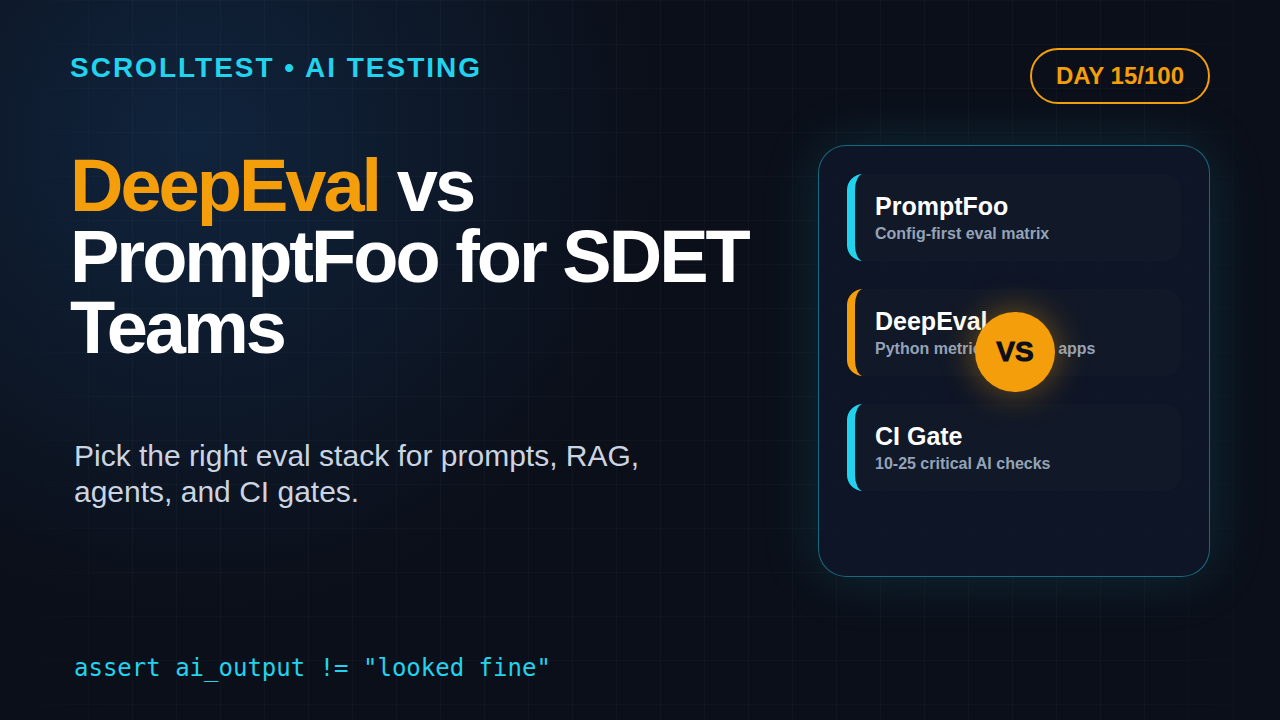
Here is my short answer. Pick PromptFoo when you want a broad, CLI-first evaluation matrix for prompts, providers, red-team checks, and config-driven comparisons. Pick DeepEval when your AI testing work is Python-first and you want test-case style evaluation with metrics that feel closer to unit tests for LLM systems.
If your QA team already writes Playwright TypeScript and runs checks through GitHub Actions, PromptFoo usually feels faster to adopt. If your team already writes Python API tests, uses pytest, or works close to RAG pipelines, DeepEval usually feels more natural.
My default recommendation
For most SDET teams starting from zero, I recommend this sequence:
- Start with PromptFoo for prompt and response regression matrices.
- Add DeepEval when you need richer Python metrics for RAG, agents, or component-level evaluation.
- Keep both behind a small test data contract so your cases do not become tool-locked.
This is not fence-sitting. It is a practical rollout. PromptFoo gives many teams a quick first win. DeepEval becomes valuable when evaluation logic grows beyond simple assertions.
Decision table
| Need | Better fit | Reason |
|---|---|---|
| Prompt comparison across models | PromptFoo | Config-driven matrix view and CLI flow |
| Python-first LLM unit tests | DeepEval | Test cases and metrics fit Python workflows |
| Red-team checks | PromptFoo | Docs expose red teaming as a core product area |
| RAG evaluation metrics | DeepEval | Strong metric-oriented design for LLM evals |
| QA team with Playwright TypeScript | PromptFoo first | Easier to run as a separate CLI gate |
| ML platform team using Python | DeepEval first | Closer to the codebase and data pipeline |
What PromptFoo Does Well
PromptFoo’s biggest strength is that it treats evaluation like a product-team workflow. You define prompts, providers, test cases, and assertions in a configuration file. Then you run the suite and inspect the matrix of results.
Config-first testing
Config-first evaluation is powerful when the team is still learning AI testing. You can start with a small YAML file, commit it to the repo, and run it in CI.
A simple PromptFoo-style workflow looks like this:
description: customer support answer regression
providers:
  - openai:gpt-4.1-mini
prompts:
  - "Answer the customer question using the policy text: {{question}}"
tests:
  - vars:
      question: "Can I get a refund after 45 days?"
    assert:
      - type: contains
        value: "30 days"
      - type: not-contains
        value: "guaranteed refund"
Provider and prompt comparisons
PromptFoo shines when you compare multiple prompts, models, or settings. That is common in AI product work. Product managers often ask, “Does prompt B reduce hallucination?” Engineering asks, “Can we switch to a cheaper model?” QA asks, “Did the new prompt break our support policy?”
A matrix view helps because you are not checking one answer in isolation. You are comparing behavior across cases. That is closer to how regression testing should work.
This connects well with the evidence mindset I wrote about in AI Testing Evidence Pack: Trace, Screenshot, Logs. For AI systems, you need artifacts that explain why the result passed, not just a green badge.
Red-team coverage
PromptFoo’s documentation makes red teaming a visible part of the workflow. That matters for teams testing chatbots, internal copilots, support assistants, or AI features that touch customer data.
For an SDET team, red-team checks should not be treated as a one-time security workshop. At minimum, keep a small regression pack for:
- Prompt injection attempts.
- Policy bypass attempts.
- PII leakage scenarios.
- Unsafe tool-use requests.
- Jailbreak strings that previously worked.
PromptFoo makes that style of repeated attack simulation easier to operationalize than a spreadsheet of manual prompts.
What DeepEval Does Well
DeepEval feels closer to a Python testing framework for LLM applications. You create an LLM test case, attach metrics, and run the evaluation. If your AI feature is part of a Python service, this can feel natural.
The DeepEval quickstart says you can install it with pip install -U deepeval and run evaluations using deepeval test run. That is the kind of command SDETs can put into a CI job without a long ceremony.
Metric-oriented evaluation
DeepEval’s strong point is metric-based evaluation. Instead of only saying “contains this word,” you can evaluate answer relevancy, faithfulness, contextual precision, or task completion depending on the metric you choose.
This matters for RAG testing. A RAG answer can mention the right keyword and still be wrong. For example, it may cite the refund policy but mix up the time window. A metric-based check gives you more room to evaluate semantic quality, not just string matching.
Python test ergonomics
Here is a simplified DeepEval-style example for a support answer:
from deepeval import assert_test
from deepeval.metrics import AnswerRelevancyMetric
from deepeval.test_case import LLMTestCase


def test_refund_policy_answer():
    test_case = LLMTestCase(
        input="Can I get a refund after 45 days?",
        actual_output="Refunds are available only within 30 days of purchase.",
        expected_output="Refunds are allowed within 30 days only."
    )

    metric = AnswerRelevancyMetric(threshold=0.7)
    assert_test(test_case, [metric])
For Python SDETs, this shape is familiar. It looks like a test. It can live near API tests. It can use fixtures. It can be extended when the team needs custom setup.
Better fit for RAG and agent internals
DeepEval becomes especially useful when you care about the internal components of an AI system. Did retrieval return the correct documents? Did the answer stay faithful to the context? Did the agent choose the correct tool? Did a multi-turn conversation preserve the user goal?
Those questions are harder than “does the answer contain X?” DeepEval’s model fits teams that want to evaluate the building blocks, not only the final text.
If you are building agent tests, also read AI QA Agents: From Prompts to Runnable Checks. Evals become much stronger when they end in executable checks instead of loose text reviews.
The SDET Evaluation Criteria I Use
Tool comparisons become messy when people compare logos instead of engineering constraints. I use seven criteria when I review AI testing tools for QA teams.
1. Can a QA engineer add a regression case in 10 minutes?
A good eval tool must make regression capture easy. When production exposes a bad AI answer, the SDET should be able to add it as a test quickly. If adding a case requires three framework experts, the suite will die.
PromptFoo is strong here because a YAML case is easy to review. DeepEval is also strong if the team is comfortable with Python.
2. Does the failure explain the product risk?
A failure that says “score 0.62” is not enough. The report should help the team understand the broken behavior. For QA, the useful failure message says what rule was violated, which input triggered it, and what evidence was used.
This is where I tell teams to wrap tool output with their own naming convention. Do not name a test case_17. Name it refund_policy_after_45_days_must_not_offer_refund.
3. Can it run in CI without drama?
SDET teams live in CI. If the tool is useful only on a laptop, it will not protect releases. Both PromptFoo and DeepEval can be run from command-line flows, but your setup must control secrets, model cost, retries, and report artifacts.
4. Can you separate smoke evals from deep evals?
Do not run 500 expensive AI checks on every pull request. Split the suite:
- PR smoke: 10 to 25 critical cases.
- Nightly regression: broader prompt, RAG, and red-team pack.
- Release gate: high-risk cases linked to customer impact.
- Exploration: new adversarial prompts and edge cases.
This split matters more than the tool choice.
5. Can it support human review when needed?
Not every AI evaluation should be fully automated on day one. Some product risks need review. The tool should generate enough evidence for a human reviewer to make a decision without rerunning everything manually.
6. Can it avoid false confidence?
The biggest risk in AI testing is a beautiful dashboard with weak tests. A suite with 98% pass rate means nothing if the cases are shallow. SDETs must review the quality of prompts, expected behavior, and thresholds like they review selectors in UI automation.
7. Can it fit the team’s language stack?
This is practical and underrated. A TypeScript-heavy QA team may maintain PromptFoo faster. A Python-heavy platform team may maintain DeepEval faster. Pick the tool your team can debug at 2 AM during a release freeze.
🚀 Build Real AI Testing Skills
Stop testing AI by guesswork. Learn DeepEval, RAG evaluation, and agent testing with guided projects.
Hands-On Examples: PromptFoo and DeepEval
Let us make this real. Assume we are testing a release-note summarizer for QA engineers. The feature reads a changelog and returns test impact areas.
The requirement is simple: if a Playwright release note mentions browser context, tracing, or selectors, the assistant must return at least one regression testing action.
PromptFoo example
description: release note reviewer eval
providers:
  - openai:gpt-4.1-mini
prompts:
  - |
    You are a QA release-note reviewer.
    Read this release note and return test impact areas.
    Release note: {{release_note}}

tests:
  - vars:
      release_note: "Browser context storage behavior changed for persistent sessions."
    assert:
      - type: contains
        value: "regression"
      - type: contains-any
        value:
          - "login"
          - "session"
          - "storage"
This is a good starting test. It is not perfect, but it catches a basic failure: the assistant cannot ignore the session risk.
DeepEval example
from deepeval import assert_test
from deepeval.metrics import GEval
from deepeval.test_case import LLMTestCase, LLMTestCaseParams


def test_release_note_reviewer_mentions_test_impact():
    output = "Run login regression and verify persistent session storage."

    test_case = LLMTestCase(
        input="Browser context storage behavior changed for persistent sessions.",
        actual_output=output,
        expected_output="Mention session or login regression testing impact."
    )

    metric = GEval(
        name="QA impact coverage",
        criteria="The answer must identify at least one concrete regression test area.",
        evaluation_params=[
            LLMTestCaseParams.INPUT,
            LLMTestCaseParams.ACTUAL_OUTPUT,
            LLMTestCaseParams.EXPECTED_OUTPUT,
        ],
        threshold=0.7,
    )

    assert_test(test_case, [metric])
The hybrid pattern I prefer
For serious teams, I prefer a hybrid pattern:
- Use deterministic assertions for non-negotiable facts.
- Use LLM-based metrics for semantic quality.
- Keep a small set of golden examples reviewed by humans.
- Store raw inputs, outputs, model name, prompt version, and score.
- Convert every production failure into a regression case.
That pattern works with either tool. The discipline matters more than the brand.
CI/CD Strategy for AI Regression Testing
The worst rollout is to add 200 evals to CI and make every pull request slow, flaky, and expensive. SDET teams should introduce AI evals like they introduce browser automation: start small, stabilize, then expand.
A practical pipeline
Here is the pipeline I would use:
- Pre-commit or local: validate config files and test data schema.
- Pull request: run 10 critical evals against a stable model setting.
- Nightly: run broad regression across prompts, providers, and RAG cases.
- Release candidate: run high-risk red-team and customer-impact cases.
- Post-release: sample production failures and add new regression cases.
Keep model temperature low for regression gates. Record the model version when possible. If the provider changes behavior, you need a paper trail.
GitHub Actions sketch
name: ai-evals
on:
  pull_request:
  workflow_dispatch:

jobs:
  promptfoo-smoke:
    runs-on: ubuntu-latest
    steps:
      - uses: actions/checkout@v4
      - uses: actions/setup-node@v4
        with:
          node-version: 22
      - run: npm install -g promptfoo
      - run: promptfoo eval -c evals/promptfooconfig.yaml
        env:
          OPENAI_API_KEY: ${{ secrets.OPENAI_API_KEY }}

  deepeval-smoke:
    runs-on: ubuntu-latest
    steps:
      - uses: actions/checkout@v4
      - uses: actions/setup-python@v5
        with:
          python-version: '3.12'
      - run: pip install -U deepeval
      - run: deepeval test run tests/ai
        env:
          OPENAI_API_KEY: ${{ secrets.OPENAI_API_KEY }}
Do not copy this blindly into production. Add caching, report upload, failure thresholds, and cost controls. The point is that both tools can sit inside a normal CI workflow.
What to store as evidence
For each failed AI eval, store:
- Input prompt or task.
- Retrieved context if RAG is involved.
- Actual output.
- Expected rule or rubric.
- Metric score and threshold.
- Model/provider/version if available.
- Trace, screenshot, or browser recording for agentic flows.
Without this evidence, debugging becomes a Slack debate. With evidence, it becomes engineering.
India Career Context for QA Engineers
For Indian QA engineers, this topic has career value. I do not think every manual tester must become an ML engineer. But I do think SDETs who can build AI eval suites will stand out in product companies.
Many service-company projects still measure QA by test cases executed. Product companies increasingly care about release risk, observability, automation, and developer productivity. AI features add another layer: can you prove this assistant, agent, or RAG workflow did not regress?
If you are targeting ₹25-40 LPA SDET roles, AI evaluation is a strong add-on skill next to Playwright, API testing, CI/CD, Docker, and cloud basics. It shows that you can test modern software, not only traditional forms and tables.
Portfolio project idea
Build a small public project called ai-support-eval-suite:
- Five support policy questions.
- Five adversarial prompts.
- One PromptFoo config.
- One DeepEval test file.
- One GitHub Actions workflow.
- A short README explaining failures and trade-offs.
This is stronger than writing “AI testing knowledge” on a resume. It gives hiring managers something to inspect.
Interview talking point
If an interviewer asks about DeepEval vs PromptFoo, do not answer like a tool fan. Answer like an engineer:
“I use PromptFoo when I need a fast config-driven matrix for prompts and providers. I use DeepEval when I need Python metrics for RAG or agent components. In both cases, I separate smoke evals from nightly evals, store evidence, and turn production failures into regression cases.”
That answer signals maturity.
Final Recommendation
My final DeepEval vs PromptFoo recommendation is simple: do not choose based on hype. Choose based on your test ownership model.
Use PromptFoo first if your SDET team wants prompt comparisons, red-team checks, and CI-friendly config. Use DeepEval first if your team lives in Python and needs metrics for RAG, agents, and LLM components.
For many teams, the best answer is not either-or. Start with PromptFoo to build the habit of repeatable AI regression checks. Add DeepEval where semantic scoring and Python test ergonomics give you stronger coverage.
Key takeaways:
- DeepEval vs PromptFoo is a workflow decision, not a popularity contest.
- PromptFoo is strong for config-driven prompt, provider, and red-team matrices.
- DeepEval is strong for Python-first metric evaluation of LLM apps.
- SDET teams should split evals into PR smoke, nightly regression, and release gates.
- The best AI testing portfolio project includes both tools and a CI workflow.
FAQ
Is PromptFoo better than DeepEval?
PromptFoo is better for config-driven prompt and provider comparisons. DeepEval is better for Python-first metric evaluation. The better tool depends on your stack.
Can SDETs use DeepEval without data science experience?
Yes, but start with simple cases and clear metrics. Do not begin with complex scoring. Begin with high-risk product rules and make failures easy to understand.
Can PromptFoo run in CI?
Yes. PromptFoo is CLI-friendly and fits well into GitHub Actions or similar CI systems. Keep a small PR suite first so cost and runtime stay under control.
Should QA teams use LLM-as-judge metrics?
Use them carefully. They are useful for semantic checks, but they should not replace deterministic assertions for hard rules like prices, dates, policy limits, or security constraints.
What should I learn first as a QA engineer?
Learn PromptFoo first if you want a fast start. Learn DeepEval next if you work with Python, RAG, or agents. Also learn how to store evidence and run evals in CI, because that is where SDET value shows up.
🎓 Become an AI-Powered QA Engineer
Join hundreds of SDETs mastering LLM, RAG, and agent testing. Lifetime access, hands-on labs, and a job-ready portfolio.