
n8n Workflows for QA: Test Data and CI Automation
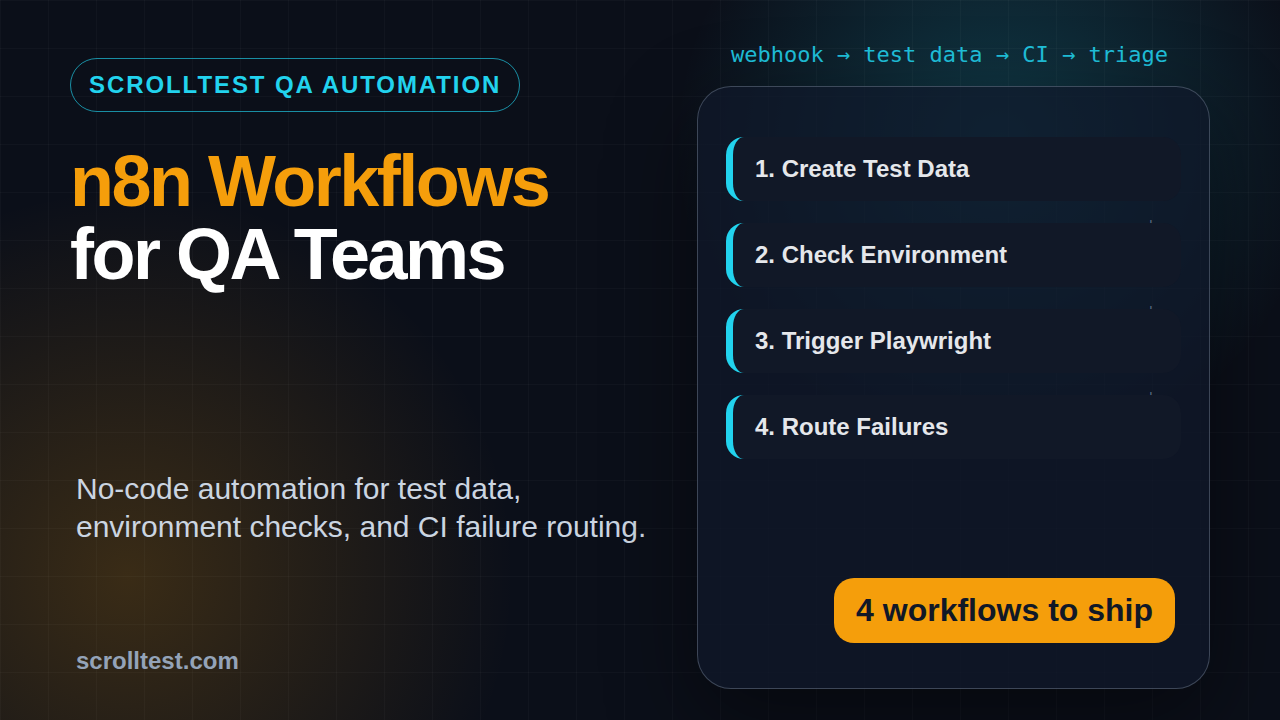
n8n workflows for QA are useful when your testing problem is not another assertion library, but the boring glue around test data, environments, notifications, and triage. I see QA teams lose hours every week copying data between Jira, Slack, GitHub, Postman, databases, and CI tools. This guide shows how to use n8n as a practical automation layer without turning your test strategy into a no-code toy.
🤖 Learning AI-powered testing? Go hands-on with LLM, RAG, and AI-agent testing in the AI-Powered Testing Mastery course at The Testing Academy.
Table of Contents
- What Are n8n Workflows for QA?
- Why QA Teams Should Care About n8n Workflows for QA
- Where n8n Fits in a Modern Testing Stack
- Workflow 1: Test Data Management
- Workflow 2: Environment Readiness Checks
- Workflow 3: CI Failure Triage and Notifications
- Workflow 4: API Contract Smoke Tests
- Governance, Security, and Maintenance
- India Context for QA Careers
- Key Takeaways
- FAQ
Contents
What Are n8n Workflows for QA?
n8n is a workflow automation tool that connects apps, APIs, databases, queues, and custom code steps through a visual builder. The project is not a small side utility. The public GitHub repository had about 191,991 stars and 58,449 forks when I checked it on 11 June 2026, and npm reported 358,076 downloads for the n8n package in the previous month. Those numbers do not prove quality, but they do prove strong adoption and active interest.
For QA, the real value is simple: n8n can automate the work around tests. It is not a replacement for Playwright, Selenium, Cypress, REST Assured, Postman, or your CI runner. It is the layer that says, “Before the suite starts, create the right data. When it fails, collect the right context. When the environment is down, stop wasting compute. When a contract breaks, alert the owner with a useful message.”
No-code does not mean no engineering
I do not like the phrase no-code when it is used to sell shortcuts. QA automation still needs engineering thinking. You still need idempotency, versioning, logging, retries, secrets, and ownership. n8n simply lowers the friction for building these support automations.
The best n8n workflows for QA are small, explicit, and boring. They do one job and leave an audit trail. They also expose the hidden work that usually sits in one senior tester’s head.
The right mental model
Think of n8n as a control plane for testing operations. Your test frameworks execute checks. n8n coordinates the surrounding system. That split keeps your Playwright suite clean and your operational automation visible.
- Use Playwright for browser and API assertions.
- Use your CI tool for builds, parallelism, and artifacts.
- Use n8n for cross-tool orchestration, enrichment, routing, and scheduled operations.
- Use databases and service APIs as the source of truth, not spreadsheet copies.
If you are already thinking about connected tooling, read the ScrollTest post on the QA tooling fragmentation problem. n8n helps with that exact pain when used carefully.
Why QA Teams Should Care About n8n Workflows for QA
Most QA bottlenecks are not caused by the test runner. They are caused by waiting, searching, asking, and repeating. A regression run fails because the payment sandbox is down. A tester cannot reproduce a bug because the test account has the wrong role. A release manager asks for the same summary every Friday. A developer wants logs, screenshots, and request IDs, but the failure message only says “expected true to be false”.
That is where n8n workflows for QA pay off. They remove handoffs. They standardize pre-checks. They make failure information more useful before a human opens the ticket.
Where I see the biggest return
I would start with four areas before touching anything fancy:
- Test data setup: create, reset, or expire test users and orders through APIs.
- Environment readiness: check health endpoints, queues, feature flags, and key dependencies before CI burns minutes.
- Failure triage: route failures to the right Slack channel or Jira component with artifacts attached.
- Release smoke checks: call a short API or browser smoke pack when a deployment event arrives.
None of these require a 40-node workflow. In fact, if your first workflow has 40 nodes, you probably built a maintenance problem.
What the public data says
n8n’s official documentation describes workflows built from nodes, triggers, credentials, expressions, and executions. That matters for QA because each execution can show what happened, when it happened, and which step failed. GitHub shows a large open-source community around the tool. npm shows real package usage. For comparison, Playwright’s GitHub repository had about 90,697 stars on the same check date, which confirms that modern QA teams are already comfortable with developer-first tooling. The opportunity is to connect these tools better, not to replace one with another.
I also like n8n because it is API-friendly. A QA team can start with a webhook, call a REST endpoint, transform JSON, and post a message. Later, the same workflow can call a Playwright job, create a Jira ticket, or update a release dashboard.
Where n8n Fits in a Modern Testing Stack
A healthy testing stack has clear boundaries. When boundaries are unclear, teams create monster workflows that nobody wants to touch after the first demo. I use this rule: n8n should orchestrate, not assert the whole product.
Good use cases
- Calling an internal API to create a customer, cart, subscription, or refund.
- Checking whether a QA environment is ready before a smoke suite starts.
- Listening to deployment webhooks and triggering targeted tests.
- Collecting CI failure artifacts and posting a clean summary.
- Rotating test data or cleaning stale test entities nightly.
- Sending a daily quality digest to Slack, Teams, or email.
Bad use cases
- Replacing version-controlled test code with visual spaghetti.
- Storing production secrets inside random nodes without access control.
- Building critical assertions that are impossible to review in pull requests.
- Using no-code workflows to bypass engineering standards.
- Letting every tester create separate workflows for the same shared system.
For browser tests, keep using a real framework. If your team is moving in that direction, the ScrollTest Playwright locators and assertions tutorial is a good companion. n8n can trigger and enrich those tests, but the assertions should live in a reviewable repository.
A simple architecture
Here is a practical architecture I would accept in a real QA team:
Deployment webhook
      ↓
n8n workflow: environment pre-check
      ↓
CI job: Playwright smoke suite
      ↓
n8n workflow: collect results + enrich failure
      ↓
Slack/Jira: actionable report with owner, logs, trace, and run URL
This keeps the heavy work in CI, keeps assertions in code, and lets n8n handle the glue. It also gives manual testers a safe path into automation because they can design process flows first, then learn the code behind specific nodes.
Workflow 1: Test Data Management
Test data is where many automation dreams go to die. Teams write good tests, then run them against dirty accounts, expired cards, stale inventory, and half-migrated feature flags. n8n workflows for QA can reduce that chaos by creating repeatable data setup flows.
The problem
Manual test data creation has three failures:
- It depends on tribal knowledge.
- It leaves junk behind.
- It is hard to reproduce when a bug appears three days later.
Good test data automation must be idempotent. Running it twice should not create two different worlds unless that is the point. Every entity should carry a clear prefix, owner, timestamp, and cleanup policy.
The workflow design
Build a workflow called qa-create-order-scenario. Trigger it through a webhook with a short JSON payload:
{
  "scenario": "paid_order_with_refund_eligible_item",
  "environment": "qa",
  "requestedBy": "playwright-ci",
  "ttlMinutes": 180
}
The workflow should:
- Validate the environment and scenario name.
- Call the identity API to create or reuse a test user.
- Call the catalog API to reserve a test SKU.
- Create a cart and order through service APIs.
- Store the generated IDs in a test data table.
- Return a compact response to the test runner.
import { test, expect, request } from '@playwright/test';

test('refund button appears for eligible paid order', async ({ page }) => {
  const api = await request.newContext();
  const setup = await api.post(process.env.N8N_TEST_DATA_WEBHOOK!, {
    data: {
      scenario: 'paid_order_with_refund_eligible_item',
      environment: 'qa',
      requestedBy: 'playwright-ci',
      ttlMinutes: 180
    }
  });

  expect(setup.ok()).toBeTruthy();
  const data = await setup.json();

  await page.goto(`${process.env.APP_URL}/orders/${data.orderId}`);
  await expect(page.getByRole('button', { name: 'Request refund' })).toBeVisible();
});
This pattern keeps test setup outside the UI. It also makes failures easier to debug because the test report can include the exact orderId, userId, and workflow execution ID.
Cleanup matters
Add a scheduled cleanup workflow. Run it every hour. Query records with expired TTL. Delete or mark entities inactive through supported APIs. If deletion is unsafe, add a qa_archived status and exclude those records from normal QA flows.
Do not connect directly to production-like databases unless your organization explicitly allows it. APIs give you validation, audit logs, and safer permissions.
Workflow 2: Environment Readiness Checks
A failed test run is not always a product bug. Sometimes the environment is broken before the first test starts. I prefer a hard readiness gate because it saves CI time and reduces noisy failure reports.
What to check
A useful readiness workflow checks more than one /health endpoint. It should verify dependencies that affect the test suite:
- Application health endpoint returns success.
- Database migration version matches the expected release.
- Authentication service can issue a token for a test user.
- Payment, email, or notification sandbox is reachable.
- Feature flags required for the suite have expected values.
- Critical queues are not backed up beyond a defined threshold.
How to wire it
Create a webhook named qa-env-ready. Your CI pipeline calls it before running tests. n8n performs checks in parallel where possible, then returns a machine-readable verdict.
READY=$(curl -s -X POST "$N8N_ENV_READY_WEBHOOK" \
  -H "Content-Type: application/json" \
  -d '{"environment":"qa","suite":"checkout-smoke"}')

echo "$READY"

echo "$READY" | jq -e '.ready == true' > /dev/null || exit 1
npm run test:smoke
If the environment is not ready, the workflow should post a clear message to Slack:
QA environment blocked: checkout-smoke
Reason: payment sandbox timeout after 3 retries
Owner: payments-platform
Next action: check sandbox incident channel
CI job skipped: yes
This is better than 87 failed browser tests that all point at the checkout page.
Set thresholds with engineering
Do not invent thresholds alone. Work with developers and DevOps. For example, a queue depth of 100 may be normal for one service and a release blocker for another. Store thresholds in a config file or a small database table so changes are reviewed.
🚀 Build Real AI Testing Skills
Stop testing AI by guesswork. Learn DeepEval, RAG evaluation, and agent testing with guided projects.
Workflow 3: CI Failure Triage and Notifications
Failure notification is where many teams spam everyone and help nobody. A useful n8n workflow should reduce noise, not broadcast panic.
The input payload
Your CI job can call an n8n webhook after a failed test run with a payload like this:
{
  "repo": "web-checkout-tests",
  "branch": "release-2026.06",
  "suite": "checkout-smoke",
  "status": "failed",
  "failedTests": 3,
  "runUrl": "https://ci.example.com/runs/123",
  "traceUrl": "https://artifacts.example.com/trace.zip",
  "commit": "abc123"
}
The workflow can then enrich the payload. It can map test file paths to code owners, fetch the last deployment event, check whether the failure is already known, and create one Jira ticket instead of five duplicates.
Routing logic
I keep routing rules boring:
- If authentication tests fail, notify identity owners and QA lead.
- If payment sandbox is down, notify platform channel and skip bug creation.
- If the same test failed in the last three runs, mark it as recurring.
- If the failure includes a Playwright trace, attach the trace link in the first message.
- If it is a new release-blocking failure, create a Jira ticket with severity and owner.
For deeper thinking on AI-assisted failure handling, read API testing with AI agents. The same principle applies here: automation should explain the failure with evidence, not pretend to be certain.
Add a small classifier, not a magic bot
You can add a code node that classifies failure messages using rules first:
type FailureRoute = 'auth' | 'payments' | 'environment' | 'unknown';

export function routeFailure(message: string, file: string): FailureRoute {
  const text = `${file} ${message}`.toLowerCase();

  if (text.includes('401') || text.includes('login') || text.includes('token')) return 'auth';
  if (text.includes('payment') || text.includes('card') || text.includes('refund')) return 'payments';
  if (text.includes('timeout') || text.includes('503') || text.includes('connection refused')) return 'environment';

  return 'unknown';
}
Only after rules are stable would I add an LLM summary. Even then, the LLM should summarize artifacts and suggest a route. It should not silently close tickets or change release status.
Workflow 4: API Contract Smoke Tests
n8n can run simple API checks directly, but I prefer using it to trigger proper contract checks and collect the result. This keeps the workflow readable and the checks version-controlled.
The lightweight option
For a small service, an n8n HTTP Request node can call a contract endpoint, validate a few fields, and alert if the shape changes. This is useful for internal tools where a full contract framework would be too heavy.
{
  "service": "catalog",
  "endpoint": "/v1/products/qa-smoke-sku",
  "requiredFields": ["id", "name", "price", "inventoryStatus"]
}
The workflow should fail if required fields are missing, if a status code is unexpected, or if response time crosses a threshold agreed with the owning team.
The stronger option
For customer-facing APIs, keep contract tests in code. Trigger them from n8n on schedule or deployment. Publish the result back to the release channel. If you use Playwright for API checks, the ScrollTest article on DeepEval vs PromptFoo for QA teams is also relevant when the API returns LLM-generated content and you need evaluation, not just schema validation.
import { test, expect } from '@playwright/test';

test('catalog contract exposes fields needed by checkout', async ({ request }) => {
  const response = await request.get('/v1/products/qa-smoke-sku');
  expect(response.status()).toBe(200);

  const body = await response.json();
  expect(body).toEqual(expect.objectContaining({
    id: expect.any(String),
    name: expect.any(String),
    price: expect.any(Number),
    inventoryStatus: expect.stringMatching(/IN_STOCK|OUT_OF_STOCK/)
  }));
});
Why this helps releases
Contract smoke tests catch integration failures before UI tests turn them into vague browser errors. A missing inventoryStatus field should be reported as a catalog contract break, not as a checkout page flake.
Governance, Security, and Maintenance
The biggest risk with n8n workflows for QA is not the tool. The risk is unmanaged automation. A visual workflow can become a production dependency without the same review, access control, or monitoring as code.
Rules I would enforce from day one
- Every workflow has an owner, purpose, and expected input payload.
- Every credential is stored in n8n credentials or a secret manager, not pasted in notes.
- Critical workflows are exported and version-controlled.
- Workflow names include the environment and purpose.
- Production access requires separate credentials and approvals.
- All failure branches log enough context for debugging.
- High-impact workflows have alerts for repeated failures.
Version control
n8n supports workflow exports. Use them. Keep exports in a repository next to README files that explain the trigger, inputs, outputs, credentials, and rollback steps. This is not paperwork. It is how a second person can repair the workflow when the original creator is on leave.
Idempotency and retries
Retries are dangerous when an action is not idempotent. Retrying a health check is fine. Retrying “create refund” without an idempotency key is not fine. For test data workflows, generate a scenario run ID and pass it to downstream APIs where possible.
scenarioRunId = qa-checkout-20260611-093000-001
idempotencyKey = scenarioRunId + actionName
owner = playwright-ci
cleanupAfter = 2026-06-11T12:30:00Z
With this pattern, repeated calls either return the existing entity or fail safely. That is the difference between automation and accidental data pollution.
Observability
Do not rely only on the workflow canvas. Send important events to your normal observability stack or at least a searchable log store. Track execution count, failure rate, average duration, and top failure reasons. If a workflow supports CI, treat it like CI infrastructure.
India Context for QA Careers
For QA engineers in India, n8n is not a replacement for learning automation code. It is a good bridge skill. Service companies like TCS, Infosys, Wipro, and Cognizant still have many teams where test data setup and reporting are manual. Product companies expect SDETs to connect APIs, CI, cloud services, and test frameworks without waiting for a separate tooling team.
If you are targeting ₹25-40 LPA SDET roles, “I know Selenium” is no longer enough. A stronger interview story is: “I built a workflow that checks environment readiness, triggers Playwright smoke tests, enriches failures with traces, and routes them to owners. It reduced false release blockers and gave developers actionable context.” That shows systems thinking.
What to learn first
- HTTP basics: methods, headers, status codes, auth, retries.
- JSON transformation and schema validation.
- Webhook design and idempotency keys.
- CI/CD basics in GitHub Actions, GitLab CI, Jenkins, or Azure DevOps.
- Playwright API testing and trace artifacts.
- Basic SQL for test data lookup and cleanup.
Then add n8n. The order matters. If you learn the tool without the fundamentals, you will build fragile flows. If you learn the fundamentals first, n8n becomes a speed multiplier.
A practical portfolio project
Build one workflow that checks environment readiness, triggers a Playwright smoke suite, reads the result JSON, posts a Slack summary, and creates a Jira ticket only for new release-blocking failures. Export the workflow to Git and write a short README with inputs, outputs, credentials, and rollback steps. This portfolio project is much stronger than another generic login test because it proves you can improve the testing system, not only write assertions.
Key Takeaways
n8n workflows for QA work best when they automate the support system around tests. Keep the assertions in code, keep orchestration visible, and keep ownership clear.
- Use n8n for test data setup, environment readiness, failure triage, and release notifications.
- Do not replace Playwright, Selenium, or API test frameworks with a giant visual workflow.
- Design every workflow with idempotency, logging, retries, and cleanup from the start.
- Use official APIs and service contracts rather than direct database hacks wherever possible.
- For career growth, position n8n as proof that you understand QA systems, CI, and automation operations.
The best QA engineers in 2026 will not be the ones who click the most tools. They will be the ones who connect tools into reliable feedback loops. n8n workflows for QA are one practical way to build those loops without waiting six months for a platform team.
FAQ
Can n8n replace Selenium or Playwright?
No. n8n should not replace Selenium or Playwright for browser automation. Use it to trigger tests, prepare data, check environments, and distribute results. Keep browser assertions in a test framework that supports code review, traces, fixtures, and parallel execution.
Is n8n safe for test data management?
It can be safe if you use proper credentials, scoped APIs, idempotency keys, audit logs, and cleanup workflows. It is unsafe if people paste admin secrets into nodes and run destructive steps without approvals.
Should manual testers learn n8n?
Yes, if they also learn HTTP, JSON, API testing, and CI basics. n8n gives manual testers a practical bridge into automation because they can model workflows visually while still learning the engineering concepts underneath.
What is the first workflow a QA team should build?
Start with environment readiness. It is small, low-risk, and immediately useful. A readiness workflow that blocks bad CI runs can save hours of false debugging every week.
How do I avoid workflow chaos?
Set rules early. Name workflows clearly, assign owners, export them to Git, document inputs and outputs, store secrets properly, and review changes for critical flows. Treat important workflows like code, even if they are built visually.
Sources: n8n official documentation on workflows, nodes, credentials, and executions; GitHub repository metrics for n8n, Playwright, and Testcontainers checked on 11 June 2026; npm downloads API for the n8n package checked on 11 June 2026.
🎓 Become an AI-Powered QA Engineer
Join hundreds of SDETs mastering LLM, RAG, and agent testing. Lifetime access, hands-on labs, and a job-ready portfolio.

