QASkills Playwright Upgrade Checklist for Teams
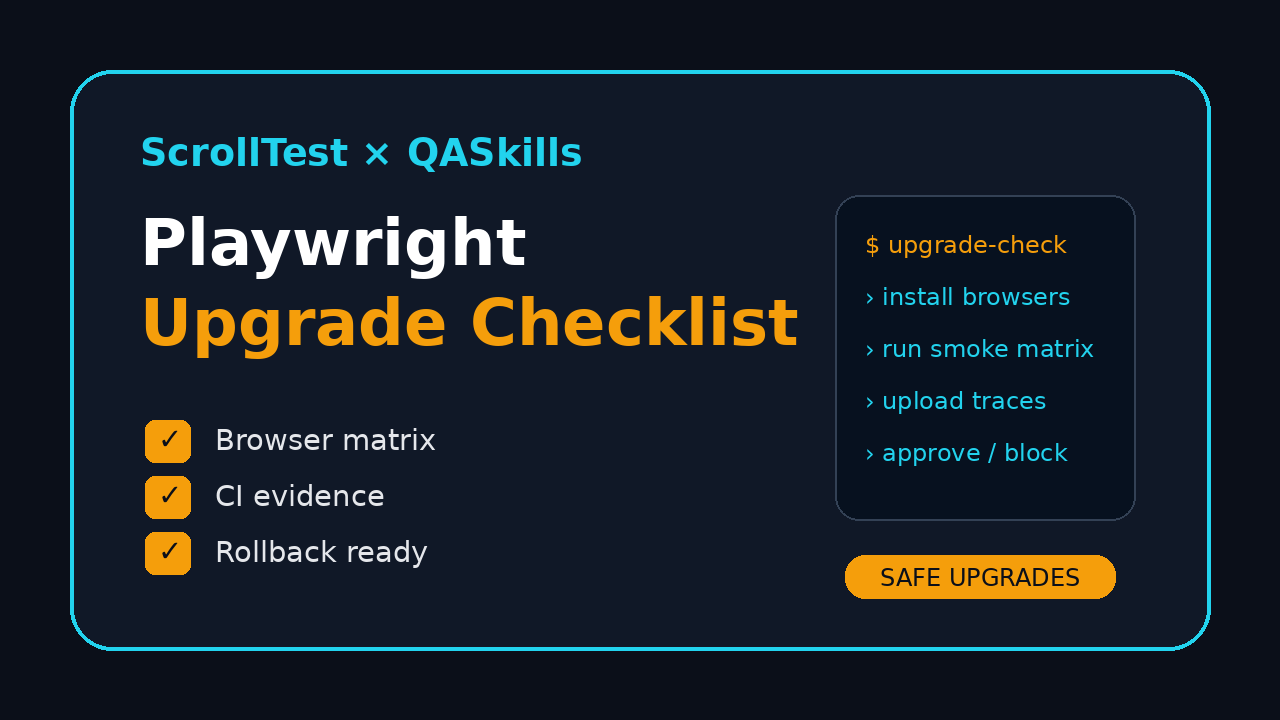
If your team upgrades test frameworks only when CI breaks, the upgrade is already late. This QASkills Playwright upgrade checklist gives QA teams a repeatable way to check Playwright changes before they hit every repository, every pipeline, and every developer branch.
I see the same pattern in many automation teams: one engineer bumps @playwright/test, the smoke suite looks green, and two days later mobile emulation, traces, Docker images, or selectors start failing in another service. The fix is not “be more careful.” The fix is a reusable upgrade workflow that captures evidence and makes the risk visible.
Table of Contents
- Why a Playwright upgrade checklist matters
- What the QASkills workflow should validate
- Research snapshot: Playwright, Selenium, and npm data
- The upgrade risks most teams miss
- How to implement the checklist in CI
- What evidence to capture before approval
- India QA team context
- A practical rollout plan
- Key takeaways
- FAQ
Contents
Why a Playwright upgrade checklist matters
Playwright upgrades are not rare events anymore. The latest npm package for @playwright/test is version 1.61.1, and the latest GitHub release at the time of this run is v1.61.1, published on 2026-06-23. That pace is healthy, but it creates operational work for QA teams.
Framework upgrades touch more than test code
A Playwright version bump can affect browser binaries, test runner behavior, trace output, reporter plugins, Docker images, TypeScript types, and retry behavior. If your test suite is small, you may notice the problem quickly. If your company has 20 repos and three CI templates, you need a standard checklist.
The QASkills Playwright upgrade checklist is useful because it moves upgrade work from memory to evidence. Instead of asking, “Did we check everything?”, the team asks, “Where is the run evidence for Chromium, Firefox, WebKit, selectors, API mocks, and rollback?” That question changes the quality of the release decision.
The command is simple:
npm install -D @playwright/test@latest
npx playwright install --with-deps
npx playwright test
The cost sits in the places that command does not inspect. It does not tell you whether your base Docker image includes the right system libraries. It does not tell you whether traces are still uploaded as CI artifacts. It does not tell you whether your shared helper wrapped an API that changed behavior. A checklist forces those questions into the run.
What the QASkills workflow should validate
QASkills is a practical fit for this because upgrade validation is a reusable skill. A good skill should not be a motivational prompt. It should produce a checklist, commands, evidence names, and a pass or fail decision that another engineer can repeat.
Start with a clear scope
Every upgrade run should name the old version, target version, repositories, browser matrix, CI environment, and owner. This sounds basic, but it prevents the most common confusion: one person validates on macOS while the actual regression pipeline runs on Ubuntu. The checklist should record both environments.
- Old Playwright version and target Playwright version
- Node.js version and package manager
- Operating system used locally and in CI
- Browser projects covered: Chromium, Firefox, WebKit, branded Chrome, mobile emulation
- Critical tags: smoke, checkout, login, payments, API mocks, visual checks
- Rollback command and owner
Make the output strict
I prefer a checklist that refuses vague results. “Looks fine” is not a result. “122/122 smoke tests passed on Ubuntu with Playwright 1.61.1, trace artifacts attached, no new retry spike” is a result. The skill should ask for counts, artifact paths, and the exact failing spec list.
Research snapshot: Playwright, Selenium, and npm data
Framework upgrade decisions should not be based on hype. They should be based on release activity, ecosystem signals, and the risk of doing nothing. The public data is enough to create a sensible policy.
Playwright is an active dependency
GitHub reports 92,166 stars for microsoft/playwright at the time of research. The npm downloads API reports 172,653,760 downloads for @playwright/test between 2026-06-03 and 2026-07-02. Those numbers do not prove your suite is safe, but they prove this dependency is part of a fast-moving ecosystem.
Selenium is still active too
This is not a Playwright versus Selenium fight. Selenium’s latest GitHub release in this research is Selenium 4.45.0, published on 2026-06-16. Mature teams often run both stacks during migration, which makes upgrade discipline more important, not less.
Internal context matters more than public numbers
Your team’s real signal is local: how many tests flaked after the last upgrade, how long rollback took, how often retries increased, and whether developers trusted the report. A QASkills workflow should collect those internal numbers after every run. After three upgrades, you will know if your risk is browser binaries, selectors, CI containers, or test data.
The upgrade risks most teams miss
The risky part of Playwright upgrades is not usually the public API. It is the chain around the runner. The QASkills Playwright upgrade checklist should inspect that chain, because CI failures rarely arrive as neat release-note examples.
Risk 1: Browser binary drift
Playwright manages browser binaries, but teams still break when the CI cache, Docker image, and installation command disagree. A developer may run the new browser locally while CI reuses an older cache. The fix is to print the browser version during the run and archive the install logs.
npx playwright --version
npx playwright install --with-deps
node -e "console.log(process.version)"
Risk 2: Reporter and trace gaps
Trace files are often the first thing teams lose during a rushed upgrade. The tests still run, but the debugging evidence disappears. Your checklist should verify HTML report generation, trace retention, video retention for failed tests, screenshot naming, and CI artifact upload.
Risk 3: Selector assumptions
Good Playwright tests use locators, roles, and test ids. Older tests sometimes carry CSS selectors that depend on internal layout. A minor frontend change plus a framework upgrade can make that weakness visible. This is why I like adding a selector audit to the upgrade workflow.
Most large suites wrap Playwright behind helpers: login flows, API clients, storage state builders, fixture factories, and data cleanup methods. The upgrade checklist should run a small “helper contract” suite before the full regression. When helpers pass, failures are easier to isolate.
How to implement the QASkills Playwright upgrade checklist in CI
A checklist becomes valuable only when it runs the same way every time. I would wire the QASkills output into a small upgrade branch pipeline. The pipeline does not need to run the full overnight regression first. It needs a sharp sequence that tells the team whether the upgrade deserves more compute.
A simple CI gate
- Create an upgrade branch, for example
chore/playwright-1-61-1. - Update
@playwright/testand lockfile in one commit. - Run install with browser dependencies on the same OS as production CI.
- Execute smoke tests across Chromium, Firefox, and WebKit.
- Run tagged critical flows: login, checkout, search, forms, and API mocks.
- Upload traces, screenshots, videos, and HTML report.
- Post a markdown summary with pass counts, fail counts, retries, and rollback command.
Example GitHub Actions job
name: playwright-upgrade-check
on:
  pull_request:
    paths:
      - 'package.json'
      - 'package-lock.json'
      - 'playwright.config.ts'
      - 'tests/**'
jobs:
  upgrade-check:
    runs-on: ubuntu-latest
    steps:
      - uses: actions/checkout@v4
      - uses: actions/setup-node@v4
        with:
          node-version: 22
          cache: npm
      - run: npm ci
      - run: npx playwright install --with-deps
      - run: npx playwright --version
      - run: npx playwright test --project=chromium --grep @smoke
      - run: npx playwright test --project=firefox --grep @critical
      - run: npx playwright test --project=webkit --grep @critical
      - uses: actions/upload-artifact@v4
        if: always()
        with:
          name: playwright-upgrade-evidence
          path: |
            playwright-report/
            test-results/
Example TypeScript guard
I also like one small guard test that validates the evidence pipeline itself. It catches “tests passed but artifacts are missing” problems.
import { test, expect } from '@playwright/test';

test('upgrade evidence guard captures trace and screenshot', async ({ page }, testInfo) => {
  await page.goto('https://example.com');
  await expect(page).toHaveTitle(/Example Domain/);
  await page.screenshot({ path: testInfo.outputPath('upgrade-guard.png') });
  testInfo.annotations.push({
    type: 'upgrade-check',
    description: 'Artifact generation verified for Playwright upgrade review'
  });
});
What evidence to capture before approval
Approval should not depend on the most senior automation engineer saying, “I think it is fine.” Approval should depend on a small evidence pack. This is where QASkills can shine, because a reusable skill can force the same summary format for every team.
The upgrade evidence pack
- Version diff: old Playwright, new Playwright, Node.js, OS, package manager
- Install log: browser dependency installation and binary versions
- Run matrix: projects, tags, pass count, fail count, skipped tests
- Retry trend: total retries before and after upgrade
- Failure list: spec file, test title, browser, error category
- Artifacts: HTML report, traces, screenshots, videos, console logs
- Risk notes: selectors, data, environment, helper abstractions, product bugs
- Rollback plan: exact command, branch, owner, expected recovery time
Use a pass or block decision
The final checklist should return one of three decisions: pass, pass with known risk, or block. “Pass with known risk” is important. It lets the team merge a safe upgrade while documenting one non-blocking issue, such as a flaky visual test already tracked in Jira.
India QA team context
In India, many QA teams operate with mixed ownership. One group maintains Selenium, another experiments with Playwright, and a platform team owns CI templates. In TCS or Infosys style service teams, the client may decide the upgrade window. In product companies, the automation guild often owns the framework policy.
The career signal for SDETs
This is a strong career area for SDETs. A tester who can say, “I built an upgrade gate that reduced surprise CI failures and produced evidence for every framework bump” sounds different from someone who only says, “I know Playwright.” In interviews for ₹25-40 LPA automation roles, evidence-driven CI work stands out.
How managers should assign ownership
Do not assign upgrade ownership to whoever last touched the framework. Assign it to a rotating owner with a written playbook. One engineer owns the run, one reviews the evidence, and one approves rollout. This spreads knowledge across the team and prevents a single-person bottleneck.
A practical rollout plan
Do not introduce this workflow as a 20-page governance document. Start with one repo, one upgrade, and one evidence template. Keep it useful enough that engineers want to reuse it.
Week 1: Create the checklist
Write the QASkills workflow around your current test architecture. Add the sections for version diff, browser install, smoke matrix, critical flows, reporter artifacts, trace retention, and rollback. Link it in the repository README and CI template.
Week 2: Run it on one real upgrade
Pick a non-critical service first. Run the upgrade branch, collect evidence, and record every gap. If the artifact path is wrong, fix it. If the smoke tag is meaningless, tighten it. If WebKit never runs, decide whether that is a real business risk or dead configuration.
Week 3: Make it a reusable skill
Once the workflow is stable, package it as a reusable QASkills skill. The skill should generate the commands, the CI checklist, the markdown report, and the review questions. It should also suggest internal links to your Playwright standards.
Week 4: Roll it out to the next three repos
Three repos are enough to expose shared problems. You may find that each team names artifacts differently, uses different tags, or stores authentication state in different paths. Standardize only what matters for upgrade safety. Do not turn this into a tooling migration project.
Reusable QASkills prompt template for upgrade reviews
A checklist is useful, but a reusable skill needs a consistent instruction format. I keep the prompt boring on purpose. It asks for inputs, rejects missing data, and produces a markdown report that a lead can paste into a pull request. The goal is not clever wording. The goal is repeatable behavior.
The input block
The skill should start by asking for the smallest set of facts that change the result. If the team cannot provide these facts, the upgrade should not be approved yet. Missing context is a risk signal.
Playwright upgrade review
Old version: 1.60.0
Target version: 1.61.1
Repository: web-checkout-tests
Node version: 22
CI image: ubuntu-latest
Browsers: chromium, firefox, webkit
Critical tags: @smoke, @checkout, @auth, @api-mock
Rollback owner: qa-platform
That input block makes the review searchable. Three months later, when a manager asks why a browser upgrade broke a checkout flow, the team can find the exact run instead of scanning Slack threads.
The output block
The output should be a decision report, not a long essay. I use this structure:
Decision: PASS_WITH_RISK
Summary: 312 tests passed, 2 known visual tests skipped, 0 new critical failures.
Artifacts: playwright-report.zip, traces.zip, install-log.txt
New risk: Firefox retry count moved from 3 to 9 on @checkout.
Owner: Ravi
Next action: merge after visual baseline review.
This format also helps managers. They do not need to read every trace. They need to know whether the team has evidence, whether risk is accepted, and who owns the next action.
Metrics to track after every upgrade
One upgrade report is useful. Five reports become a trend. This is where many QA teams leave value on the table. They collect evidence during a crisis, then throw it away after the pull request is merged.
Track retry movement
Retries are one of the fastest signals of upgrade pain. A suite can still be green while reliability gets worse. If a smoke pack usually has 2 retries and the upgrade branch has 19, I do not call that safe. I call that a warning.
- Total tests executed
- Total retries before upgrade
- Total retries after upgrade
- Top 10 specs by retry count
- Retry split by browser project
Track artifact completeness
A failed test without a trace is a process failure. Your upgrade report should record whether traces, screenshots, videos, and HTML reports were created. If artifact completeness drops, block the upgrade until the CI pipeline is fixed.
Track rollback time
Rollback time is underrated. If reverting Playwright takes 5 minutes, the team can move faster. If rollback takes half a day because the lockfile, Docker image, and shared CI template all changed together, the rollout should be staged.
How leads should review the upgrade pull request
A lead does not need to approve Playwright upgrades by gut feeling. Review the pull request like a production change. Ask for the evidence, check the risk notes, and make sure the rollback command is real.
Five review questions
- Does the pull request change only framework-related files, or does it mix product test rewrites with the upgrade?
- Did the same CI environment run the old and new versions?
- Are failed tests explained with trace links, not screenshots pasted into chat?
- Did retries increase in any critical browser project?
- Can one engineer rollback the upgrade without waiting for another team?
If the answer to any question is weak, do not merge out of politeness. Ask for the missing evidence. A clean review habit protects the team from slow, confusing test failures later.
Common mistakes when teams automate upgrade checks
The first mistake is overbuilding. Teams try to create a universal upgrade engine that handles every framework, every language, and every CI system. That project usually stalls. Start with Playwright and one workflow.
Mistake 1: Mixing refactor and upgrade work
Do not rewrite selectors, rename fixtures, and upgrade Playwright in the same pull request. If the branch fails, nobody knows which change caused it. Keep the upgrade branch mechanical. Refactor after the new version is stable.
Mistake 2: Ignoring WebKit because Chrome passed
Many teams say they support three browsers but only trust Chromium results. If WebKit matters to your customers, it belongs in the upgrade gate. If it does not matter, remove it from the policy and stop pretending.
Mistake 3: Treating AI output as approval
QASkills can generate the checklist and summarize the evidence, but a human still approves the risk. AI should reduce missing steps. It should not become a rubber stamp for framework changes.
Related ScrollTest reading
If you are building a broader automation standard, read Playwright Upgrade Checklist for QA Teams for the base validation model. For agent-style evidence, read AI Browser Agent Evidence Checklist for QA Teams. If your team is collecting skills instead of one-off prompts, read QA Agent Skill Library: Reusable Skills Beat Prompts.
Key takeaways
The QASkills Playwright upgrade checklist is not about making upgrades slow. It is about making upgrade risk visible before it becomes a release blocker.
- Playwright upgrades affect browser binaries, CI images, reporters, traces, and helper abstractions.
- Use public data from GitHub and npm to understand release activity, but trust your own retry and failure trends for local decisions.
- A useful QASkills workflow outputs commands, evidence, pass or block decisions, and rollback steps.
- CI should archive traces, screenshots, videos, and HTML reports for every upgrade branch.
- SDETs who own evidence-driven framework upgrades build stronger career stories than testers who only run scripts.
FAQ
How often should a team upgrade Playwright?
For most active teams, monthly or quarterly is better than waiting six months. The longer you wait, the harder it becomes to separate framework changes from application changes. If your product is regulated or release-heavy, use a monthly review and a quarterly upgrade window.
Should the QASkills Playwright upgrade checklist run the full regression suite?
Not first. Start with install checks, smoke tests, critical flows, and artifact validation. If that passes, run the broader regression. This keeps the first signal fast and saves CI minutes.
Can the same workflow work for Selenium?
Yes, with edits. Selenium has different drivers, bindings, and grid concerns, but the evidence model is similar: version diff, environment, browser matrix, artifacts, failure list, and rollback plan.
What is the biggest mistake during Playwright upgrades?
The biggest mistake is validating only on a developer laptop. The real system is CI plus Docker plus browser binaries plus reports plus team conventions. Validate that system, not just the package version.
Where does QASkills fit?
QASkills turns the upgrade checklist into a reusable workflow. That means the next engineer does not start from a blank document. They run the skill, follow the commands, attach evidence, and make a decision the team can review.