Selenium 4.45 Upgrade Checklist for QA Teams
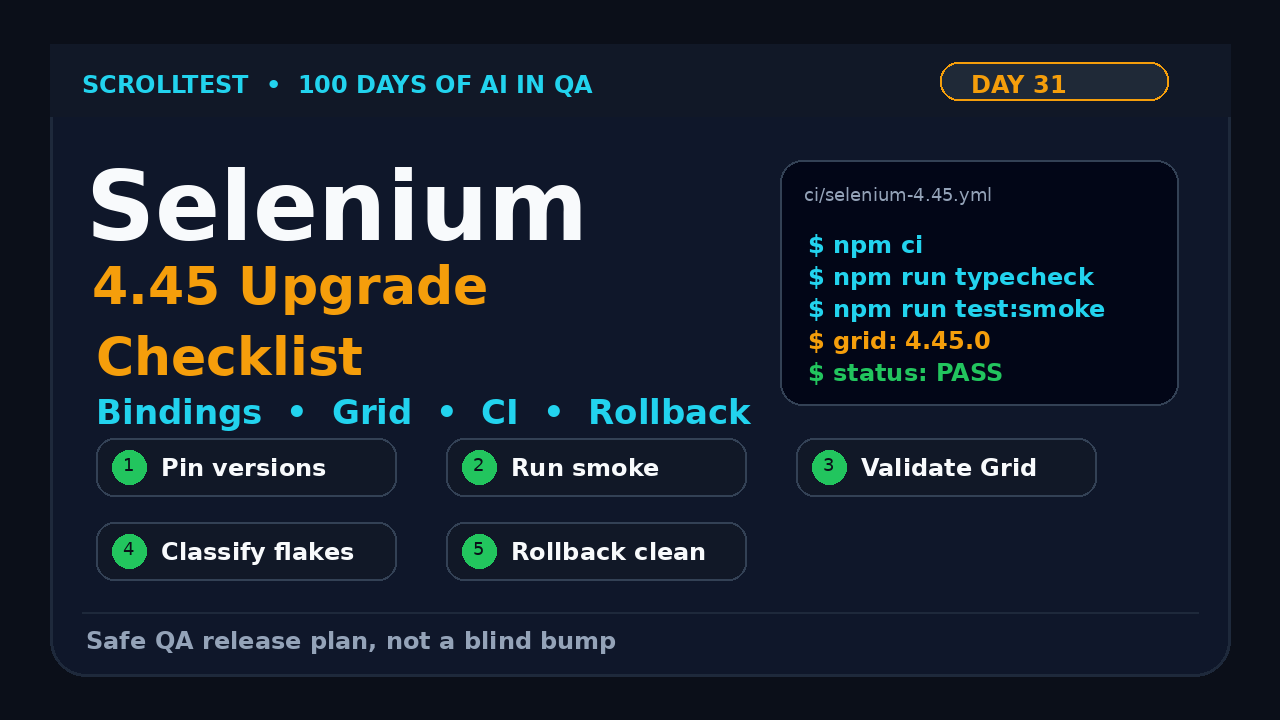
Day 31 of 100 Days of AI in QA & SDET. This Selenium 4.45 upgrade checklist is for QA teams that do not want library updates to become Friday-night CI fires. Selenium 4.45.0 shipped on 16 June 2026, and the right question is not “should we upgrade?” The right question is “how do we upgrade without losing trust in our regression suite?”
I see many teams treat Selenium upgrades as a dependency chore. That is a mistake. A browser automation upgrade touches test code, browser drivers, Grid, Docker images, CI caches, reporting, retries, and sometimes the habits of the entire QA team.
Table of Contents
- Why the Selenium 4.45 upgrade checklist matters
- Release facts QA teams should verify first
- Pre-upgrade inventory before touching code
- Binding upgrades by language
- Grid and infrastructure checks
- CI pipeline upgrade plan
- Flaky test triage after the upgrade
- AI-assisted review for Selenium upgrades
- Rollback plan and release gate
- FAQ
Contents
Why the Selenium 4.45 upgrade checklist matters
A Selenium update is never just a package version. It changes the contract between your test suite and the browser. Selenium 4.45.0 includes component-level changes across Java, Python, .NET, Ruby, JavaScript, Grid, and build tooling according to the official release notes.
That matters because most teams do not run one clean stack. They run a mixed stack: Java tests for old enterprise flows, JavaScript tests for newer apps, Python utilities for test data, Dockerized Grid for parallel execution, and CI jobs spread across Jenkins, GitHub Actions, or GitLab.
What changes in the real world
The visible change may be a version number in pom.xml, package.json, requirements.txt, or Gemfile. The invisible change is the risk profile of your suite. A locator that was already weak may start failing more often. A Grid node that was already overloaded may expose WebSocket timing issues. A CI cache that was already stale may hide the real package being executed.
The official release notes call out items such as a Grid WebSocket proxy race fix, Java logging class removal, JavaScript atom migration work, dependency updates, and language-specific changes. None of those automatically mean your suite breaks. They mean you need a controlled rollout instead of a blind version bump.
My rule for QA leads
I use a simple rule: if an upgrade can change browser execution, it deserves a test plan. Selenium sits on the hot path of UI automation. Treat it with the same discipline you apply to application releases.
- Pin the current working versions before the upgrade.
- Upgrade in a branch, not directly on main.
- Run a small smoke suite first.
- Run a representative cross-browser pack next.
- Compare failures by category, not by panic.
If your team needs a broader strategy view, read Selenium Strategy 2026: What Still Works. This article is the operational checklist for the upgrade itself.
Release facts QA teams should verify first
Before writing any code, confirm what you are upgrading to. I verified three hard facts for this checklist.
- The official GitHub release is Selenium 4.45.0, published on 16 June 2026.
- The npm package selenium-webdriver reports version 4.45.0.
- The npm downloads API reported 8,104,412 downloads for
selenium-webdriverfrom 6 June 2026 to 5 July 2026.
These numbers are useful because they give your team confidence that you are not chasing a random mirror, stale blog post, or copied command from an old Stack Overflow answer.
Do not copy release notes blindly
Release notes are input, not a test plan. The Selenium release notes list many changes, but your team must translate them into your stack. A Java team should inspect Java changelog risk. A JavaScript team should check package lock updates and browser compatibility. A Grid-heavy team should care about Grid proxy, WebSocket, node, router, distributor, and session behavior.
Compare with your current baseline
Write down your current versions in one place. I like a simple file named automation-baseline.md in the repository:
# Automation baseline before Selenium 4.45 upgrade
Selenium Java: 4.44.0
selenium-webdriver npm: 4.44.0
Chrome: 126.x in CI image
Firefox: 128.x in CI image
Grid: Docker image selenium/standalone-chrome:4.44.0
CI runner: ubuntu-24.04
Smoke suite runtime: 11 min 30 sec
Known flaky tests: 7
This one file saves arguments later. If runtime jumps, failures increase, or Grid sessions behave differently, you have a clean before-and-after snapshot.
Pre-upgrade inventory before touching code
The safest Selenium 4.45 upgrade checklist starts with inventory. Most failed upgrades are not caused by Selenium. They are caused by unknown dependencies around Selenium.
List the repositories and owners
Start with a repository map. Do not assume the automation code lives in one repo. Many teams have API utilities, UI tests, shared page objects, framework packages, test data helpers, and Docker image definitions split across different repos.
- UI automation repository
- Shared framework library
- Test data service clients
- Docker image or Grid compose files
- CI pipeline templates
- Reporting dashboard integration
- Slack or Teams notification scripts
Assign one owner per repo. No shared ownership fog. If a failure appears in CI, the owner should know whether it is a binding issue, browser issue, Grid issue, or test data issue.
Capture runtime and flake baseline
Before the upgrade, run your current stable suite. Capture these metrics:
- Smoke suite pass rate
- Smoke suite runtime
- Cross-browser suite pass rate
- Grid session queue time
- Top 10 flaky tests
- Retry count by test class or spec file
- Browser crash count
If you do not measure flakes before the upgrade, every existing flaky test becomes a Selenium 4.45 suspect. That wastes engineering time.
For the upgrade branch, avoid changing locators, application code, test data, and reporting format at the same time. Keep the diff boring. A boring diff is easier to review and easier to roll back.
Here is the checklist I use before opening the upgrade PR:
- Create branch
upgrade/selenium-4-45. - Record current dependency versions.
- Run baseline smoke suite and save report link.
- Update only Selenium and direct driver/Grid dependencies.
- Commit dependency changes separately from test fixes.
- Run smoke suite again.
- Classify every failure before fixing anything.
Binding upgrades by language
Selenium supports multiple language bindings, and each team feels the upgrade differently. Do not let one language team define the risk for everyone else.
Java teams
Java Selenium suites often sit inside Maven or Gradle projects with custom wrappers. Update the Selenium dependency, then compile before running tests. Compilation catches API removals faster than a full regression run.
<dependency>
  <groupId>org.seleniumhq.selenium</groupId>
  <artifactId>selenium-java</artifactId>
  <version>4.45.0</version>
</dependency>
Run:
mvn -U -DskipTests clean test-compile
mvn -Dgroups=smoke test
Watch for deprecated logging usage, old custom driver factories, and wrappers that swallow Selenium exceptions. If your framework hides real errors behind generic RuntimeException, fix that before debugging failures.
JavaScript and TypeScript teams
The npm package for Selenium WebDriver now reports 4.45.0. Update with an exact version and commit the lock file.
npm install selenium-webdriver@4.45.0 --save-exact
npm test -- --grep smoke
For TypeScript projects, run type checking separately from tests:
npm run typecheck
npm run test:smoke
Do not skip this. A test suite can appear healthy while type-level issues wait in rarely executed helper paths.
Python teams
Python teams should isolate the upgrade in a fresh virtual environment. I still see teams upgrade in a dirty local environment and then blame CI when the result differs.
python -m venv .venv-selenium-445
source .venv-selenium-445/bin/activate
pip install --upgrade selenium==4.45.0
pytest -m smoke --maxfail=5
If you maintain shared fixtures, check driver setup, implicit wait configuration, and exception handling. Selenium upgrades often expose fixture shortcuts that were already fragile.
.NET and Ruby teams
.NET and Ruby suites need the same discipline: update package versions, run compile or syntax checks, run smoke, then run a targeted regression pack. Do not mix package upgrades with large refactors.
If your org has multiple language stacks, publish one upgrade note with separate sections for Java, JavaScript, Python, .NET, and Ruby. A single Slack message saying “Selenium upgraded” is not enough.
Grid and infrastructure checks
The Selenium documentation says Grid routes WebDriver commands to remote browser instances so tests can run on remote machines and in parallel. That routing layer is exactly why Grid upgrades deserve separate validation.
Check standalone, hub-node, and distributed modes
Teams usually run Grid in one of three ways: standalone for small suites, hub-node for medium suites, or distributed for larger parallel execution. Your Selenium 4.45 upgrade checklist should match the mode you actually use.
- Standalone: verify one browser session starts and closes cleanly.
- Hub-node: verify node registration and session routing.
- Distributed: verify router, distributor, session map, event bus, and node health.
For Docker-based teams, pin image versions instead of using floating tags:
services:
  chrome:
    image: selenium/standalone-chrome:4.45.0
    shm_size: 2gb
    ports:
      - "4444:4444"
Floating tags make audits painful. If latest changes under you, you cannot easily answer which Selenium build caused the failure.
Validate WebSocket and BiDi-heavy flows
The Selenium 4.45.0 release notes mention a Grid WebSocket proxy race fix. If your tests use browser logs, console events, network signals, or WebDriver BiDi-style flows, include those tests in the upgrade pack.
Do not rely only on login and checkout smoke tests. Add tests that exercise:
- Remote browser session creation
- Console log capture
- Network or performance log collection
- File upload and download
- Multiple tabs or windows
- Session cleanup after failure
Watch the boring infra numbers
Grid failures often look like test failures. Track node CPU, memory, session queue time, browser startup time, and container restarts. If tests fail only when parallelism increases, you may have an infrastructure problem, not a locator problem.
For a release-note focused view, also read Selenium 4.45 Regression Briefing for QA Teams.
CI pipeline upgrade plan
A local Selenium upgrade that fails in CI is not complete. CI is where browser automation becomes real.
Pin the execution environment
CI runners have their own truth: OS image, browser version, driver resolution, cache layer, Java version, Node version, Python version, Docker version, and secret configuration. Record them.
Here is a GitHub Actions example for a controlled JavaScript smoke run:
name: selenium-445-smoke
on: [pull_request]
jobs:
  smoke:
    runs-on: ubuntu-24.04
    steps:
      - uses: actions/checkout@v4
      - uses: actions/setup-node@v4
        with:
          node-version: '22'
          cache: 'npm'
      - run: npm ci
      - run: npm run typecheck
      - run: npm run test:smoke
      - uses: actions/upload-artifact@v4
        if: always()
        with:
          name: selenium-445-report
          path: reports/
Notice the order. Install from lock file, type check, run smoke, upload evidence. That evidence matters when a product manager asks if the upgrade is safe.
Split the pipeline into gates
Do not run the full 3-hour regression suite as the first signal. Use gates:
- Build and dependency resolution
- Static checks and type checks
- Single-browser smoke suite
- Cross-browser critical path suite
- Grid parallel execution suite
- Nightly full regression
Each gate should answer one question. Can the project build? Can tests start a browser? Can the main flows pass? Can Grid handle parallel sessions? Can the full regression survive overnight?
Keep rollback easy
The upgrade PR should be reversible with one revert. If you need six manual steps to roll back, your upgrade process is too risky. Keep dependency updates, CI changes, and test fixes in clear commits.
If your team is serious about release gates, connect this with AI Test Evidence for Browser Agents. The same evidence discipline applies to classic Selenium suites.
Flaky test triage after the upgrade
Every Selenium upgrade creates one messy question: did the upgrade break the test, or did it reveal a bad test? You need a triage system, not gut feeling.
Classify failures before fixing
I use five buckets:
- Dependency failure: package resolution, compile error, missing transitive dependency.
- Browser startup failure: driver, container, permissions, sandbox, display.
- Grid failure: session routing, node registration, queue timeout.
- Test design failure: weak waits, bad locator, shared state, bad data.
- Application failure: real product bug exposed by stable automation.
Only one of these is directly “Selenium broke us.” Most failures are test design, environment, or dependency discipline.
Reduce false positives
Do not increase retries as your first fix. Retries hide signal. Instead, inspect screenshots, page source, browser logs, Grid logs, and timing. If the element appears after 9 seconds and your wait is 5 seconds, that is not a Selenium 4.45 problem. That is a wait strategy problem.
A small helper script can summarize failures by category:
from collections import Counter

failures = [
    {"test": "checkout_guest", "bucket": "test_design"},
    {"test": "login_sso", "bucket": "grid"},
    {"test": "invoice_pdf", "bucket": "browser_startup"},
]

summary = Counter(f["bucket"] for f in failures)
for bucket, count in summary.most_common():
    print(f"{bucket}: {count}")
Fix the top failure class first
If 14 failures come from one bad driver factory, fix the factory. If 9 failures come from one overloaded Grid node, fix infra. If 12 failures come from weak locators, improve the locator strategy. Do not allow engineers to randomly fix tests from the top of the report.
AI-assisted review for Selenium upgrades
This is the AI in QA part of Day 31. I do not want AI writing blind test fixes. I want AI reading the diff, grouping risk, and asking better review questions.
Use AI to inspect the dependency diff
Paste the dependency diff and ask for risk areas. A useful prompt is:
You are reviewing a Selenium 4.45 upgrade PR.
Find risks in dependency changes, CI changes, Grid config, waits,
custom driver factories, and exception handling.
Return a checklist grouped by build, runtime, Grid, and flaky tests.
This gives the reviewer a structured starting point. It does not replace execution. AI cannot tell you whether your Grid nodes are overloaded unless you give it logs and metrics.
Use AI to cluster failure logs
After a smoke run, feed anonymized stack traces and ask the model to cluster them by root cause. Keep secrets out. Remove customer data. Do not paste internal URLs unless your company policy allows it.
For QA teams moving into AI evaluation, this is the same skill you use for LLM testing: define acceptance criteria, collect evidence, and verify outputs. If you want a Python-first LLM eval path, read DeepEval for QA Engineers.
What AI should not do
Do not let AI mass-edit locators after a dependency upgrade. That creates a noisy diff and makes rollback hard. Keep the upgrade mechanical first. Then fix genuine test debt in separate commits.
Rollback plan and release gate
The Selenium 4.45 upgrade checklist is not done until rollback is clear. A good rollback plan is boring: revert the PR, restore the lock file, restore the Docker image tag, and re-run the previous smoke suite.
Define pass criteria
Before merging, agree on pass criteria. Here is a practical version:
- Build and dependency resolution pass on clean CI.
- Smoke suite pass rate is equal to or better than baseline.
- Runtime increase is under 10% unless explained.
- No new Grid session creation failures.
- No browser startup failures in supported browsers.
- Known flaky tests are not counted as new failures.
- Rollback command is documented in the PR.
Communicate like an engineering team
The upgrade note should include version, scope, evidence, risk, rollback, and owner. Keep it short.
Selenium upgrade: 4.44.0 to 4.45.0
Scope: Java UI smoke + Grid Chrome suite
Evidence: CI run #1842, report link, Grid logs attached
Result: 126/126 smoke tests passed, runtime 12m 04s vs 11m 52s baseline
Risk: low for Chrome smoke, medium for Firefox nightly until tomorrow
Rollback: revert PR #912 and restore selenium/standalone-chrome:4.44.0
Owner: QA Platform
India context for SDETs
For SDETs in India, this kind of upgrade discipline is career capital. Many service-company teams still treat automation as script maintenance. Product companies expect ownership of CI signal, release risk, infrastructure evidence, and rollback planning. That is the difference between “I write Selenium scripts” and “I own browser automation reliability.”
If you are targeting senior SDET or QA lead roles, learn to explain upgrades this way. It shows engineering maturity without buzzwords.
FAQ
Should every team upgrade to Selenium 4.45 immediately?
No. Upgrade on a planned branch with smoke, Grid, and CI evidence. If your current release week is high risk, schedule the upgrade early next week and pin existing versions until then.
Is Selenium 4.45 better than Playwright for new projects?
That depends on your browser matrix, language stack, team skills, and product needs. Selenium still wins in mature cross-language ecosystems and enterprise browser coverage. Playwright often feels faster for modern TypeScript-first teams. Do not turn an upgrade into a tool war.
What is the biggest Selenium upgrade mistake?
Mixing upgrade changes with test refactoring. Keep the version bump small, collect evidence, then fix test debt separately.
How many tests should run before merging?
At minimum, run build checks, a single-browser smoke suite, a cross-browser critical path suite, and one Grid parallel run if you use Grid. Full regression can run nightly if the earlier gates are clean.
Can AI help with Selenium upgrades?
Yes, but use it for review, clustering, and checklist generation. Do not let it rewrite half the framework in the same PR.
Key takeaways
The Selenium 4.45 upgrade checklist is simple: know your baseline, upgrade one layer at a time, validate Grid and CI, classify failures before fixing, and keep rollback boring.
- Selenium 4.45.0 is a real release with language, Grid, and dependency-level changes.
- Most upgrade pain comes from weak baselines and noisy diffs.
- Grid deserves separate validation because it changes execution behavior at scale.
- AI is useful for reviewing diffs and clustering failures, not for blind fixes.
- Senior SDETs win trust by showing evidence, not by saying “all tests passed locally.”
Use this checklist before your next Selenium upgrade. Your future CI dashboard will thank you.