DeepEval 4.x QA Skill Stack for SDETs
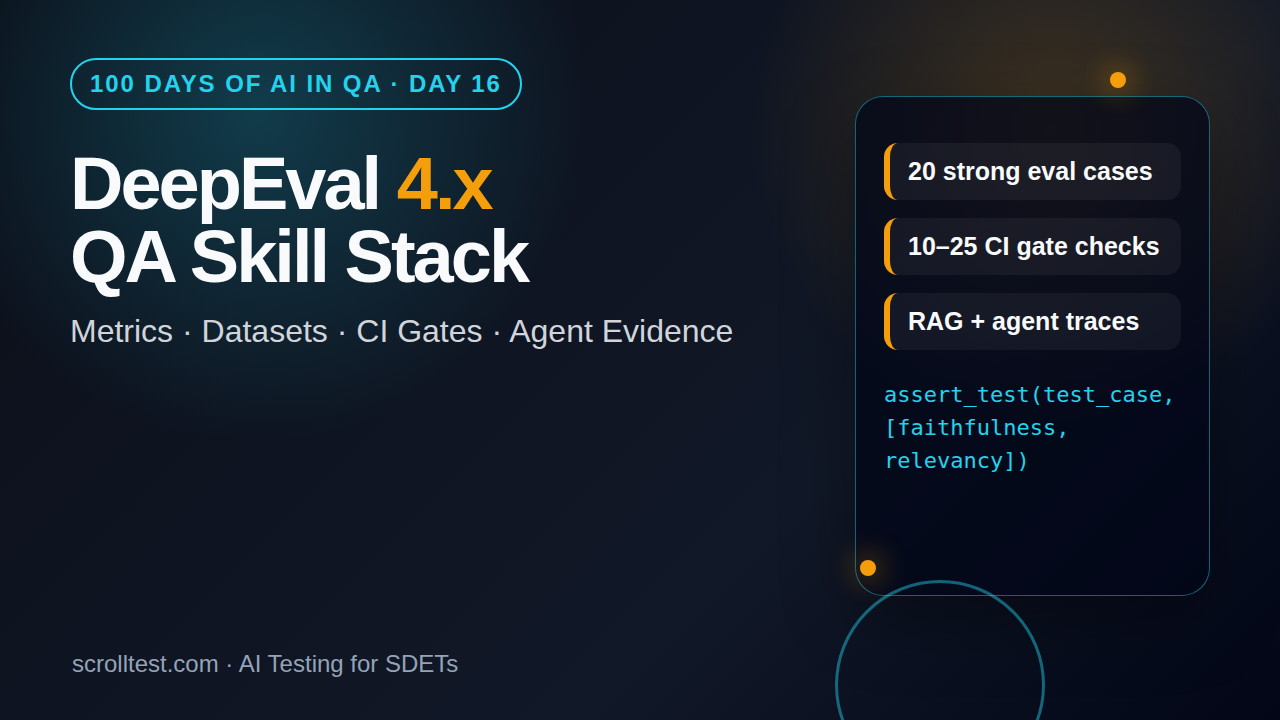
Day 16/100 of AI in QA & SDET: the DeepEval 4.x QA skill stack is the practical bridge between “we tried the chatbot and it looked fine” and “we can catch the same AI failure again before release.” DeepEval 4.x matters because SDETs need a testing vocabulary for LLM apps, RAG answers, coding agents, and browser agents that fail in messy, non-deterministic ways.
🤖 Learning AI-powered testing? Go hands-on with LLM, RAG, and AI-agent testing in the AI-Powered Testing Mastery course at The Testing Academy.
I see many QA teams treat AI testing like exploratory testing with screenshots. That is useful for discovery, but it is not enough for regression. This guide shows the skill stack I would build around DeepEval 4.x if I had to make an SDET team useful on AI product testing in the next 30 days.
Table of Contents
- Why DeepEval 4.x matters for QA teams
- The DeepEval 4.x QA skill stack
- Metrics SDETs must understand
- How to build eval datasets from real bugs
- DeepEval 4.x QA skill stack in CI
- RAG and agent testing examples
- India career context for SDETs
- Common mistakes I see
- Key takeaways
- FAQ
Contents
Why DeepEval 4.x Matters for QA Teams
DeepEval describes itself as “The LLM Evaluation Framework” on GitHub. As of my research for this article, the DeepEval repository has more than 16,000 GitHub stars, and its v4.0.5 release was published on May 28, 2026 with support for the claude-opus-4-8 model preset. PyPI currently lists DeepEval 4.0.7 as the latest package version.
Those numbers do not mean every QA team should adopt it tomorrow. They do show that LLM evaluation is moving from research notebooks into engineering workflows. That is where SDETs should pay attention.
AI bugs do not look like normal UI bugs
A normal UI bug often has a clear expected result. Click button, see modal. Submit form, receive validation. AI bugs are different. The output can be partly correct, confidently wrong, unsafe, too verbose, missing context, or inconsistent across repeated runs.
That creates a testing gap. Manual testers can spot bad answers, but screenshots do not create a repeatable safety net. Automation engineers can write assertions, but exact string checks break when the answer is semantically correct with different wording.
The DeepEval 4.x QA skill stack gives SDETs a middle path: use deterministic checks where rules are strict, and use LLM-aware metrics where judgment is semantic.
What changed for SDETs
The old SDET skill stack was web automation, API testing, SQL, CI/CD, and reporting. That stack still matters. But AI product testing adds new layers:
- Prompt and response evaluation
- RAG context validation
- Agent trace review
- Safety and jailbreak checks
- Model drift monitoring
- Dataset design for evals
If you already write Playwright, Pytest, or API tests, this is not a complete career reset. It is an extension. The best SDETs will know how to combine browser evidence with eval evidence. I covered the evidence side in AI Testing Evidence Pack: Trace, Screenshot, Logs.
The DeepEval 4.x QA Skill Stack
The mistake is thinking the tool is the skill. It is not. DeepEval gives you primitives, but QA value comes from how you turn product risk into repeatable checks.
I would teach the DeepEval 4.x QA skill stack in five layers.
Layer 1: Failure framing
Before you write an eval, write the failure in plain English. Bad framing creates noisy tests. Good framing creates maintainable checks.
Use this format:
- User task: what the user asked the AI to do.
- Expected behavior: what a useful, safe answer must include.
- Forbidden behavior: what the model must not do.
- Evidence: prompt, output, retrieved context, trace, or screenshot.
- Regression check: the smallest eval that catches this failure.
Example: “The support bot recommends a refund policy that is not present in the retrieved documents.” That is a faithfulness problem. Do not label it as “AI hallucination” and stop. Turn it into a faithfulness eval with source context.
Layer 2: Metric selection
SDETs are used to pass/fail assertions. LLM metrics feel strange at first because many are scored between 0 and 1. That does not make them weak. It means you must define thresholds and review failures like test evidence.
DeepEval includes metrics for areas such as answer relevancy, faithfulness, contextual precision, contextual recall, hallucination, toxicity, bias, summarization, and GEval-style custom judgment. The exact set changes over time, so always check the official docs and release notes before locking a framework design.
Layer 3: Dataset design
Most teams jump straight to 500 eval rows. I prefer 20 strong rows first. A small, high-quality eval set catches more product risk than a large spreadsheet full of vague prompts.
Your first dataset should include:
- 5 happy-path tasks users ask every day
- 5 edge cases from real support tickets or bug reports
- 5 safety or policy boundary checks
- 5 regression cases from previous AI failures
This is where QA engineers have an advantage. We already know how to find edge cases. We just need to express them as eval inputs and expected outcomes.
Layer 4: CI gates
Do not run every eval on every pull request. That gets expensive and slow. Run a small gate in PR, then a broader suite nightly.
A practical split:
- PR gate: 10 to 25 critical evals, fast model, strict timeout
- Nightly gate: 100 to 300 evals, broader coverage, trend reports
- Release gate: critical journeys plus manual trace review
This matches how mature teams already handle UI automation. Smoke first, full regression later.
Layer 5: Evidence review
A failed eval without context is another flaky test. Store the input, model output, retrieved context, metric score, threshold, and reason. If the AI feature involves a browser agent, also save trace, screenshot, console logs, and network clues.
That is the difference between “AI failed again” and “this release changed retrieval ranking, which dropped contextual recall below our threshold.”
Metrics SDETs Must Understand
You do not need a PhD to start with LLM evals. You do need to know what each metric is trying to catch. Here are the ones I would put in the first week of training.
Answer relevancy
Answer relevancy checks whether the response actually answers the user’s question. This catches the classic support bot problem: the answer sounds polished but ignores the task.
For QA, this maps to intent coverage. If the user asks for refund eligibility and the bot explains account setup, the answer is not relevant even if the grammar is perfect.
Faithfulness
Faithfulness checks whether the answer stays grounded in provided context. This is critical for RAG systems because the model should not invent facts outside retrieved documents.
Use faithfulness when testing policy bots, documentation assistants, sales enablement copilots, or internal knowledge search. It is one of the first metrics I would add for any enterprise AI feature.
Contextual precision and recall
Contextual precision asks whether the retrieved context is useful. Contextual recall asks whether the required information was retrieved. These metrics help you test the retrieval system, not just the model response.
That matters because many “LLM bugs” are actually retrieval bugs. The model cannot answer from the right document if the retriever sends the wrong chunks.
Custom GEval-style checks
Some product rules do not fit a built-in metric. For example, “The answer must explain the trade-off in less than 120 words and must not recommend contacting support unless the policy is ambiguous.”
That is where custom criteria help. Write the rule in plain English, provide test cases, and review false positives carefully before you trust the gate.
How to Build Eval Datasets From Real Bugs
The best eval dataset is not invented in a meeting room. It comes from production bugs, support tickets, sales demos, dogfooding notes, and failed manual test sessions.
The 30-minute bug-to-eval workflow
When someone reports a bad AI answer, do this before the context disappears:
- Save the exact user input.
- Save the model output.
- Save retrieved context or tool calls.
- Write one sentence explaining why the output is wrong.
- Choose the smallest metric that should catch it.
- Add the case to a regression eval dataset.
- Run it against the current model and next candidate model.
This turns every AI bug into a future guardrail. It also gives QA a concrete role in AI delivery, not just a seat at the demo.
A simple DeepEval Python example
Here is a minimal pattern. Treat this as a starting point, not a complete framework.
from deepeval import assert_test
from deepeval.test_case import LLMTestCase
from deepeval.metrics import AnswerRelevancyMetric, FaithfulnessMetric


def test_refund_policy_answer_is_relevant_and_grounded():
    test_case = LLMTestCase(
        input="Can I get a refund after 45 days?",
        actual_output=(
            "Refunds are available only within 30 days of purchase. "
            "After 45 days, the policy does not allow a refund."
        ),
        retrieval_context=[
            "Refunds are available within 30 days of purchase. "
            "Requests after 30 days are not eligible."
        ],
    )

    answer_relevancy = AnswerRelevancyMetric(threshold=0.8)
    faithfulness = FaithfulnessMetric(threshold=0.8)

    assert_test(test_case, [answer_relevancy, faithfulness])
The important part is not the syntax. The important part is that a support policy failure is now a regression check.
Store evals like test assets
Keep eval cases in source control. Review them in pull requests. Tag them by product area. Remove duplicates. Mark flaky or subjective cases for human review instead of pretending every semantic judgment is stable.
I like this folder structure:
evals/
  support_bot/
    refund_policy_cases.jsonl
    cancellation_cases.jsonl
  rag/
    contextual_recall_cases.jsonl
  safety/
    policy_boundary_cases.jsonl
  tests/
    test_support_bot_eval.py
DeepEval 4.x QA Skill Stack in CI
The DeepEval 4.x QA skill stack becomes real only when it runs before release. A local notebook is research. A CI gate is engineering.
PR gate example
For pull requests, I prefer a small set of high-signal cases. Fail fast when the AI feature violates a hard rule. Warn when semantic scores drift slightly.
name: ai-evals

on:
  pull_request:
    paths:
      - "app/ai/**"
      - "evals/**"

jobs:
  deepeval-smoke:
    runs-on: ubuntu-latest
    timeout-minutes: 15
    steps:
      - uses: actions/checkout@v4
      - uses: actions/setup-python@v5
        with:
          python-version: "3.11"
      - name: Install dependencies
        run: |
          pip install -r requirements.txt
      - name: Run critical AI evals
        env:
          OPENAI_API_KEY: ${ secrets.OPENAI_API_KEY }
        run: |
          pytest evals/tests -m critical --maxfail=1
This is intentionally boring. Boring CI is good. If your eval setup requires a heroic debugging session every Friday, the team will bypass it.
Nightly regression
Nightly runs can be broader. Track scores over time. If answer relevancy drops from 0.91 to 0.76 after a prompt change, that is a release signal. If faithfulness drops only for one document category, that points to retrieval or chunking.
Do not hide these reports in a terminal log. Put the summary in Slack, a dashboard, or the same release checklist your QA team already uses.
Cost control
LLM evals cost money and time. Start small. Cache responses where appropriate. Use cheaper models for first-pass checks if accuracy is acceptable. Reserve expensive judge models for critical release gates.
This is another reason SDETs should own the testing strategy. We already think in coverage, risk, runtime, and signal-to-noise ratio.
🚀 Build Real AI Testing Skills
Stop testing AI by guesswork. Learn DeepEval, RAG evaluation, and agent testing with guided projects.
RAG and Agent Testing Examples
DeepEval is especially useful when AI features have hidden steps: retrieval, tool calls, planning, browser actions, code generation, or summarization.
RAG support bot
For a RAG bot, test three things separately:
- Did retrieval fetch the right chunks?
- Did the answer stay faithful to those chunks?
- Did the answer actually help the user?
Many teams test only the final answer. That hides the root cause. If retrieval is weak, prompt changes become guesswork.
Browser agent
For browser agents, combine Playwright evidence with evals. A browser agent may complete a task but explain the wrong reason. Or it may fail a step and still produce a confident summary.
A strong test report includes:
- Initial instruction
- Planned steps
- Actual browser actions
- Screenshot or trace
- Final answer
- Eval score for task completion and explanation quality
If you are building this style of workflow, read Playwright MCP for QA Engineers and QA Agent Skills Roadmap. They connect browser automation, agent skills, and evaluation into one QA workflow.
Coding assistant
For coding agents, do not rely only on “the code compiles.” Add evals around instruction following, security constraints, test coverage, and explanation quality. PromptFoo’s GitHub repository positions it around testing prompts, agents, RAGs, and red teaming, and its npm package currently shows more than 1.3 million downloads in the last month. That demand exists because teams need repeatable checks around AI behavior, not just demos.
India Career Context for SDETs
For Indian QA engineers, AI testing is a career opening. I do not mean “learn one tool and get a 50 LPA job.” That is lazy content. I mean SDETs who can combine automation, CI, and LLM evals will stand out in product companies and AI-heavy teams.
What hiring managers will look for
In interviews, I would expect practical questions:
- How do you test a RAG bot?
- How do you detect hallucination?
- How do you decide eval thresholds?
- How do you debug a failed AI agent run?
- How do you run evals in CI without wasting cost?
A manual tester can start with failure framing and dataset creation. An automation tester can add DeepEval, PromptFoo, Pytest, and CI. A senior SDET can own the complete AI quality strategy.
The practical 30-day roadmap
Here is the roadmap I would follow:
- Week 1: Learn LLM failure types: hallucination, irrelevance, unsafe answer, missing context.
- Week 2: Build 20 eval cases from a sample support bot or documentation bot.
- Week 3: Run DeepEval checks locally and in GitHub Actions.
- Week 4: Add trace review, reports, and a release checklist.
If you can show this as a GitHub project, it is stronger than another generic Selenium framework clone.
Common Mistakes I See
Most failed AI testing efforts do not fail because the team picked the wrong library. They fail because the testing design is weak.
Mistake 1: Treating eval scores as absolute truth
An eval score is a signal, not a judge from heaven. Review failed cases. Tune thresholds. Compare against human judgment. Keep a list of known false positives and false negatives.
Mistake 2: Testing only happy paths
Happy paths make AI look impressive. Edge cases make AI testable. Add policy boundaries, missing context, contradictory context, vague user prompts, and unsafe requests.
Mistake 3: No owner for the dataset
Datasets rot. Product policies change. Prompts change. Retrieval changes. Assign ownership like you would for test suites. If nobody owns the eval dataset, it becomes stale within weeks.
Mistake 4: Ignoring security and red teaming
OWASP maintains a Top 10 project for LLM applications because LLM apps introduce security risks such as prompt injection, sensitive information disclosure, supply chain concerns, and unsafe output handling. QA teams do not need to become security researchers overnight, but they should know when an AI behavior is a security risk and when to involve AppSec.
Key Takeaways
The DeepEval 4.x QA skill stack is not about chasing a shiny framework. It is about giving QA teams a repeatable way to test AI behavior.
- DeepEval 4.x is part of the shift from AI demos to AI regression testing.
- SDETs should learn metrics such as relevancy, faithfulness, contextual precision, and contextual recall.
- Start with 20 strong eval cases from real bugs, not 500 weak spreadsheet rows.
- Run 10 to 25 critical evals in PR and a broader suite nightly.
- Combine eval scores with trace, screenshot, logs, and retrieval evidence.
If you want a practical next step, take one bad AI answer from your product or a demo app today. Write the user task, expected behavior, forbidden behavior, and evidence. Then turn it into one DeepEval test. That single regression check is how AI testing maturity starts.
FAQ
Is DeepEval only for Python teams?
DeepEval is strongest in Python workflows, especially when your team already uses Pytest or Python-based AI services. JavaScript-heavy teams may also evaluate PromptFoo for config-driven checks and CLI workflows.
Should QA teams use DeepEval or PromptFoo?
Use DeepEval when you want Python-native tests, RAG metrics, and Pytest-style integration. Use PromptFoo when you want prompt comparison, provider comparison, red teaming workflows, and YAML-driven evals. Many mature teams can use both for different layers.
How many evals should run in CI?
Start with 10 to 25 critical evals in pull requests. Run larger suites nightly or before release. The goal is fast signal, not maximum row count.
Can manual testers contribute to the DeepEval 4.x QA skill stack?
Yes. Manual testers can contribute by writing failure descriptions, collecting real examples, defining expected behavior, and reviewing eval outputs. That is valuable QA work even before they automate the checks.
What should I learn after basic DeepEval tests?
Learn RAG evaluation, agent trace review, prompt versioning, CI reporting, and security testing for LLM applications. That combination makes you useful on real AI product teams.
Sources checked: DeepEval GitHub repository and v4.0.5 release, PyPI DeepEval package metadata, PromptFoo GitHub repository and v0.121.17 release, npm monthly download API for PromptFoo, and OWASP Top 10 for LLM Applications.
🎓 Become an AI-Powered QA Engineer
Join hundreds of SDETs mastering LLM, RAG, and agent testing. Lifetime access, hands-on labs, and a job-ready portfolio.