Playwright Upgrade Checklist: 3 Files Before Merge
A Playwright upgrade checklist is not paperwork. It is the difference between a safe browser automation upgrade and a release day where the suite fails because the browser binary, test runner, and CI cache are no longer aligned.
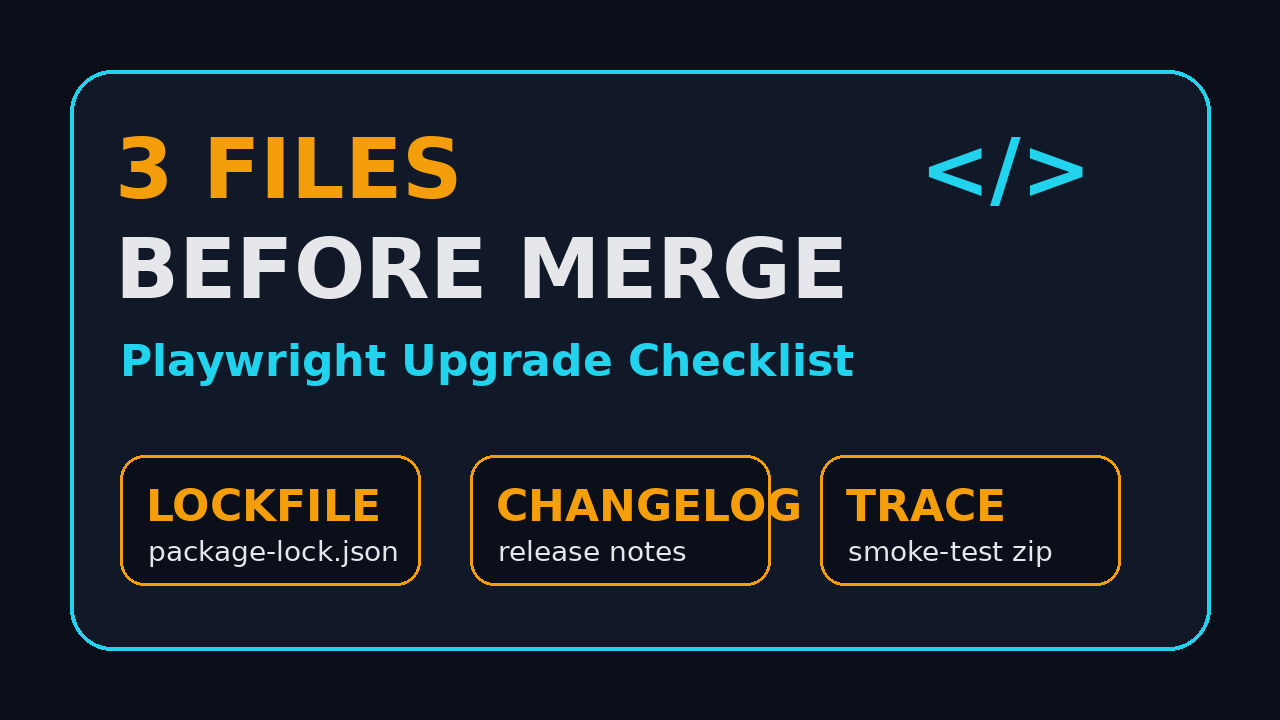
I use one rule: do not merge a Playwright upgrade until the pull request includes three pieces of evidence. The lockfile shows exactly what changed, the changelog link explains expected risk, and the smoke-test trace proves a real user path still works.
Table of Contents
- Why Playwright Upgrades Break
- The 3-File Checklist
- File 1: Lockfile Review
- File 2: Changelog Link
- File 3: Smoke-Test Trace
- CI Gate
- Reviewer Playbook
- 90-Minute Drill
- India QA Context
- Common Mistakes
- Key Takeaways
- FAQ
Contents
Why Playwright Upgrades Break Good Test Suites
Playwright is stable, but it is not a static library. A version bump can change the test runner, browser channels, reporters, trace output, locator behavior, and the browser engines that execute your app. That is why I treat every upgrade as a release-risk change, not a housekeeping chore.
The ecosystem is large. The npm downloads API reports more than 260 million downloads for playwright from 2026-06-12 to 2026-07-11. The npm API for @playwright/test reports more than 181 million downloads in the same period.
GitHub tells the same story. The Microsoft Playwright repository API reports more than 92,000 stars and more than 6,000 forks. The latest release I checked is v1.61.1, published on 2026-06-23. A project that active deserves disciplined upgrades.
Small version bumps still expose weak selectors
A weak selector can pass for months because timing is lucky. Then a browser update changes rendering by a fraction, and the same test starts failing. The upgrade gets blamed, but the test was already fragile. I see this most in login pages, payment flows, dashboards with virtual tables, and React screens with transitions.
Browser binaries matter
The official Playwright browser documentation explains browser installation with commands such as npx playwright install. If CI caches old browsers while the lockfile points to a new runner, the result is noisy failure. The checklist forces the team to inspect both dependency and runtime evidence.
The 3-File Playwright Upgrade Checklist
The Playwright upgrade checklist is intentionally small. I want a reviewer to inspect it in 10 minutes. If the checklist needs a meeting, it is too heavy. If the checklist cannot explain the risk, it is too weak.
- Lockfile diff:
package-lock.json,pnpm-lock.yaml, oryarn.lockshowing the exact resolved version change. - Changelog link: the official Playwright release notes or matching GitHub release.
- Smoke-test trace: a trace zip from one critical user journey after the upgrade.
The lockfile answers what changed. The changelog answers what risk to expect. The trace answers what actually happened in your app. If one side is missing, the upgrade review is incomplete.
## Playwright upgrade evidence
- Lockfile diff reviewed: yes
- Release notes: https://playwright.dev/docs/release-notes
- Target version: v1.61.1
- Smoke trace: artifacts/playwright-smoke-login-trace.zip
- Smoke command: npx playwright test tests/smoke/login.spec.ts --trace on
- Browser install: npx playwright install --with-deps
File 1: Lockfile Review
The lockfile is the first file because it removes guessing. package.json says what you asked for. The lockfile says what your package manager actually resolved. Those are not always the same thing.
For npm users, that means package-lock.json. For pnpm users, that means pnpm-lock.yaml. For Yarn users, that means yarn.lock. If your team uses Docker, also check the Dockerfile and CI image because the Node.js version can change dependency behavior.
- Old and new
@playwright/testversions are obvious. - The
playwrightpackage is not duplicated by a helper package. - The PR does not update unrelated libraries without explanation.
- The lockfile was produced by the same package manager used in CI.
- The Node.js version in CI matches the version used by the author.
node --version
npm --version
npm ls @playwright/test playwright
npx playwright --version
git diff -- package.json package-lock.json
For pnpm, I ask for pnpm why @playwright/test. For Yarn, I ask for the relevant yarn why output. The command is less important than the proof that the installed version is the intended version.
Lockfile review catches accidental bundle upgrades. A Playwright PR should not silently update ESLint, Vite, Axios, and five test helpers. If the upgrade fails, rollback becomes messy because there are too many suspects.
If your test data layer is weak, the upgrade will expose it. Pair this checklist with the ScrollTest guide on test data management for SDETs and CI/CD pipelines. Dependency evidence and clean data setup belong together.
File 2: Changelog and Release Notes Link
The second file is a link, but it is not optional. Use the official Playwright release notes and, when needed, the GitHub releases page. Do not replace official notes with a random summary post.
I do not accept minor upgrade as a risk assessment. Minor releases can include browser version changes, reporter behavior, new assertions, locator improvements, and deprecations. Most are positive changes, but a reviewer still needs to know what changed.
- Previous version and target version.
- Release-note URL and GitHub release URL.
- Any browser install change or CI image change.
- Any deprecation or behavior change relevant to your suite.
- Rollback plan if smoke tests fail after merge.
Release note review:
- Upgrading @playwright/test from 1.60.x to 1.61.1.
- Official notes checked: https://playwright.dev/docs/release-notes
- GitHub release checked: https://github.com/microsoft/playwright/releases/tag/v1.61.1
- Impacted areas: login smoke, checkout smoke, visual dashboard smoke.
- Rollback: revert this PR and restore previous browser cache key.
The release-note comment becomes operational memory. When the build fails at 2 AM, the next engineer should understand the upgrade decision without reading 40 Slack messages.
For a broader release-gate mindset, read the ScrollTest article on AI test evidence in CI/CD release gates. The principle is the same: release decisions need proof, not optimism.
File 3: Smoke-Test Trace
The smoke-test trace is the file most teams skip. I think it is the strongest proof. A trace shows the upgraded runner interacting with your real app. It captures actions, DOM snapshots, network requests, console logs, timing, screenshots, and failure context.
The official Playwright Trace Viewer documentation explains how traces help inspect test execution. For upgrades, I use a passing trace as pre-merge evidence, not only as a post-failure debugging tool.
- Login and dashboard load.
- Checkout or payment initiation.
- Lead creation or form submission.
- Search plus result selection.
- One API-backed flow that touches test data.
npx playwright test tests/smoke/login.spec.ts --project=chromium --trace onimport { defineConfig, devices } from '@playwright/test';
export default defineConfig({
retries: process.env.CI ? 1 : 0,
reporter: [['html'], ['list']],
use: { trace: 'on-first-retry', screenshot: 'only-on-failure' },
projects: [{ name: 'chromium', use: { ...devices['Desktop Chrome'] } }],
});- The browser opens the expected URL.
- The test uses user-visible locators instead of fixed sleeps.
- Console errors are absent or explained.
- Network calls return expected status codes.
- The final assertion proves a user-visible outcome.
If the trace is full of page.waitForTimeout(5000), the upgrade has revealed a test design problem. That is not Playwright being flaky. That is automation debt becoming visible.
Turn the Checklist Into a CI Gate
A checklist helps. A CI gate makes the habit stick. Start with a pull request template, then add a smoke workflow that runs when Playwright dependencies or config files change.
The official Playwright CI documentation recommends predictable browser installation in CI. I like the explicit npx playwright install --with-deps chromium step because it makes the browser dependency visible in logs.
name: playwright-upgrade-smoke
on:
  pull_request:
    paths: [package.json, package-lock.json, playwright.config.ts, tests/**]
jobs:
  smoke:
    runs-on: ubuntu-latest
    steps:
      - uses: actions/checkout@v4
      - uses: actions/setup-node@v4
        with: { node-version: 22, cache: npm }
      - run: npm ci
      - run: npx playwright install --with-deps chromium
      - run: npx playwright test tests/smoke/login.spec.ts --project=chromium --trace on
The pipeline should upload playwright-report/ and test-results/ even when tests fail. A red build without artifacts is just a complaint. A red build with traces is evidence.
Reviewer Playbook for Test Leads
Test leads often approve upgrades because the build is green. I think that is too shallow. A green build tells you selected tests passed once. It does not prove the dependency change was controlled, the browser binary was aligned, or rollback is safe.
- Does the lockfile show only the intended Playwright-related change?
- Did the author link the official release note for the target version?
- Is there a smoke-test trace attached as a CI artifact?
- Does the trace cover a business-critical path?
- Can we revert this PR and restore the previous cache key in less than 15 minutes?
When the upgrade branch fails, split failures into three buckets: real application bug, weak test design, or upgrade incompatibility. A real bug usually reproduces manually. Weak test design shows poor selectors, fixed sleeps, or test data coupling. Upgrade incompatibility maps to release notes, browser binaries, or config behavior.
Do not let the team use Playwright is flaky as a blanket explanation. The trace gives you enough evidence to name the failure more precisely. That precision is what separates a senior SDET from someone only running commands.
A 90-Minute Upgrade Drill
If your team has never run a controlled Playwright upgrade, do a 90-minute drill before the next real release. Pick one repository, create a branch, upgrade @playwright/test, run the smoke workflow, and attach the three files to a practice pull request.
Use the first 20 minutes for dependency work: check Node.js, package manager, lockfile, and the current Playwright version. Use the next 30 minutes for the smoke test: choose one business-critical flow, remove obvious fixed waits, and run it with --trace on.
Use the next 20 minutes for CI: install browsers explicitly, upload artifacts, and confirm the trace opens. Use the final 20 minutes for review: ask the five reviewer questions and write a rollback note.
This drill teaches more than a slide deck because it creates a real artifact. Junior SDETs learn what a controlled dependency change looks like. Test leads learn where the suite is weak. Managers get a repeatable process that does not depend on one senior engineer being online.
The drill also gives you a baseline. If the practice upgrade takes 90 minutes now, the production upgrade should not become a 2-day incident later. If the practice upgrade takes 4 hours, your problem is not Playwright. Your problem is missing smoke coverage, unclear ownership, or CI drift.
India QA Team Context
For India-based QA teams, this checklist has a career angle. Product companies increasingly expect SDETs to own CI health, dependency upgrades, and release risk. Service-company habits like automation team will fix it later do not work when a Playwright suite blocks production deploys.
In interviews, I ask candidates how they upgrade automation frameworks. Weak answers focus only on commands. Strong answers cover dependency control, CI setup, browser installation, smoke selection, rollback, and artifact review.
If you are moving from manual testing to SDET work, this is a practical portfolio item. Create a small Playwright project, perform one upgrade, attach the three files, and write the PR description. That artifact is stronger than another generic certificate screenshot.
I will not pretend one checklist creates a ₹25 LPA role. It does not. But the behavior behind this checklist is exactly what stronger teams reward: ownership, evidence, rollback thinking, and clear communication.
Common Mistakes I See
Updating too many dependencies
A PR that updates Playwright, TypeScript, ESLint, a UI library, and a test data helper is hard to review. If the suite fails, you now have five suspects. Keep the Playwright upgrade isolated unless there is a documented reason.
Skipping browser installation in CI
Playwright tests need the right browser binaries. If CI relies on stale cached binaries, the lockfile does not tell the full story. Make the install command visible in the workflow.
Treating traces as failure-only artifacts
Traces are not only for debugging red builds. For upgrades, a passing trace is proof. It shows how the new runner behaved in your app.
No rollback plan
Every upgrade PR should explain rollback. Usually that means reverting the PR and clearing the browser cache key. In a release week, a clear rollback plan is worth more than a long Slack debate.
Key Takeaways
The Playwright upgrade checklist is simple because upgrade safety should not depend on heroics. Before merging a browser automation upgrade, ask for proof.
- Use the lockfile to prove exactly which Playwright dependency changed.
- Use official release notes to understand expected risk.
- Use a smoke-test trace to prove the upgraded runner works against your app.
- Use CI artifacts so reviewers can inspect evidence after the run.
- Keep the PR small so rollback is fast if production risk appears.
If your team is already investing in Playwright, also read the ScrollTest guide on testing multi-select dropdowns in Playwright. Stable automation comes from precise evidence, not lucky waits.
FAQ
What is the minimum Playwright upgrade checklist?
The minimum checklist has three items: a lockfile diff, an official changelog or release-note link, and a smoke-test trace from a critical flow.
Should I upgrade Playwright every release?
Not always. Teams with strong CI can upgrade frequently. Teams with fragile suites should first create smoke coverage, clean selectors, and reliable test data.
Which smoke test should I trace?
Trace the flow that best represents release risk. For many teams that is login plus dashboard load. For commerce teams it may be checkout.
Do I need traces for every browser?
Not for the first gate. Start with Chromium because it is usually the fastest signal. Add Firefox and WebKit when product traffic or risk demands it.
How do I convince my team to follow this?
Make it easy. Add the checklist to the pull request template, create one smoke workflow, and upload artifacts automatically.
The same model works for Selenium, Cypress, WebdriverIO, and test infrastructure libraries. The names change, but the evidence stays the same: dependency diff, official change source, runtime proof, and rollback path. Playwright just makes the trace part especially useful because the artifact is rich and easy to inspect.
The same model works for Selenium, Cypress, WebdriverIO, and test infrastructure libraries. The names change, but the evidence stays the same: dependency diff, official change source, runtime proof, and rollback path. Playwright just makes the trace part especially useful because the artifact is rich and easy to inspect.
The same model works for Selenium, Cypress, WebdriverIO, and test infrastructure libraries. The names change, but the evidence stays the same: dependency diff, official change source, runtime proof, and rollback path. Playwright just makes the trace part especially useful because the artifact is rich and easy to inspect.
The same model works for Selenium, Cypress, WebdriverIO, and test infrastructure libraries. The names change, but the evidence stays the same: dependency diff, official change source, runtime proof, and rollback path. Playwright just makes the trace part especially useful because the artifact is rich and easy to inspect.
The same model works for Selenium, Cypress, WebdriverIO, and test infrastructure libraries. The names change, but the evidence stays the same: dependency diff, official change source, runtime proof, and rollback path. Playwright just makes the trace part especially useful because the artifact is rich and easy to inspect.
The same model works for Selenium, Cypress, WebdriverIO, and test infrastructure libraries. The names change, but the evidence stays the same: dependency diff, official change source, runtime proof, and rollback path. Playwright just makes the trace part especially useful because the artifact is rich and easy to inspect.
The same model works for Selenium, Cypress, WebdriverIO, and test infrastructure libraries. The names change, but the evidence stays the same: dependency diff, official change source, runtime proof, and rollback path. Playwright just makes the trace part especially useful because the artifact is rich and easy to inspect.
The same model works for Selenium, Cypress, WebdriverIO, and test infrastructure libraries. The names change, but the evidence stays the same: dependency diff, official change source, runtime proof, and rollback path. Playwright just makes the trace part especially useful because the artifact is rich and easy to inspect.
The same model works for Selenium, Cypress, WebdriverIO, and test infrastructure libraries. The names change, but the evidence stays the same: dependency diff, official change source, runtime proof, and rollback path. Playwright just makes the trace part especially useful because the artifact is rich and easy to inspect.
The same model works for Selenium, Cypress, WebdriverIO, and test infrastructure libraries. The names change, but the evidence stays the same: dependency diff, official change source, runtime proof, and rollback path. Playwright just makes the trace part especially useful because the artifact is rich and easy to inspect.
The same model works for Selenium, Cypress, WebdriverIO, and test infrastructure libraries. The names change, but the evidence stays the same: dependency diff, official change source, runtime proof, and rollback path. Playwright just makes the trace part especially useful because the artifact is rich and easy to inspect.
The same model works for Selenium, Cypress, WebdriverIO, and test infrastructure libraries. The names change, but the evidence stays the same: dependency diff, official change source, runtime proof, and rollback path. Playwright just makes the trace part especially useful because the artifact is rich and easy to inspect.
The same model works for Selenium, Cypress, WebdriverIO, and test infrastructure libraries. The names change, but the evidence stays the same: dependency diff, official change source, runtime proof, and rollback path. Playwright just makes the trace part especially useful because the artifact is rich and easy to inspect.