Selenium 4.46.0 Upgrade Smoke Test for SDETs
Selenium 4.46.0 upgrade smoke test is the gate I want before any team merges a dependency bump for selenium-webdriver. Selenium 4.46.0 shipped on July 11, 2026, and the JavaScript package is already the latest npm release, so the right question is not “should we upgrade?” The right question is “did this upgrade break the three things our suite depends on every day?”
This guide turns a short Reels idea into a full release-gate playbook. I use TypeScript because most modern web teams can run it quickly in CI, but the same checks apply to Java, Python, Ruby, and .NET Selenium stacks.
Table of Contents
- Why This Upgrade Matters
- What Changed in Selenium 4.46.0
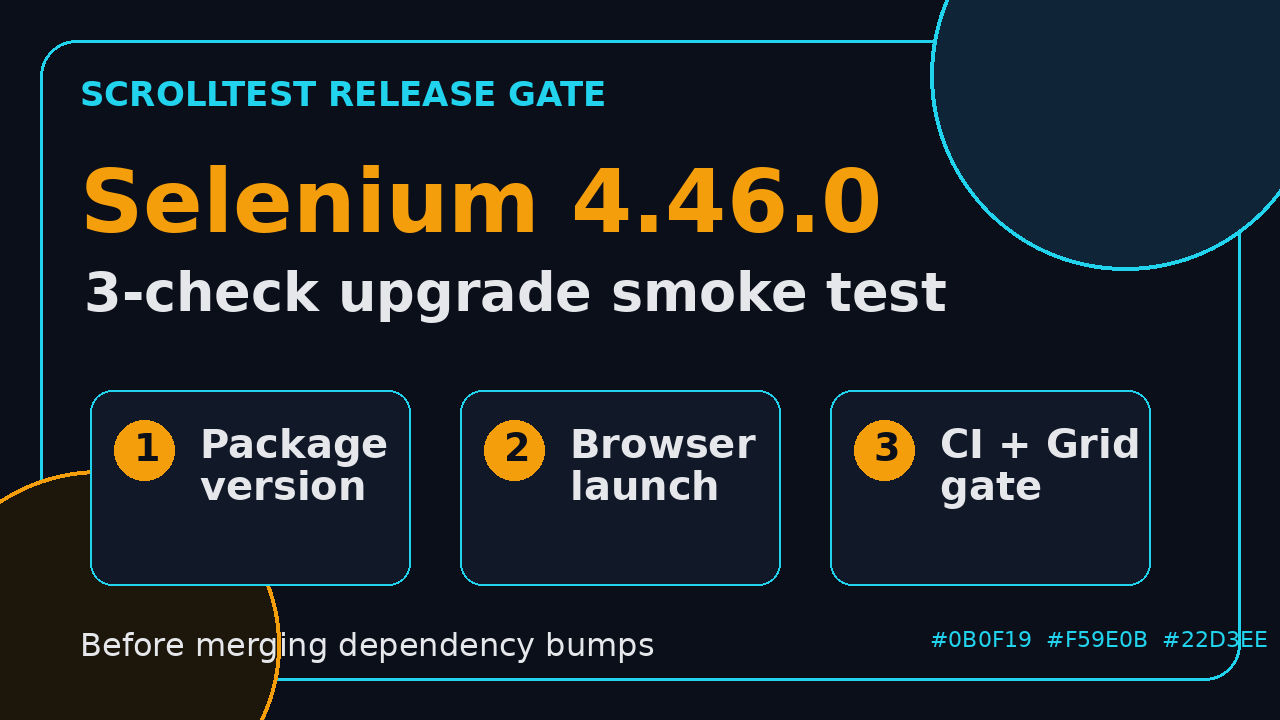
- The 3 Checks Before You Merge
- TypeScript Selenium 4.46.0 Upgrade Smoke Test
- CI Gate for Dependency Bumps
- Grid, BiDi, and Browser Compatibility
- India SDET Context
- Rollback Plan and Merge Rules
- FAQ
Contents
Why This Selenium 4.46.0 Upgrade Smoke Test Matters
Dependency bumps are production changes
I see teams treat Selenium upgrades like housekeeping. Someone opens a Renovate or Dependabot PR, the unit tests stay green, and the branch gets merged before lunch. That is risky. Selenium sits between your test code, your browser, your driver binaries, your Grid, your CI container, and sometimes your proxy rules. One small client change can surface as a broken browser launch, a changed timeout, or a flaky session handshake.
The official npm package describes selenium-webdriver as the official WebDriver JavaScript bindings from the Selenium project. The npm registry entry for 4.46.0 lists version 4.46.0 and shows runtime dependencies including ws, tmp, jszip, and @bazel/runfiles. That matters because a lockfile bump can update more than the Selenium client line you noticed in the PR.
The release is real and recent
The GitHub release API for Selenium 4.46.0 reports a publish time of 2026-07-11T00:47:53Z. The npm registry reports the JavaScript package version timestamp as 2026-07-11T00:44:10.345Z. Those two timestamps are close enough that I treat the npm package and GitHub release as the same release train.
At the time of research for this article, the npm downloads API reports 7,986,059 downloads in the last month for selenium-webdriver. GitHub reports the Selenium repository at more than 34,000 stars and 8,600 forks. This is not a niche library where only one squad gets surprised. A bad upgrade habit can hit a lot of CI pipelines.
Internal quality beats blind confidence
If your team is comparing browser automation tools, read the ScrollTest guide on Playwright vs Selenium vs Cypress in 2026. The point here is narrower. Even when Selenium is the correct choice, you still need an upgrade gate that proves your real environment is safe.
My rule is simple: no Selenium dependency bump merges without a 10-minute smoke test that covers package resolution, browser launch, a real DOM assertion, and one protocol-sensitive check. If your Grid is used in production CI, Grid must be part of the gate too.
What Changed in Selenium 4.46.0
Read release notes like an SDET, not a tourist
The Selenium 4.46.0 GitHub release includes changes across Java, Python, .NET, Ruby, JavaScript, build tooling, and Selenium Manager. I do not copy the whole release note into a test plan. I classify it into risk areas:
- Client binding risk: JavaScript, Java, Python, .NET, or Ruby API behavior that your tests call directly.
- Protocol risk: WebDriver BiDi, CDP compatibility, or session negotiation changes.
- Driver and browser risk: Selenium Manager, browser discovery, proxy settings, or download behavior.
- Grid risk: remote sessions, containers, node registration, and capabilities.
- Build risk: package dependencies, lockfile changes, or CI base image mismatches.
The 4.46.0 release notes specifically mention Java BiDi classes being marked beta, Java output for browser and available CDP versions, JavaScript binding-neutral BiDi schema work, Ruby HTTP client customization, .NET BiDi stream changes, and Selenium Manager related proxy behavior. I treat these as signals. The smoke test does not need to assert every internal implementation detail. It needs to exercise the user-facing paths most likely to fail after the upgrade.
BiDi deserves a separate check
Selenium’s documentation has a dedicated page for WebDriver BiDi. BiDi is important because teams increasingly use browser logs, network events, and script execution signals to debug modern apps. If your test framework uses these features, a plain “open Google and check title” script is not enough.
I do not recommend putting every advanced BiDi scenario in the upgrade gate. Keep the gate small. Subscribe to one browser log event or run one script-based check, depending on what your stack already uses. If it fails, the upgrade PR stops. The owner can then run the full regression suite and inspect protocol details.
Upgrade documentation still matters
Selenium’s official upgrade to Selenium 4 documentation is still worth linking in the PR description. It reminds reviewers that Selenium 4 is not just a package number. It includes W3C WebDriver behavior, browser options, service classes, and changed defaults from the Selenium 3 era.
For a team already on Selenium 4.x, 4.46.0 should usually be a minor upgrade. Still, minor does not mean zero risk. The test code, browser version, and CI image decide the blast radius.
The 3 Checks Before You Merge
Check 1: package and lockfile integrity
The first check is boring, which is exactly why teams skip it. Confirm the installed version and capture the dependency tree. In Node projects, I want these commands in the PR log:
npm view selenium-webdriver version
npm view selenium-webdriver@4.46.0 dependencies --json
npm ci
npm ls selenium-webdriver
node -p "require('selenium-webdriver/package.json').version"
The expected output should include 4.46.0. If npm ci modifies the lockfile, the PR is not ready. If your monorepo has multiple packages, run the version check from the package that owns browser automation, not from the repository root only.
Check 2: local browser launch and DOM assertion
The second check proves the client can start a real browser. I prefer a small local page served from the test repo because it removes internet flakiness. The test should launch Chrome or Firefox, load a deterministic page, find one element, click one button, and assert one state change.
This is not full end-to-end testing. It is a dependency smoke test. If the browser cannot launch, every deeper regression is noise.
Check 3: protocol-sensitive signal
The third check depends on your risk area. Pick one:
- Browser logs: prove your logging hook still captures a known console message.
- Network or BiDi: prove the event stream your framework consumes still works.
- Remote Grid: prove a session can start against your Selenium Grid image.
- Proxy path: prove your corporate proxy or NO_PROXY rules still allow Selenium Manager and browser launch.
For most teams, I start with browser logs and one Grid run. If your suite uses a custom proxy, make the proxy check mandatory. Proxy regressions waste hours because local laptops pass while CI fails inside a restricted network.
TypeScript Selenium 4.46.0 Upgrade Smoke Test
Install the exact version
Create a small branch and pin the dependency. Do not use a loose range while testing an upgrade. The point is to know exactly what passed.
npm install --save-dev typescript ts-node @types/node
npm install selenium-webdriver@4.46.0
npm install --save-dev chromedriver
node -p "require('selenium-webdriver/package.json').version"
If your project uses Selenium Manager instead of chromedriver, keep your current pattern. Do not rewrite the driver strategy and upgrade Selenium in the same PR. One change per PR is boring discipline, but it saves the team during rollback.
Create a deterministic HTML fixture
Add this file as fixtures/upgrade-smoke.html. It gives you a stable DOM, a button click, and a console message.
<!doctype html>
<html lang="en">
  <head>
    <meta charset="utf-8" />
    <title>Selenium Upgrade Smoke</title>
  </head>
  <body>
    <h1 id="status">ready</h1>
    <button id="run">Run smoke</button>
    <script>
      console.log('selenium-upgrade-smoke:boot');
      document.getElementById('run').addEventListener('click', () => {
        document.getElementById('status').textContent = 'passed';
        console.log('selenium-upgrade-smoke:clicked');
      });
    </script>
  </body>
</html>
Write the smoke test
This TypeScript example uses Chrome in headless mode, opens the local fixture, clicks the button, and asserts the state change. It also prints the Selenium version so the CI artifact is self-explanatory.
import path from 'node:path';
import { pathToFileURL } from 'node:url';
import { Builder, By, until } from 'selenium-webdriver';
import chrome from 'selenium-webdriver/chrome';
import pkg from 'selenium-webdriver/package.json' assert { type: 'json' };

async function main() {
  console.log(`selenium-webdriver version: ${pkg.version}`);

  const options = new chrome.Options()
    .addArguments('--headless=new')
    .addArguments('--no-sandbox')
    .addArguments('--disable-dev-shm-usage');

  const driver = await new Builder()
    .forBrowser('chrome')
    .setChromeOptions(options)
    .build();

  try {
    const fixturePath = path.resolve('fixtures/upgrade-smoke.html');
    await driver.get(pathToFileURL(fixturePath).toString());

    await driver.wait(until.elementLocated(By.id('run')), 5000);
    await driver.findElement(By.id('run')).click();

    const status = await driver.findElement(By.id('status')).getText();
    if (status !== 'passed') {
      throw new Error(`Expected status passed, got ${status}`);
    }

    console.log('Selenium 4.46.0 upgrade smoke test passed');
  } finally {
    await driver.quit();
  }
}

main().catch((error) => {
  console.error(error);
  process.exit(1);
});
Run it with:
node --loader ts-node/esm tests/selenium-upgrade-smoke.tsIf your project is not ESM, adjust the import style. The core idea stays the same: print version, launch browser, interact with DOM, assert the result, quit cleanly.
CI Gate for Selenium 4.46.0 Dependency Bumps
Put the gate close to the dependency PR
A Selenium upgrade gate should run on dependency PRs, not only on nightly regression. Nightly failures are useful, but they are late. The merge button needs a direct signal.
If your CI system is GitHub Actions, start with this job:
name: selenium-upgrade-smoke

on:
  pull_request:
    paths:
      - 'package.json'
      - 'package-lock.json'
      - 'tests/selenium-upgrade-smoke.ts'
      - 'fixtures/upgrade-smoke.html'

jobs:
  smoke:
    runs-on: ubuntu-latest
    timeout-minutes: 10
    steps:
      - uses: actions/checkout@v4
      - uses: actions/setup-node@v4
        with:
          node-version: 22
          cache: npm
      - run: npm ci
      - run: node -p "require('selenium-webdriver/package.json').version"
      - run: npm run test:selenium-upgrade-smoke
If your team already uses a QA-first pipeline, pair this with the ScrollTest guide on building a QA-first CI/CD pipeline. A dependency gate should be one small stage in a larger release safety model, not a random script nobody owns.
Make the pass criteria explicit
I want these pass criteria in the PR checklist:
selenium-webdriverresolves to4.46.0.- Chrome launches in the same CI image used by the test suite.
- The DOM fixture click changes state from
readytopassed. - The job finishes in under 10 minutes.
- Driver cleanup runs even when the assertion fails.
- One Grid run passes if Grid is part of the production test path.
Do not accept “full suite passed locally” as proof. Local machines hide CI image problems, corporate proxy problems, and Grid capability differences.
Keep artifacts small but useful
Store the CI log, browser version, Selenium version, and screenshot on failure. You do not need a 400 MB video for this gate. You need enough evidence to answer one question: did the dependency bump break our minimum browser automation contract?
The same discipline applies to Playwright upgrades. ScrollTest already has a practical Playwright upgrade checklist with trace, diff, and rollback. Selenium teams need the same level of release hygiene.
Grid, BiDi, and Browser Compatibility
Grid changes the risk profile
If your tests run through Selenium Grid, local smoke is not enough. A Grid session adds remote capabilities, container networking, node capacity, browser images, and timeout behavior. The smallest useful Grid check starts one remote Chrome session and runs the same fixture test.
const gridUrl = process.env.SELENIUM_REMOTE_URL;
const builder = new Builder().forBrowser('chrome');

if (gridUrl) {
  builder.usingServer(gridUrl);
}

const driver = await builder
  .setChromeOptions(options)
  .build();
Run the smoke once locally and once with SELENIUM_REMOTE_URL. If Grid is Docker-based, pin the Grid image in the same PR description. Do not upgrade the client and the Grid image without naming both versions.
BiDi is a feature flag in your test strategy
BiDi is powerful, but it should not silently enter your critical path. If your framework uses BiDi for console logs, network events, or script pinning, write that into the test plan. If it does not, keep the 4.46.0 gate focused on classic WebDriver flow and one browser log check.
For JavaScript teams, the 4.46.0 release note mentions binding-neutral BiDi schema work. I do not turn that into a scary claim. I turn it into a simple practice: any protocol-touching release note gets one protocol-touching smoke check.
Browser versions must be visible
Print the browser version in CI. Print the Selenium version. Print the Node version. This gives you a clean comparison when a future upgrade breaks on Chrome 129 but passes on Chrome 128, or when a CI base image moves from Node 20 to Node 22.
node --version
npm ls selenium-webdriver
google-chrome --version || chromium-browser --version
Numbers in logs beat Slack guesses. A future incident should start with facts, not screenshots of half a stack trace.
India SDET Context: Why This Skill Pays
Dependency ownership separates seniors from script writers
In India, many QA engineers get stuck because they can write test cases but cannot own release risk. The ₹25-40 LPA SDET and QA lead roles usually expect more than Selenium syntax. They expect dependency hygiene, CI ownership, rollback thinking, and clear communication with developers.
I see this in interviews. A candidate who says “I upgraded Selenium and ran regression” sounds average. A candidate who says “I built a 10-minute Selenium 4.46.0 upgrade smoke test that checked lockfile integrity, browser launch, Grid session creation, and rollback safety” sounds like an owner.
Service companies and product companies test ownership differently
In large service-company projects, a dependency bump may move through a shared platform team. In product companies, the automation owner may approve the PR directly. Both environments need the same habit: write the risk down, run the smallest proof, and keep rollback simple.
If you are moving from manual testing to automation, do not only learn selectors and waits. Learn dependency upgrades. Learn CI logs. Learn browser and driver versioning. These topics sound less glamorous than AI agents, but they build trust with engineering managers.
Use the upgrade PR as a portfolio artifact
If your company allows sanitized examples, turn your upgrade process into a portfolio note. Show the checklist, the CI job, the failure screenshot, and the rollback command. Do not expose private URLs or product details. Focus on the engineering method.
For broader career planning, ScrollTest’s AI QA portfolio sprint shows how to package practical QA work into visible proof. A Selenium upgrade gate is one of those proof points because it connects automation code with release safety.
Rollback Plan and Merge Rules
Write the rollback before the merge
A clean rollback plan is short:
git revert <merge_commit_sha>
npm ci
npm run test:selenium-upgrade-smoke
npm run test:critical-regression
If your Grid image changes too, include the image tag rollback. If your CI base image changes too, split it into a separate PR. I do not want three moving parts in a browser automation dependency upgrade.
Use a 7-step merge checklist
Here is the checklist I would put into the PR template:
- Confirm package version is
selenium-webdriver@4.46.0. - Confirm lockfile changed only for expected packages.
- Run local smoke test on Chrome or Firefox.
- Run CI smoke test in the production CI image.
- Run Grid smoke test if Grid is used.
- Attach browser, Node, and Selenium versions to PR evidence.
- Write rollback command and owner name before merge.
That is not bureaucracy. That is the minimum bar for a dependency sitting at the center of your browser automation stack.
Decide what does not belong in the smoke test
Do not put login, payment, PDF export, email verification, and visual assertions into the upgrade smoke test. Those belong in regression. The smoke test should stay small enough that developers trust it and run it often.
My target is 10 minutes or less in CI. If the gate crosses 10 minutes, people start bypassing it. If it finishes in 2 minutes, even better. The value is fast feedback on one narrow risk.
Conclusion: Keep the Upgrade Small, Prove the Contract
The Selenium 4.46.0 upgrade smoke test is not about worshipping a version number. It is about proving that your automation contract still works after the dependency bump. Selenium 4.46.0 is a real release with JavaScript package metadata, release notes, and active usage. Your team should respond with a real gate, not blind confidence.
Key takeaways:
- Selenium 4.46.0 was published on July 11, 2026, so treat it as a current release train upgrade.
- Check package resolution, browser launch, and one protocol-sensitive path before merge.
- Add a Grid smoke if CI uses Selenium Grid.
- Keep the gate under 10 minutes so teams actually run it.
- Write rollback steps before the merge, not during the incident.
FAQ
Should every team upgrade to Selenium 4.46.0 immediately?
No. Upgrade when you can run a small smoke gate and rollback safely. If a release freeze is active, wait. If your current Selenium version blocks browser compatibility or security policy, prioritize the upgrade.
Is this smoke test enough to replace regression testing?
No. It only proves the minimum browser automation contract. You still need critical user journey tests, cross-browser coverage, and product-specific regression before major releases.
Should I test both Chrome and Firefox?
Test the browser your CI relies on first. If your product officially supports Firefox, add Firefox to the matrix. Keep the first gate small, then expand only where support policy demands it.
What if my team uses Java or Python instead of TypeScript?
Use the same structure: print the binding version, open a local fixture, click one element, assert state, quit the driver, and run one Grid or protocol-sensitive check. The language changes, the release-risk model does not.
How do I explain this to developers?
Say this: “The Selenium bump touches our browser automation contract. This 10-minute job proves package resolution, browser launch, and Grid compatibility before merge.” That is specific enough for a developer to respect.