n8n Workflows for QA: 3 Automations to Try
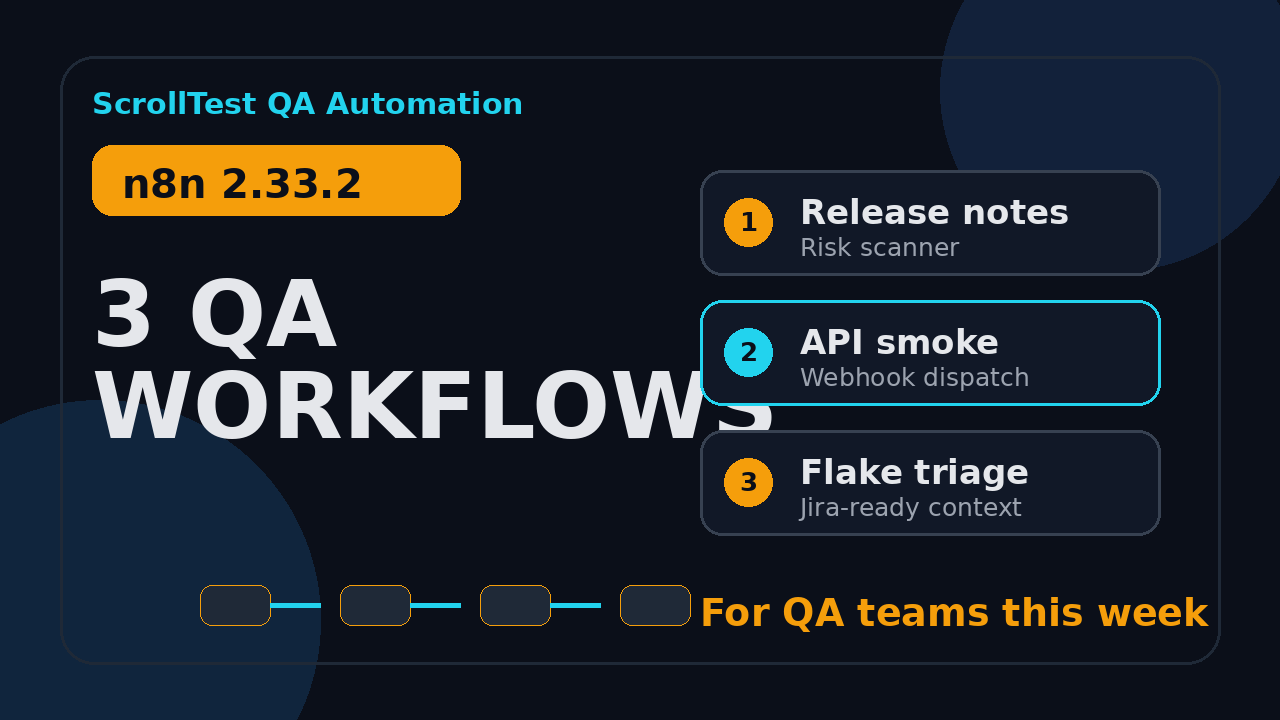
n8n workflows for QA are useful only when they remove boring handoffs from a real release. n8n 2.33.2 shipped on July 30, 2026 with a focused AI Assistant sandbox provider fix, and that small release is a good reminder: QA automation is not only browser scripts, it is also the glue around those scripts.
I see QA teams lose time in the same three places every week: reading tool release notes too late, running API smoke checks manually, and rewriting flaky-test context for Jira. This guide turns those gaps into 3 practical n8n workflows you can build this week without pretending n8n replaces Playwright, Postman, or your CI server.
Table of Contents
- Why n8n workflows for QA make sense now
- Workflow 1: Release-note impact scanner
- Workflow 2: API smoke check dispatcher
- Workflow 3: Flaky-test triage assistant
- TypeScript example: call n8n from Playwright
- CI/CD, security, and ownership rules
- India context for SDETs and QA leads
- 7-day rollout plan
- Key takeaways
- FAQ
Contents
Why n8n workflows for QA make sense now
The data says adoption is real
n8n is not a tiny side project anymore. The public GitHub repository shows 199,243 stars and 59,883 forks at the time of this run, and npm reported 335,472 downloads for the package between July 4 and August 2, 2026. Those numbers come from the GitHub repository API and the npm downloads API, not from a random landing-page counter.
The specific trigger for this article is n8n 2.33.2, published on July 30, 2026. The release note lists one bug fix: preserving AI Assistant sandbox provider selection. That is not a giant feature launch, but it matters for QA because small platform fixes often change how internal automation behaves after an upgrade.
n8n is glue, not your test runner
I do not use n8n to assert that a checkout button works. Playwright is better for that. I use n8n to collect signals, route them, enrich them, and notify the right person with enough context to act. That distinction keeps the architecture clean.
A good QA workflow in n8n usually sits next to the test runner. It watches GitHub releases, accepts webhook events from CI, calls an API endpoint, runs a small function, or creates a ticket. The test logic stays in TypeScript, Java, Python, or Postman collections where code review and version control are easier.
What QA teams should automate first
Start with workflows that are low-risk and high-noise. Do not begin by letting an AI agent approve production deployments. Begin with reminders, summaries, smoke triggers, and triage drafts that a human can verify in under 2 minutes.
- Release-note scanner for Playwright, Selenium, n8n, and API dependencies.
- API smoke dispatcher that hits health endpoints after a deploy.
- Flaky-test triage assistant that groups failures by spec, browser, and error signature.
- Daily QA digest that posts only failed checks, not every passing build.
If you want the broader version of this idea, read the previous ScrollTest article on n8n workflows for QA test data and CI automation. This post is narrower: 3 automations worth building right now.
Workflow 1: Release-note impact scanner
Problem: upgrades reach QA too late
Most QA teams learn about tool changes from broken builds. A developer upgrades a package, CI starts failing, and then someone searches release notes during the incident. That is backwards. QA should know about risky releases before the pull request lands.
The 2.33.2 n8n release is a perfect small example. One bug fix sounds harmless, but the phrase AI Assistant sandbox provider selection points to configuration behavior. If your QA automation depends on AI-assisted workflow generation, sandbox configuration drift is testable risk.
n8n design
Use the Schedule Trigger node to run every morning at 09:30 IST. Add an HTTP Request node for the GitHub releases API, a Code node to extract the latest tag, and a Slack, Teams, Telegram, or email node for the summary.
- Schedule Trigger runs once per day.
- HTTP Request fetches GitHub releases for n8n, Playwright, Selenium, Cypress, or your internal package registry.
- Code node filters releases containing words like bug fix, breaking, auth, sandbox, selector, API, or retry.
- Notification node posts a short risk summary to the QA channel.
- Optional Jira node creates a tracking ticket only for high-risk releases.
Risk scoring that works
I keep the first scoring model simple. Assign 3 points for breaking change, 2 points for auth or security, 2 points for browser or selector, 1 point for retry or timeout, and 1 point for dependency. Anything above 3 deserves a QA review before upgrade.
Do not overfit the model. A 15-line Code node is easier to maintain than a 400-line classifier. If your team already uses PromptFoo or DeepEval for AI gates, connect the release-note summary to your eval queue later. I explain that style of gate in PromptFoo Eval Gate: Stop Bad Prompt Releases.
Expected output
The message should be short enough to read on mobile: package name, version, release date, risk score, 3 bullets, and one recommended action. A QA lead in Bengaluru checking Slack before stand-up does not need a 1,200-word generated essay.
Workflow 2: API smoke check dispatcher
Problem: smoke checks happen after users complain
API smoke tests are usually written but not always triggered at the right time. A release finishes, a deployment webhook fires, and the QA engineer still runs a command manually. That gap is exactly where n8n helps.
The workflow is not a replacement for CI. It is an orchestration layer that says: deployment finished, environment is ready, now run the correct smoke pack and push a readable result to the release channel.
n8n design
Use the Webhook node as the entry point. Your CI server sends environment, build number, commit SHA, and service name. n8n validates the payload, calls the smoke endpoint or test runner, and routes failures.
- Input: deployment webhook from GitHub Actions, Jenkins, GitLab, or Azure DevOps.
- Processing: map service name to the right smoke collection.
- Execution: call a test-runner API, trigger a container job, or hit lightweight health endpoints.
- Output: post pass or fail with build number, failed endpoint, and owner.
What to check
Keep the first smoke pack boring. Check authentication, one read endpoint, one write endpoint in a safe sandbox, one database-backed query, and one downstream dependency. Five checks are enough to catch obvious release damage without becoming a second regression suite.
For API teams, I usually add a strict timeout. If the response time crosses 2 seconds for a simple health endpoint, the workflow marks it as warning. If status is not 2xx, it marks it as failure. If JSON schema changes unexpectedly, it marks it as investigation.
A sample payload
{
  "service": "orders-api",
  "environment": "staging",
  "build": "2026.08.04.17",
  "commit": "9bd6f28",
  "smokePack": "orders-critical"
}
The payload is intentionally small. If n8n needs 20 fields to start a smoke workflow, your interface is already too fragile.
Workflow 3: Flaky-test triage assistant
Problem: flaky failures arrive without context
Flaky tests waste senior engineer time because the failure message is rarely the whole story. You need browser, spec, retry count, trace URL, screenshot URL, commit, recent owner, and whether the same error happened yesterday.
n8n can collect that context and prepare a triage note. A human still decides priority. The automation removes copy-paste work and makes the decision faster.
n8n design
Start the workflow from a CI webhook or a failed test artifact upload. Fetch the Playwright JSON report, group failures by test title and error signature, attach trace links, and create a Jira issue only if the failure repeats across 2 runs or blocks a release branch.
- Group by spec file and test title.
- Normalize stack traces by removing line numbers that change often.
- Attach screenshot and trace links instead of uploading huge files.
- Label failures as product bug, test data issue, selector issue, environment issue, or unknown.
- Post a daily summary with top 5 repeated failures.
Classification rules before AI
Use deterministic rules first. If the error contains strict mode violation, selector issue is likely. If it contains ECONNRESET or 503, environment issue is likely. If an assertion shows expected 200 but received 500, product or API dependency is more likely.
AI can summarize the failure after rules run. I do not let an LLM be the first decision-maker because flaky-test data is noisy. The LLM gets structured inputs and writes a short note, not a final verdict.
Tie it to existing QA knowledge
If your team is already testing AI agents or MCP tools, connect this pattern with the ScrollTest MCP Testing Guide for QA Teams. The same idea applies: collect evidence, test the contract, and report the failure in language a reviewer can act on.
TypeScript example: call n8n from Playwright
Why I prefer a webhook boundary
A webhook boundary keeps test code clean. Playwright should not know how Jira, Slack, Teams, or email are configured. It should send a structured event, then n8n handles routing.
import { test, expect } from "@playwright/test";

const N8N_WEBHOOK = process.env.N8N_WEBHOOK_URL!;

test.afterEach(async ({ request }, testInfo) => {
  if (testInfo.status === testInfo.expectedStatus) return;

  await request.post(N8N_WEBHOOK, {
    data: {
      title: testInfo.title,
      file: testInfo.file,
      project: testInfo.project.name,
      status: testInfo.status,
      retry: testInfo.retry,
      durationMs: testInfo.duration,
      error: testInfo.error?.message?.slice(0, 1000),
      ciBuildUrl: process.env.CI_BUILD_URL,
      commit: process.env.GITHUB_SHA
    },
    timeout: 5000
  });
});

test("checkout smoke creates an order", async ({ page }) => {
  await page.goto("/checkout");
  await page.getByRole("button", { name: "Place order" }).click();
  await expect(page.getByTestId("order-confirmation")).toBeVisible();
});
What the workflow receives
n8n receives one event per failed test. The workflow can enrich the event with links to artifacts, lookup code owners, and decide whether the failure is new or repeated. This is better than sending every raw CI log to a shared channel.
Guardrails
Do not send secrets in the webhook payload. Do not send full customer data. Do not send 10 MB traces directly through the webhook. Send URLs to protected artifacts and keep access controlled in your CI system.
CI/CD, security, and ownership rules
Use credentials like production code
QA automation glue often becomes shadow infrastructure. That is dangerous. Treat n8n credentials like production credentials: owner, rotation date, access scope, and a short incident plan.
n8n supports self-hosting options, and the official Execute Sub-workflow node lets teams split reusable logic into separate workflows. That matters when multiple QA squads need the same notification, risk-scoring, or smoke-dispatch pattern without copying nodes by hand.
Keep CI as the source of truth
n8n should report and orchestrate, but CI should remain the source of truth for pass or fail. If GitHub Actions says a required check failed, do not let an n8n success notification override that. The workflow is a messenger, not a release authority.
Audit every workflow
Every production-facing QA workflow needs a short README: trigger, inputs, outputs, owner, failure mode, and rollback. If a workflow touches release communication, review it like test framework code. One bad notification can make a team ignore real failures for weeks.
India context for SDETs and QA leads
This is career-relevant automation
For Indian QA engineers, n8n is a good bridge skill. Many teams in TCS, Infosys, Wipro, Cognizant, and service-based accounts still separate manual testing, automation, DevOps, and reporting. Product companies expect SDETs to connect those dots.
I see the strongest SDET profiles showing three layers: test automation in Playwright or Selenium, CI/CD ownership, and workflow automation around releases. That combination is more valuable than learning 20 unrelated tools.
Salary signal, not salary promise
A mid-level automation engineer in India can often move faster toward ₹18-30 LPA interviews by showing ownership of release quality, not only page-object code. Senior SDETs targeting ₹30-45 LPA roles need to show system thinking: observability, flaky-test reduction, API contracts, and tool governance.
Do not put n8n on your resume as a buzzword. Put a result: built a release-note scanner for 12 dependencies, reduced manual smoke coordination from 30 minutes to 5 minutes, or grouped 200 flaky failures into 17 actionable signatures.
Interview talking point
A good interview answer sounds like this: I keep tests in Playwright, trigger QA workflows through n8n webhooks, store artifacts in CI, and create Jira tickets only after repeat failure thresholds. That answer shows judgment.
7-day rollout plan
Day-by-day implementation
- Day 1: Pick one service and one QA channel. Do not automate the whole company.
- Day 2: Build the deployment webhook and log every payload for one staging release.
- Day 3: Add 5 API smoke checks with strict 2-second timeout rules.
- Day 4: Add release-note scanning for 3 tools: n8n, Playwright, and Selenium.
- Day 5: Add flaky-test grouping from Playwright JSON reports.
- Day 6: Add owner lookup and Jira draft creation for repeated failures.
- Day 7: Review false positives, remove noisy alerts, and write the workflow README.
Metrics to track
Track 4 numbers: manual minutes saved per release, number of smoke failures caught before testers joined the call, repeated flaky signatures grouped, and noisy notifications removed. If a workflow does not improve one of these numbers, delete it.
When not to use n8n
Skip n8n if the task belongs inside the test runner, needs tight version control, or handles sensitive data your automation platform should never see. A Playwright fixture, a GitHub Action, or a small internal service may be the better answer.
Operating model for a QA automation workflow
Name one accountable owner
Every n8n workflow needs one accountable owner, not a group alias. The owner checks failed executions, reviews credential expiry, and removes noisy branches. If nobody owns the workflow, it becomes a haunted alert machine after 3 releases.
I prefer a simple naming pattern: qa-release-scan, qa-api-smoke-dispatch, qa-flake-triage, and qa-daily-digest. Prefixing with qa helps DevOps teams see that this is release-quality infrastructure, not a random personal automation.
Version workflow changes
n8n workflows can be exported as JSON. For production QA flows, export the JSON after every meaningful change and commit it to a repo. Add a 5-line changelog with date, author, reason, and rollback note. This makes reviews possible when a notification format or webhook contract changes.
Do not review workflow screenshots as the only source of truth. Screenshots help explain intent, but JSON exports and webhook examples help engineers reproduce the workflow when staging breaks at 11 PM.
Test the workflow itself
The workflow is part of your QA system, so test it. Keep 3 sample payloads: passing deployment, failed API smoke, and repeated flaky UI failure. After every edit, run those payloads through the webhook and confirm the exact message that lands in Slack, Teams, Jira, or email.
A useful workflow test has concrete assertions: status PASS appears once, failed endpoint is visible, trace URL is clickable, duplicate Jira ticket is not created, and execution finishes under 10 seconds. These are not fancy checks. They prevent embarrassing release-room noise.
Measure noise like a bug
Noise is a defect. If the workflow posts 40 messages and only 2 lead to action, fix the workflow. Add thresholds, group repeated failures, or send a digest instead of real-time alerts. QA credibility improves when every alert means someone should do something now.
This is where n8n helps more than another dashboard. A dashboard waits for someone to look. A workflow moves the right summary to the right place, but only after you teach it what deserves attention.
My rule is simple: if the workflow cannot explain its last 10 executions, it is not production-ready. Add execution logging, keep sample inputs, and review failures during the weekly QA sync until the team trusts the automation.
Key takeaways for n8n workflows for QA
- Use n8n as QA glue, not as a replacement for Playwright, Postman, or CI.
- Start with 3 workflows: release-note scanning, API smoke dispatching, and flaky-test triage.
- Use the July 30, 2026 n8n 2.33.2 release as a reminder to test small platform changes too.
- Keep human approval for release decisions. Automation should prepare evidence, not fake certainty.
- For SDETs in India, workflow automation is a strong career signal when tied to measurable release-quality outcomes.
The best n8n workflows for QA are boring in the right way. They run on schedule, collect the exact context, and make one QA decision easier before stand-up.
FAQ
Can n8n replace my test automation framework?
No. Keep browser and API assertions in Playwright, Selenium, Postman, REST Assured, or your chosen framework. Use n8n to trigger, enrich, route, and summarize automation events.
Is n8n safe for production QA workflows?
It can be, if you treat credentials, webhooks, and workflow ownership seriously. Use scoped tokens, avoid sending secrets, and keep CI as the final pass-or-fail source.
Which workflow should I build first?
Build the API smoke dispatcher first if your team deploys often. Build the flaky-test triage workflow first if your biggest pain is noisy UI automation failures.
Do I need AI inside these workflows?
Not on day one. Start with deterministic rules. Add an LLM only for summarization after you already have structured test data and clear thresholds.
How does this connect to release-note testing?
Release notes are test inputs. The ScrollTest n8n 2.33.0 workflow article shows why QA teams should watch platform changes before a broken build teaches the lesson for them.