Shift-Left Testing in Practice: The Complete Guide to Quality Engineering in Agile and DevOps Teams
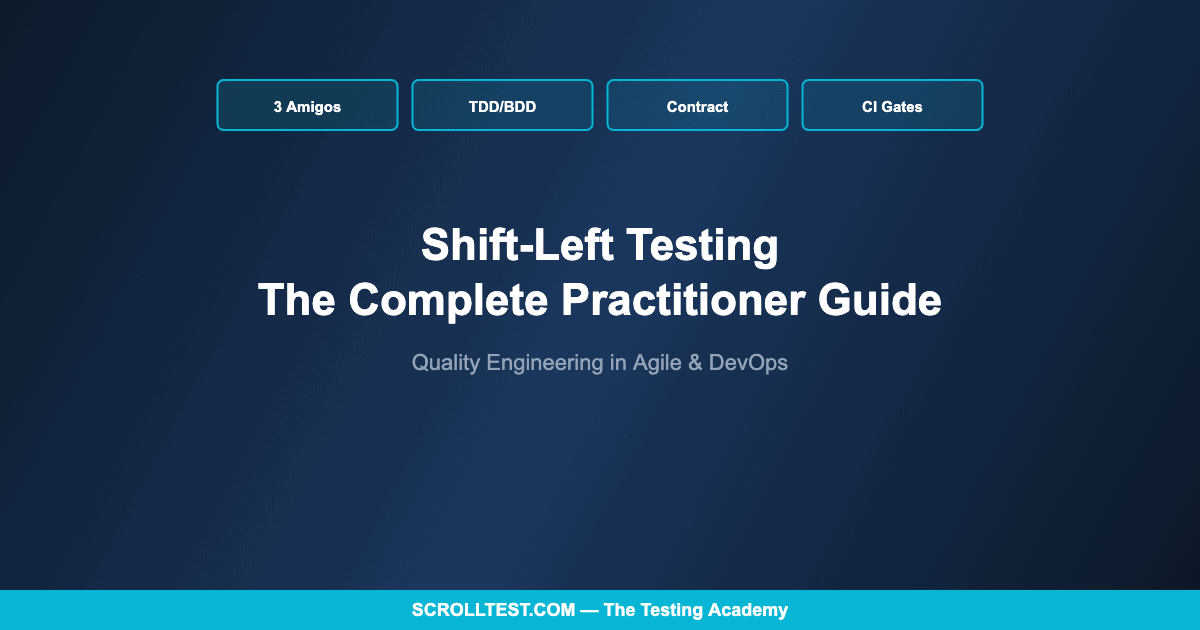
Shift-left testing has become the most invoked and least implemented principle in modern QA. Every team claims to do it. Most teams actually mean “we added some unit tests.” True shift-left testing is a fundamental reorganization of how quality is built into the development lifecycle — from requirements through production monitoring. This guide covers what it actually looks like in practice, with five concrete techniques, measurable metrics, and the organizational changes required to make it stick.
🎭 Want to master this with real projects? Join the Playwright Automation Mastery course at The Testing Academy.
The phrase “shift left” originates from visualizing the software development lifecycle as a timeline running left to right: requirements, design, development, testing, deployment, monitoring. Traditional QA sits at the right side of that timeline — testing happens after development is “done.” Shifting left means moving quality activities earlier in the timeline, catching defects when they are cheapest to fix.
The concept is sound. The problem is that most teams interpret it as “start testing earlier” without changing anything else about how they work. They add a few unit tests to the sprint and call it shift-left. Real shift-left testing requires changes in process, tooling, team structure, and organizational culture that go far beyond writing tests sooner.
Contents
Practice #1: Three Amigos Sessions
The first and most impactful shift-left practice happens before any code is written. Three Amigos is a structured conversation between a developer, a tester, and a product owner (or business analyst) about a user story or feature before development begins. The tester’s role is to ask the questions nobody else asks: “What happens if the user enters nothing? What if the session expires mid-flow? What does this feature look like for a user with accessibility needs?”
These conversations surface ambiguities and edge cases that would otherwise become bugs discovered weeks later in testing — or worse, months later in production. In my experience, a 30-minute Three Amigos session prevents an average of 3-5 defects per story. At an estimated cost of $500-2000 per defect found in testing (considering investigation, reporting, fixing, retesting), the ROI is immediate and substantial.
Practice #2: Test-Driven and Behavior-Driven Development
TDD and BDD are the most technically rigorous forms of shift-left testing. In TDD, developers write a failing test before writing the production code that makes it pass. This inverts the traditional sequence — the test defines the requirement, and the code fulfills it. The result is code that is inherently testable, with high unit test coverage as a side effect rather than a retrofit.
BDD extends this to the team level using shared language. Feature files written in Gherkin syntax (Given-When-Then) serve as both requirements documentation and executable test specifications. When done well, BDD bridges the communication gap between technical and non-technical team members. When done poorly — which is common — it becomes a bureaucratic layer that slows development without improving quality. The key differentiator is whether the business actually reads and validates the feature files, or whether they become developer-maintained test specifications dressed in natural language.
Practice #3: Contract Testing
In microservices architectures, integration bugs are the most expensive and hardest to catch. Service A changes its API response format, and Service B breaks because it expected the old format. Contract testing prevents this by establishing formal agreements between services about their API interfaces. Tools like Pact allow consumers and providers to independently verify that they honor the contract, catching breaking changes before they reach integration testing.
Contract testing is shift-left because it moves integration verification from the integration testing phase (where you need all services running together) to the unit testing phase (where each service can verify independently). This is faster, cheaper, and more reliable than full-stack integration testing.
Practice #4: PR-Level Automated Checks
Every pull request should run a suite of automated checks before it can be merged: unit tests, linting, static analysis, security scanning, and a targeted subset of integration tests. This catches defects at the point of code change, when the developer has maximum context about what they changed and why. Fixing a bug immediately after writing the code takes minutes. Finding the same bug two weeks later in a QA cycle takes hours.
The key word is “targeted.” Running your entire test suite on every PR creates long feedback loops that developers learn to ignore. Select the tests most likely to be affected by typical changes — smoke tests, tests related to recently modified modules, and any tests that have caught regressions in the past month. Save the full regression suite for merge-to-main or nightly runs.
🚀 Level Up Your Playwright
From locators to CI pipelines — build a production-grade Playwright + TypeScript framework step by step.
Practice #5: Definition of Done Includes Tests
This sounds obvious and is rarely enforced. The Definition of Done for a user story should explicitly require: unit tests for new code, updated tests for modified code, and a QA review of the test coverage. If a story is marked “done” without tests, the team has accepted technical debt — and technical debt in test coverage compounds faster than almost any other form.
Enforcement requires tooling and culture. Coverage gates in CI (minimum coverage thresholds for changed files) provide the tooling. Peer review norms that include test review alongside code review provide the culture. Neither alone is sufficient — gates without culture produce gaming (tests that exist to satisfy metrics but do not validate behavior), and culture without gates relies on individual discipline that erodes under deadline pressure.
Shift-Right: The Complement to Shift-Left
Shift-left does not mean ignoring what happens after deployment. Shift-right testing — monitoring, chaos engineering, feature flags, and production observability — complements shift-left by catching issues that only manifest under real-world conditions. A comprehensive quality strategy shifts in both directions: earlier in the lifecycle and deeper into production.
Metrics That Prove Shift-Left Works
Three metrics demonstrate the impact of shift-left practices. Defect escape rate measures the percentage of bugs found in production versus total bugs found. A decreasing escape rate means you are catching more bugs before they reach users. Time-to-detect measures the average time between when a bug is introduced (the commit) and when it is found. Shift-left reduces this from weeks to hours or minutes. Cost-per-bug compares the average cost of fixing bugs found at different lifecycle stages — requirements, development, testing, production. Shift-left moves the distribution toward the cheaper end.
The Honest Caveats
Shift-left requires organizational buy-in that QA teams often lack the authority to mandate. Three Amigos sessions require developer and product owner time. TDD requires developer discipline and training. Contract testing requires cross-team coordination. These are not QA initiatives — they are engineering culture changes that need sponsorship from engineering leadership.
The ROI numbers I cited (3-5 defects prevented per Three Amigos session, $500-2000 per defect) are estimates based on my consulting experience, not rigorous research. They vary by team, application, and organization. Treat them as directional indicators, not precise predictions.
Not every team needs every practice. A two-person startup does not need formal Three Amigos sessions. A monolithic application does not need contract testing. Adopt the practices that address your team’s actual pain points, not the ones that sound most impressive in a conference talk.
Quality as an Engineering Discipline
The deeper insight behind shift-left is that quality is an engineering discipline, not a phase. The best teams I work with do not have a “testing phase” — they have quality practices embedded throughout their development workflow. Testing is not something that happens to code after it is written. It is something that shapes how code is written, reviewed, deployed, and monitored. Shift-left is the mechanism for achieving that integration.
Implementing shift-left practices in your team — from Three Amigos facilitation to CI/CD quality gates to production monitoring — is the focus of Module 7 in my AI-Powered Testing Mastery course, with templates, checklists, and case studies from real team transformations.
🎓 Master Playwright End to End
Join hundreds of SDETs building real automation frameworks. Lifetime access, hands-on projects, and a job-ready portfolio.