Selenium 4.45.0 Upgrade Notes for Test Leads
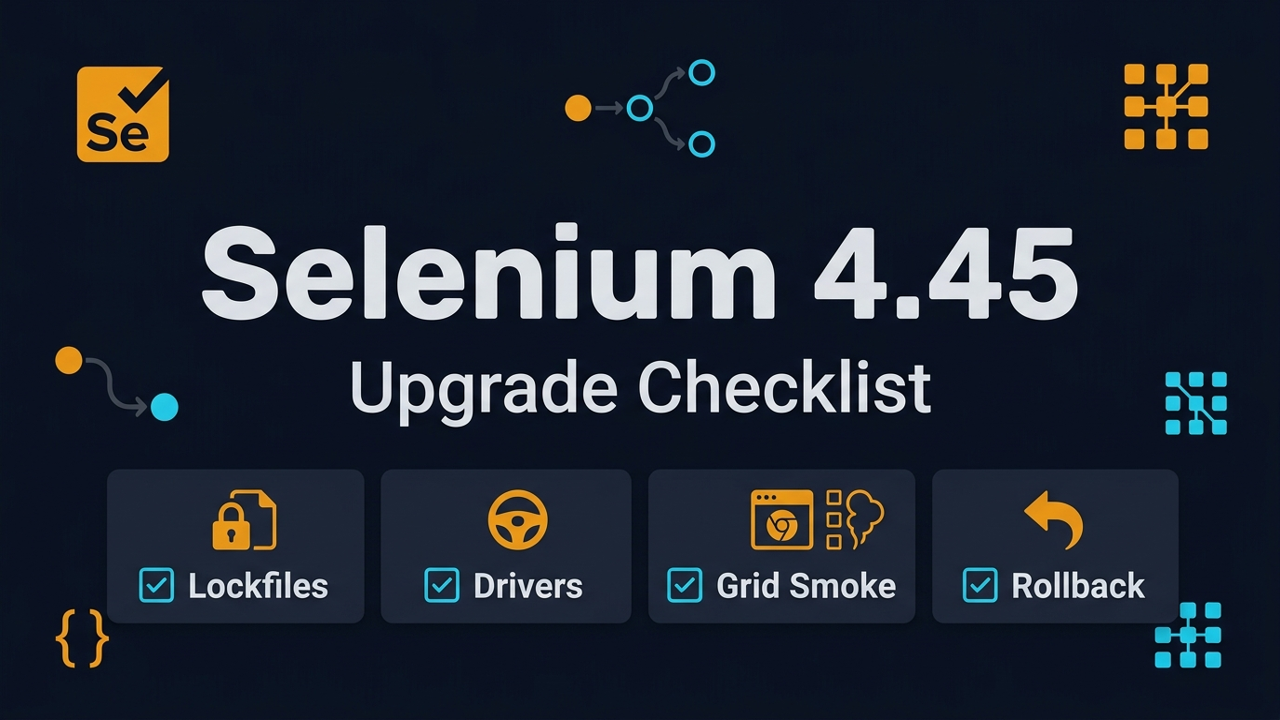
Selenium 4.45.0 upgrade notes matter because this release is not a tiny dependency bump for teams that run Selenium Grid, Java bindings, JavaScript bindings, or Safari smoke tests. I treat it as a controlled test-platform change: lock the dependency, smoke the Grid, prove driver resolution, and keep a rollback branch ready before sprint work gets hit.
Table of Contents
- Why This Release Needs a Test Lead Review
- Selenium 4.45.0 Upgrade Notes: Risk Summary
- Dependency Lockfiles First
- Driver and Browser Compatibility
- Grid Smoke Tests Before Full Regression
- CI Release Gates for Test Leads
- Rollback Plan That Does Not Need a War Room
- India Context for SDET Managers
- Key Takeaways
- FAQ
Contents
Why This Release Needs a Test Lead Review
Start with the release facts, not Slack panic
The official Selenium 4.45.0 GitHub release was published on 16 June 2026. The release notes list 141 change bullets across build work, Java, JavaScript, .NET, Ruby, Python, Rust, Grid, and BiDi. That number alone does not mean the release is risky. It means a test lead should not approve it from a green unit-test badge alone.
The Selenium GitHub repository also remains a large and active project. The GitHub API showed 34,281 stars and 8,706 forks when I checked it for this article. The JavaScript package selenium-webdriver showed 7,904,989 npm downloads in the last month through the npm downloads API. This is not an abandoned library. It is a high-traffic automation dependency where small compatibility issues can affect many pipelines quickly.
Separate project risk from product risk
I do not read a Selenium release note as a list of features to celebrate. I read it as a list of assumptions that may have changed under my test framework. The product team cares about checkout, login, invoice creation, search, refunds, and critical user journeys. The test platform team cares about sessions, drivers, timeouts, proxying, screenshots, network events, and reporting.
Your job as a test lead is to connect those two worlds. If Selenium 4.45.0 changes Grid behavior, the product team may only see “tests are flaky again.” If driver discovery changes, developers may only see “CI is red.” If Java deprecated classes are removed, framework maintainers may see compilation failures after a harmless-looking dependency PR. The upgrade review prevents that translation problem.
Check whether you are already behind
One important note: package indexes may already show newer versions by the time you run this review. During research, PyPI and npm both showed 4.46.0 as latest for Selenium packages. That does not make Selenium 4.45.0 irrelevant. Many enterprise teams upgrade in controlled steps because their browser matrix, Grid topology, and compliance sign-off move slower than open-source releases.
If your current baseline is 4.43 or 4.44, a 4.45.0 review is still useful. Treat it as a checkpoint. If you decide to jump directly to a newer patch, reuse the same checklist and swap the source release note.
Selenium 4.45.0 Upgrade Notes: Risk Summary
The items I would flag first
The release notes contain many build-system changes, but test leads should focus on runtime behavior. I would start with four areas from Selenium 4.45.0: Grid WebSocket proxy fixes, Redis-backed SessionMap bundling, Java removal of deprecated logging classes, and language-binding atom migrations to TypeScript for element visibility and attribute behavior.
- Grid: The release includes fixes around WebSocket proxy race handling, TCP backpressure, frame handling, and Redis-backed SessionMap bundling.
- Java: Deprecated logging classes were removed, so older framework utilities may fail at compile time.
- JavaScript: The find-elements atom and related atoms moved toward TypeScript implementations, which deserves selector and visibility smoke coverage.
- Python: The release notes mention handling Data URLs in
continue_request()and Safari test marking around SafariDriver 26.5. - BiDi: Multiple .NET BiDi changes landed, including download ID events and immutable user-facing collections.
What not to overreact to
Do not panic because the release has 141 bullets. Many are build, dependency, and repository maintenance items. I counted 44 build-labeled bullets, 21 .NET-labeled bullets, 16 Ruby-labeled bullets, 10 JS-labeled bullets, 10 BiDi-labeled bullets, and 8 Grid-labeled bullets in the GitHub release text. The useful question is not “how many bullets exist?” The useful question is “which bullets touch the parts of Selenium we run in CI?”
If your stack is Java + Selenium Grid + Chrome, Java and Grid deserve priority. If you run Node.js test helpers with selenium-webdriver, JavaScript atom changes deserve a small selector and visibility pack. If you do not run Safari, SafariDriver notes should not block your upgrade.
The upgrade decision I recommend
My default decision is: approve a small proof branch, not a direct main-branch bump. Create a branch that changes only Selenium-related dependencies and lockfiles. Run a short cross-browser smoke pack. Run Grid health checks. Then run a reduced regression suite with failed-test evidence. Only after that should the dependency bump enter the normal sprint branch.
This is also how I would run a Playwright upgrade. If you want a parallel checklist for browser automation upgrades, see the ScrollTest guide on Playwright upgrade radar for QA teams. The tool differs, but the release-risk thinking is the same.
Dependency Lockfiles First
Do not upgrade from a floating dependency
The first review artifact is the lockfile diff. I do not approve Selenium upgrades from a screenshot of a passing local run. I want to see pom.xml, build.gradle, package-lock.json, pnpm-lock.yaml, requirements.txt, poetry.lock, or Gemfile.lock depending on the stack.
For Java teams, the version should be explicit. For Node teams, the selenium-webdriver dependency should be pinned by the lockfile. For Python teams, the package index currently lists Python >=3.10 for Selenium, so do not let an old CI image silently become the real blocker.
A practical dependency review checklist
Use this numbered review before you run the full suite:
- Confirm the old Selenium version from the lockfile, not from memory.
- Change only Selenium-related packages in the first PR.
- Commit the lockfile diff with the dependency file in the same commit.
- Record the Java, Node, Python, Ruby, or .NET runtime version used in CI.
- Run dependency audit commands before the browser suite starts.
- Paste the official release URL in the PR description.
- Add a rollback commit or branch name before requesting review.
Commands I want in the PR description
Here is a simple TypeScript-flavored preflight that prints the installed Selenium package and runtime. It is intentionally boring because boring checks catch expensive mistakes.
node -v
npm ls selenium-webdriver
npx tsc --noEmit
For Java teams, I want the Maven or Gradle dependency tree. This catches transitive movement that the test lead may miss in a UI diff.
./mvnw -q dependency:tree -Dincludes=org.seleniumhq.selenium
./gradlew dependencies --configuration testRuntimeClasspath | grep selenium
If the output shows more than one Selenium family version, stop. Mixed binding versions are not a test strategy. They are a future incident report.
Driver and Browser Compatibility
Selenium Manager is useful, but still needs proof
The official Selenium Manager documentation describes Selenium Manager as the built-in tool Selenium uses to help manage browser drivers and browsers. That reduces manual driver setup, but it does not remove the need for CI proof. Corporate proxies, locked-down runners, custom Chrome channels, and old base images still create surprises.
My rule is simple: every upgrade PR must show browser and driver versions from the same environment that runs tests. A laptop screenshot does not count. A GitHub Actions, Jenkins, GitLab, Azure DevOps, or Buildkite log does count.
Use a tiny WebDriver smoke test
This TypeScript smoke test is small enough to run before the main regression suite. It proves session creation, navigation, title read, screenshot capture, and clean quit.
import { Builder, Browser, By, until } from "selenium-webdriver";
import * as fs from "node:fs/promises";

async function smoke() {
  const driver = await new Builder().forBrowser(Browser.CHROME).build();
  try {
    await driver.get("https://www.selenium.dev/selenium/web/web-form.html");
    await driver.wait(until.elementLocated(By.name("my-text")), 10_000);
    await driver.findElement(By.name("my-text")).sendKeys("selenium-4.45.0");
    const title = await driver.getTitle();
    if (!title.toLowerCase().includes("web form")) {
      throw new Error(`Unexpected title: ${title}`);
    }
    const png = await driver.takeScreenshot();
    await fs.writeFile("artifacts/selenium-445-smoke.png", png, "base64");
  } finally {
    await driver.quit();
  }
}

smoke().catch((error) => {
  console.error(error);
  process.exit(1);
});
Do not skip Safari and Firefox decisions
Selenium 4.45.0 includes Safari-related test notes and Firefox-relevant automation areas through browser-driver behavior. If your product officially supports Safari, keep a Safari smoke test in scope. If Safari is not supported, write that in the PR. Silence creates confusion later when a stakeholder asks why only Chrome passed.
This is where test leads need to be strict. Browser coverage is a product decision. Selenium is only the execution layer.
Grid Smoke Tests Before Full Regression
Why Grid deserves its own section
The official Selenium Grid documentation positions Grid as the way to run WebDriver sessions across machines and browsers. In Selenium 4.45.0, Grid gets several release-note bullets around WebSocket proxy handling, TCP backpressure, frame handling, and Redis-backed SessionMap bundling. That is enough for me to require a Grid-specific smoke pack before burning hours on full regression.
Grid failures are expensive because they masquerade as application failures. A checkout test fails because a browser session disappeared. A file upload test fails because the node dropped. A parallel run slows down because the router is under pressure. The product code did not change, but the sprint board still fills with red builds.
A minimal Grid smoke pack
I use a 10-test Grid pack before full regression. It should finish fast and produce artifacts. The goal is not coverage. The goal is platform confidence.
- 1 Chrome session on the default node.
- 1 Firefox session if Firefox is supported.
- 1 Safari session if Safari is supported.
- 2 parallel Chrome sessions to check scheduling.
- 1 screenshot capture check.
- 1 file download or upload check if your app depends on it.
- 1 WebSocket-heavy page if your product uses live updates.
- 1 retry-disabled test to expose raw infrastructure failures.
- 1 Grid status endpoint check.
- 1 artifact upload check from the CI runner.
Capture Grid status before and after
Do not only store the JUnit XML. Capture Grid status too. The exact endpoint depends on your setup, but many teams use a status call before the suite starts.
curl -s http://localhost:4444/status | jq .
If you run Grid in Docker Compose, save the container image tags and container logs. If the Grid is managed by another platform team, ask for the node image version and browser version in the change ticket. A Selenium upgrade without runtime evidence is only half an upgrade.
For a related release-note review style, see Selenium release notes: QA risk review playbook. That article pairs well with this one when you need a reusable team ritual.
CI Release Gates for Test Leads
Gate the upgrade with evidence, not opinions
I like three CI gates for Selenium upgrades. Gate 1 is dependency integrity. Gate 2 is browser platform smoke. Gate 3 is reduced product regression. Each gate should produce a log, a report, or a screenshot that a reviewer can inspect without rerunning the suite locally.
Here is the shape I prefer:
name: selenium-upgrade-check
on: [pull_request]

jobs:
  selenium-445-smoke:
    runs-on: ubuntu-latest
    steps:
      - uses: actions/checkout@v4
      - uses: actions/setup-node@v4
        with:
          node-version: 22
          cache: npm
      - run: npm ci
      - run: npm ls selenium-webdriver
      - run: npm run test:selenium-smoke
      - uses: actions/upload-artifact@v4
        if: always()
        with:
          name: selenium-445-artifacts
          path: artifacts/
Make retries visible
Retries hide infrastructure pain. They are useful in a production suite, but I disable or isolate them in the upgrade smoke stage. If the Selenium 4.45.0 branch only passes because every failed session gets retried twice, the test lead needs to know before merging.
Use a clear label in CI: SELENIUM_UPGRADE_SMOKE=true. That lets your framework write stricter logs, disable noisy retries, or capture extra driver details only during upgrade review.
Compare against the previous baseline
Run the same smoke pack on the old Selenium version and the new version. You do not need a massive benchmark. You need a practical comparison: pass count, failure type, median smoke duration, browser versions, and artifact availability. If the old branch passes 10 of 10 and the new branch passes 8 of 10, do not debate. Fix or postpone.
If you are building stronger release gates across automation tools, the ScrollTest post on AI test evidence for browser agents has a useful evidence-first mindset. Even when the test runner is not AI-based, the approval pattern is similar: collect proof, store it, review it.
Rollback Plan That Does Not Need a War Room
Rollback is a requirement, not pessimism
A rollback plan is not a sign that the team lacks confidence. It is how a serious team protects sprint throughput. Selenium upgrades can fail in ways that show up only after parallel load, a specific browser channel, or a late-night CI image refresh. If rollback takes 2 hours, the upgrade is not ready.
Before merging, answer these questions:
- What exact commit restores the previous Selenium version?
- Which lockfiles must revert together?
- Does the Grid image tag also need rollback?
- Who owns the rollback approval if the test platform fails after office hours?
- Which dashboard shows upgrade-related failures?
Use a reversible branch strategy
I prefer a dedicated upgrade branch named something like chore/selenium-4-45-0-upgrade. Keep product test edits out of it unless they are directly caused by Selenium behavior. If the branch changes 50 selectors, 12 waits, 3 page objects, and the dependency version, nobody can tell whether Selenium improved or the framework got rewritten.
Good upgrade PRs are narrow. They should feel almost boring to review. Dependency diff. Smoke evidence. Grid evidence. Known risks. Rollback note. Merge.
Document accepted risk
Sometimes you accept a minor known issue because the release fixes a bigger problem. That is fine. Write it down. Example: “Safari smoke is postponed because the product does not support Safari in July. Chrome and Firefox smoke passed on CI run 1842. Rollback branch is rollback/selenium-444.”
That note protects the test lead later. It also helps new SDETs understand that upgrade decisions are engineering decisions, not random dependency chores.
India Context for SDET Managers
Why this matters in Indian QA teams
In India, many QA teams sit between service-company delivery pressure and product-company release expectations. A test lead in a TCS, Infosys, Wipro, Cognizant, or Accenture-style delivery setup may not control the browser infrastructure. A product-company SDET lead may own the full CI pipeline. The Selenium upgrade checklist changes slightly, but the evidence expectation should not.
If you are hiring SDETs in Bengaluru, Pune, Hyderabad, Chennai, or NCR, I would rather see one candidate explain lockfiles, Grid smoke tests, and rollback plans than recite every WebDriver locator. Senior SDET compensation in strong product teams can move into the ₹25-40 LPA range, but that jump is usually tied to ownership. Upgrade ownership is a practical way to show it.
Give manual testers a concrete path
For manual testers moving into automation, Selenium upgrades are a good learning project. They touch dependency management, CI, browser drivers, logs, and test evidence. That is more valuable than writing another login test from a tutorial.
Here is a 5-day learning plan for a junior QA engineer:
- Day 1: Read the Selenium 4.45.0 release note and highlight runtime changes.
- Day 2: Run a local smoke test on Chrome and Firefox.
- Day 3: Run the same test through Grid.
- Day 4: Add CI artifact upload for screenshots and logs.
- Day 5: Write a rollback note and present the upgrade decision.
This is how a tester moves from “I know Selenium” to “I can protect a release pipeline.”
Key Takeaways
My Selenium 4.45.0 upgrade notes for leads
Use Selenium 4.45.0 upgrade notes as a release-readiness exercise, not a dependency chore. The official release has 141 change bullets, but your review should focus on the areas your team actually runs: language bindings, driver discovery, Grid, BiDi, and browser coverage.
- Start with the official GitHub release note and lockfile diff.
- Run a 10-test Grid smoke pack before full regression.
- Print browser, driver, runtime, and Selenium versions from CI.
- Disable or isolate retries during the upgrade smoke stage.
- Keep rollback boring: one branch, one commit path, one owner.
If I had to summarize the whole review in one sentence: do not ask “does Selenium 4.45.0 work?” Ask “can our team prove Selenium 4.45.0 works for our browser matrix without derailing sprint work?”
FAQ
Should every team upgrade to Selenium 4.45.0 immediately?
No. Check your current version, browser matrix, Grid usage, and release calendar first. If your current suite is stable and a newer Selenium patch is already approved internally, use this checklist for that target version instead.
What is the biggest Selenium 4.45.0 risk for test leads?
For teams using Selenium Grid, I would review Grid behavior first because the release notes include several Grid-related WebSocket and TCP handling changes. For framework-heavy Java teams, I would also check the removal of deprecated logging classes.
How many tests should run before approving the upgrade?
I start with 10 platform smoke tests and then run a reduced regression suite for critical user journeys. The exact number depends on your product, but the smoke pack should prove session creation, navigation, screenshots, parallelism, and Grid status.
Do I need to test Selenium Manager separately?
Yes, if your CI depends on Selenium Manager for driver or browser resolution. The official Selenium Manager docs explain the capability, but your CI environment still needs proof because proxies, images, and permissions vary.
What should I put in the upgrade PR?
Include the official release link, old and new dependency versions, lockfile diff, CI smoke run, Grid status evidence, known risks, and rollback branch. If those items are missing, the PR is not ready for a test lead review.
Read next: If you want a broader release-review ritual, start with Selenium 4.45 regression briefing for QA teams and then adapt this checklist to your own CI pipeline.