n8n Workflow Testing: A Hands-On QA Mini-Project
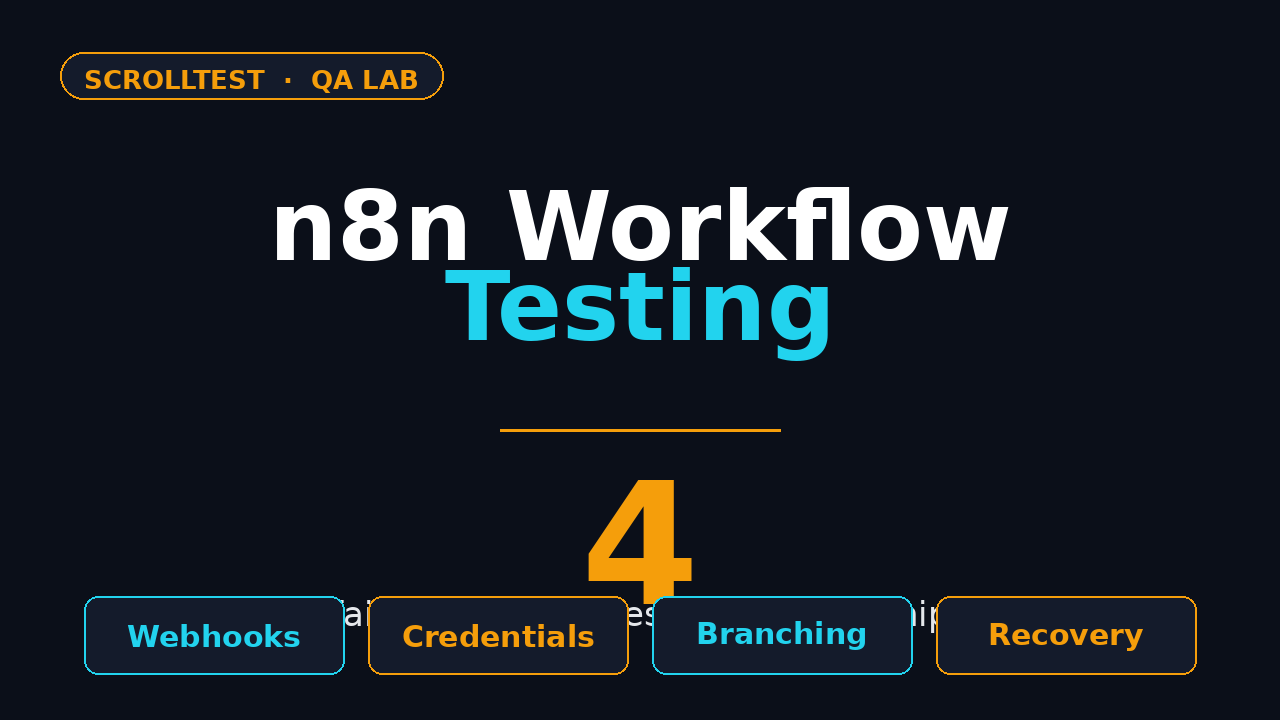
I keep meeting QA engineers who treat n8n like a black box. They build a workflow, click Execute once, watch the green ticks appear, and call it shipped. That is not n8n workflow testing, that is hope. In this lab I walk you through testing the four places n8n workflows actually break in production: webhook triggers, credentials, branching logic, and failure recovery. You can finish the whole thing in an afternoon with a free self-hosted instance.
Table of Contents
- Why n8n Workflow Testing Matters Now
- Set Up Your Test Environment
- Test Webhook Triggers First
- Validate Credentials Before You Automate
- Cover Branching Logic With Pinned Data
- Prove Failure Recovery Works
- Automate the Regression With CLI and CI
- India Context: Why This Skill Pays Off
- Key Takeaways
- Frequently Asked Questions About n8n Workflow Testing
Contents
Why n8n Workflow Testing Matters Now
n8n stopped being a niche tool a while ago. The repo on GitHub sits at 200,410 stars and 60,102 forks as I write this, and the n8n npm package pulled 393,738 downloads in the last month. The companion AI package, @n8n/n8n-nodes-langchain, added another 246,848 downloads in the same window. A workflow automation platform that big is not a hobby project anymore; it is infrastructure.
The part most QA teams miss is that a workflow is just code with a drag-and-drop interface. Every node has inputs, outputs, and failure modes. When a workflow silently drops a webhook, ships a record with a stale credential, or takes the wrong branch on an IF node, a real business process breaks. It might be a lead not routed to sales, an order not synced to the database, or an AI agent pipeline that returns garbage. You would never ship an API without tests. You should not ship an n8n workflow without them either.
I have written about this before on ScrollTest, so if you want the background first, start with what breaks when n8n ships a release and the version checks every QA team should run. This lab is the hands-on companion: the actual tests, not the theory.
Here is the other shift I see: low-code and no-code platforms are pulling QA in earlier. The tester who can validate a workflow, not just a web page, owns a bigger slice of the delivery pipeline. That is exactly the gap this lab closes.
Set Up Your Test Environment
You do not need the n8n Cloud paid tier to do this. A self-hosted instance in Docker is enough for everything in this lab, and it keeps your test data out of a shared workspace.
Spin Up n8n With Docker
The fastest path is a single container with a local SQLite database. This command gives you an instance on http://localhost:5678:
docker run -it --rm \
  --name n8n-test \
  -p 5678:5678 \
  -v n8n_test_data:/home/node/.n8n \
  -e GENERIC_TIMEZONE="Asia/Kolkata" \
  docker.n8n.io/n8nio/n8n
Use the named volume n8n_test_data so your workflows and credentials survive a container restart while you work. When you want a clean slate for the next run, delete the volume with docker volume rm n8n_test_data.
Install the n8n CLI and Get an API Key
n8n ships a beta CLI called @n8n/cli that talks to a running instance through the public API. It is the backbone of any automated regression for your workflows, and it is documented here. Install it and point it at your instance:
npm install -g @n8n/cli

n8n-cli config set-url http://localhost:5678
n8n-cli config set-api-key n8n_api_xxxxxxxxxxxx
n8n-cli config show
Grab your API key from Settings > n8n API in the UI. The CLI stores its config in ~/.n8n-cli/config.json with 0600 permissions, so your key is not sitting in plain text in a repo. Every command below uses the same client, which means every check you write here can run in CI later.
Test Webhook Triggers First
Webhooks are where n8n workflows meet the outside world, and they are where most silent failures start. The good news is n8n gives you a test path that makes this easy if you use it on purpose.
Test URL vs Production URL
Every Webhook node in n8n generates two URLs: a Test URL and a Production URL, as the n8n webhook docs explain. The test URL is for development. You click Listen for test event, and n8n registers the webhook so incoming data shows up in the editor UI. That test webhook stays live for 120 seconds, which is long enough to fire a request and inspect the payload. The production URL is what you wire into an external service, and data through it does not render in the editor, so you cannot debug it by watching the canvas.
The testing rule I follow is simple: never validate a webhook trigger on the production URL. Always drive the test URL with a real request, check the payload shape, and only then switch the node to the production URL and publish.
Assert the Payload Before You Wire Anything Else
Here is the first real test in this lab. Stand up a workflow with a single Webhook node configured for POST, click Listen for test event, and fire a request at the test URL with curl:
curl -X POST "http://localhost:5678/webhook-test/your-test-path" \
  -H "Content-Type: application/json" \
  -d '{"event":"lead_created","email":"dev@example.com","plan":"pro"}'
Watch the editor: the node should light up and show the three fields (event, email, plan) in its output panel. If the output is empty, the webhook path or method is wrong. If only some fields arrive, the upstream sender is not sending what you think it is. That mismatch is exactly the bug you want to catch before production, not after.
A second check: send a payload with a missing field and confirm your workflow either handles it or fails loudly. A webhook that silently accepts a malformed payload is a data-integrity incident waiting to happen.
Validate Credentials Before You Automate
The second place n8n workflows break is credentials. A workflow that worked yesterday fails today because a token expired, a password rotated, or a scope changed. n8n stores credentials encrypted, but encryption does not tell you the credential still works.
Test Every Credential Before First Run
Before you run a workflow for the first time, open every credential it uses and trigger the built-in connection test. Most service nodes expose a test or re-check option that pings the provider and reports whether the credential is valid. Do this for every credential in the workflow, not just the one you changed. A Gmail OAuth token and a Postgres connection can both look fine in the UI while one of them is actually expired.
Make this a checklist item, not a habit you trust yourself to remember. I have watched a single expired API key take down a lead-routing workflow for three days because nobody re-tested the credential after the monthly rotation.
Rotate Credentials and Re-Test
The real test here is a rotation drill. Rotate a token on the provider side, update the credential in n8n, and re-run the workflow. If the workflow still succeeds, you know the credential reference and the test path are correct. If it fails, you caught the mismatch in a controlled environment instead of at 2 AM on a customer call.
You can also script credential checks through the CLI. List your credentials and inspect their types to confirm nothing is missing or mislabeled:
n8n-cli credential list --format=json | jq '.[] | {id, name, type}'Cover Branching Logic With Pinned Data
Branching is where n8n workflows quietly go wrong. An IF node or a Switch node with three branches needs every branch exercised, but most people only test the happy path because the unhappy paths are annoying to trigger.
Pin Data to Freeze Your Inputs
n8n has a feature built exactly for this: you can pin data to a node. Pinning freezes the node’s output so you can test downstream nodes without re-running everything upstream. Right-click a node, choose Pin data, and paste a fixed JSON sample. Now the branching logic below it runs against a known input every time.
Pinning is also how n8n helps you debug past failures. Open the Executions tab, pick a failed execution, and choose Debug in editor. n8n copies that execution’s data into your current workflow and pins it to the first node, as described in the debugging executions docs. You can then fix the broken node and re-run with the exact data that failed, which is far faster than reproducing a flaky upstream service.
Build a Truth Table for Every Branch
For any node with branching, write a truth table before you test. If your Switch routes on a plan field with values free, pro, and enterprise, you need four test cases: one per branch, plus one for the fallback (unknown or missing value). Pin each input in turn and confirm the execution lands on the right path.
Here is the checklist I use:
- Every explicit branch fires with its matching input.
- The fallback branch fires with an unknown or missing value.
- An empty input does not silently pass through as the first branch.
- No branch writes partial data when it should short-circuit.
The last one catches a nasty class of bug: a workflow that starts writing to the database, hits an error mid-branch, and leaves a half-written record because nobody tested the failure path. If you want to see how I apply this kind of thinking to QA automation more broadly, I covered the fundamentals in three n8n automations every QA team should try.
Prove Failure Recovery Works
Workflows fail. The question is whether they fail safely. n8n gives you two recovery mechanisms, and both deserve a test, not just a hope.
Retrying Failed Executions
Not every failure needs a full error workflow. For a transient failure, n8n lets you retry the same execution with the same input data. Open a failed execution and you get two options: Retry with currently saved workflow (after you fix something) or Retry with original workflow (to re-run it unchanged). Both reuse the previous execution’s data, so you are not re-triggering a flaky upstream service by hand.
You can script the same retry through the CLI, which matters when a nightly run fails and you want the pipeline to retry once before alerting a human:
n8n-cli execution retry --id=EXECUTION_IDThe thing to test here is that a retry actually recovers. Point the workflow at an endpoint that returns 500 the first time and 200 on the second call, and confirm the retried execution succeeds and does not duplicate side effects. A workflow that retries an order-sync call twice and creates two orders is worse than one that fails cleanly.
Error Trigger Workflows
The second mechanism is a dedicated error workflow. You create a separate workflow that starts with the Error Trigger node, then point your main workflow at it from Workflow Settings > Error workflow. When the main workflow errors, the error workflow runs and can send a Slack or email alert, write to a log, or trigger a fallback. The full setup is in the error handling docs.
To test this properly, make the main workflow fail on purpose. n8n has a Stop And Error node built exactly for that: drop it into a branch, and the execution fails under conditions you choose, which fires the error workflow. If the alert never arrives, your recovery path is broken, and you want to learn that now, not during an incident.
My rule is blunt: an untested error workflow does not count as error handling. It counts as a comment that says “we will fix this later.”
Automate the Regression With CLI and CI
Manual checks are fine for the first pass, but the point of a lab is to build something you can run again. The n8n CLI turns your checks into a script, and CI turns the script into a gate.
n8n-cli Execution Checks
After you run a workflow, query its executions and fail the run if anything errored. The CLI makes this a one-liner:
n8n-cli execution list --status=error --limit=10 --format=jsonWire that into your CI job right after a test trigger. If the list is non-empty, the pipeline fails. You can also version your workflows as code by exporting them, which is how you make “the workflow changed” a reviewable diff instead of a mystery:
n8n-cli package export --workflow-id=YOUR_WORKFLOW_ID --output=workflow.n8npThe package command is in preview, so pin your expectations accordingly, but the export/import pattern is the same one you would use for infrastructure-as-code. Store the exported package in the repo next to your tests. I wrote a full walkthrough of the CI-gate pattern for LLM evaluation that uses the same structure over at PromptFoo and DeepEval in a CI gate.
A Playwright Smoke Test for the Editor UI
Beyond the API, the n8n editor itself is a web app, and a UI regression is a real risk when n8n ships an update. A quick Playwright smoke test can open the editor, confirm the workflow canvas renders, and click through a node’s settings panel. Here is a minimal TypeScript example:
import { test, expect } from '@playwright/test';

test('workflow canvas renders', async ({ page }) => {
  await page.goto('http://localhost:5678/workflow/1');
  await expect(page.locator('.workflow-canvas')).toBeVisible();
  await expect(page.locator('.node')).toHaveCount(3);
});
If you want to go further, this is exactly the kind of browser check my team runs through BrowsingBee, the AI browser testing tool I am building. An AI agent drives the same editor UI, and if a selector changes or the canvas fails to render after an upgrade, it catches the regression and screenshots it for you. For a workflow platform you depend on, a browser-level smoke test on every upgrade is cheap insurance.
The complete loop is: trigger the workflow through the test webhook, assert the payload, check execution list for errors, and run the Playwright smoke test. Put those four steps in a CI job and you have a regression gate for your automation layer.
India Context: Why This Skill Pays Off
I see the demand for this skill first-hand in the Bengaluru market. Companies that run operations on n8n, Zapier, or Make are starting to ask SDETs to own the testing for those automations, and the job postings that mention workflow automation testing sit a clear tier above generic manual QA.
In India, an automation-focused SDET with Playwright and API skills lands in the ₹18–30 LPA band at product companies, and adding AI-agent and workflow testing to that stack is what pushes candidates toward the upper end. A tester who can only click through a web app is competing with thousands. A tester who can validate a webhook, a credential rotation, and a failure-recovery path is competing with very few.
The pattern mirrors what I teach at The Testing Academy: stop testing only the UI, and start testing the systems that move data. n8n is a clean on-ramp because it is visual, free to self-host, and documented well enough that you can teach yourself this entire lab over a weekend.
Key Takeaways
If you take one thing from this n8n workflow testing lab, take the checklist below. Run all six before you call any workflow production-ready:
- n8n is production infrastructure: 200,410 GitHub stars and 393,738 monthly npm downloads mean your team is likely already running it.
- Test webhook triggers on the Test URL with Listen for test event (a 120-second window) before touching the production URL.
- Re-test every credential after any rotation, and script a
credential listcheck into your regression. - Use pin data and a truth table to force every branch, including the fallback and empty-input cases.
- Prove recovery works: retry a failed execution and fire a real Error Trigger workflow with a forced Stop And Error failure.
- Automate it all with
n8n-cli execution list --status=error, a workflow export, and a Playwright smoke test in CI.
Frequently Asked Questions About n8n Workflow Testing
Do I need an n8n Cloud account to test workflows?
No. You can run the entire lab on a free self-hosted Docker instance with a local SQLite database. The only paid features this lab does not need are things like version history and log streaming that are nice to have but not required for testing webhooks, credentials, branching, and recovery.
How is n8n workflow testing different from API testing?
API testing verifies a single endpoint’s contract. n8n workflow testing verifies the whole data flow: the trigger, the credentials, the branching, and the failure recovery, all in one execution. You are asserting that the orchestration produces the right outcome, not just that one node returns 200.
Can I run n8n tests in a CI pipeline?
Yes. Spin up n8n in a Docker container inside the CI job, import your workflow package, trigger it through the test webhook, and fail the pipeline if n8n-cli execution list --status=error returns anything. Add a Playwright smoke test for the editor UI if you want browser-level coverage.
What is the difference between retrying an execution and an error workflow?
Retrying an execution re-runs the same workflow with the same input data, which suits transient failures like a brief rate-limit. An error workflow is a separate workflow that runs after the main workflow fails and handles the aftermath, like alerting a human or writing a fallback record. A retry fixes a flaky run; an error workflow handles the outcome of a real failure.
Is this skill worth learning in 2026?
In my experience, yes. Workflow automation platforms are becoming a standard part of the SDET toolkit as companies move QA earlier into low-code delivery. The ability to test n8n workflows alongside APIs and UIs differentiates you in the Indian hiring market, where workflow automation testing is showing up more often in senior SDET roles.