n8n Workflow Version Checks for QA Teams
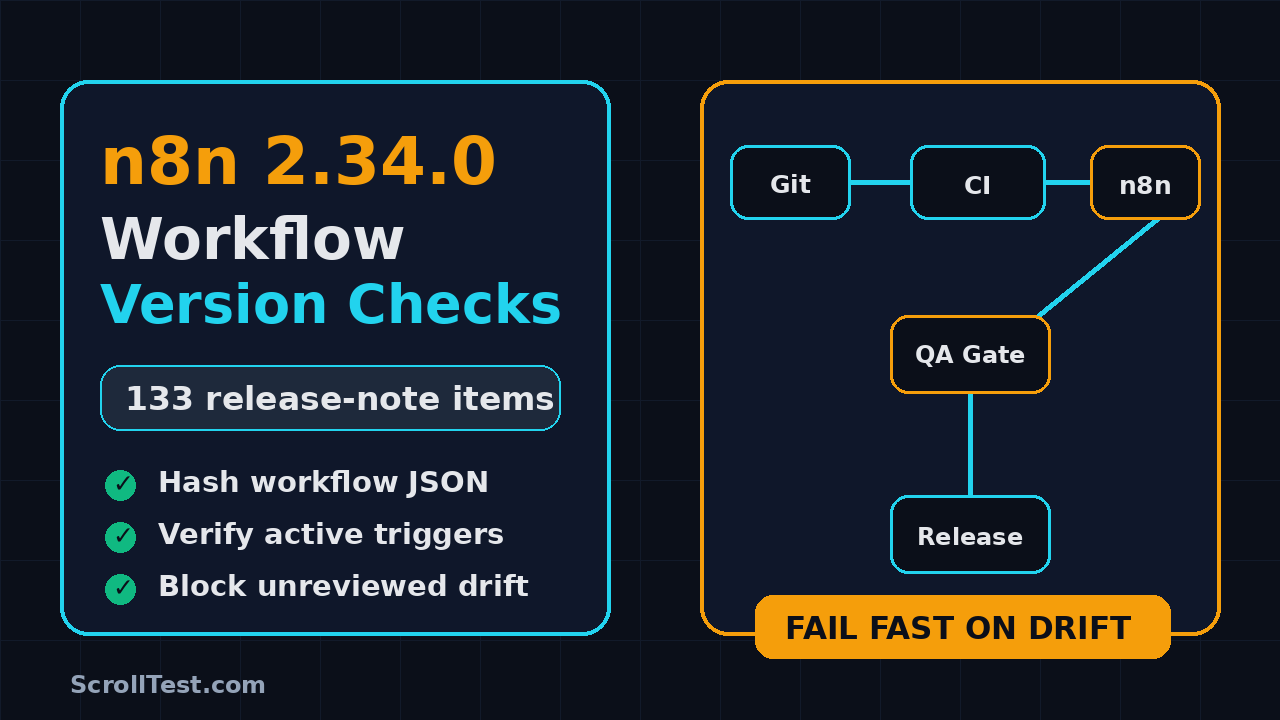
n8n workflow version checks are no longer a nice governance add-on. After the n8n 2.34.0 release shipped 133 listed changes on 4 August 2026, QA teams need a simple rule: if a workflow can change production behaviour, it deserves the same release discipline as application code.
Table of Contents
- Why n8n 2.34.0 Matters for QA
- What n8n Workflow Version Checks Mean
- 7 Risks QA Should Test Before Upgrading
- A TypeScript Release Gate for n8n Workflow Version Checks
- How to Put the Check in CI/CD
- The Human Review Process I Use
- India QA Hiring Context
- Key Takeaways
- FAQ
Contents
Why n8n 2.34.0 Matters for QA
n8n is not just a low-code toy in many teams now. It sends Slack alerts, syncs test data, triggers CI jobs, creates Jira bugs, calls LLMs, and moves customer data between systems. That means a small workflow edit can break a regression pipeline faster than a bad pull request.
The official n8n 2.34.0 GitHub release was published on 4 August 2026. The release notes list 133 bullet items across bug fixes, features, core changes, editor behaviour, MCP, AI agent handling, workflow reviews, and integrations. I do not read that as panic. I read it as a signal that QA needs version-aware automation checks.
n8n adoption is large enough to deserve real gates
The GitHub repository API showed 199,755 stars and 59,999 forks during this research run. The npm downloads API reported 363,325 downloads for the n8n package from 8 July 2026 to 6 August 2026. These numbers matter because test automation risk grows when a tool leaves the experimentation corner and becomes shared infrastructure.
I see this pattern in QA teams often. One person starts with an n8n workflow to send a regression summary to Slack. Two months later, the same instance updates test data, dispatches Playwright smoke runs, calls an LLM to classify failures, and posts release readiness into a product channel. Nobody notices the workflow has become part of the release path until it fails at 11:30 PM.
The release has workflow and agent signals
Several 2.34.0 entries are directly relevant to test automation ownership. The release includes fixes and features around MCP workflow reads, workflow SDK validation, workflow review requests, review approval, auto-publishing after approval, blocking publish while a review is open, workflow tag import/export, trigger-status drift, and agent execution telemetry. Those are not cosmetic items for a QA lead. They touch the exact surfaces where workflow state and runtime behaviour can drift.
If your team already read my earlier note on n8n QA automation workflows in 2.33.0, treat this article as the next step. The conversation has moved from “Can QA use n8n?” to “How do we prove the right workflow version is running?”
What n8n Workflow Version Checks Mean
n8n workflow version checks are automated checks that compare the workflow you expect with the workflow that exists in n8n before a test or release job runs. The check can be simple at first: workflow ID, active status, node count, tags, last updated time, and a hash of the exported JSON. Later, you can add semantic rules around credentials, triggers, error handling, and allowed node types.
Version checks are not the same as backups
A backup answers, “Can I restore an old workflow?” A version check answers, “Am I about to run tests against the workflow I reviewed?” These are different questions. QA usually needs the second question inside CI because a backup after a bad edit does not protect the release you already approved.
The n8n documentation has a dedicated page for workflow history. Use it as part of your manual recovery model. For automated release gates, I still want a machine-readable snapshot checked into Git or exported into a build artifact. That gives the pipeline something deterministic to compare.
Minimum fields to track
I start with a small manifest. Do not boil the ocean on day one. A useful first manifest has these fields:
- workflowId: the stable n8n workflow identifier used by the API.
- name: the readable workflow name shown to the team.
- expectedHash: SHA-256 of the normalized workflow JSON.
- requiredTags: tags like
qa,release-gate, orproduction. - mustBeActive: true for workflows that are part of the live release path.
- allowedVersion: the n8n version range you have tested, such as
>=2.34.0 <2.35.0. - owner: a named QA or SDET owner, not a team alias nobody reads.
This manifest is boring. That is why it works. It gives your CI job a precise contract instead of a screenshot in a Confluence page.
Where this fits in your QA architecture
If you use n8n to orchestrate browser tests, read n8n workflows for QA test data and CI automation first. If you already mix workflow automation with Playwright, keep the version gate beside your Playwright configuration, not in a separate operations repo. The people who own the tests should see workflow drift in the same pull request where they review test changes.
7 Risks QA Should Test Before Upgrading
Here is the practical checklist I would run before accepting n8n 2.34.0 in a QA environment. You do not need all seven gates on day one. You do need the first three if n8n triggers any release signal.
1. Workflow JSON drift
Workflow JSON drift happens when the production workflow differs from the reviewed workflow in Git. This can happen through a UI edit, an AI assistant edit, a package import, or a well-meaning hotfix during an incident. The fix is not a meeting. The fix is a hash check that fails loudly.
2. Trigger-status drift
The 2.34.0 release notes mention detection and healing of trigger-status drift and unreported published workflows in reconciliation. That is a strong hint for QA. If a workflow is supposed to listen for webhook events, schedules, or tool calls, your test gate should confirm the trigger state before the release relies on it.
3. Review-state bypass
The release also includes workflow review items: detail endpoints for review requests, approval or request-changes actions, auto-publish after approval, and blocking publish while a review is open. A QA team should not treat that as only a product feature. Add a policy: production-tagged workflows must show an approved review state before a pipeline consumes them.
4. Credential and secret assumptions
2.34.0 includes entries around bound stored credentials, credential reuse guidance in MCP workflow reads, and agent-builder credentials. For QA, the test is simple: never assert that a workflow is safe just because the nodes exist. Confirm the credential references are present in the correct environment and that the workflow fails safely when a credential is missing.
5. AI and MCP behavioural changes
n8n 2.34.0 contains multiple AI, agent, MCP, and workflow SDK validation changes. If you use n8n for LLM-driven test triage, use a separate regression gate for AI outputs. I would pair n8n checks with a prompt regression tool. ScrollTest already has related guides on PromptFoo regression gates and AI regression testing for PromptFoo pipelines.
6. Integration node behaviour
The 2.34.0 release lists fixes for AWS Bedrock, Slack, MCP Server Trigger, Execute Workflow, Telegram examples, resource mapper validation, and more. If your workflow touches Slack, Bedrock, Jira, GitHub, or a test-management tool, write one smoke assertion per integration. A green workflow execution is not enough; assert the destination system receives the expected payload.
7. Error workflow dispatch
Release notes mention skipping error workflow dispatch for AI builder verification runs. That sounds narrow, but it reminds me of a larger rule: error workflows deserve tests too. If your QA reporting workflow has an error branch, trigger that branch in staging once per release. Otherwise the first real incident becomes your only test case.
A TypeScript Release Gate for n8n Workflow Version Checks
Here is a starter release gate you can run from GitHub Actions, GitLab CI, Jenkins, or a local pre-release command. It calls the n8n API, normalizes volatile fields, hashes the workflow, and compares it with a manifest committed to your repo.
Manifest file
{
  "workflows": [
    {
      "workflowId": "AbC123ReleaseGate",
      "name": "QA Regression Summary to Slack",
      "expectedHash": "REPLACE_WITH_SHA256",
      "requiredTags": ["qa", "release-gate"],
      "mustBeActive": true,
      "allowedVersion": ">=2.34.0 <2.35.0",
      "owner": "sdet-platform"
    }
  ]
}
TypeScript check
import crypto from "node:crypto";
import fs from "node:fs/promises";

type WorkflowRule = {
  workflowId: string;
  name: string;
  expectedHash: string;
  requiredTags: string[];
  mustBeActive: boolean;
  allowedVersion: string;
  owner: string;
};

const N8N_BASE_URL = process.env.N8N_BASE_URL!;
const N8N_API_KEY = process.env.N8N_API_KEY!;

function stableWorkflowPayload(workflow: any) {
  const clone = structuredClone(workflow);
  delete clone.updatedAt;
  delete clone.createdAt;
  delete clone.versionId;
  delete clone.shared;
  delete clone.staticData;
  return clone;
}

function sha256(value: unknown) {
  return crypto
    .createHash("sha256")
    .update(JSON.stringify(value, Object.keys(value as object).sort()))
    .digest("hex");
}

async function getWorkflow(id: string) {
  const response = await fetch(`${N8N_BASE_URL}/api/v1/workflows/${id}`, {
    headers: { "X-N8N-API-KEY": N8N_API_KEY }
  });

  if (!response.ok) {
    throw new Error(`n8n workflow ${id} returned HTTP ${response.status}`);
  }

  return response.json();
}

async function main() {
  const manifest = JSON.parse(
    await fs.readFile("qa/n8n-workflow-manifest.json", "utf8")
  ) as { workflows: WorkflowRule[] };

  const failures: string[] = [];

  for (const rule of manifest.workflows) {
    const workflow = await getWorkflow(rule.workflowId);
    const actualHash = sha256(stableWorkflowPayload(workflow));

    if (rule.mustBeActive && workflow.active !== true) {
      failures.push(`${rule.name}: expected active=true`);
    }

    for (const tag of rule.requiredTags) {
      const hasTag = (workflow.tags ?? []).some((t: any) => t.name === tag);
      if (!hasTag) failures.push(`${rule.name}: missing tag ${tag}`);
    }

    if (actualHash !== rule.expectedHash) {
      failures.push(`${rule.name}: hash mismatch ${actualHash}`);
    }
  }

  if (failures.length > 0) {
    console.error("n8n workflow version checks failed:");
    for (const failure of failures) console.error(`- ${failure}`);
    process.exit(1);
  }

  console.log("n8n workflow version checks passed");
}

main().catch((error) => {
  console.error(error);
  process.exit(1);
});
One warning: JSON hashing is only useful when the normalization is stable. If your n8n export includes environment-specific fields, strip them before hashing. Keep the stripping list small and reviewed. If you remove half the workflow from the hash, you no longer have a version check.
How to update the expected hash safely
Use a simple 4-step flow:
- Export the workflow from staging after the change is reviewed.
- Run the hash command locally and update
expectedHash. - Open a pull request with the workflow JSON and manifest change.
- Require one QA reviewer and one application owner before merge.
That process sounds slower than editing a workflow in the UI. It is. That friction is the point for production workflows. For scratch workflows, skip it. For release gates, keep it.
How to Put the Check in CI/CD
The most valuable place for n8n workflow version checks is before expensive test execution. If the workflow that prepares test data or reports release status has drifted, fail in 20 seconds. Do not discover the problem after a 47-minute regression suite.
GitHub Actions example
name: QA Release Gate

on:
  workflow_dispatch:
  pull_request:
    branches: [main]

jobs:
  n8n-workflow-version-checks:
    runs-on: ubuntu-latest
    steps:
      - uses: actions/checkout@v4
      - uses: actions/setup-node@v4
        with:
          node-version: 22
      - run: npm ci
      - run: npm run check:n8n-workflows
        env:
          N8N_BASE_URL: ${{ secrets.N8N_BASE_URL }}
          N8N_API_KEY: ${{ secrets.N8N_API_KEY }}

  playwright-smoke:
    needs: n8n-workflow-version-checks
    runs-on: ubuntu-latest
    steps:
      - uses: actions/checkout@v4
      - uses: actions/setup-node@v4
        with:
          node-version: 22
      - run: npm ci
      - run: npx playwright test --project=chromium --grep @smoke
This is the same mental model I recommend in QA-first CI/CD pipelines. Test the release plumbing before you test the product. Broken plumbing gives you noisy product signals.
What to fail on
For a production workflow, I fail the pipeline on these exact conditions:
- The workflow cannot be fetched from the n8n API.
- The workflow is inactive when the manifest says active.
- The workflow hash differs from the reviewed hash.
- A required tag is missing.
- A forbidden node type appears, such as an unapproved HTTP call.
- The workflow uses a credential reference that is not allowed in the target environment.
- The n8n instance version is outside the tested version range.
Do not fail on every small metadata difference. A good gate blocks behaviour risk, not harmless timestamp changes. That is why the normalization function matters.
Where to store evidence
Store the manifest and workflow exports in Git. Store execution evidence as CI artifacts for 7 to 30 days, depending on your audit needs. In regulated teams, keep the approved workflow JSON, hash, reviewer, and release ID together. In a startup, a Git commit plus CI log is usually enough.
The Human Review Process I Use
Automation gates catch drift. Humans still catch intent. I want a short review process that a QA lead can run without turning n8n into a bureaucratic monster.
Use workflow ownership tiers
Classify workflows into three tiers:
- Tier 1: Production release path. Blocks or announces releases. Requires version checks, review, and smoke tests.
- Tier 2: QA productivity. Helps testers but does not change release state. Requires owner and basic smoke checks.
- Tier 3: Personal experiments. Local learning or throwaway automation. No formal gate, but no production credentials.
This tiering helps managers. Not every workflow deserves the same process. If you force Tier 1 governance on every experiment, people bypass the process. If you allow Tier 3 freedom on release workflows, production pays the bill.
Review questions for every Tier 1 workflow
I use these review questions:
- What release decision depends on this workflow?
- Which systems does it write to?
- What credentials does it use?
- What happens when the workflow fails halfway?
- How do we know the deployed workflow matches the reviewed workflow?
- Which test proves the happy path?
- Which test proves the failure path?
These seven questions are enough for most teams. If a workflow owner cannot answer them, the workflow is not ready for the release path.
Run a workflow smoke pack
A workflow smoke pack is a small set of checks that runs after an n8n upgrade and before a release cut. For n8n 2.34.0, I would include at least these cases:
- Trigger a webhook workflow with a known payload and assert HTTP 200.
- Run a scheduled workflow manually and assert the expected log event.
- Send one Slack test message to a private QA channel.
- Execute one AI or MCP workflow in staging with a fixed prompt.
- Force one controlled failure and assert the error workflow runs.
This is not a full regression suite. It is a sanity check for the automation layer that supports the regression suite.
India QA Hiring Context
For Indian QA engineers, n8n workflow version checks are a practical skill, not a buzzword. Service companies still have huge manual and Selenium-heavy teams. Product companies increasingly expect SDETs to own CI, observability, test data, workflow automation, and AI-assisted triage.
The career signal
A mid-level SDET who can say “I wrote Playwright tests” is useful. A senior SDET who can say “I built a release gate that verifies n8n workflow hashes, Playwright smoke tests, PromptFoo prompt regressions, and Slack release evidence” is a different profile. That person can talk to QA, DevOps, platform, and engineering managers in the same meeting.
In Bengaluru, Pune, Hyderabad, and remote-first product teams, I see stronger compensation for engineers who connect test automation to release safety. For many experienced SDETs, the difference between a ₹12-18 LPA automation role and a ₹25-40 LPA platform-quality role is not one more locator strategy. It is ownership of the systems that decide whether software ships.
What to learn next
If you are building this skill, learn in this order:
- n8n workflow basics: triggers, credentials, tags, executions.
- REST API usage for workflow reads and test evidence.
- Git-based workflow export and review.
- Playwright smoke checks for systems touched by workflows.
- Prompt regression checks for AI workflows.
- CI/CD failure policy and release evidence.
Do not start by building a fancy dashboard. Start with one workflow, one manifest, one hash, and one CI failure. That is enough to show leadership value.
Key Takeaways
- n8n workflow version checks protect QA teams from silent workflow drift.
- n8n 2.34.0 shipped on 4 August 2026 with 133 listed release-note items, including workflow, review, MCP, and agent-related changes.
- The n8n project had 199,755 GitHub stars and 363,325 npm downloads in the last-month API window checked for this article, so QA teams should treat it as serious infrastructure when it touches releases.
- A useful first gate checks workflow ID, active status, required tags, normalized JSON hash, owner, and tested n8n version range.
- For India-based SDETs, owning this kind of release automation is a strong career signal because it connects QA work to production risk.
My recommendation is simple: pick your most important n8n workflow today and add one version check before your next release. Do not wait for the perfect governance model. A 30-line TypeScript gate is better than a silent production workflow edit.
FAQ
Do all n8n workflows need version checks?
No. Personal experiments and low-risk productivity workflows do not need heavy governance. Add n8n workflow version checks to workflows that touch production data, release decisions, CI jobs, test data, customer alerts, or engineering-manager dashboards.
Can workflow history replace Git-based checks?
Workflow history helps with investigation and recovery. Git-based checks help before a release runs. I use both when a workflow matters. The release gate should compare a reviewed artifact with the live n8n workflow before tests depend on it.
Should QA own n8n or should DevOps own it?
DevOps should help with hosting, secrets, backup, and platform reliability. QA should own the test intent, release evidence, and validation rules for workflows used by QA. If the workflow decides whether a release is safe, QA cannot outsource the logic completely.
What is the fastest first implementation?
Export one Tier 1 workflow, normalize the JSON, hash it with SHA-256, commit the expected hash, and run the TypeScript check in CI before Playwright smoke tests. That gives you immediate drift detection without buying any new tool.
How often should I update the workflow hash?
Update the hash only when the workflow change is intentional and reviewed. If the hash changes without a pull request or release note, treat it as drift. The whole point of the check is to force a conversation before automation changes production behaviour.