MCP 2.0 for QA: A Beginner’s Guide to Model Context Protocol
Every QA engineer I talk to in 2026 is hearing the same three letters on repeat: MCP. MCP 2.0 for QA is not a side project anymore, it is the layer that lets AI agents call your tools, read your test results, and act inside your pipelines. If you are testing AI agents or building test automation that an LLM drives, the Model Context Protocol is the wire those calls travel over. This guide gives you the plain-English foundation, the v2 changes that matter, and a checklist you can use this week.
Table of Contents
- What Is the Model Context Protocol?
- Why MCP 2.0 for QA Matters Right Now
- MCP 2.0 for QA: What Changed in the July 2026 Release
- MCP 2.0 Architecture in Plain English
- Run Your First MCP Server and Test It
- How to Test an MCP-Based AI Agent
- Common Traps QA Teams Hit with MCP 2.0
- The Adoption Numbers Behind MCP 2.0
- India Context: What This Means for SDET Careers
- Key Takeaways
- FAQ
Contents
What Is the Model Context Protocol?
The Model Context Protocol is an open standard for connecting AI models to external tools and data sources. Anthropic introduced it in late 2024, and the spec now lives in its own GitHub repository alongside official SDKs for Python and TypeScript. Think of it as the USB-C port for AI agents: instead of every model integrating with every tool through a custom plugin, both sides speak one protocol.
In practice, MCP describes a client, a server, and a set of JSON messages they exchange. The client is usually an AI application like an agent or an IDE assistant. The server is a small program that exposes tools, resources, and prompts. When the agent needs to run a command or read data, it sends a request to the server, and the server responds with a structured result.
The problem MCP solves
Before MCP, wiring an LLM to a tool meant writing a bespoke integration for every pair. One connector for the browser, another for the database, another for the test runner. That is M times N integration work. MCP collapses it to M plus N: build each tool once as an MCP server, and every MCP-aware client can use it. The official documentation describes it as a standard for “context” that gives models access to the tools and data they need.
MCP in one sentence
If you know API testing, you already know half of MCP. An MCP server is a JSON-RPC endpoint or a stdio subprocess, a client is anything that calls it, and a tool is just a function the model can invoke with typed arguments. The rest is protocol detail you pick up as you go.
Why MCP 2.0 for QA Matters Right Now
I see teams adding AI copilots and autonomous test agents without realizing those agents reach your systems through a protocol they have never tested. That is a gap. When the agent calls a test runner, reads a log, or triggers a deployment, the correctness of that handshake is a QA problem, not a developer nicety.
Three concrete reasons this lands on your plate now:
- AI agents are the new “system under test.” When your team ships an agent that browses, queries, and clicks, the integration layer is where most failures hide.
- Tools are now versioned APIs. An MCP server exposes a schema. Schema drift between the agent and the server is a real defect class, and it is exactly the kind of thing contract testing catches.
- v2 is a breaking change. If your team built anything against MCP v1, the July 2026 stable release changed the handshake, the auth model, and the request lifecycle. Someone has to verify the migration.
This is not a future problem. The Python SDK crossed 24,000 GitHub stars and the spec repo passed 9,000. QA teams that understand this protocol are the ones writing the agent test strategy instead of inheriting it.
Here is a concrete failure pattern I keep seeing. A team ships an AI test-triage agent that calls an MCP server to pull flaky-test history. It works in staging, then fails in production because the server returns a field named last_seen in one environment and lastSeen in another. Schema drift. Nobody tested the tool contract, so the agent silently mislabels every failing build for a week before anyone notices.
MCP 2.0 for QA: What Changed in the July 2026 Release
MCP 2.0 shipped as the stable release of the Python SDK on July 28, 2026, aligned to the 2026-07-28 spec revision. The TypeScript server packages hit 2.0.0 a day earlier. Here is what changed, framed for testers.
No more initialize handshake
MCP v1 began every session with an initialize exchange between client and server. In the 2026-07-28 revision, requests are stateless. The server advertises itself through a server/discover endpoint, and the client negotiates the version automatically. For QA this means your smoke tests no longer need to model the handshake first.
The server can no longer call the client
In v1, a server could send requests back to the client during a session. The new spec removes that. Tools now return the question instead, using multi-round-trip requests, and a Resolve(fn) parameter is filled in by your function without the model seeing the plumbing. This is a significant testability win because the interaction graph is simpler to model.
FastMCP becomes MCPServer
The decorator API you may have used as FastMCP is now MCPServer, and there is a first-class Client object. The low-level server was rebuilt around a shared dispatcher, and one Client now replaces the old transport plus ClientSession plus initialize() layering. The v2.0.0 release notes have the before-and-after for every breaking change.
OAuth gets real
Auth is hardened with RFC 9207 issuer validation, a SEP-990 identity-assertion flow, and a client-credentials extension. For security-focused QA this is good news: you can now test issuer validation and token flows the way you test any OAuth API.
OpenTelemetry tracing and a standalone types package
v2 ships OpenTelemetry tracing on by default, and the protocol types now live in their own package, mcp-types, published in lock-step with mcp. For QA, the tracing matters more than the packaging: when a multi-tool agent run fails, you can trace which tool returned what without adding your own instrumentation.
One SDK serves both protocol eras
The same server can speak the new stateless protocol and still serve every 2025-era client, over Streamable HTTP and stdio, with no configuration. That backward compatibility is why you can adopt v2 incrementally instead of big-bang.
If you are mid-migration and need the full breaking-change list, I have a dedicated checklist in my MCP 2.0 breaking changes guide and a step-by-step hands-on migration checklist.
MCP 2.0 Architecture in Plain English
Most guides bury you in message schemas. Here is the version I give my team, reduced to what you actually test.
A client connects to a server over one of two transports: Streamable HTTP (a URL) or stdio (a subprocess). The client discovers what the server offers, then calls tools. A tool call is a JSON-RPC message carrying a tool name and typed arguments, and it returns structured content. A resource is data the server can serve. A prompt is a template the model can use. If you have ever tested a REST or GraphQL API, the mental model transfers almost one to one: the transport differs, but discover, call, and validate are the same three beats.
The four things you verify at the protocol level are:
- Discovery: does the server list the tools it claims to support?
- Invocation: does a tool call with valid arguments return the right result?
- Validation: do invalid arguments return a clear error instead of crashing the server?
- Auth: does the server reject unauthenticated or wrong-scope calls?
That list is your test plan skeleton for any MCP integration. Everything else is domain detail.
Run Your First MCP Server and Test It
Nothing teaches the protocol faster than standing up a server and hitting it. The v2 install is straightforward:
pip install "mcp[cli]"
# or
uv add "mcp[cli]"
Here is a minimal server using the v2 MCPServer API. The decorator pattern is unchanged from the old FastMCP, so if you wrote v1 code the shape looks familiar:
from mcp.server import MCPServer

server = MCPServer("qa-tools")

@server.tool()
def get_environment(stage: str) -> str:
    """Return the environment under test."""
    return f"Running against {stage}"

server.run()
On the client side, one object does the work of the old transport plus session plus initialize stack:
from mcp import Client

client = Client("https://qa-tools.example.com/mcp")
result = await client.call_tool("get_environment", {"stage": "staging"})
print(result)
The exact import paths are the kind of thing that shifts between minor releases, so cross-check the Python SDK documentation for the current surface. The point is the shape: a server decorates tools, a client calls them, and the protocol carries the rest.
Once the server is up, a smoke test in Playwright or plain HTTP is enough to catch most integration bugs. Here is a TypeScript test that verifies the Streamable HTTP endpoint answers a tool call:
import { test, expect } from '@playwright/test';

test('MCP server answers a tool call', async ({ request }) => {
  const response = await request.post('https://qa-tools.example.com/mcp', {
    data: {
      jsonrpc: '2.0',
      method: 'tools/call',
      params: { name: 'get_environment', arguments: { stage: 'staging' } },
      id: 1,
    },
  });
  expect(response.ok()).toBeTruthy();
  const body = await response.json();
  expect(body.result.content).toBeTruthy();
});
That single test catches three failures at once: the server is up, the endpoint speaks the protocol, and the tool returns content. Wire it into CI and you have a cheap canary for every agent that depends on that server.
When I onboard a team to MCP, this is the first test I make them write, before any agent logic exists. If the server cannot answer a raw tool call, no amount of prompt engineering will save the agent. Fix the contract first, then worry about the model.
How to Test an MCP-Based AI Agent
Testing the server is the easy half. Testing the agent that uses it is where the interesting failures live. I break agent testing into four layers, and MCP sits in the middle of all of them.
Layer 1: The tool contract
Test each MCP tool the way you test any API. Valid inputs return correct outputs, invalid inputs return structured errors, and the schema matches what the agent expects. If the agent assumes a field named duration_ms and the server returns durationMs, you have a silent defect no unit test on either side will catch.
Layer 2: The tool selection
Give the agent a task and verify it picks the right tool for the job. This is a behavior test, not a unit test. I feed the agent scenarios and assert which tool it calls, with what arguments. When it routes a question to the wrong tool, that is a product bug, not a model quirk.
Layer 3: The conversation state
MCP 2.0 is stateless by default, which means state lives in your agent’s memory, not in the protocol. Test what happens across multiple turns: does the agent remember context, and does it recover when a tool call fails mid-task? For the memory side, my AI agent memory testing guide covers checkpointing in detail.
Layer 4: The outcome quality
For anything that generates text, tool correctness is necessary but not sufficient. You still have to judge the answer. I pair MCP-level contract tests with LLM evaluation for faithfulness and answer relevance. If you are new to that side, start with my LLM hallucination testing guide, then layer on retrieval checks from the RAG testing guide.
The number one mistake I see is teams testing only Layer 1 and calling it done. The agent can pass every tool contract test and still pick the wrong tool, lose state, or hallucinate an answer. Spread your coverage across all four layers.
Common Traps QA Teams Hit with MCP 2.0
After helping teams adopt v2 over the last few weeks, here are the failures I keep seeing.
- Assuming v1 clients just work. The SDK serves both eras, but your test harness has to exercise both, especially if a legacy client is still in production.
- Ignoring the stdio hardening. v2 diverts a server’s stdout to stderr while serving. If your logging pipeline greps stdout, your logs silently disappear.
- Testing only happy-path tool calls. Error paths, wrong types, and missing arguments are where v2 servers actually crash.
- Forgetting auth in CI. OAuth issuer validation is new. If your CI mocks auth away, you ship a server that rejects real tokens.
- Skipping OpenTelemetry. v2 ships tracing on by default. If you turn it off blindly, you lose the one signal that makes multi-tool failures debuggable.
- Not version-pinning the SDK. v1 is in maintenance mode now. Pin
mcp<2if you are not ready, or you will wake up on a v2 upgrade you did not plan for.
None of these are hard to fix. They are just easy to miss when you treat MCP as “the AI team’s problem” instead of an integration surface you own.
The Adoption Numbers Behind MCP 2.0
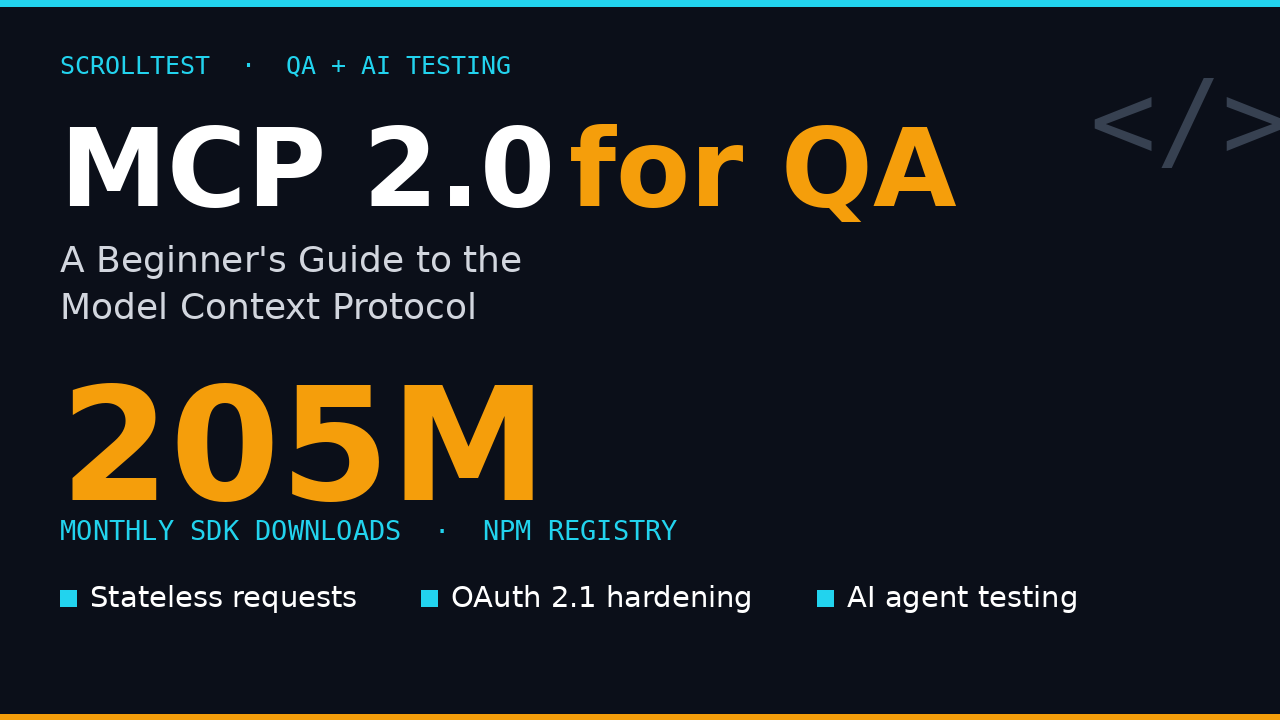
If you are wondering whether it is worth your learning time, the numbers settle it. The npm registry reports the @modelcontextprotocol/sdk package, the client library embedded in tools like Claude Desktop and Cursor, hit over 205 million downloads in the last 30 days. The @modelcontextprotocol/server package crossed 8.6 million in the same window. That 205 million figure is a single rolling 30-day window from the npm registry API, not a cumulative total.
On the repo side, the Python SDK holds over 24,000 stars with more than 3,800 forks, and the TypeScript SDK sits above 13,000 stars. The specification repository passed 9,000 stars. The PyPI package mcp is now at 2.0.0, which means a plain pip install mcp pulls the v2 line by default.
Adoption this broad means one thing for QA: the odds that your next project includes an MCP integration are high, and the odds that someone tests it properly before you get involved are low. That gap is your opportunity.
India Context: What This Means for SDET Careers
I spend a lot of time with QA engineers in Bengaluru, Hyderabad, and Pune, and the hiring pattern is clear. Companies that used to list “Selenium + Java” are now listing “AI agent testing” and “LLM evaluation” on SDET roles, and MCP keeps showing up in the fine print.
Here is the practical takeaway. A mid-level SDET in a product company in India earns roughly ₹25 to 40 LPA, and the gap between the median and the top end is increasingly explained by AI testing skills, not by one more automation framework. The engineers who can say “I test AI agents, and I know the MCP layer those agents run on” are the ones getting the senior offers and the architect tracks.
If you are building toward that, the sequence I recommend is short. Learn to stand up an MCP server and test its tool contract. Then learn to evaluate agent output for faithfulness and relevance. Then put both in a CI pipeline. That combination moves you from “automation tester” to “AI quality engineer” on paper, and it shows up in interviews immediately.
You do not have to build this from scratch alone. I keep a curated directory of AI agent skills for QA engineers over at QASkills.sh, and it includes the eval and testing skills you can drop into an MCP or agent workflow today. Pick one skill, run it in CI, and you have a talking point for your next interview.
Key Takeaways
- MCP is the open protocol that lets AI agents call tools and data sources, and MCP 2.0 for QA is now the version you will meet in production.
- v2 removes the initialize handshake, makes the server stateless, renames FastMCP to MCPServer, and hardens OAuth.
- The v2 Python SDK shipped July 28, 2026, with v1 in maintenance mode, and one server now serves both protocol eras.
- Test MCP at four layers: tool contract, tool selection, conversation state, and outcome quality.
- With over 205 million monthly downloads of the client SDK, this is the highest-impact skill a QA engineer can add in 2026.
FAQ
What is MCP 2.0 for QA engineers?
It is the current version of the Model Context Protocol that QA engineers need to understand to test AI agents and the tools those agents call. The v2 Python SDK released in July 2026 and is what a fresh install gives you by default.
Do I need to know Python to work with MCP?
No. Official SDKs exist for both Python and TypeScript, and at the protocol level everything is JSON-RPC over HTTP or stdio. If you can test a REST API, you can test an MCP server with Postman, Playwright, or plain HTTP.
Is MCP 2.0 backward compatible with v1?
Mostly, at the server level. The v2 SDK serves both the 2026-07-28 protocol and every 2025-era client from the same server. The breaking changes affect how you write code, not whether old clients can connect, so you can migrate incrementally.
What is the difference between an MCP tool and a resource?
A tool is a function the model can invoke with arguments and a result. A resource is data the server can serve, like a file or a query result. Prompts are templates. Most QA work starts with tools because that is where the action and the bugs are.
Where should I start if my team is already on MCP v1?
Start with the breaking-changes list, then work through a migration checklist. I have both on ScrollTest: the breaking changes guide and the hands-on migration checklist.