LangGraph Checkpoint Testing: What’s New in 4.2.0
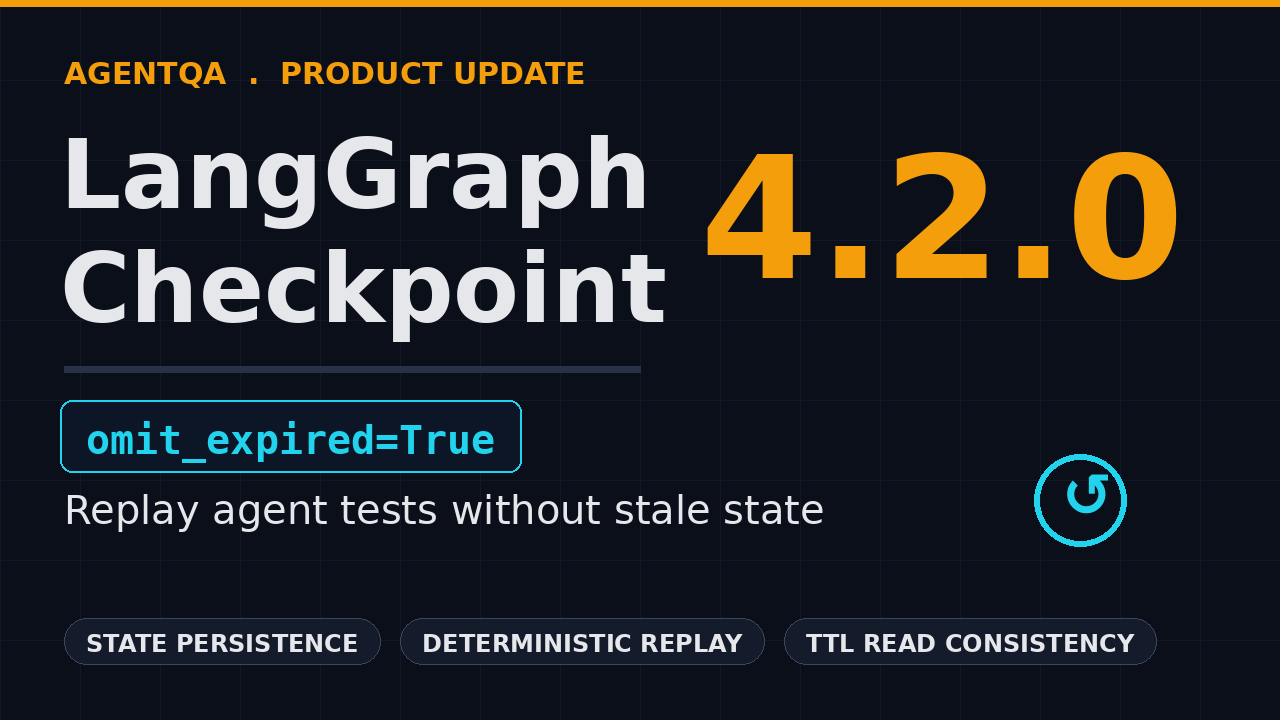
This week AgentQA shipped an upgrade you won’t see in the changelog of your test runner: we moved our Playwright agent engine onto langgraph-checkpoint 4.2.0. I’m writing this because most QA teams still think of LangGraph as an AI-app framework, not a testing tool. It’s both. Checkpointing is the difference between an AI agent test that passes once and a test that passes every time, on demand.
Table of Contents
- What LangGraph Checkpoint Testing Actually Is
- Why AgentQA Moved to langgraph-checkpoint 4.2.0
- What Actually Changed in 4.2.0
- omit_expired: The One Flag That Fixes a Real Bug
- State Persistence and Replay: Making Agent Tests Deterministic
- A Working Replay Example in Python
- Where Checkpoint Testing Still Breaks
- India Context: AI Agent Testing in 2026
- Key Takeaways
- FAQ
Contents
What LangGraph Checkpoint Testing Actually Is
Forget “AI testing” as a buzzword. Here’s the concrete definition I use with my team.
LangGraph is an orchestration framework for building stateful AI agents as graphs of nodes. Every time a node runs, LangGraph writes a checkpoint: a serialized snapshot of the graph state at that exact moment. A checkpointer is the component that stores those snapshots and hands them back on demand. LangGraph checkpoint testing means using those snapshots to pause, rewind, and replay agent runs instead of re-running them from scratch.
The pieces that matter for testing:
- State: a typed dict (messages, tool calls, browser actions, assertions) that flows through the graph.
- Checkpoint: a point-in-time copy of that state plus a unique
checkpoint_idand a link to its parent. - Thread: a named conversation or run, identified by
thread_idin the config. - Replay: rewinding to any checkpoint and resuming execution from that exact snapshot.
That last item is the whole point. When your agent test flakes because a model returned a slightly different sentence on a Tuesday, a checkpoint lets you rewind to the step before the nondeterminism and replay only the part that matters. No full-suite re-run. No re-burning API tokens on the first ten steps.
LangGraph’s adoption makes this worth learning. The repo sits at 40,204 GitHub stars as of August 2026, and the langgraph Python package pulled 71.9 million downloads last month (2.49 million on a single day), per PyPI download stats. This isn’t a niche framework anymore. It’s the default for stateful agents.
Why AgentQA Moved to langgraph-checkpoint 4.2.0
AgentQA is our planner-generator-healer pipeline: a Playwright agent plans a test, generates the code, runs it, then heals the selectors when the UI shifts. The engine keeps its graph state in a checkpointer so a run can be paused, inspected, and replayed. When we build a test that drives a browser through a login flow, we don’t want to re-run the login every time we debug the checkout step.
The upgrade to langgraph-checkpoint 4.2.0 (released August 7, 2026) landed for three reasons:
- Read consistency under TTL. The 4.2.0 release adds an opt-in
omit_expiredflag so reads never surface a checkpoint or store entry that already expired. Before this, a test could read a “dead” snapshot between sweeps. - Delta channel correctness. A fix to how writes are collected when a delta channel is seeded with a plain value, which matters for reconstructing state history after a rewind.
- Dependency hygiene. The
langsmithtracing dependency moved from 0.8.0 to 0.8.18, so our trace export stops lagging the upstream fixes.
The package itself is lean. langgraph-checkpoint 4.2.0 requires Python 3.10+, is MIT-licensed, and depends only on langchain-core >= 0.2.38 and ormsgpack >= 1.12.0 for fast serialization. That’s a small surface area, which is exactly what you want from a persistence layer you’re going to trust in CI.
What Actually Changed in 4.2.0
I read the release notes line by line so you don’t have to. The changes since checkpoint==4.1.1:
- feat: opt-in
omit_expiredonTTLConfig, the headline feature (PR #8354). Skips expired rows at query time on read. - fix: collect writes at plain-value seed in delta channel history (PR #8526). Corrects history reconstruction when a delta channel starts from a plain value instead of a snapshot blob.
- deps: langsmith 0.8.0 to 0.8.18 (PR #8173). Tracing client bump.
- Several internal chores: type-checking migration to
ty, lint cleanup, README standardization. No runtime behavior change from these.
Notice what’s not there: no breaking API change. 4.2.0 is a drop-in from 4.1.x. If you’re already on the 4.x line, pip install --upgrade langgraph-checkpoint==4.2.0 should be a clean swap, because the new flag defaults to False and preserves existing behavior unless you opt in.
The delta channel fix, in plain English
Delta channels store state as a compact set of changes instead of full snapshots, which keeps long histories small. The fix in 4.2.0 (PR #8526) corrects how writes are collected when a delta channel’s history is seeded with a plain value rather than a snapshot blob. If your agent stores message history in a delta channel, this is the change that makes rewinds reconstruct the right history. It’s a bug fix, not a feature, but for replay testing it matters more than most “features” do.
Versioning that trips people up
Here’s a trap worth knowing. The Python langgraph-checkpoint package is on 4.2.0, but its sibling implementations have their own numbers: langgraph-checkpoint-sqlite is on 3.1.1 and langgraph-checkpoint-postgres is on 3.1.2. The JavaScript port (@langchain/langgraph-checkpoint) is on a totally separate 1.x line. When you search for “checkpoint 4.2.0” and land on npm, you’ll see 1.1.5 and think you’re behind. You’re not. Those are different packages. Match the PyPI page, not the npm one.
Which checkpointer backend should you use?
There are three common backends, and the choice changes what you can assert:
- InMemorySaver: fastest, lives in RAM, gone when the process exits. Use it for unit tests and quick replay experiments.
- SqliteSaver: persists to a local file. Good for local regression suites where you want history to survive a test run.
- PostgresSaver / PostgresStore: the production choice. Shared across CI workers, supports TTL and the new
omit_expiredflag.
For a Playwright agent that drives a real browser in CI, InMemory is a trap. The browser session outlives the process that spawned it, and losing your checkpoint history every restart defeats the purpose of replay. Start with SQLite locally, move to Postgres when you parallelize.
How we validated the upgrade before shipping it
I don’t trust a version bump until it survives CI. Here’s the checklist we ran before wiring 4.2.0 into production:
- Pin and freeze. Lock
langgraph-checkpoint==4.2.0in your requirements file, run the full agent suite against both the old and new versions, and diff the pass rates. Any new failure gets triaged before the upgrade moves. - Smoke the replay path. Write one test that runs a graph, lists its history, rewinds to a known
checkpoint_id, and asserts the resumed state matches the snapshot. This is the exact behavior you’re paying for. - Exercise omit_expired. Insert a store entry with a short
default_ttl, force it past expiry, then read with and withoutomit_expiredand assert the flag changes the result. - Check the trace export. Confirm the langsmith 0.8.18 bump didn’t change your trace schema or break your observability dashboards.
If any step fails, the upgrade waits. A persistence layer is not the place for a “trust me, it’s a minor release” call.
omit_expired: The One Flag That Fixes a Real Bug
This is the change I care about, so I’m giving it its own section.
LangGraph’s Postgres store supports TTL, a time-to-live on stored entries so old agent memory gets cleaned up. The problem: deletion only happens through a background sweeper thread, not at read time. Between sweeps, a read can still return a row whose expires_at has already passed. The row is logically dead but physically present.
For a test, that means you can read an expired checkpoint, act on stale state, and get a failure that has nothing to do with your assertion. The window is small (the default sweep interval is 5 minutes) but CI runs at 3 a.m., and a flaky read is still a flaky read.
4.2.0 closes the window. TTLConfig now has an omit_expired field:
class TTLConfig(TypedDict, total=False):
    refresh_on_read: bool            # default True
    omit_expired: bool               # NEW in 4.2.0, default False
    default_ttl: float | None        # minutes, default None (no expiry)
    sweep_interval_minutes: int | None  # default None (no sweeping)
When you set omit_expired=True, the Postgres store injects (expires_at IS NULL OR expires_at > NOW()) into its get, search, and list_namespaces queries. Expired-but-unswept rows vanish from reads instantly, without waiting for the sweeper cadence.
Two details from the PR that show the maintainers thought it through:
- The filter applies to both the SELECT and the refresh UPDATE, so a
refresh_ttl=Trueread can’t resurrect an expired row back to life while still extending genuinely live ones. - Search pagination stays correct even when an expired row sits inside the page window, because the predicate gates the inner scans before
LIMIT/OFFSET.
The PR’s test suite covers four behaviors across sync and async paths on PG16 (210 tests passing), including a raw-SQL check proving the row is still physically present while being omitted. That’s the level of rigor I want behind a flag I’m wiring into a test pipeline.
State Persistence and Replay: Making Agent Tests Deterministic
The omit_expired flag is the 4.2.0 headline, but the reason AgentQA leans on checkpoints at all is bigger: state persistence and replay turn an inherently nondeterministic agent into something you can test with confidence.
Here’s the core problem with testing AI agents. A normal unit test runs the same code with the same inputs and expects the same outputs. An agent makes model calls, so the same inputs can produce different trajectories. You can’t assert “the agent always takes these seven steps” because step four might differ on a rerun.
Checkpointing gives you three superpowers that solve this:
- Time-travel debugging. After a failed run, walk
get_state_history()backward to find the exact step where the agent made the wrong call. The state is right there, serialized. - Deterministic replay. Rewind to a known-good checkpoint and resume from that snapshot. The flaky part re-executes, but everything before it is frozen.
- Resume after failure. If a browser step times out mid-run, restart from the last checkpoint instead of the login screen.
This is the same machinery I cover in my LangGraph state persistence testing guide, and it’s why I keep telling QA teams that checkpointing is a testing primitive, not an app-infrastructure detail.
Wiring checkpoints into a Playwright agent test
Here’s how the pieces map to a real browser test. Your graph nodes become steps like navigate, find_selector, click, assert. Each node writes its result into state and LangGraph snapshots it. When the assert node fails because a selector changed, you don’t re-run the whole flow. You rewind to the find_selector checkpoint and replay from there, feeding the healer the exact state it needs.
The practical payoff shows up in three places:
- Flaky test triage. The checkpoint history is a free execution trace. You can see what the agent saw at every step without adding logging.
- Cheaper debugging. Rewinding to step five costs a fraction of the tokens of a full re-run, because steps one through four are already done.
- Reproducible failures. A bug report can carry a
thread_idandcheckpoint_idinstead of a screenshot. Anyone on the team can rewind to the exact failing state.
A Working Replay Example in Python
Enough theory. Here’s the minimum code to checkpoint and replay a graph. No API keys, no Playwright, just the persistence layer.
from typing import TypedDict
from langgraph.graph import StateGraph, START, END
from langgraph.checkpoint.memory import InMemorySaver


class AgentState(TypedDict):
    messages: list
    step: int


def agent_node(state: AgentState) -> dict:
    # In a real agent this would call an LLM or drive the browser
    return {"step": state.get("step", 0) + 1}


builder = StateGraph(AgentState)
builder.add_node("agent", agent_node)
builder.add_edge(START, "agent")
builder.add_edge("agent", END)

graph = builder.compile(checkpointer=InMemorySaver())
config = {"configurable": {"thread_id": "regression-run-1"}}

graph.invoke({"messages": [], "step": 0}, config)

# List every checkpoint written during the run, newest first
for snap in graph.get_state_history(config):
    cid = snap.config["configurable"]["checkpoint_id"]
    print(cid, snap.values.get("step"))
To rewind, point the config at a specific checkpoint and invoke again. LangGraph resumes from that snapshot, not from the beginning:
rewind = {
    "configurable": {
        "thread_id": "regression-run-1",
        "checkpoint_id": "<the-id-you-want>",
    }
}
graph.invoke(None, rewind)  # resumes from that exact state
And the 4.2.0 feature in practice, a Postgres store that omits expired rows on read:
from langgraph.store.postgres import PostgresStore

with PostgresStore.from_conn_string(
    "postgresql://qa:secret@localhost:5432/agentqa",
    ttl={
        "default_ttl": 60,             # entries expire after 60 minutes
        "sweep_interval_minutes": 5,   # background sweeper cadence
        "omit_expired": True,          # NEW in 4.2.0
    },
) as store:
    store.start_ttl_sweeper()
With omit_expired=True, a read never returns a logically expired entry, even if the sweeper hasn’t run yet. Without it, you’re gambling on a five-minute window.
Where Checkpoint Testing Still Breaks
I’m not going to hand you the happy path and pretend it’s free. Here’s where checkpoint testing bites, based on what we hit building AgentQA.
- Thread sprawl. Every test run that doesn’t reuse a
thread_idcreates a new history tree. Without a cleanup policy, your Postgres or SQLite file grows until reads slow down. Use TTL anddelete_threaddeliberately. - Serde mismatches. A checkpoint is serialized with a specific serializer (msgpack by default). If you change your state schema mid-version, old checkpoints won’t deserialize. Version your state type and treat it like a database migration.
- Replay is not a mock. Rewinding to a checkpoint still calls the model for the resumed steps. It freezes history, not the future. For truly deterministic assertions, pair replay with a pinned model or a recorded response.
- The store vs. the checkpointer. The 4.2.0
omit_expiredflag lives on the store (long-term memory), not the checkpointer. Teams confuse the two. If you set TTL on the checkpointer expectingomit_expiredto work, it won’t. That’s a different component. - Checkpoint bloat on long runs. A graph that loops a hundred times writes a hundred checkpoints. If you only need the last N, prune aggressively with
graph.get_state_historyplus a retention policy, or your replay walk becomes slow and noisy.
The self-healing angle connects here too: a replayed checkpoint is the cleanest input you can give a healer, because it starts from a known state. I go deeper on that in my self-healing test automation guide.
India Context: AI Agent Testing in 2026
If you’re a QA engineer in Bengaluru, Hyderabad, or Pune, here’s the part that matters for your career.
AI agent testing is the fastest-moving corner of QA hiring right now. Companies that a year ago asked for “Selenium + Java” are now asking candidates to explain how they’d test a LangGraph agent and make a flaky agent run reproducible. The engineers who can answer “checkpoints, replay, and TTL read-consistency” are separating from the pack.
On money: AI-SDET roles with LangGraph and Playwright on the job description are landing in the ₹25 to 40 LPA band at product companies and AI startups, in my experience, noticeably above the manual-to-automation median. The premium isn’t for knowing a framework. It’s for proving you can make a nondeterministic system testable. That’s exactly the skill this upgrade exercises. If you want the full breakdown, I wrote up SDET salary data for India in 2026 separately.
The catch: this knowledge has a short half-life. Checkpoint semantics, TTL flags, and version numbers move fast. 4.2.0 landed two weeks ago and the sibling packages are already on their own 3.1.x cadence. The engineers who stay current by reading release notes are the ones who get the calls.
Key Takeaways
- langgraph-checkpoint 4.2.0 shipped August 7, 2026, with one headline feature: an opt-in
omit_expiredflag onTTLConfigthat filters expired rows at read time instead of waiting for the sweeper. - Checkpointing is a testing primitive: it gives you time-travel debugging, deterministic replay, and resume-after-failure for AI agents.
- The upgrade is a drop-in.
omit_expireddefaults toFalse, so existing behavior is unchanged until you opt in. - Don’t confuse the store (long-term memory, where
omit_expiredlives) with the checkpointer (run state). They’re different components with different TTL handling. - AI agent testing skills are commanding a real premium in India right now, but the knowledge expires fast. Stay on the release notes.
FAQ
What is langgraph-checkpoint 4.2.0?
It’s the August 7, 2026 release of the Python langgraph-checkpoint package, the base library for LangGraph’s checkpoint savers. Its headline change is an opt-in omit_expired flag on TTLConfig, plus a delta-channel history fix and a LangSmith dependency bump.
Do I need to change my code to upgrade to 4.2.0?
No. The new flag defaults to False, so upgrading from 4.1.x is a drop-in. You only set omit_expired=True if you want expired-but-unswept rows filtered from reads.
What’s the difference between a checkpointer and a store?
A checkpointer saves the graph state at each step of a run, enabling rewind and replay. A store holds long-term, cross-thread memory. The 4.2.0 omit_expired flag applies to the Postgres store, not the checkpointer.
How does replay make an AI agent test deterministic?
Replay rewinds to a saved checkpoint and resumes from that exact snapshot. Everything before the rewind point is frozen, so you re-execute only the nondeterministic part. You can pin the model or record responses to freeze the future steps too.
Where can I learn LangGraph checkpoint testing end to end?
Start with my LangGraph testing guide and the state persistence and replay walkthrough on ScrollTest, then read the 4.2.0 release notes directly.
If you’re building or testing AI agents with Playwright and want state persistence handled for you, that’s exactly what we’re building at AgentQA: planner, generator, healer, all checkpointed so a run can be replayed from any step.