AI Browser Release Radar for QA Teams
I see QA teams lose more time to surprise tool upgrades than to the upgrade itself. An AI browser release radar fixes that by turning Playwright, Selenium, PromptFoo, and DeepEval changes into one weekly list of test risks, owner actions, and evidence needed before a release train moves.
This post is also a product note for ScrollTest. The goal is simple: track browser automation and AI evaluation releases in one place, then translate release notes into work a QA lead can assign in under ten minutes.
Table of Contents
- What Is an AI Browser Release Radar?
- Why QA Teams Need It Now
- The Tools This Radar Covers
- The Weekly Workflow I Recommend
- A Practical Release Risk Model
- Automation Examples You Can Copy
- India Context for SDETs and QA Leads
- ScrollTest Product Update
- Key Takeaways
- FAQ
Contents
What Is an AI Browser Release Radar?
An AI browser release radar is a repeatable system that watches tool releases and converts them into QA action items. It is not a newsletter. It is not a Slack dump of changelog links. It is a small operating rhythm for teams that own browser tests, API checks, and LLM evaluation suites.
The radar has three jobs:
- Detect important releases from browser automation and AI testing tools.
- Classify each release by risk to the current test estate.
- Create a short checklist that a QA owner can run before upgrading.
Why I use the word radar
A radar does not fix the aircraft. It tells you what is entering range, how fast it is moving, and whether somebody needs to respond. That is exactly what QA teams need when Playwright, Selenium, PromptFoo, or DeepEval ships a new version.
Without a radar, teams notice changes late. The package update lands in a Dependabot pull request, the CI image changes under them, and the first real signal is a flaky nightly build. By then the discussion is emotional. Engineers argue about whether the tool is broken, whether the app changed, or whether the tests were always weak.
What makes it AI specific
Traditional browser release tracking focuses on locators, drivers, browsers, and CI images. AI testing adds a second layer: prompts, model outputs, evaluation metrics, scoring thresholds, and datasets. A single library update can change how an assertion is scored, how a provider is called, or how test cases are loaded.
That is why I group browser automation and AI evaluation together. Modern QA teams are already using Playwright traces next to LLM eval reports. The release radar should see both sides of that system.
Why QA Teams Need an AI Browser Release Radar Now
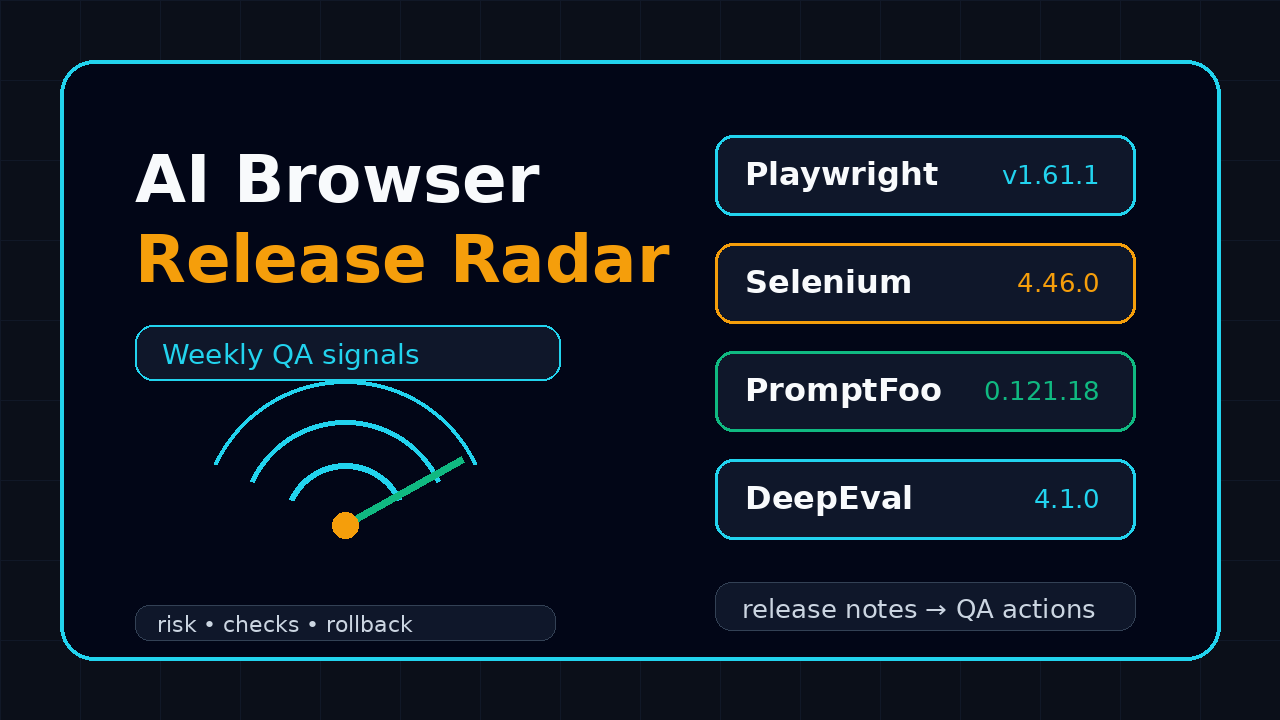
The current release pace is not slow. Microsoft published Playwright v1.61.1 on 23 June 2026. Selenium published Selenium 4.46.0 on 11 July 2026. The npm registry reports PromptFoo 0.121.18, and PyPI reports DeepEval 4.1.0 at the time of writing.
Those are not random version numbers. They sit directly in the path of automated releases. Playwright and Selenium touch browser execution. PromptFoo and DeepEval touch AI evaluation. If your team ships a chatbot, AI assistant, agent workflow, or browser-heavy SaaS product, these tools now affect release confidence.
Most teams do not fail because they cannot read release notes. They fail because nobody owns the conversion from release note to test action. A senior SDET sees a new version. A frontend engineer sees a Renovate pull request. A DevOps engineer sees a Docker image update. Each person has a partial view.
The result is predictable:
- A package update is merged because all unit tests pass.
- End-to-end tests fail later on a branch that did not make the update.
- The team spends two hours proving whether the failure is tool, infra, test data, or application behavior.
- The release manager asks for a rollback command that nobody documented.
A release radar stops that cycle. It creates one shared artifact before the merge, not after the firefight.
AI apps raise the cost of vague quality signals
With deterministic UI tests, a failure usually points to an element, assertion, network call, or timeout. With AI output, a failure may mean prompt drift, retrieval mismatch, model behavior change, evaluation threshold change, or a real product regression. Saying “the AI is flaky” is not enough.
If you already use AI evaluation gates, read our guide on AI test evidence in CI/CD release gates. The same idea applies here: no release should depend on vibes when the evidence can be captured in a trace, report, or eval artifact.
The Tools This Radar Covers
The first ScrollTest release radar focuses on four tool families: Playwright, Selenium, PromptFoo, and DeepEval. That is intentional. These tools map to the two testing systems I see growing fastest in real teams: browser automation and LLM regression testing.
Playwright release notes
Playwright changes matter because it packages browser automation, assertions, tracing, test runner behavior, browser channels, and developer tooling in one ecosystem. A small release can still affect screenshots, locators, network waiting, or the browsers installed in CI.
For Playwright teams, the radar should capture:
- Version number and release date.
- Browser engine changes and bundled browser revisions.
- Test runner changes that affect retries, workers, projects, or reporters.
- Known issues from GitHub discussions or issue comments when they are public.
- Rollback command and lockfile diff.
If your team is still building the basics, this older ScrollTest tutorial on testing multi-select dropdowns in Playwright is a good reminder that stable automation starts with clear selectors and visible assertions, not just a newer package version.
Selenium release notes
Selenium remains important for enterprises with Grid, mixed languages, legacy suites, and long-lived test frameworks. The Selenium 4 line also keeps moving, so the radar cannot treat it as a static old tool.
For Selenium teams, I track:
- Server and Grid changes.
- Language binding changes for Java, Python, JavaScript, and C#.
- Driver management behavior.
- Remote execution compatibility.
- Docker image impact when Grid is containerized.
ScrollTest recently published Selenium 4.45.0 upgrade notes for test leads. Use that format as a baseline. Each Selenium upgrade should answer one question first: will this change how my current Grid, drivers, and bindings behave under CI load?
PromptFoo release notes
PromptFoo is useful when QA teams want repeatable prompt tests, provider comparisons, red-team style checks, and regression reports that can run in CI. Its npm package version is easy to track, but the risk sits in how teams configure prompts, providers, assertions, and expected outputs.
The release radar should capture:
- Version and package source.
- Assertion behavior changes.
- Provider integration changes.
- CLI command changes that may break pipelines.
- Report format changes that affect dashboards.
If your team is just starting with LLM testing, pair this radar with a small suite of frozen prompt cases. Ten good cases beat one hundred vague prompts.
DeepEval release notes
DeepEval is popular with teams that want Python-first LLM evaluation. It is often used for metrics, test cases, datasets, and CI checks around chatbot or RAG behavior. Because it lives in the Python ecosystem, teams also need to watch dependency constraints and environment reproducibility.
For DeepEval, I track:
- PyPI version and release timestamp.
- Metric behavior changes.
- Dataset and test case API changes.
- Provider or model integration changes.
- Breaking changes in examples or docs.
We have a focused guide on DeepEval for QA engineers. That article covers the basic shape of a test. The radar adds the operational layer: what changed this week, and what should the team do about it?
AI Browser Release Radar: The Weekly Workflow I Recommend
An AI browser release radar works best when it runs on a fixed cadence. I prefer a weekly check for most QA teams and an additional check before any major release branch is cut. Daily tracking creates noise unless you are building a testing platform or heavily regulated product.
Step 1: collect release signals
Start with primary sources only. GitHub releases, npm registry data, PyPI package data, and official documentation should beat random blog summaries. Secondary commentary is useful later, but it should not be the source of truth for version numbers.
Use commands like these in a scheduled job:
curl -s https://api.github.com/repos/microsoft/playwright/releases/latest \
  | python3 -c 'import sys,json; d=json.load(sys.stdin); print(d["tag_name"], d["published_at"])'

curl -s https://api.github.com/repos/SeleniumHQ/selenium/releases/latest \
  | python3 -c 'import sys,json; d=json.load(sys.stdin); print(d["tag_name"], d["published_at"])'

curl -s https://registry.npmjs.org/promptfoo/latest \
  | python3 -c 'import sys,json; d=json.load(sys.stdin); print(d["version"])'

curl -s https://pypi.org/pypi/deepeval/json \
  | python3 -c 'import sys,json; d=json.load(sys.stdin); print(d["info"]["version"])'
Step 2: compare against your current stack
A release is only risky in context. Playwright 1.61.1 may be low risk for a team already on 1.61.0 and high risk for a team jumping from 1.52. Selenium 4.46.0 may be simple for a local Python suite and risky for a large Java Grid setup.
Every radar entry should include your current version, target version, and jump size. I use this simple structure:
{
  "tool": "playwright",
  "current_version": "1.59.0",
  "target_version": "1.61.1",
  "risk": "medium",
  "owners": ["qa-platform", "frontend-sdet"],
  "evidence_required": ["trace", "html-report", "lockfile-diff", "rollback-command"]
}
Step 3: map release notes to test areas
Do not paste release notes directly into Jira. Convert them into test areas. A browser engine update maps to visual checks, screenshots, downloads, uploads, authentication flows, and flaky timing hotspots. A test runner update maps to retries, parallelism, project config, and reporting. An LLM eval update maps to metrics, thresholds, datasets, and provider calls.
This conversion is the whole value of the radar. It turns vendor language into QA work.
Step 4: define the merge gate
Before the upgrade branch merges, require evidence. The evidence does not need to be large. It needs to be specific.
- One passing smoke run on CI.
- One trace from a critical browser journey.
- One HTML or JSON report from the test runner.
- One eval report for AI behavior if PromptFoo or DeepEval changed.
- One rollback command copied into the pull request.
That checklist gives managers and release owners something concrete. It also trains junior engineers to think beyond green checks.
A Practical Release Risk Model
The radar needs a risk model, or every release becomes “medium risk” by default. I use four labels: watch, low, medium, and high. The labels are not emotional. They are based on blast radius.
Watch
Use watch when a release exists but does not touch your stack yet. Example: a Selenium language binding you do not use, a PromptFoo provider your team has not configured, or a DeepEval metric that is not in your suite.
Low risk
Low risk means the version jump is small, the impacted area is narrow, and rollback is straightforward. A patch release with documentation updates may be low risk. Still record it. A low-risk release can become high risk if it lands during a release freeze.
Medium risk
Medium risk means the change touches CI, browser execution, reporting, or evaluation behavior. This is the most common label for Playwright and Selenium updates in active test estates. It requires a smoke suite and trace evidence before merge.
High risk
High risk means the change affects core execution, breaks old APIs, modifies scoring behavior, or changes CI images used by multiple squads. High-risk upgrades need a named owner, a rollback plan, and one release window. Do not sneak them into unrelated work.
Here is the scoring table I use:
| Signal | Risk impact | Evidence required |
|---|---|---|
| Patch release, no config change | Low | Smoke run |
| Browser engine or driver change | Medium | Trace plus critical journeys |
| Grid, worker, or parallelism change | Medium to high | CI report plus load sample |
| LLM metric or assertion change | High | Eval report plus threshold review |
| Major version jump | High | Migration branch plus rollback plan |
Automation Examples You Can Copy
The release radar should be boring to run. That means a small script, a small output file, and a predictable review rhythm. Here is a Python example that fetches versions and writes a compact radar snapshot.
import datetime as dt
import json
import requests

HEADERS = {"User-Agent": "ScrollTestReleaseRadar/1.0"}
SOURCES = {
    "playwright": "https://api.github.com/repos/microsoft/playwright/releases/latest",
    "selenium": "https://api.github.com/repos/SeleniumHQ/selenium/releases/latest",
    "promptfoo": "https://registry.npmjs.org/promptfoo/latest",
    "deepeval": "https://pypi.org/pypi/deepeval/json",
}

def fetch(name, url):
    data = requests.get(url, headers=HEADERS, timeout=30).json()
    if name in ["playwright", "selenium"]:
        return {
            "tool": name,
            "version": data["tag_name"],
            "published_at": data.get("published_at"),
            "source": data.get("html_url"),
        }
    if name == "promptfoo":
        return {"tool": name, "version": data["version"], "source": url}
    return {"tool": name, "version": data["info"]["version"], "source": url}

snapshot = {
    "generated_at": dt.datetime.now(dt.UTC).isoformat(),
    "items": [fetch(name, url) for name, url in SOURCES.items()],
}

print(json.dumps(snapshot, indent=2))
Turn versions into action items
Fetching versions is table stakes. The next step is classification. You can store your current approved versions in a JSON file and compare them with the latest known versions.
{
  "approved": {
    "playwright": "1.60.0",
    "selenium": "4.45.0",
    "promptfoo": "0.121.10",
    "deepeval": "4.0.7"
  },
  "policy": {
    "browser_tool_minor_jump": "medium",
    "llm_eval_metric_change": "high",
    "patch_only": "low"
  }
}
For a real team, I would push the snapshot into a Slack channel or a weekly Confluence page. For a product like ScrollTest, I prefer a public article and a dashboard entry because it helps QA teams copy the decision model.
What not to automate
Do not automate judgment too early. A script can fetch a version and compare numbers. It cannot fully understand your flaky login flow, your finance product’s audit requirement, or your India release freeze around a major customer rollout.
Keep the human review, but make the input cleaner. That is the balance.
India Context for SDETs and QA Leads
In India, this skill is becoming a career separator. Service company QA teams often inherit large Selenium suites and strict process gates. Product companies expect SDETs to own Playwright, CI, observability, and sometimes AI evaluation in the same sprint.
When I interview SDETs for senior roles, I do not only ask whether they know Playwright or Selenium. I ask how they upgrade a framework without breaking release confidence. The candidate who can explain lockfiles, traces, rollback commands, and eval reports sounds ready for ownership.
What ₹25 to 40 LPA SDETs show differently
Senior SDETs in the ₹25 to 40 LPA band usually bring systems thinking. They do not say, “I wrote automation.” They say, “I reduced release risk by defining upgrade gates, CI evidence, and ownership.” That is the language of staff-level QA work.
A release radar gives you a visible artifact for that story. You can show:
- Which tool releases you tracked.
- Which risks you classified.
- Which smoke tests protected the upgrade.
- Which rollback command you prepared.
- Which AI eval cases blocked silent regressions.
How manual testers can use this
If you are moving from manual testing to automation, do not wait until you can write a perfect framework. Start by creating a weekly release radar for your team. Read one Playwright release note, one Selenium release note, and one AI testing tool release. Convert each into three test ideas.
That exercise builds product sense and automation sense at the same time. It also gives you a better portfolio artifact than another login test copied from a course.
ScrollTest Product Update: What We Are Shipping
ScrollTest will start publishing an AI and browser release radar for QA teams. The radar will track Playwright, Selenium, PromptFoo, DeepEval, and other tools when they matter to release quality. The goal is not to chase every version. The goal is to tell QA teams what changed, what can break, and what evidence to collect.
What each radar entry will include
- Tool name and latest version.
- Primary source link.
- Risk label for QA teams.
- Recommended smoke checks.
- CI and rollback notes.
- AI evaluation impact when relevant.
How this fits the ScrollTest content system
ScrollTest already publishes practical QA guides, release notes, and AI testing workflows. The radar will connect those pieces. A Selenium update can link to upgrade notes. A DeepEval change can link to a QA quick start. A CI risk can link to evidence-gate guidance.
This matters because QA teams do not need more isolated tutorials. They need connected operating playbooks. When a tool changes, they should know which article, checklist, and command to use next.
First radar snapshot
Here is the current snapshot from primary sources:
- Playwright: v1.61.1, published on GitHub on 23 June 2026.
- Selenium: 4.46.0, published on GitHub on 11 July 2026.
- PromptFoo: 0.121.18, reported by the npm registry.
- DeepEval: 4.1.0, reported by PyPI.
My recommendation: treat Selenium 4.46.0 as medium risk for Grid-heavy teams, Playwright 1.61.1 as medium risk for teams jumping more than one minor version, PromptFoo changes as medium to high risk when CI assertions depend on exact outputs, and DeepEval changes as high risk when metric behavior or thresholds affect release gates.
Key Takeaways
The AI browser release radar is a small habit with a large payoff. It keeps release-note reading close to the actual QA work, and it reduces the drama around test framework upgrades.
- Track primary sources first: GitHub releases, npm, PyPI, and official docs.
- Convert every tool release into test areas, not just Jira links.
- Require evidence before upgrades merge: trace, report, lockfile diff, and rollback command.
- Treat LLM evaluation changes as release-risk changes, not documentation chores.
- Use the radar as a career artifact if you want to move into senior SDET or QA lead roles.
My blunt view: teams that own release intelligence will move faster than teams that only react to broken pipelines. The radar is how QA earns that seat.
FAQ
Is an AI browser release radar only for large teams?
No. A two-person QA team can use it. Keep the format small: one table, four tools, one risk label, and one action item per tool. The value comes from consistency, not size.
How often should QA teams run the radar?
Weekly is enough for most teams. Add one extra check before a major release branch or framework upgrade. Daily checks create noise unless your product depends heavily on test infrastructure.
Should every release be upgraded immediately?
No. Track every relevant release, but upgrade based on risk, need, and release timing. A security fix or serious bug fix may move fast. A minor feature can wait for the next planned framework window.
Can this work with Cypress, WebdriverIO, or other tools?
Yes. The model is tool-agnostic. Replace or add sources based on your stack. The core pattern stays the same: detect, classify, assign evidence, then merge with confidence.
What is the first thing I should do after reading this?
Create a small radar file for your team with four columns: tool, current version, latest version, and QA action. Fill it every Friday for one month. You will quickly see where your release risk is hiding.