Selenium 4.45 Regression Briefing for QA Teams
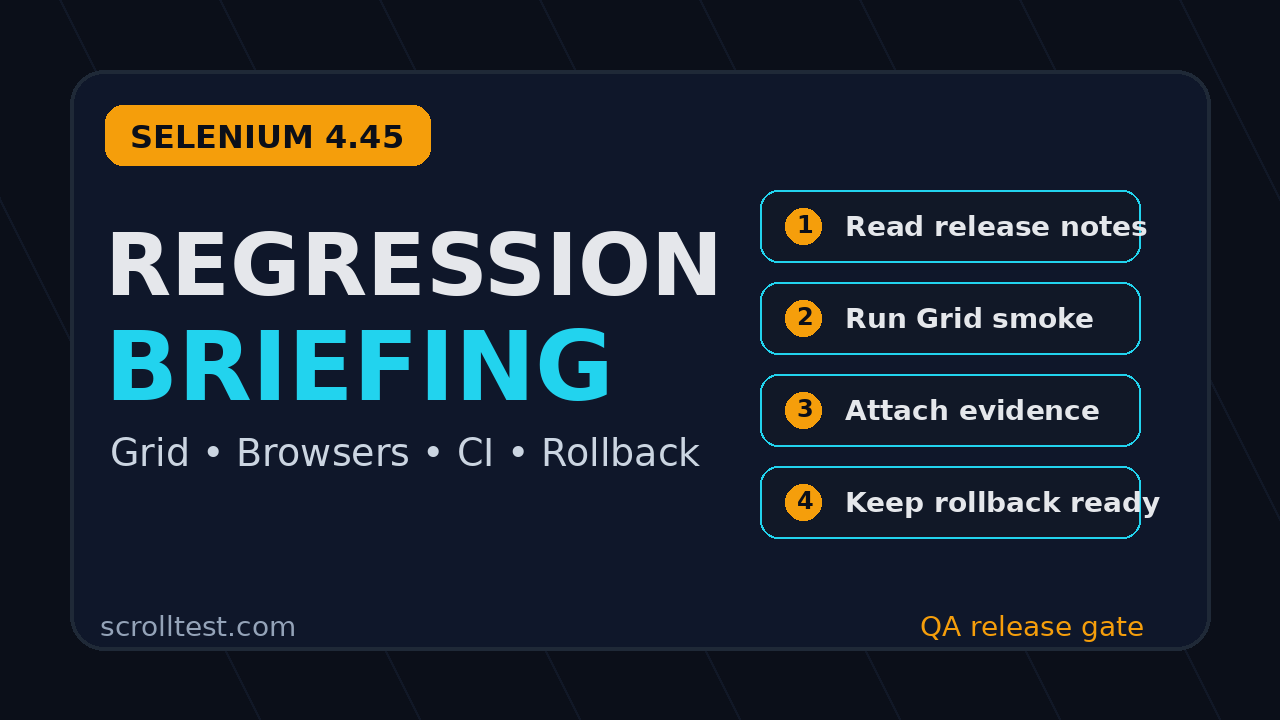
Selenium 4.45 regression briefing is the note I want every QA team to write before a framework upgrade reaches main. Selenium 4.45.0 shipped on 16 June 2026, and the release is not scary, but it touches enough Grid, language binding, build, and dependency areas that a blind upgrade is still bad engineering.
This article gives you a reusable briefing template, a risk checklist, CI commands, owner matrix, and a sample team note you can copy into Jira, Confluence, Notion, or GitHub Issues. I am not treating release notes as paperwork. I am treating them as regression-control assets.
Table of Contents
- Why a Selenium 4.45 Regression Briefing Matters
- Selenium 4.45.0 Release Facts to Capture
- Risk Map: Bindings, Grid, Browsers, and CI
- The Selenium 4.45 Regression Briefing Template
- CI Playbook for a Safe Selenium Upgrade
- Flaky-Test Watchlist and Evidence Rules
- India QA Team Context: Ownership and Hiring Signal
- Sample Briefing Note You Can Copy
- Key Takeaways for Selenium 4.45 Regression Briefing
- FAQ
Contents
Why a Selenium 4.45 Regression Briefing Matters
I see teams upgrade Selenium in one of two ways. Mature teams write a small release note, run a risk-based suite, assign owners, and merge with proof. Tired teams update the dependency, wait for CI, and call every later failure “flaky.” The first group learns from releases. The second group collects mystery failures.
The official Selenium 4.45.0 GitHub release lists the release date, assets, and component changes. It also points readers to component changelogs for Java, Python, .NET, Ruby, and JavaScript. That alone tells me the upgrade is not a one-line dependency change for serious teams. If your estate has Java UI suites, Python smoke checks, a Grid on Kubernetes, and a small JavaScript helper project, your briefing must call out each surface separately.
A framework release is a production change
Test frameworks sit in the release path. When a Selenium change breaks driver creation, Grid routing, wait behavior, logging, or dependency resolution, product releases slow down. I do not care that it is “only test code.” If it blocks deployment or hides a production bug, it is production infrastructure.
A regression briefing answers five questions before anyone debates the upgrade:
- Which Selenium version is being changed, and from what baseline?
- Which language bindings and runtime versions are affected?
- Which critical user journeys prove the upgrade is safe?
- Who owns CI, Grid, browser coverage, and rollback?
- What evidence is required before the change moves forward?
Release-note reading is a senior QA skill
Most SDETs can write a Page Object. Fewer can read a release note and convert it into a team action plan. That gap matters in 2026 because QA teams are now expected to own browser infrastructure, CI economics, AI-assisted maintenance, and evidence quality. A simple briefing is how you show that ownership.
If your team already follows a release discipline, read Selenium Release Notes: QA Risk Review Playbook and connect this article to your existing checklist. If you are starting from zero, use the template below first and refine it after one release cycle.
Selenium 4.45.0 Release Facts to Capture
The first part of the Selenium 4.45 regression briefing should be boring and factual. Do not start with opinions. Start with version, date, source links, affected packages, and the exact dependency lines you plan to change. This prevents the common “which version did we test?” argument two days later.
Minimum facts for the briefing header
For Selenium 4.45.0, I would capture the following facts:
- Release: Selenium 4.45.0.
- Published: 16 June 2026, based on the GitHub release timestamp.
- Primary source: SeleniumHQ GitHub release page.
- Important component areas: Java, Python, .NET, Ruby, JavaScript, Grid, build, and dependencies.
- Highlighted Grid change: a WebSocket proxy pre-handshake race fix in PR #17435.
- Assets: Java zip, .NET zip, Selenium Server jar, and Selenium Server zip are present on the release page.
That last point is not trivia. If your team downloads the Selenium Server jar directly in Docker builds, you need to know whether the artifact you consume is the jar, zip, language binding package, or a transitive dependency through Maven, Gradle, npm, PyPI, RubyGems, or NuGet.
Dependency lines to paste into the note
Put the exact old and new dependency lines in the briefing. Do not write “upgrade Selenium.” Write the diff. A reviewer should know what is changing without opening a pull request.
<!-- Maven: before -->
<dependency>
  <groupId>org.seleniumhq.selenium</groupId>
  <artifactId>selenium-java</artifactId>
  <version>4.44.0</version>
</dependency>

<!-- Maven: after -->
<dependency>
  <groupId>org.seleniumhq.selenium</groupId>
  <artifactId>selenium-java</artifactId>
  <version>4.45.0</version>
</dependency>
# Python: example upgrade command for a controlled branch
python -m pip install --upgrade "selenium==4.45.0"
python -m pip freeze | grep seleniumUse your real baseline version. If you are jumping from 4.30 to 4.45, the risk is not the same as moving from 4.44 to 4.45. A multi-minor upgrade needs a stronger smoke pack and a slower rollout.
Source links that belong in the briefing
I like three source links in the note: the release page, one change that may affect runtime behavior, and one standards or documentation page that explains the browser automation contract. For Selenium 4.45.0, the release page and the Grid WebSocket PR are relevant. The W3C WebDriver specification is useful when teams need to separate Selenium behavior from browser-driver behavior.
Risk Map: Bindings, Grid, Browsers, and CI
The Selenium 4.45 regression briefing should not treat every change equally. A build dependency update may be low risk for your product suite. A Grid proxy race fix may be important if your tests use remote sessions, browser logs, BiDi-style communication, or long-running parallel jobs. The point is not panic. The point is targeted regression.
Language binding risk
Start by listing which bindings your organization uses. Many companies say “we use Selenium,” but the reality is messier:
- Core web regression suite in Java.
- Production smoke checks in Python.
- A few old admin tests in C#.
- Node scripts for test data setup or visual capture.
- Ruby checks left from an older framework.
If only Java is in production CI, say that. If Python scripts trigger smoke checks in deployment pipelines, say that too. Hidden bindings create hidden upgrade risk.
Grid and remote execution risk
The release includes a Grid-related change: “Close pre-handshake race in WebSocket proxy.” I read that as a signal to test remote execution paths, not just local Chrome. If your team runs Selenium Grid, Selenoid, cloud browsers, Kubernetes nodes, or vendor grids, include at least one remote smoke check in the briefing.
Remote execution deserves its own evidence because failures often look like product bugs:
- Session creation times out under parallel load.
- Console logs or network events disappear.
- Downloads fail only on remote nodes.
- WebSocket-heavy pages break in Grid but pass locally.
- Video or screenshot artifacts are missing after retry.
For deeper release discipline, connect this to Selenium 4.45 Scroll Testing: What QA Must Check. Scroll, viewport, screenshot, and remote-browser behavior are often where browser automation upgrades expose weak assumptions.
Browser coverage risk
Do not run only Chrome and declare victory if your customers use Edge, Firefox, or Safari. A practical briefing does not need a full cross-browser matrix for every patch release, but it should name the required browsers for release confidence.
My default browser coverage for a Selenium framework upgrade is:
- Chrome stable on local runner.
- Chrome stable on Grid or CI runner.
- Edge stable if the product has enterprise users.
- Firefox for one critical journey if the app claims Firefox support.
- Safari only when the product officially supports macOS Safari and the team has a real runner.
CI risk
Selenium upgrades often fail because of the surrounding build system, not Selenium itself. Java teams hit Maven cache or transitive dependency issues. Python teams hit virtual environment drift. Node teams hit lockfile changes. Docker teams hit browser-driver mismatch. The briefing must name the CI risk directly.
The Selenium 4.45 Regression Briefing Template
Here is the template I would use for a real team. Keep it short enough that engineers will write it, but strict enough that it catches lazy upgrades.
Template section 1: upgrade summary
## Selenium 4.45 Regression Briefing

Owner: [Name]
Reviewer: [Name]
Upgrade PR: [Link]
Baseline version: [Current Selenium version]
Target version: 4.45.0
Source release: https://github.com/SeleniumHQ/selenium/releases/tag/selenium-4.45.0
Planned rollout: [date/time]
Rollback owner: [Name]
This section removes ambiguity. If a release manager asks who owns rollback, the answer is in line eight. If CI fails tomorrow, nobody wastes time asking which version moved.
Template section 2: affected surfaces
## Affected Surfaces

Language bindings:
- Java: yes / no
- Python: yes / no
- JavaScript: yes / no
- .NET: yes / no
- Ruby: yes / no

Execution:
- Local browser: yes / no
- Selenium Grid: yes / no
- Cloud browser provider: yes / no
- Docker image: yes / no
- Kubernetes runner: yes / no

Browser coverage required:
- Chrome:
- Edge:
- Firefox:
- Safari:
I like this section because it exposes blind spots. If nobody knows whether a smoke job uses Python Selenium, that is not a reason to skip the line. It is a reason to find the owner.
Template section 3: risk classification
## Risk Classification

Overall risk: Low / Medium / High
Reason:
- [Example: patch-level move from 4.44 to 4.45]
- [Example: Grid WebSocket proxy fix means remote tests need smoke coverage]
- [Example: Docker image rebuild required]

No-go conditions:
- Session creation failure rate increases.
- Login smoke fails in Chrome or Edge.
- Remote screenshot/video evidence missing.
- Any P0 checkout/admin journey fails twice after rerun.
Do not overcomplicate risk scoring. Low, medium, high is enough. What matters is the reason and the no-go condition.
Template section 4: evidence required
## Evidence Required Before Merge

1. Dependency diff attached.
2. Local smoke result attached.
3. CI smoke result attached.
4. Grid smoke result attached if Grid is used.
5. Screenshot or trace attached for one critical journey.
6. Flaky-test watchlist reviewed.
7. Rollback command documented.
This turns the briefing from a note into a gate. I am not asking for a 40-page document. I am asking for enough proof that the upgrade did not silently weaken the test platform.
CI Playbook for a Safe Selenium Upgrade
The Selenium 4.45 regression briefing should include the exact CI commands or jobs that prove the upgrade. If you cannot name the job, you do not have a gate. If the job is too slow, create a smaller one for framework upgrades.
Step-by-step CI rollout
Use this rollout when the suite is large and the team cannot wait for a full overnight run on every dependency update:
- Create a branch only for the Selenium upgrade.
- Update dependency files and lockfiles.
- Rebuild the test runner Docker image if the image includes browsers or drivers.
- Run local smoke for one critical flow.
- Run CI smoke on the same flow.
- Run remote/Grid smoke if your release path uses Grid.
- Run the top flaky-test watchlist to detect behavior changes.
- Run a reduced cross-browser matrix.
- Attach evidence to the PR.
- Merge only after rollback is documented.
Example GitHub Actions job
Here is a simple GitHub Actions pattern for a Java Selenium suite. Adapt it to your framework, but keep the separation between smoke and full regression.
name: selenium-upgrade-smoke

on:
  pull_request:
    paths:
      - 'pom.xml'
      - 'src/test/**'
      - '.github/workflows/selenium-upgrade-smoke.yml'

jobs:
  smoke:
    runs-on: ubuntu-latest
    timeout-minutes: 25
    steps:
      - uses: actions/checkout@v4
      - uses: actions/setup-java@v4
        with:
          distribution: temurin
          java-version: '21'
      - name: Print Selenium dependency
        run: mvn -q dependency:tree | grep selenium || true
      - name: Run critical Selenium smoke
        run: mvn test -Dgroups=critical-smoke -Dselenium.version=4.45.0
      - name: Upload screenshots
        if: always()
        uses: actions/upload-artifact@v4
        with:
          name: selenium-smoke-evidence
          path: target/screenshots
Example flaky delta script
A small script can compare pass rates before and after the upgrade. This is not a replacement for judgment, but it stops people from ignoring obvious instability.
from pathlib import Path
import json

before = json.loads(Path('reports/baseline.json').read_text())
after = json.loads(Path('reports/selenium-4-45.json').read_text())

for test_name, old in before.items():
    new = after.get(test_name, {})
    old_rate = old.get('pass_rate', 0)
    new_rate = new.get('pass_rate', 0)
    if old_rate - new_rate >= 0.10:
        print(f'REVIEW: {test_name} dropped from {old_rate:.0%} to {new_rate:.0%}')
Teams with mature dashboards can automate this. Smaller teams can start with a JSON report, a spreadsheet, or a short CI artifact summary.
Flaky-Test Watchlist and Evidence Rules
A Selenium upgrade is the worst time to accept vague failure notes. “It failed once” is not evidence. “The login button was not clickable after 10 seconds on Chrome Grid node 3, with screenshot and browser console attached” is evidence. The briefing should force that standard.
Build a watchlist before the upgrade
Pick 10 to 20 tests that have failed in the last month. Include the tests that engineers already distrust. If Selenium 4.45 makes those tests worse, you want to know before the merge. If it makes them better, you want to know that too.
Your watchlist should include:
- Login and session tests.
- Checkout or payment-like flows.
- File upload and download tests.
- Scroll-heavy pages.
- Dynamic table or virtual list tests.
- Tests that use browser logs, network events, or remote execution.
- Any test with more than two retries in the last seven days.
If scroll behavior is a recurring pain point, also read Selenium Strategy 2026: What Still Works. The best Selenium suites in 2026 are not bigger. They are more intentional about which journeys deserve browser automation.
Evidence rules for upgrade failures
Set the evidence rules before failures happen. This keeps the team from debating screenshots after the build is already red.
Failure evidence required:
- Test name and commit SHA.
- Browser and browser version.
- Local or remote execution.
- Grid node or provider details if remote.
- Screenshot at failure.
- Page source or DOM snapshot for locator failures.
- Console logs for JavaScript errors.
- Retry result and rerun command.
I prefer one rerun for suspected infrastructure failures and zero silent retries for known product failures. Retry policy should reveal signal, not hide it.
When to rollback
Rollback is not failure. Rollback is a release-control tool. Roll back Selenium 4.45 if one of these happens and the team cannot explain it within the agreed window:
- Critical smoke fails in two independent CI attempts.
- Grid session creation becomes unstable under normal parallel load.
- Cross-browser coverage loses a supported browser.
- Evidence artifacts disappear from CI.
- The upgrade requires unrelated product-test rewrites to pass.
India QA Team Context: Ownership and Hiring Signal
In India, many QA teams still split work into “automation engineer updates framework” and “manual tester validates product.” That split is getting weaker. Product companies and stronger service teams increasingly expect SDETs to own release risk, CI evidence, and framework upgrade discipline.
Why this matters for SDET growth
If you are targeting ₹25-40 LPA roles, do not present yourself as someone who only writes test scripts. Show that you can protect the release system. A Selenium 4.45 regression briefing is a small artifact, but it signals senior thinking. It says you can read upstream changes, map risk, talk to DevOps, and decide what evidence matters.
For engineers moving from TCS, Infosys, Wipro, Cognizant, or similar environments into product companies, this habit is valuable. Product teams do not want long status calls. They want crisp notes, clean ownership, and fast rollback options.
Interview angle
If an interviewer asks, “How do you handle framework upgrades?” do not answer with “I update the Maven version and run tests.” A stronger answer sounds like this:
“I create a regression briefing. I capture the version diff, release-note risks, affected bindings, Grid impact, browser matrix, smoke suite, flaky watchlist, and rollback owner. For Selenium 4.45, I would pay attention to remote execution because the release includes a Grid WebSocket proxy race fix.”
That answer shows judgment. It is also easier to defend because it connects to a real release note.
Sample Briefing Note You Can Copy
Here is a compact example you can paste into a PR description or release ticket.
## Selenium 4.45 Regression Briefing

Owner: QA Platform
Reviewer: DevOps + Web QA Lead
Baseline: Selenium 4.44.0
Target: Selenium 4.45.0
Release source: https://github.com/SeleniumHQ/selenium/releases/tag/selenium-4.45.0
Risk: Medium
Reason: Patch-level upgrade, but Grid WebSocket proxy fix means remote execution needs smoke evidence.

Affected bindings:
- Java: yes, main UI suite
- Python: yes, deployment smoke checks
- JavaScript: no production suite
- .NET/Ruby: no

Required checks:
1. Local Chrome login + checkout smoke.
2. CI Chrome login + checkout smoke.
3. Grid Chrome remote smoke.
4. Edge smoke for admin login.
5. Top 15 flaky tests from last 30 days.
6. Screenshot and console-log artifact verification.

No-go conditions:
- Session creation failure in CI Grid.
- Login or checkout smoke fails twice.
- Screenshot artifacts missing.
- Python deployment smoke cannot install pinned Selenium version.

Rollback:
- Revert dependency PR.
- Restore previous Docker image tag.
- Re-run smoke on Selenium 4.44.0.

Decision:
- Merge only after CI evidence is attached to this ticket.
This is intentionally plain. A briefing that people actually use beats a perfect template that nobody opens.
Key Takeaways for Selenium 4.45 Regression Briefing
A Selenium 4.45 regression briefing turns an upgrade into a controlled engineering decision. It does not need ceremony. It needs facts, owners, risk, and evidence.
- Selenium 4.45.0 was published on 16 June 2026, so use the official GitHub release as the source of truth.
- Capture exact dependency diffs instead of writing vague upgrade notes.
- Treat Grid and remote execution as separate risk surfaces, especially because this release includes a WebSocket proxy race fix.
- Run local, CI, remote, and reduced cross-browser smoke checks before merging.
- Attach screenshots, logs, DOM evidence, and rollback steps to the PR or ticket.
If your team wants a broader upgrade system, pair this template with the Playwright Upgrade Checklist for QA Teams. The tools differ, but the release discipline is the same: read the notes, map the risk, prove the change, and keep rollback boring.
FAQ
Is Selenium 4.45.0 a mandatory upgrade?
No public release note makes it mandatory for every team. Treat it as a normal framework upgrade unless your team needs a specific fix or dependency update. The right move is to test it through a controlled Selenium 4.45 regression briefing, not to upgrade blindly.
What is the biggest risk in Selenium 4.45.0?
For many teams, the biggest practical risk is not one code change. It is the interaction between language bindings, Grid, browser versions, Docker images, and CI caches. If you use Grid heavily, include remote smoke coverage because the release includes a WebSocket proxy race fix.
How many tests should I run before merging?
Start with a critical smoke suite, one remote/Grid path if applicable, a reduced cross-browser matrix, and your top flaky-test watchlist. Do not run thousands of tests just to feel safe if nobody reviews the evidence. Run the tests that can expose upgrade risk quickly.
Should manual testers care about Selenium release notes?
Yes, if their sign-off depends on automation evidence. A manual tester who understands framework risk can ask better questions: which browser changed, which evidence was captured, what failed after retry, and when do we roll back?
Can this template work for Playwright or Cypress?
Yes. Change the source links, affected surfaces, and tool-specific checks. The structure remains useful: version facts, risk map, smoke gates, flaky watchlist, evidence, and rollback.