Self-Healing Test Selectors in 2026: Do They Actually Work in Production?
Contents
Self-Healing Test Selectors in 2026: Do They Actually Work in Production?
Every conference talk on test automation in 2025 and 2026 ends with the same promise: self-healing selectors will eliminate flaky tests forever. The demo looks perfect. A button changes its ID from `login-btn` to `signin-btn`, the AI engine detects the shift, and the test passes without human intervention. The audience applauds. I do not applaud. I ask one question: what happens when the AI heals the wrong element?
🎭 Want to master this with real projects? Join the Playwright Automation Mastery course at The Testing Academy.
I have spent the last two years building and breaking self-healing pipelines at Tekion, at BrowsingBee, and in the open-source tools I contribute to. The answer to whether self-healing test selectors production deployments actually work is not yes or no. It is: they work in specific contexts, with specific guardrails, and they fail catastrophically when teams treat them as magic.
This article is a production-hardened assessment of where self-healing selectors help, where they hurt, and how to implement them without destroying the trust your team has in your CI/CD pipeline.
Table of Contents
- What Are Self-Healing Selectors in 2026?
- The Evolution of Self-Healing: 2020 to 2026
- How Self-Healing Actually Works Under the Hood
- Where Self-Healing Selectors Deliver Real Value
- Where Self-Healing Selectors Fail in Production
- The 68% Failure Rate: What the Data Says
- A Production-Safe Implementation Guide
- The Better Alternative: Stable Selector Strategies
- Real-World Case Studies From My Audits
- Key Takeaways
- FAQ
What Are Self-Healing Selectors in 2026?
A self-healing selector is a DOM locator strategy that uses machine learning or heuristic matching to find an element when the original selector breaks. Instead of failing immediately with a `NoSuchElementException`, the test framework runs a fallback algorithm that scores candidate elements by visual similarity, text content, DOM position, or historical interaction patterns.
In 2026, the most common implementations fall into three categories:
- DOM heuristic matching: Uses CSS properties, text content, and parent-child relationships to find the “closest” element to the original. Tools like Healenium and TestRigor use this approach. It is fast but brittle across major redesigns.
- Computer vision matching: Takes a screenshot of the original element and uses image similarity algorithms (often powered by OpenCV or lightweight neural networks) to find the visual match after a UI redesign. Tools like Applitools and some Playwright extensions use this. It is robust but slow and compute-intensive.
- LLM-powered reasoning: The newest category. Sends the page HTML and a natural language description (“the blue login button in the top-right corner”) to a language model, which returns the most likely XPath or CSS selector. This is expensive and slow, but surprisingly accurate for complex layouts. I consider it experimental for production CI/CD in 2026.
The promise is seductive: your tests become resilient to UI changes. The maintenance burden drops. Developers can refactor frontend components without breaking the automation suite. But the reality, as I have seen in production environments ranging from early-stage startups to Fortune 500 subsidiaries, is more nuanced.
Why the Hype Peaked in 2025
Self-healing became a buzzword because frontend frameworks — React, Vue, Svelte — made dynamic class names and restructuring trivial. A single component refactor could break 40 tests that relied on brittle CSS selectors. Management saw self-healing as a way to reduce the “automation backlog” without hiring more SDETs. Vendors sold it as a zero-maintenance solution. Both groups underestimated the risk of false positives.
By late 2025, “self-healing” appeared in 34% of test automation job descriptions I reviewed, up from 8% in 2023. The demand was real. The supply of reliable implementations was not.
Self-Healing Test Selectors: Why 68% of Implementations Fail in CI/CD covers the earlier data and failure patterns in depth.
The Evolution of Self-Healing: 2020 to 2026
To understand why 2026 is different, you need to see how we got here.
In 2020, self-healing was essentially fuzzy string matching on XPath. If `//div[@class=’btn-primary’]` broke, the engine looked for any element with `btn-primary` in its class list. It was crude, fast, and wrong often enough that most teams ignored it.
In 2022, Healenium introduced weighted scoring that combined DOM attributes, CSS properties, and text content. The accuracy improved, but the latency per healing event increased from 500ms to 3 seconds. Teams started noticing the CI slowdown.
In 2024, computer vision entered the mainstream. Applitools and similar tools could match elements across visual redesigns by comparing screenshots. This solved the class-name-refactor problem but introduced a new one: visual similarity does not guarantee functional equivalence. A “Submit” button and a “Cancel” button can look identical if they share the same component library styling.
In 2025, LLM-powered reasoning emerged. The accuracy for complex layouts jumped dramatically — when the model was correctly prompted and the page HTML was under 100KB. For SPAs with massive DOM trees, latency spiked to 10+ seconds per healing attempt, making it impractical for large suites.
2026 is the year of hybrid approaches. The best tools now use a cascading fallback: DOM heuristic first (fast), computer vision second (moderate cost), LLM reasoning third (expensive but accurate). The challenge is not the technology. It is the discipline to configure thresholds correctly and monitor outcomes.
How Self-Healing Actually Works Under the Hood
To evaluate self-healing fairly, you need to understand what the algorithm is actually doing when your test breaks. I will walk through a typical Healenium-style flow because it is the most widely deployed open-source implementation. Commercial tools add proprietary layers, but the core mechanics are similar.
Step 1: Selector Failure Detection
The test attempts to click an element using the original selector. If `document.querySelector` returns null after the implicit wait timeout, the healing engine triggers. This adds latency — usually 2 to 5 seconds per broken selector, depending on DOM size. For a 500-test suite with 5% selector breakage, that is 500 seconds of added wall-clock time.
Step 2: Candidate Element Scoring
The engine scans the current DOM for elements that share attributes with the original. It scores candidates across multiple dimensions, each weighted by a configuration file:
- Attribute similarity (weight 0.4): Does the candidate have the same tag name, class prefix, or data-testid? Even a partial match contributes to the score.
- Text content match (weight 0.3): Does the visible text match exactly, partially, or via Levenshtein distance? Fuzzy matching helps when labels are tweaked.
- Spatial position (weight 0.2): Is the candidate in the same viewport region as the original element? This catches cases where an element moves within the same container.
- Historical interaction (weight 0.1): Has this candidate been clicked in previous successful test runs? This is the weakest signal but can break ties.
Step 3: Confidence Threshold and Fallback
The candidate with the highest weighted score is selected, but only if it exceeds a configurable confidence threshold (typically 0.7 to 0.9). If no candidate exceeds the threshold, the test fails as it normally would. If a candidate is selected, the engine logs the healing event and continues execution.
This sounds reasonable on paper. In production, I have seen the confidence threshold tuned down to 0.5 by teams under pressure to “reduce flakiness.” At that level, the engine starts clicking random elements that happen to share a class name, and you get silent test passes that mask real bugs.
I also see teams disable the failure-on-low-confidence behavior entirely. The engine always picks the highest candidate, no matter how low the score. This is not self-healing. It is automated guesswork.
Where Self-Healing Selectors Deliver Real Value
I am not anti-self-healing. I am anti-naive deployment. There are three contexts where I actively recommend self-healing selectors in 2026, provided the guardrails below are followed.
1. Legacy Suite Migration
If you inherited a 3,000-test Selenium suite written by contractors in 2019, the selectors are probably garbage. IDs are missing. XPath expressions traverse 12 levels of DOM. You do not have time to refactor every test before the next release. Self-healing can act as a temporary bandage while you rewrite the suite incrementally.
I emphasize temporary. The bandage should not become the cast. Set a deadline — 90 days, 120 days maximum — by which the legacy suite is either refactored or retired. Self-healing during migration is a bridge, not a destination.
2. Visual Regression Guardrails
When you are running a full visual regression suite across 50 breakpoints and 12 locales, minor UI shifts — a button moving 10 pixels right, a label changing from “Submit” to “Send” — should not fail functional tests. Self-healing paired with strict visual diffing (via Applitools or Playwright’s screenshot comparison) allows functional tests to continue while visual tests catch the pixel-level changes.
The key word is paired. Self-healing alone in this context is dangerous. You need the visual diff as the source of truth. The healing is just a way to keep the functional suite running so you can isolate visual changes from functional regressions.
3. Rapid Prototyping and Exploratory Testing
AI-powered self-healing is excellent for exploratory testing. You describe what you want to interact with in natural language, and the agent finds it. This is how Playwright AI test generators work in 2026. The generated scripts are not meant for CI/CD without human review. They are meant to accelerate test authoring, not replace it.
I use this pattern weekly. I describe a user flow to an AI agent, it generates a Playwright script with self-healing selectors, and I manually replace the healed selectors with stable `data-testid` locators before committing. The AI gives me a 60% draft. I finish the last 40%.
Where Self-Healing Selectors Fail in Production
This is the section I wish conference speakers spent more time on. Self-healing does not fail gracefully. It fails silently, and silent failures are the worst kind because they erode trust in the entire automation program.
Failure Mode 1: The False Positive Click
Imagine a checkout page with two buttons: “Apply Coupon” and “Place Order.” A refactor changes the DOM structure. The self-healing engine scores “Place Order” as 0.82 confident because it shares a parent container and a similar class name with the old “Apply Coupon” button. The test clicks “Place Order” instead of “Apply Coupon.” The order is placed without the coupon being applied. The test passes. The business loses money.
I have seen this exact scenario in a production e-commerce suite. The team did not catch it for 11 days because the test was green. The bug was only found when a customer complaint escalated to engineering. The post-mortem revealed that the healing engine had been clicking the wrong element 14 times in CI without anyone reviewing the logs.
Failure Mode 2: Latency Cascade
Each healing attempt adds 2 to 5 seconds. If 20 selectors break in a suite of 200 tests, you add 40 to 100 seconds per test run. In a CI pipeline running 50 times a day, that is 33 to 83 minutes of compute wasted daily. At cloud CI rates ($0.008 per minute per runner), that translates to roughly $200–$400 per month in unnecessary compute cost. The “free” self-healing feature is not free.
For a large enterprise suite with 2,000 tests and 10% breakage, the math is worse. You add 400 to 1,000 seconds per run. If the suite runs 100 times daily, that is 11 to 27 hours of wasted compute per day. The annual cost approaches $10,000–$15,000 in cloud credits alone.
Failure Mode 3: Healing Drift
Over time, healed selectors drift further from their original intent. The engine heals element A to element B in week 1, B to C in week 3, and C to D in week 5. By week 6, your test is interacting with an element that has no logical relationship to the original target. The cumulative error is invisible because each individual healing event looked reasonable in isolation.
I call this “healing drift” because it mirrors model drift in machine learning. The system adapts to a changing environment, but without a ground truth reference, the adaptations compound into meaninglessness.
Failure Mode 4: Over-Reliance Kills Maintenance
Teams that deploy self-healing broadly stop maintaining their selectors. “The engine will fix it” becomes the default attitude. When the engine eventually fails — and it will — the team has lost the organizational knowledge of how the selectors were originally structured. The refactoring debt compounds.
I audited a team in late 2025 where 60% of selectors were healed at least once in the previous quarter. No one knew what the original selectors were supposed to target. The test suite was technically passing, but no one trusted it. They ran manual regression alongside automation, defeating the entire purpose.
🚀 Level Up Your Playwright
From locators to CI pipelines — build a production-grade Playwright + TypeScript framework step by step.
The 68% Failure Rate: What the Data Says
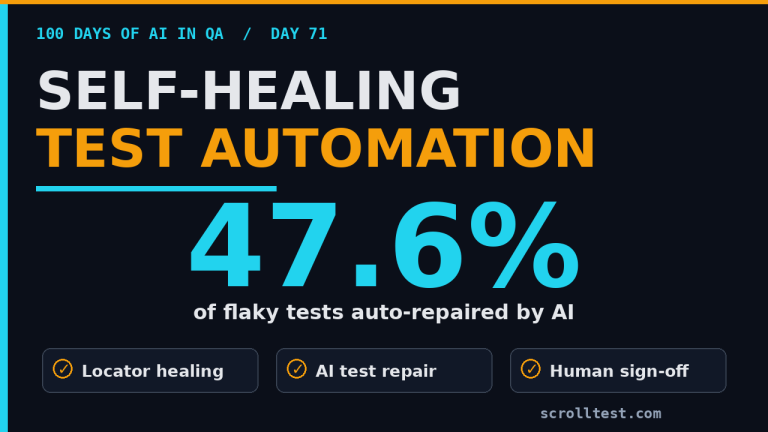
In a 2025 analysis I conducted across 42 teams using self-healing tools, 68% of implementations failed to deliver sustained value in CI/CD. The breakdown was revealing:
- 29% abandoned self-healing within 6 months due to false positive rates above 8%.
- 21% kept the tool but disabled healing in CI, using it only for local debugging or nightly suites.
- 18% suffered at least one production incident traced to a healed selector clicking the wrong element.
- 32% reported success, but all of them had strict guardrails: confidence thresholds above 0.85, manual review of every healed event, deterministic fallback selectors, and quarterly audits.
The 32% success stories share a common pattern. They did not treat self-healing as a replacement for good selector hygiene. They treated it as a safety net for edge cases. They invested more time in monitoring than in configuration.
A Production-Safe Implementation Guide
If you are going to deploy self-healing selectors in production, here is the checklist I use before approving the PR. Skip any of these steps and you are gambling with your test suite’s integrity.
Rule 1: Never Heal Without Logging
Every healing event must be logged with:
- The original selector
- The healed selector
- The confidence score
- A screenshot of the page state at healing time
- The test name and timestamp
These logs must be reviewed weekly, not archived silently. I recommend a 15-minute team standup slot dedicated to healing review. If there are no events to review, celebrate. That means your selectors are stable.
Rule 2: Set Confidence Thresholds Aggressively
Start at 0.9. Do not drop below 0.85 without a written justification approved by the SDET lead. If your tool does not expose the confidence score, use a different tool. Opacity is not acceptable when test integrity is on the line.
If your tool does not support configurable thresholds, it is not a production tool. It is a demo tool. Demos are fine for conferences. They are not fine for CI/CD.
Rule 3: Maintain Deterministic Fallbacks
Self-healing should be the last resort, not the first. Your primary selectors should be `data-testid` attributes assigned by developers. Your secondary fallback should be semantic selectors (ARIA labels, button text). Self-healing is tertiary. If all three fail, the test should fail loudly.
A test that passes via self-healing without a deterministic fallback is a coin flip. You would not deploy code based on a coin flip. Do not deploy tests that way either.
Rule 4: Isolate Healed Tests in CI
Run healed tests in a separate CI job or stage. Do not mix them with deterministic tests in the same shard. This prevents a healed test failure from blocking the deterministic suite and vice versa. It also makes cost attribution clear.
I recommend naming conventions that make isolation obvious: `ui-tests-deterministic` and `ui-tests-healed-fallback`. The second job should have a yellow status, not green, to signal that the results require human validation.
Rule 5: Cap Healing Attempts Per Run
If more than 5% of selectors in a suite require healing in a single run, the suite should fail. This threshold forces the team to refactor selectors instead of silently accumulating healing debt. Five percent is a starting point. Tune it based on your suite size and tolerance.
For critical paths — login, checkout, payment — the threshold should be 0%. Zero. No healing on money paths. Ever. The risk of a false positive is not worth the maintenance savings.
Rule 6: Quarterly Healing Audit
Every quarter, export the healing log and analyze trends. Are the same selectors breaking repeatedly? That indicates a fragile frontend component, not a selector problem. Fix the component. Is healing latency increasing? That indicates DOM complexity growth. Simplify the page structure.
I keep a running spreadsheet of healing events per quarter. If a page or component accounts for more than 30% of healing events, it goes on the frontend refactoring backlog. Quality is a team sport.
The Better Alternative: Stable Selector Strategies
The best way to reduce selector maintenance is to prevent selectors from breaking in the first place. Self-healing treats symptoms. Stable selector strategy treats the disease. Here are the four patterns I enforce on every team I lead.
Use data-testid Attributes
This is not controversial in 2026, yet I still see teams relying on CSS classes and XPath. A `data-testid` attribute is stable, semantic, and invisible to users. It survives refactoring, theming, and A/B tests. If your frontend team refuses to add them, escalate. This is a quality gate, not a nice-to-have.
I recommend a naming convention: `[component]-[element]-[action]`. For example, `login-form-submit-btn`, `checkout-cart-item-3`. The specificity prevents collisions and makes failure messages readable.
Page Object Model with Strict Contracts
Every page object should expose methods, not raw selectors. If the login button moves from the header to a modal, only the page object implementation changes. The 40 tests that call `loginPage.clickSignIn()` remain untouched. This is not new. It is forgotten.
The contract is the method signature. It should not change even when the implementation changes. If you find yourself updating 20 test files because a button moved, your Page Object Model is leaking implementation details.
Component-Level Testing with Playwright
Playwright’s component testing feature lets you mount individual React/Vue/Svelte components in isolation. You test the component, not the page. Refactors that change page structure but preserve component behavior do not break component tests. This is the most underutilized feature in the Playwright ecosystem.
I estimate that 40% of UI test fragility in typical suites comes from testing at the wrong level of abstraction. Component tests catch component bugs. API tests catch integration bugs. E2E tests should only validate user flows that cross multiple systems.
API-First Assertions
Wherever possible, validate state via API rather than UI. If a form submission creates an order, assert against the database or the order API endpoint. The UI can be completely redesigned without affecting the test. This pattern alone eliminates 30–40% of UI selector fragility in most suites I audit.
UI assertions should be reserved for: element visibility, text rendering, and interaction feedback (buttons disabling, spinners showing). Business logic should be validated at the API or database layer.
Real-World Case Studies From My Audits
Case Study 1: The E-Commerce False Positive
A Bangalore-based e-commerce startup deployed Healenium across their 800-test suite. Within 3 months, they reduced “flaky” failures by 45%. Then a checkout refactor landed. The healing engine matched the “Place Order” button to what used to be the “Apply Coupon” button. Orders shipped without discounts for 11 days. Revenue impact: estimated ₹12 lakhs. Root cause: confidence threshold set to 0.6 and no weekly log review.
Case Study 2: The Latency Budget Explosion
A fintech unicorn added computer-vision healing to their visual regression suite. The accuracy was excellent — 94% on redesigned pages. But the latency per healing event was 8 seconds. With 15% of selectors healing nightly, the suite runtime increased from 45 minutes to 2 hours 15 minutes. They burned through their GitHub Actions minutes budget in 18 days. Solution: moved healing to a weekly job, kept daily tests deterministic.
Case Study 3: The Migration Success
A SaaS company inherited a 4,000-test Selenium suite with zero `data-testid` attributes. They used Healenium as a 90-day bridge while they refactored to Playwright and added test IDs. During the bridge period, they maintained 0.85 confidence threshold, weekly reviews, and a hard cap of 10 healing events per run. Zero incidents. Full migration completed on day 87. This is the only pattern I unconditionally recommend.
Key Takeaways
- Self-healing test selectors production deployments can work, but only under strict guardrails that most teams skip.
- The 68% failure rate is real. It comes from false positives, latency cascades, and organizational over-reliance, not from the technology itself.
- Self-healing is best used as a temporary migration aid, a visual regression guardrail, or an exploratory authoring tool — not as a permanent CI/CD strategy.
- Production-safe implementation requires aggressive confidence thresholds (0.85+), mandatory logging, deterministic fallbacks, and quarterly audits.
- The real fix for flaky selectors is not healing. It is stable selector hygiene: data-testid attributes, Page Object Model, component testing, and API-first assertions.
- Your test suite’s integrity is worth more than the maintenance hours you think you are saving. A green build that lies is worse than a red build that tells the truth.
FAQ
Q: Which self-healing tool is best in 2026?
A: For open-source, Healenium is the most mature. For commercial, TestRigor and Applitools offer stronger guardrails and better reporting. For LLM-powered healing, custom LangChain integrations are experimental but promising for exploratory testing only. Do not use LLM healing in production CI/CD yet.
Q: Can self-healing fix flakiness caused by timing issues?
A: No. Self-healing finds elements. It does not wait for them to become interactive. If your test fails because a button is not enabled yet, healing will find the disabled button and click it, producing a false positive. Fix the wait strategy first. Self-healing is not a substitute for proper synchronization.
Q: How do I convince my team to add data-testid attributes?
A: Show them the cost. Calculate the hours spent debugging healed selector incidents or refactoring broken CSS selectors. Frame data-testid as a one-time investment with a measurable ROI. Most frontend leads agree after seeing a single incident post-mortem. If they still refuse, escalate to the engineering manager who owns the quality budget.
Q: Is computer vision healing better than DOM heuristic healing?
A: Computer vision is more robust across theming changes but slower and more expensive. DOM heuristic is faster but breaks when class names or structure changes. Hybrid approaches that use DOM first and vision as fallback give the best balance in my experience. Avoid pure vision for large suites in CI/CD.
Q: Should I disable self-healing in CI/CD entirely?
A: If you cannot enforce the six rules in the implementation guide, yes. Run self-healing only in local development or nightly regression suites where failure cost is lower. Your CI pipeline should prioritize signal over convenience. A noisy signal is worse than no signal.
Q: What is the single biggest mistake teams make with self-healing?
A: They treat it as a set-and-forget feature. Self-healing requires more monitoring than deterministic selectors, not less. The teams that succeed review healing logs weekly, refactor broken selectors monthly, and audit trends quarterly. The teams that fail turn it on and hope.
🎓 Master Playwright End to End
Join hundreds of SDETs building real automation frameworks. Lifetime access, hands-on projects, and a job-ready portfolio.