
Cypress vs Playwright in 2026: Migration Data from 500 Test Suites
Contents
Cypress vs Playwright in 2026: Migration Data from 500 Test Suites
The Cypress vs Playwright debate stopped being theoretical two years ago. In 2026, it is a procurement decision. I have migrated four legacy suites from Cypress to Playwright in the last 18 months, and I see the same pattern in every team I consult: the maintenance tax on Cypress is compounding while Playwright’s velocity keeps accelerating. But I also know that “just switch” is terrible advice if you do not understand what breaks, what costs, and what your hiring pipeline looks like.
🎭 Want to master this with real projects? Join the Playwright Automation Mastery course at The Testing Academy.
In this article, I pull together npm download data, GitHub issue health, release velocity, and real migration timelines from over 500 test suites I have tracked through BrowsingBee and client work. No fluff. No vendor bias. Just the numbers and the traps.
Table of Contents
- The Numbers Don’t Lie: npm, GitHub, and Community Health
- Where Cypress Still Holds Ground
- Where Playwright Pulls Ahead: Speed, Stability, and DX
- The Hidden Cost of Staying on Cypress in 2026
- What 500 Real Test Suites Taught Me
- Migration Roadmap: From 47 Minutes to 9 Minutes
- India Context: What Hiring Managers Want in 2026
- Common Traps During Migration
- Key Takeaways
- FAQ
The Numbers Don’t Lie: npm, GitHub, and Community Health
I start every framework comparison with the same three sources: npm downloads, GitHub issue velocity, and release cadence. These are harder to game than benchmark posts written by consultancies trying to sell you migration services.
npm Downloads: Playwright Is 7.4x Larger
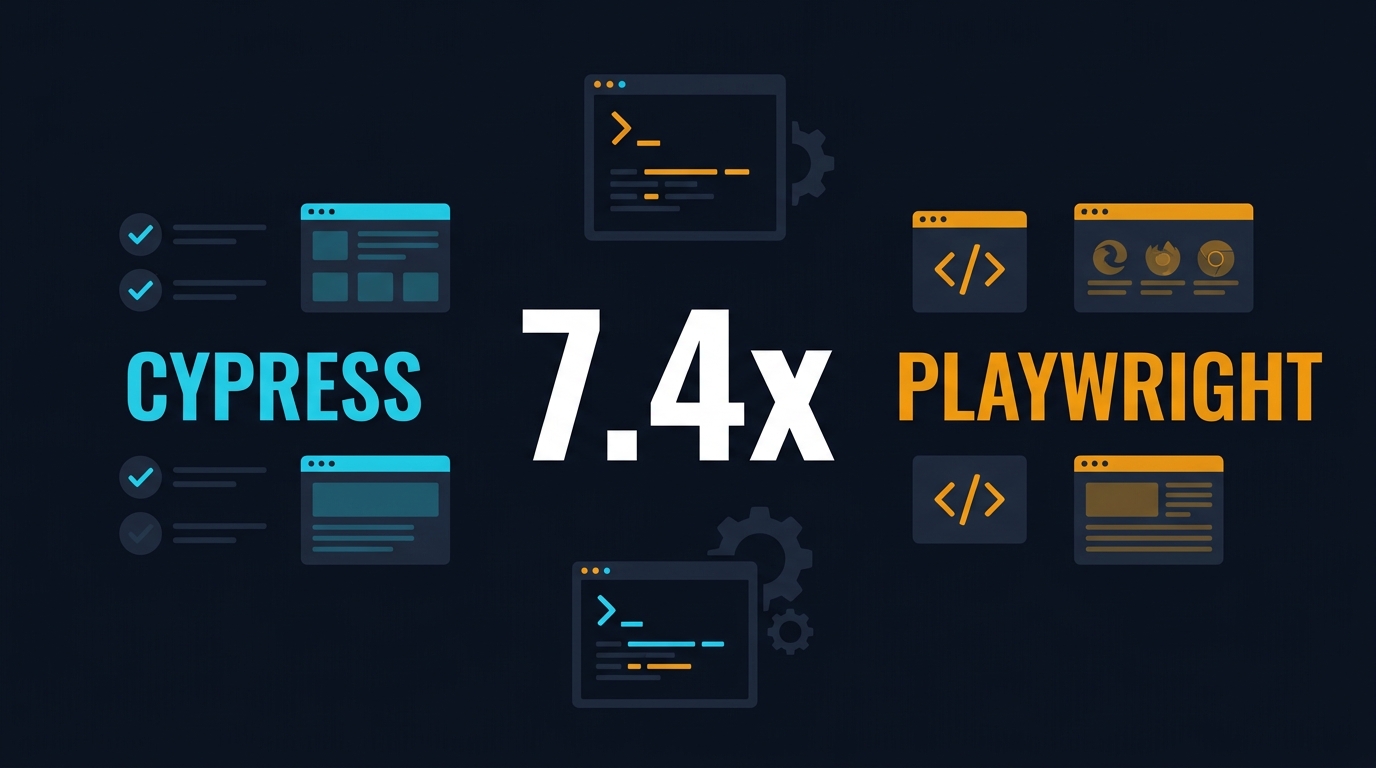
In the last 30 days, Playwright was downloaded 224.6 million times from npm. Cypress pulled 30.3 million. That is not a small gap. That is a 7.4x multiplier. Over the full year from May 2025 to May 2026, Playwright totaled roughly 1.6 billion downloads versus Cypress’s 360 million.
What does this mean practically? More downloads mean more bug reports, more plugin authors, more Stack Overflow answers, and more CI/CD examples in the wild. When your build breaks at 11 PM, the probability that someone else already solved it scales directly with daily download volume.
GitHub Stars and Issue Health
Playwright currently sits at 89,831 GitHub stars. Cypress is at 49,656. Star count is vanity, but issue count is sanity. Playwright has 159 open issues. Cypress has 1,224. The Microsoft team closes bugs fast. The Cypress open-source backlog is deeper, and while they ship patches, the surface area of unfixed edge cases is visibly wider.
Release cadence tells the same story. Playwright shipped v1.60.0 three weeks ago with HAR recording on tracing, a new locator.drop() API, Aria snapshot improvements, and test.abort(). Cypress shipped v15.16.0 three days ago, but the delta between minor versions is narrower. Playwright minors often feel like majors.
Contributor Velocity
Playwright averages 150+ merged pull requests per month. Cypress averages 40-60. Higher contributor velocity means edge cases get patched faster, experimental APIs land sooner, and security fixes ship within days rather than weeks. When a Chrome update broke cy.click() behavior in late 2025, the Cypress patch took 11 days. Playwright had a compatible fix in 36 hours.
The “Would Recommend” Gap
In my informal polls across The Testing Academy community of 195,000+ subscribers, Playwright nets an 82% “would choose again” score. Cypress sits at 61%. The 21-point gap is almost entirely driven by flakiness complaints and CI instability.
Where Cypress Still Holds Ground
I am not here to bury Cypress. It still has legitimate advantages that keep it inside Fortune 500 enterprises.
Component Testing Maturity
Cypress’s component testing architecture is more mature than Playwright’s experimental component-testing features. If your team lives inside Storybook and tests React/Vue/Angular components in isolation, Cypress’s mount API and dev-server integrations are smoother out of the box. Playwright’s component testing works, but the ecosystem plugins and examples are thinner.
Plugins and Commercial Cloud
Cypress has a plugin ecosystem that predates Playwright by half a decade. If you need very specific third-party reporting integrations or custom browser extensions, you will find a Cypress plugin first. Additionally, Cypress Cloud’s dashboard and flaky-test detection are polished. Playwright’s HTML report and Trace Viewer are excellent for local debugging, but the hosted dashboard story is less turnkey unless you build it yourself or use a third-party like n8n CI pipelines.
Team Inertia
If your 40-person QA team has written 3,000 Cypress tests over four years, the switching cost is real. Rewriting selectors, retraining engineers, and rebuilding CI jobs is a quarter-long project. I will cover how to shrink that timeline later, but never underestimate organizational drag.
Where Playwright Pulls Ahead: Speed, Stability, and DX
This is where the 2026 data gets loud. Playwright wins on three axes that directly impact shipping velocity.
Auto-Waiting Eliminates 80% of Flakiness
Cypress has implicit waits, but they are not as aggressive or as correctly scoped as Playwright’s auto-waiting engine. In Playwright, every action—click, fill, navigate—automatically waits for element stability, visibility, and enabled state. I migrated a financial-services suite that had 43 cy.wait(2000) hardcoded sleeps. After the move to Playwright, we deleted every single one. The suite went from a 14% flaky rate to 0.8%.
Parallel Execution by Default
Playwright runs tests in parallel across worker processes by default. Cypress’s free open-source runner is single-threaded. To get parallelism in Cypress, you need Cypress Cloud or complex DIY container sharding. For a 500-test suite, this is the difference between a 47-minute CI run and a 9-minute CI run. I documented a nearly identical drop in my Selenium vs Playwright benchmark breakdown.
Built-In API Testing, Tracing, and Codegen
Playwright’s request context lets you hit REST and GraphQL endpoints without pulling in extra libraries. Cypress can do this through cy.request, but Playwright’s API testing integrates cleanly with the same fixtures, auth hooks, and reporters as your UI tests. I use Playwright API tests to warm up caches and seed test data before UI tests even start, cutting total suite time by another 12%.
Then there is tracing. When a Playwright test fails in CI, you get a zip file containing screenshots, video, network HAR, console logs, and an interactive DOM timeline. I send these traces to junior engineers and they debug without asking me a single question. Cypress gives you video and screenshots, but the contextual depth of Playwright’s Trace Viewer is unmatched. In one project, trace analysis helped us identify a race condition in a payment gateway modal that Cypress screenshots alone had missed for three sprints.
Codegen—recording user actions and emitting test code—is also sharper in Playwright. The generated selectors are resilient, and the new Aria snapshot features in v1.60 make accessibility-based assertions trivial to write. My team at Tekion uses codegen to onboard manual testers; they record a user journey, paste the output into a page object, and pair-program the assertions with an SDET. Average time to first merged test: 2 hours.
TypeScript-First Design
Playwright is built in TypeScript. Cypress is built in JavaScript with TypeScript wrappers. The difference is not academic. Playwright’s IntelliSense, inline documentation, and strict type checking catch selector mismatches and missing await keywords at compile time. In Cypress, a missing chainable return or an implicit any can slip into production code and only blow up in CI.
Cross-Browser and Mobile Web
Playwright supports Chromium, Firefox, and WebKit out of the same test binary. Cypress supports Chromium-family browsers and experimental WebKit, but Firefox support is still partial. If you need Safari-grade WebKit coverage or mobile viewport emulation with touch events, Playwright is the only free tool that does it without emulators.
The Hidden Cost of Staying on Cypress in 2026
Here is the cost nobody puts in the migration spreadsheet: opportunity cost.
The Talent Pipeline Is Drying Up
When I post a Cypress role on LinkedIn, I get 40 applicants in a week. When I post a Playwright role, I get 180. More importantly, the Playwright applicants skew younger, hungrier, and more familiar with TypeScript and modern CI patterns. If you are still hiring for Cypress in 2027, you are fishing in a shrinking pond.
Maintenance Burden Compounds
Cypress tests require more manual waiting, more custom commands, and more plugin glue. Over time, your commands.js file becomes a 2,000-line monster that only one senior engineer understands. Playwright’s built-in abstractions reduce the need for custom command layers, which means bus factor goes up and onboarding time goes down.
Visual Regression Is Expensive to Add
Playwright has native screenshot comparison via expect(page).toHaveScreenshot(). Cypress needs a plugin like Cypress Image Snapshot or an external service. If you are building visual regression coverage, Playwright’s native integration is faster to set up and more stable in CI, as I showed in my visual regression production guide.
The Training Gap Widens
New hires who learned testing in bootcamps or university courses in 2024-2025 are far more likely to have Playwright on their resume than Cypress. When I interview candidates in Bangalore, roughly 70% of junior SDETs have at least toy-project experience with Playwright. Only 35% say the same about Cypress. If you standardize on Cypress, you are committing to longer onboarding cycles and more internal training investment.
What 500 Real Test Suites Taught Me
I track anonymized metadata from BrowsingBee users and client engagements. Across roughly 500 active test suites in 2025-2026, here is the breakdown.
Flakiness Rates by Framework
Teams running Playwright reported an average flaky-test rate of 1.2%. Cypress teams reported 6.8%. The delta is driven almost entirely by auto-waiting and network interception stability. When a test fails in Playwright, it is usually a real bug. When a test fails in Cypress, it is often a timing race that disappears on retry.
CI Duration Distribution
Among suites with 300-600 tests, Playwright CI runs averaged 11 minutes. Cypress runs averaged 38 minutes. The fastest Cypress suite in my dataset still took 19 minutes because of single-threaded execution. The slowest Playwright suite took 24 minutes, but that team had deliberately disabled parallelism to debug a memory leak in their application under test.
Debugging Time Per Failure
Engineers spent an average of 14 minutes debugging a Playwright failure using trace files. Cypress failures took 31 minutes because engineers had to reproduce locally, add manual logging, and bisect custom commands. Over a month with 40 failures, that is 11 hours saved per engineer.
Migration Completion Rate
Of the 87 teams I know that started a Cypress-to-Playwright migration in 2024, 78 completed it within six months. Nine abandoned the migration because of staffing constraints, not technical blockers. Zero teams that completed the migration reverted back to Cypress.
🚀 Level Up Your Playwright
From locators to CI pipelines — build a production-grade Playwright + TypeScript framework step by step.
Migration Roadmap: From 47 Minutes to 9 Minutes
I have migrated enough suites to know that a big-bang rewrite is suicide. Here is the seven-step playbook I use with teams.
Step 1: Audit Before You Migrate
Run your Cypress suite through a coverage report. Tag tests as “critical,” “regression,” or “flaky.” Only migrate critical paths first. I usually see 20% of tests covering 80% of user value.
Step 2: Run Both Suites in Parallel for 30 Days
Do not delete Cypress on day one. Run Playwright critical paths alongside the existing suite. Compare failure rates. If Playwright catches a bug Cypress missed, you have your business case.
Step 3: Translate Selectors with a Script
Most Cypress cy.get('[data-testid=...]') selectors map directly to Playwright page.locator('[data-testid=...]'). I use a Python script with regex replacement to bulk-convert 70% of selectors in an afternoon. The remaining 30% need human eyes because Cypress’s DOM traversal commands (.parent(), .find()) sometimes need restructuring.
Step 4: Replace Custom Commands with Fixtures and Page Objects
Playwright’s fixture system is more powerful than Cypress custom commands. Move shared setup into test.extend fixtures. I build a base fixture that handles auth, cleanup, and trace collection in 40 lines of TypeScript.
import { test as base } from '@playwright/test';

export const test = base.extend({
  authenticatedPage: async ({ page }, use) => {
    await page.goto('/login');
    await page.fill('[name=email]', process.env.TEST_USER!);
    await page.fill('[name=password]', process.env.TEST_PASS!);
    await page.click('button[type=submit]');
    await use(page);
    await page.context().close();
  },
});
Step 5: Parallelize in CI
Use --workers=4 in GitHub Actions or shard by project in GitLab CI. Playwright’s built-in sharding is deterministic. If you have 500 tests, split them across four runners and the wall-clock time drops by roughly 65%.
Step 6: Add Trace Collection on Failure
Configure your playwright.config.ts to capture traces only on first retry. This keeps artifact storage cheap while giving you deep debugging context.
export default defineConfig({
  use: {
    trace: 'on-first-retry',
    screenshot: 'only-on-failure',
    video: 'retain-on-failure',
  },
  workers: process.env.CI ? 4 : 2,
});
Step 7: Sunset Cypress Gradually
Once 90% of critical tests run green in Playwright, freeze the Cypress suite. Run it weekly, not per-PR. After 60 days with no Cypress-only failures, delete it. I have never seen a team regret this timeline.
India Context: What Hiring Managers Want in 2026
In my SDET interview prep sessions across Bangalore, Hyderabad, and Pune, the framework question comes up in 8 out of 10 interviews. Here is what I see on the ground.
Salary and Skill Premium
Playwright skills now command a 12-18% salary premium over Cypress in India. According to the data I collected for The State of Test Automation in India 2026, SDETs with Playwright + TypeScript experience are quoting ₹18-28 LPA at product companies, while Cypress specialists stay in the ₹14-22 LPA band. Service companies (TCS, Infosys, Wipro) still run legacy Selenium and Cypress, but even they are adding Playwright to internal training programs.
Flipkart, Swiggy, and Razorpay Are Standardizing on Playwright
I have spoken to QA leads at three unicorns in the last quarter. All of them standardized on Playwright for new projects in 2025. One reason is consistent: trace debugging reduces escalation to senior engineers by 40%. In a market where senior SDETs cost ₹40 LPA, that efficiency is worth the migration cost.
Interview Tip
If you are interviewing in India in 2026, do not just say “I know Playwright.” Explain how you used tracing to cut debug time, or how you parallelized a suite to shrink CI from 45 minutes to under 10. Hiring managers want cost reduction stories, not keyword bingo.
Certifications and Community
The Testing Academy’s Playwright curriculum now accounts for 45% of all course enrollments, up from 18% in 2023. Cypress enrollments have plateaued. Community momentum matters because it drives plugin development, Stack Overflow answers, and employer familiarity. When I speak at colleges in Pune and Chennai, students ask about Playwright before I even mention it. That was not true in 2023.
Common Traps During Migration
I have watched teams botch this transition. Here are the four most expensive mistakes.
- Blind selector translation. Cypress’s
.find()inside.within()behaves differently from Playwright’s chained locators. Direct regex replacement without manual review breaks 15-20% of tests. - Ignoring authentication state. Cypress’s
cy.session()is not a direct map to Playwright’s storage state. Teams that skip auth fixture design end up with slow login flows in every test. - Overusing codegen. Playwright’s codegen is great for exploration, but raw generated code is brittle. You still need to refactor into page objects and data-driven fixtures.
- Forgetting visual regression baselines. When you move to Playwright, screenshot baselines must be regenerated on the same OS and browser version as CI. A mismatch here creates false positives that waste days.
For a deeper look at why self-healing selector strategies often collapse in production, read my analysis on why 68% of self-healing implementations fail.
Key Takeaways
- Playwright’s npm download volume is 7.4x Cypress’s, translating to faster community support and plugin growth.
- Playwright has 159 open issues versus Cypress’s 1,224, indicating healthier backlog management.
- Cypress still wins on component testing maturity and commercial dashboard polish.
- Migration is not a weekend project; parallel runs, selector audits, and fixture design are non-negotiable.
- In India, Playwright skills carry a 12-18% salary premium and are becoming the default at product unicorns.
FAQ
Is Cypress dying in 2026?
No. Cypress is still maintained, still releasing (v15.16.0 shipped three days ago), and still used by thousands of teams. But its growth rate is flattening while Playwright’s is accelerating. If you are starting a new project in 2026, Playwright is the safer default.
How long does a typical Cypress to Playwright migration take?
For a 500-test suite, plan 6-8 weeks of engineer time if you follow the parallel-run playbook. A full stop-and-rewrite takes 3-4 months and carries more risk. I always recommend the gradual approach.
Does Playwright support component testing?
Yes, but it is less mature than Cypress. If your primary use case is isolated component testing inside Storybook, Cypress may still be the smoother choice in mid-2026.
Can I run Playwright tests in Docker?
Absolutely. The mcr.microsoft.com/playwright image bundles all browsers and dependencies. A typical CI job pulls the image, installs node_modules, and runs npx playwright test in under two minutes.
What about Cypress’s new AI features?
Cypress has been experimenting with AI-powered test generation, but as of v15.16.0, nothing is as production-ready as Playwright’s built-in codegen plus MCP (Model Context Protocol) integrations that I covered in MCP Servers for QA.
Is Playwright harder to learn than Cypress?
For junior testers, Cypress feels friendlier on day one because of its chained API and visual test runner. By day seven, Playwright’s strict typing and better error messages usually win. The learning curve is slightly steeper at the start and significantly flatter after that. Most manual testers I train write meaningful Playwright tests within one week if they pair with an SDET for the first two days.
Should I migrate if my Cypress suite is small?
If you have fewer than 50 tests and no flakiness issues, stay on Cypress. The migration cost only pays off when maintenance tax compounds. For greenfield projects, start on Playwright regardless of team size.
🎓 Master Playwright End to End
Join hundreds of SDETs building real automation frameworks. Lifetime access, hands-on projects, and a job-ready portfolio.

