AI Test Oracle Drift: CI Playbook for SDETs
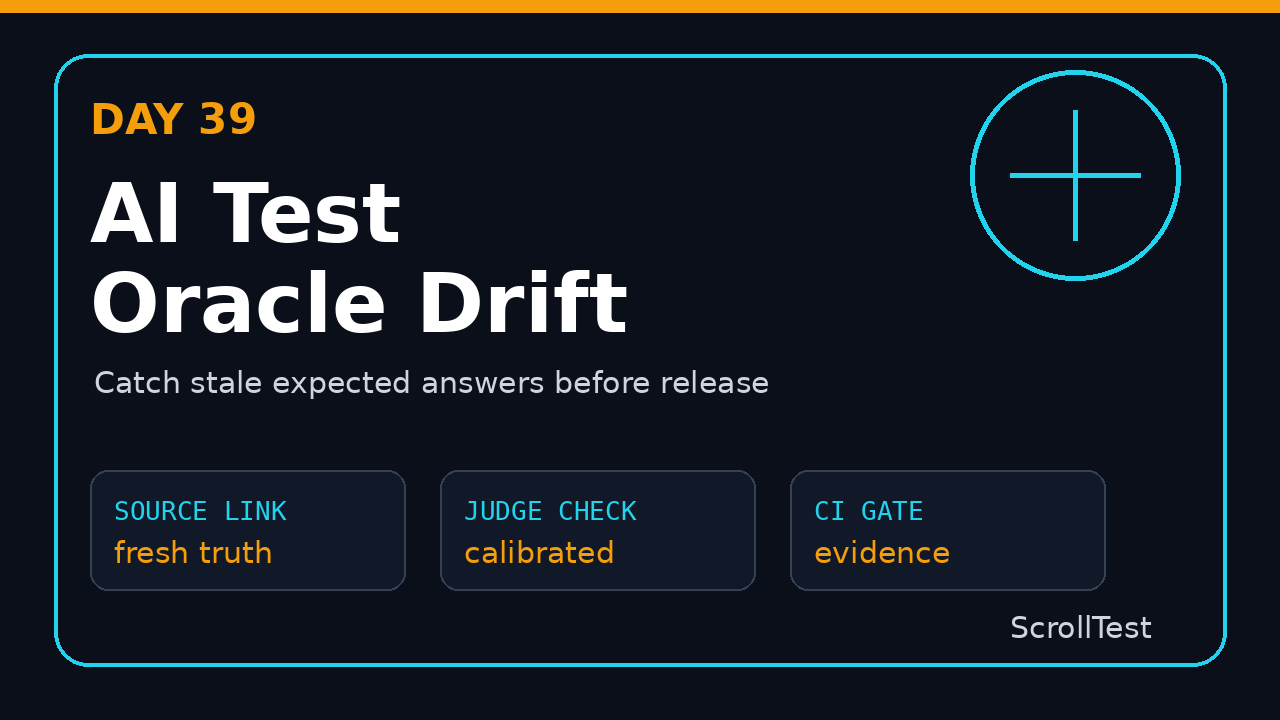
Day 39 of 100 Days of AI in QA & SDET. AI test oracle drift is what happens when your expected answer quietly stops representing product truth. The model may still return polished text, the test may still pass, and the user may still get the wrong outcome.
I see this most often in teams that add LLM checks after a production incident. They freeze ten examples, wire a simple judge, celebrate the green pipeline, and then forget that prompts, retrieval data, policies, model versions, and user expectations keep changing. This article gives SDETs a CI playbook for detecting drift before it becomes a release surprise.
Table of Contents
- What Is AI Test Oracle Drift?
- Why Green AI Tests Lie
- Signals That Your Oracle Is Drifting
- The CI Playbook for AI Test Oracle Drift
- PromptFoo and DeepEval Stack
- Failure Triage for SDETs
- India QA Leadership Context
- Implementation Template
- Key Takeaways
- FAQ
Contents
What Is AI Test Oracle Drift?
In classic test automation, the oracle is the thing that tells you whether a result is correct. It may be an assertion, a database value, a contract schema, a screenshot baseline, or a known response code. In AI testing, the oracle is messier because correctness is often semantic.
AI test oracle drift happens when that judgment layer becomes stale. Your product behavior changes, customer language changes, retrieval content changes, or risk tolerance changes, but the test still judges against the old definition of good.
The simple definition
If the model output changes and the test fails, you have a normal regression signal. If the world changes and the test still passes, you may have oracle drift. That second case is more dangerous because it creates false confidence.
For example, a support bot may pass an old refund-policy eval because it says, “refunds are available within 30 days.” If the policy changed to 14 days last week, the test should fail. If it does not, your oracle is not testing the product anymore. It is testing a museum version of the product.
Why SDETs should care
AI features create a new QA ownership problem. Product managers own intent, ML or platform teams own the model layer, backend teams own retrieval and APIs, and QA owns release confidence. When nobody owns the oracle, everyone assumes the green check means quality.
That is why I treat oracle drift as a release risk, not a research topic. It belongs beside flaky tests, dependency upgrades, schema changes, and broken environment data. It needs owners, dashboards, and CI gates.
Why Green AI Tests Lie During AI Releases
Green AI tests can lie for four common reasons. None of them mean the team is careless. They mean the test system is incomplete.
1. The dataset is too small
A dataset with 20 examples can be useful for a smoke check, but it cannot represent every user segment, locale, policy edge case, and abuse path. Small datasets age quickly. They also overfit to the examples that the team remembers from the last incident.
Promptfoo describes itself as an open-source CLI and library for evaluating and red-teaming LLM apps in its official introduction. That matters because red-team style coverage is not a nice extra. It is how you find cases that a happy-path dataset will miss.
2. The judge is not calibrated
Many teams use an LLM judge without building a calibration set. That is risky. If the judge accepts verbose but wrong answers, your score improves while the customer experience gets worse. If the judge is too strict, the team starts ignoring failures.
DeepEval’s quickstart shows the basic shape of a test case, metric, and deepeval test run command in the DeepEval docs. The important part for QA is not the command. It is the discipline of treating metrics as test code that needs review, versioning, and failure analysis.
3. The product truth moved
AI apps often depend on knowledge bases, prompts, templates, tool outputs, pricing tables, compliance rules, and feature flags. Any of those can change without a model change. If your expected output does not move with product truth, the eval becomes stale.
4. The pass threshold hides regression
A score threshold such as 0.7 can hide a meaningful decline. One release scores 0.92, the next scores 0.75, and both pass. For a release manager, that is not the same result. Trend movement matters, especially when the failing examples cluster around high-value workflows.
AI Test Oracle Drift Signals to Track
I use seven signals when I audit AI eval suites. They are simple enough for a weekly QA review and specific enough for CI automation.
Signal 1: stale expected answers
Look for expected outputs that mention old policy numbers, retired product names, deprecated URLs, or outdated process steps. These are the easiest drift issues to fix because the evidence is visible.
Signal 2: rising judge disagreement
When a human reviewer and an automated judge disagree more often, the oracle needs attention. Track disagreement as a metric. Do not bury it in screenshots or Slack threads.
Signal 3: lower score with same pass rate
If average score drops from 0.91 to 0.78 but the pipeline still passes, the threshold is hiding risk. The build should at least warn when trend movement crosses a defined band.
Signal 4: failures concentrated in one bucket
I like the four-bucket model from our AI test failure classification guide: prompt issue, retrieval issue, product bug, or dataset gap. If one bucket grows every week, the oracle is telling you where ownership is weak.
Signal 5: evaluator dependency changes
Evaluation tools ship fast. The npm registry currently reports Promptfoo as an LLM eval and testing toolkit with its latest package metadata at registry.npmjs.org/promptfoo/latest. PyPI currently reports DeepEval as “The LLM Evaluation Framework” at pypi.org/pypi/deepeval/json. If those tool versions change, your scoring behavior can change too.
Signal 6: missing source-of-truth link
Every expected answer should point to a product source, policy page, API contract, or ticket. If an expected answer exists only because someone wrote it six months ago, I mark it as weak evidence.
Signal 7: high-severity examples are not weighted
A wrong answer for a pricing page, refund policy, medical disclaimer, finance workflow, or admin permission is not equal to a slightly awkward greeting. Weight the examples. Release gates should reflect business risk.
The CI Playbook for AI Test Oracle Drift
The goal is not to run a massive eval suite on every commit. The goal is to run the right checks at the right time and preserve evidence for release decisions.
Step 1: split smoke, regression, and audit suites
Do not put every AI eval in one job. I use three layers:
- Smoke suite: 10 to 30 high-value examples on every pull request.
- Regression suite: broader dataset on nightly or pre-release builds.
- Oracle audit suite: weekly review that checks expected answers, source links, and judge agreement.
This split keeps CI fast without pretending that one small suite gives full release confidence.
Step 2: version the dataset like code
Store eval datasets in Git. Review changes through pull requests. Add owners to high-severity examples. Keep a changelog that explains why examples were added, removed, or reworded.
# eval-cases/refund-policy.yml
- id: refund-policy-001
  severity: high
  source: https://example.com/internal/refund-policy
  input: "Can I get a refund after 20 days?"
  expected_facts:
    - "refund window is 14 days"
    - "support escalation is required after the window"
  owner: qa-platform
  last_reviewed: "2026-07-17"
Step 3: add metadata that exposes drift
Most teams track input and expected output. Add product area, source URL, severity, owner, last reviewed date, retrieval collection, prompt version, model version, and evaluator version. This metadata turns vague failures into assignable work.
Step 4: fail on high-risk movement, not only absolute score
A static threshold is not enough. Add rules for score movement, high-severity failures, and judge disagreement. A simple policy works better than a clever score nobody trusts.
def release_gate(report):
    if report.high_severity_failures > 0:
        return "block"
    if report.avg_score_drop >= 0.10 and report.affected_area == "checkout":
        return "block"
    if report.judge_disagreement_rate >= 0.15:
        return "review"
    if report.stale_oracle_count >= 5:
        return "review"
    return "pass"
Step 5: publish evidence, not only status
A release manager needs to know which examples failed, why they failed, who owns them, and what changed since the last release. This connects directly to the release-gate idea in our AI test evidence in CI/CD guide.
PromptFoo and DeepEval Stack for AI Test Oracle Drift
I like a two-tool pattern because AI quality has two different jobs. One job is broad prompt and provider regression. The other is metric-heavy evaluation of app behavior. PromptFoo and DeepEval fit those jobs well.
Use PromptFoo for matrix regression
PromptFoo is useful when you want to compare prompts, models, providers, and test inputs in a readable matrix. Its docs describe matrix-style evaluations, CLI usage, CI/CD, and red-team reports. For QA teams, that maps well to regression testing language.
# promptfooconfig.yaml
prompts:
  - file://prompts/support.md
providers:
  - openai:gpt-4.1-mini
  - anthropic:messages:claude-3-5-sonnet-latest
tests:
  - vars:
      question: "Can I get a refund after 20 days?"
    assert:
      - type: contains
        value: "14 days"
      - type: not-contains
        value: "30 days"
This is not enough for every case, but it is excellent for fast feedback when prompts or providers change.
Use DeepEval for metric-rich tests
DeepEval is useful when you want Python tests, metrics, datasets, and CI behavior that feels familiar to SDETs. The official docs show local eval runs with test cases and metrics. That makes it easier to put LLM checks beside existing test automation.
from deepeval import assert_test
from deepeval.test_case import LLMTestCase
from deepeval.metrics import AnswerRelevancyMetric

def test_refund_policy_answer():
    case = LLMTestCase(
        input="Can I get a refund after 20 days?",
        actual_output=call_support_bot("Can I get a refund after 20 days?"),
        expected_output="Refund window is 14 days. Escalate after that."
    )
    metric = AnswerRelevancyMetric(threshold=0.85)
    assert_test(case, [metric])
Watch the evaluator versions
OpenAI’s evals repository describes evals as a framework for evaluating LLMs and LLM systems. That framing is important. An eval is software. It has dependencies, versions, defaults, bugs, and behavior changes. Treat evaluator upgrades the same way you treat Selenium, Playwright, or API client upgrades.
If your eval score changes after a tool upgrade, do not assume the product improved or regressed. First compare evaluator version, model version, prompt version, and dataset version. Our AI eval release watch workflow covers that dependency-monitoring habit.
Failure Triage for SDETs
Good AI testing is not only about finding failures. It is about routing failures without wasting engineering time.
Use four buckets
- Prompt issue: the instruction is unclear, conflicting, or missing constraints.
- Retrieval issue: the answer uses old, missing, or irrelevant context.
- Product bug: the app behavior is wrong outside the model layer.
- Dataset gap: the expected answer, metadata, or source link is wrong.
This avoids the lazy label of “AI flakiness.” Most failures are not magic. They are routing problems.
Ask three questions before blocking
- Is the failing example high severity or customer visible?
- Did the expected answer have a current source-of-truth link?
- Did a model, prompt, retrieval, evaluator, or dataset version change?
If the answer is unclear, block only the risky workflow and create a review task. Do not freeze the entire release because one low-severity phrasing check moved from 0.86 to 0.82.
Keep a human review lane
AI evals need human review, especially during the first 60 days of a new suite. Sample passes and failures. Review judge explanations. Check whether the failure bucket is correct. This is where experienced QA engineers add real value.
India QA Leadership Context
For Indian SDETs, this is a career opening. Many service-company teams still treat AI testing as prompt writing. Product companies need engineers who can convert vague AI risk into CI evidence, release gates, and ownership.
If you are aiming for senior SDET, staff QA, or QA manager roles in Bengaluru, Pune, Hyderabad, or remote product teams, learn to speak this language:
- dataset versioning
- oracle freshness
- judge calibration
- retrieval quality
- release evidence
- business-risk weighting
That is the difference between “I used an AI testing tool” and “I designed the quality system for AI features.” The second line is far stronger in interviews.
Implementation Template: 14-Day Rollout
If I had to implement AI test oracle drift checks in a team without creating process drama, I would use this 14-day plan.
Days 1 to 3: inventory and ownership
List AI workflows, model calls, prompts, retrieval sources, and current evals. Assign owners for each product area. Pick 20 high-value examples and add source-of-truth links.
Days 4 to 7: build the smoke gate
Create a small PromptFoo or DeepEval suite. Run it in pull requests. Publish a report artifact. Do not block releases yet. Spend this week learning failure patterns.
Days 8 to 10: add drift metadata
Add severity, owner, last reviewed date, source URL, prompt version, model version, and evaluator version. Start tracking score movement, not only pass or fail.
Days 11 to 14: turn on selective gates
Block only high-severity failures and large score drops in critical flows. Route stale oracles to review. Create a weekly 30-minute QA review for dataset health.
name: ai-eval-gate
on: [pull_request]
jobs:
  eval:
    runs-on: ubuntu-latest
    steps:
      - uses: actions/checkout@v4
      - uses: actions/setup-python@v5
        with:
          python-version: '3.11'
      - run: pip install -U deepeval
      - run: deepeval test run tests/ai_evals
      - name: Upload eval evidence
        uses: actions/upload-artifact@v4
        with:
          name: ai-eval-report
          path: .deepeval/
Keep the first version boring. A boring quality gate that runs every day beats a beautiful evaluation framework that nobody trusts.
Key Takeaways: AI Test Oracle Drift
AI test oracle drift is one of the easiest risks to miss because it hides behind green checks. The fix is not more random prompts. The fix is disciplined QA engineering.
- AI test oracle drift means your judgment layer no longer matches product truth.
- Track stale expected answers, judge disagreement, score movement, and evaluator versions.
- Split evals into smoke, regression, and oracle audit suites.
- Use PromptFoo for matrix-style regression and DeepEval for Python-based metric tests.
- Route failures into prompt, retrieval, product bug, and dataset gap buckets.
My rule is simple: if an AI feature can affect a customer decision, the oracle needs an owner. Without that owner, your CI pipeline is reporting confidence that nobody actually earned.
FAQ
Is AI test oracle drift the same as model drift?
No. Model drift is about changes in model behavior or data distribution. AI test oracle drift is about the expected-answer and judgment layer becoming stale. They can happen together, but they are not the same problem.
Should every LLM eval block a release?
No. Block high-severity failures, critical workflow regressions, and large score drops. Send low-severity wording changes to review. A gate that blocks too much will be bypassed.
Can I start without PromptFoo or DeepEval?
Yes. Start with a small dataset, source links, owners, and human review. Tools help you scale the habit. They do not replace the habit.
How often should QA review expected answers?
Review high-severity examples weekly and the full dataset at least once per release cycle. Any product policy change should trigger an immediate oracle review.
What should I show leadership?
Show trend movement, high-severity failures, owner routing, and release evidence. Leadership does not need every prompt. They need to know which customer risks are controlled.