
Selenium 4.45 Upgrade Checklist for SDETs
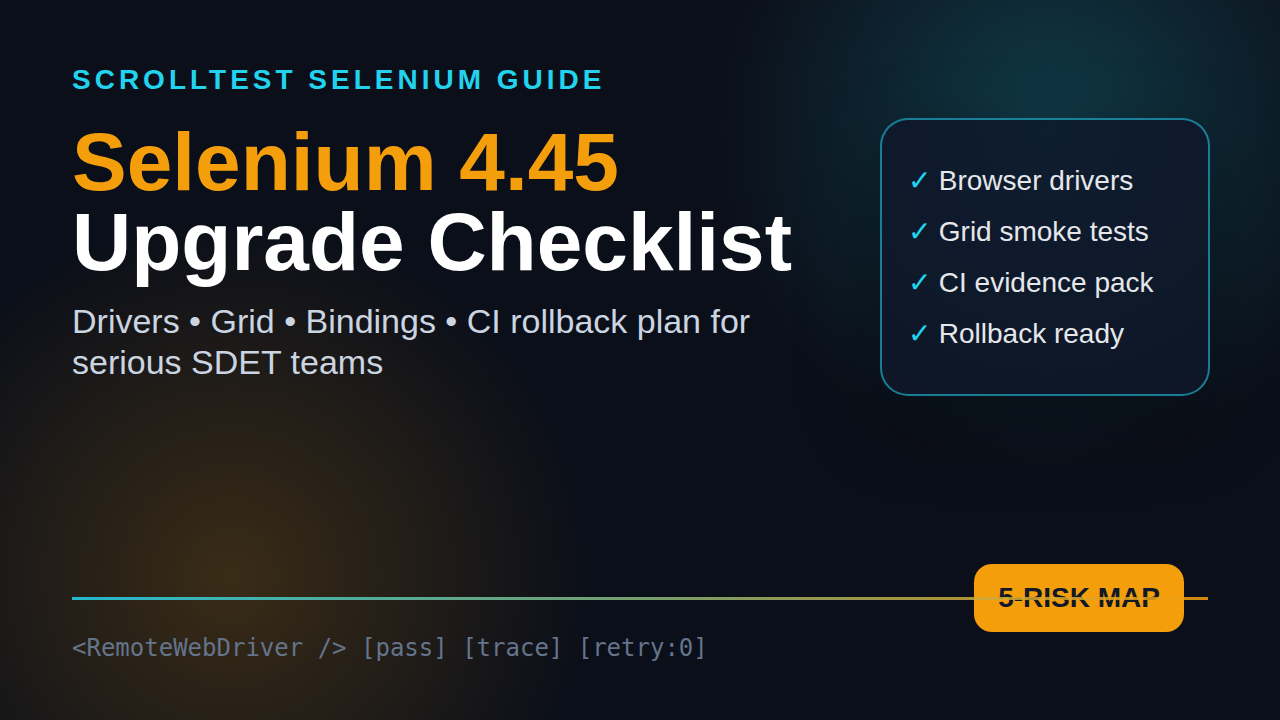
Selenium 4.45 upgrade checklist is the difference between a clean dependency bump and a two-day CI fire drill. Selenium 4.45.0 was published on GitHub on 16 June 2026, and the release touches the areas SDETs usually trust too much: language bindings, Grid, dependency packaging, and browser compatibility behavior.
🎭 Want to master this with real projects? Join the Playwright Automation Mastery course at The Testing Academy.
I do not treat Selenium upgrades as routine library chores. I treat them like small releases of my test platform. This guide gives you a practical checklist you can run before upgrading a local framework, a team CI pipeline, or a Selenium Grid used by multiple squads.
Table of Contents
- What Changed in Selenium 4.45?
- Selenium 4.45 Upgrade Checklist: Risk Map
- Before You Upgrade: Freeze the Baseline
- Check Language Bindings: Java, Python, JavaScript, .NET, Ruby
- Browser Drivers and Selenium Manager Checks
- Selenium Grid Smoke Tests After the Upgrade
- CI Pipeline Upgrade Plan
- Rollback Plan and Release Notes Template
- India SDET Career Context
- Key Takeaways
- FAQ
Contents
What Changed in Selenium 4.45?
The primary source is the Selenium 4.45.0 GitHub release. The release lists downloadable artifacts for Java, .NET, and Selenium Server, with the server JAR published as a separate artifact. It also links to detailed changelogs for Java, Python, .NET, Ruby, and JavaScript.
The release notes are not a single dramatic breaking-change announcement. That is exactly why SDETs should read them carefully. Small platform changes can break a test suite when your framework depends on old logging classes, Grid proxy behavior, JavaScript browser quirks, or pinned transitive dependencies.
The changes I would not ignore
From the GitHub release notes, these items deserve SDET attention:
- Java: deprecated logging classes were removed.
- Grid: a WebSocket proxy race before handshake was closed.
- JavaScript: handling for older browsers and missing casing was corrected.
- Python: runtime dependency lock input moved through pyproject.
- .NET: packaging and SourceLink related fixes landed.
- Ruby: curb HTTP client support was deprecated and Ruby patch versions moved forward.
None of this means your suite will fail. It means you should not bump the version on Friday evening and hope. Hope is not an upgrade strategy.
Selenium 4.45.0 is a platform update, not only a test dependency
Selenium is not a tiny assertion library. It touches browsers, drivers, remote execution, containers, proxies, language runtimes, CI images, and reporting hooks. If you run tests locally only, your upgrade path is short. If you run 2,000 tests across Chrome, Edge, Firefox, Docker, and a remote Grid, the upgrade has more blast radius.
That is why this article focuses on verification, not excitement. If you also maintain Playwright suites, read our internal migration notes on Selenium to Playwright migration planning and Selenium to Playwright setup and configuration. Even if you are staying with Selenium, those posts show how to think about framework changes as engineering work.
Selenium 4.45 Upgrade Checklist: Risk Map
A good Selenium 4.45 upgrade checklist starts with a risk map. Most teams upgrade by changing one line in pom.xml, package.json, requirements.txt, or a Docker image. That is the easy part. The hard part is knowing what else moved under your feet.
Use this five-area risk model
- Language binding risk: compile errors, removed APIs, dependency conflicts, warnings that become failures.
- Browser driver risk: browser version mismatch, Selenium Manager behavior, restricted corporate networks, driver cache issues.
- Grid risk: session creation, WebSocket behavior, node registration, container health, video or trace sidecars.
- Test framework risk: Page Objects, custom waits, logging hooks, test listeners, screenshots, retry wrappers.
- CI risk: Docker image drift, cached dependencies, parallel shard differences, non-reproducible failures.
I like this model because it forces the team to ask better questions. “Did the tests pass?” is too broad. “Did remote Chrome session creation pass through Grid after upgrading both client and server?” is testable.
Small release does not mean small impact
Selenium 4.45.0 includes build and dependency work across the project. Many of those changes are internal to Selenium, but SDETs still need to care when the framework is used in enterprise environments. Corporate proxy settings, older browser versions, Windows agents, Docker base images, and private package mirrors can expose issues that a clean open-source demo project never sees.
My rule is simple: if the test platform affects release confidence, it gets a release checklist. The checklist can be short, but it must exist.
Before You Upgrade: Freeze the Baseline
Do not start with the version bump. Start by capturing the current state. Without a baseline, every failure after the upgrade becomes an argument. Was it already flaky? Did the app change? Did the browser update? Did the Grid node restart? A baseline reduces guesswork.
Capture these numbers before touching dependencies
- Current Selenium client version and Selenium Server version.
- Browser versions for Chrome, Edge, Firefox, and Safari where applicable.
- Driver source: Selenium Manager, pinned driver binary, WebDriverManager, or custom download script.
- Pass rate for last 5 CI runs.
- Top 10 failing or flaky tests from the last 7 days.
- Average suite duration and slowest shard.
- Grid node count, max sessions, browser matrix, and Docker image tags.
If you cannot answer these points, pause. You are not ready to upgrade. You are about to debug multiple moving parts at once.
Baseline command examples
Here is a simple baseline file I ask teams to commit with the upgrade pull request. It is not fancy. It prevents memory-based debugging.
# baseline-before-selenium-445.txt
java -version
mvn -q -DskipTests dependency:tree | grep selenium
node --version
npm ls selenium-webdriver || true
python --version
pip freeze | grep selenium || true
docker images | grep selenium || true

# Browser versions on CI agent
google-chrome --version || true
microsoft-edge --version || true
firefox --version || true
For Java teams, also capture the effective dependency tree. Selenium pulls a graph of supporting libraries. A clean local machine can hide a transitive dependency conflict that appears only in a monorepo.
mvn -q dependency:tree -Dincludes=org.seleniumhq.selenium
./gradlew dependencies --configuration testRuntimeClasspath | grep -i selenium
Check Language Bindings: Java, Python, JavaScript, .NET, Ruby
The official Selenium release links to detailed changelogs for each language binding. Read the one your framework uses. Do not rely on a generic summary if your team is using custom wrappers, event listeners, or old APIs.
Java checklist
Java is still common in Indian enterprise automation teams, especially in service companies and large product companies with older Selenium frameworks. Selenium 4.45.0 notes mention removal of deprecated logging classes. If your framework imports old logging classes directly, the compile step should catch it.
<dependency>
  <groupId>org.seleniumhq.selenium</groupId>
  <artifactId>selenium-java</artifactId>
  <version>4.45.0</version>
</dependency>
Run these checks before merging:
- Compile with warnings visible, not hidden behind a quiet CI step.
- Run one local Chrome test and one remote Grid Chrome test.
- Run any tests that depend on browser logs, console logs, or custom logging listeners.
- Check Page Object constructors that create WebDriver instances directly.
- Check custom wrappers around RemoteWebDriver.
Python checklist
Python teams should check their virtual environment and lock file. The Selenium release mentions runtime dependency lock input via pyproject. That does not automatically mean your project breaks, but it does mean dependency resolution deserves attention.
python -m venv .venv
source .venv/bin/activate
pip install -U selenium==4.45.0
python - <<'PY'
from selenium import webdriver
print("selenium import ok")
PY
Then run one real smoke test against a browser. Import success is not enough. Driver startup is the real check.
JavaScript and TypeScript checklist
The Selenium 4.45.0 notes mention JavaScript fixes around older browsers and missing casing. If your suite supports older browser versions or unusual enterprise browser policies, add those scenarios to your upgrade branch.
npm install selenium-webdriver@4.45.0 --save-dev
npm ls selenium-webdriver
npx tsc --noEmit
npm test -- --grep "selenium smoke"
TypeScript projects should compile before running the full suite. A runtime-only upgrade process wastes CI minutes when a type mismatch could fail in 20 seconds.
.NET and Ruby checklist
.NET teams should check package restore, deterministic build behavior, and SourceLink-related packaging assumptions if they maintain internal libraries around Selenium. Ruby teams should check HTTP client usage because the release notes mention curb HTTP client support deprecation.
The common pattern is the same: restore dependencies from a clean cache, compile or load the framework, start one browser session, run one remote session, and capture screenshots on failure.
Browser Drivers and Selenium Manager Checks
The Selenium Manager documentation explains Selenium’s built-in driver and browser management role. Many teams depend on it indirectly even when they do not discuss it during planning. That is risky because driver lookup often fails only in CI, Docker, or corporate network environments.
Verify how your project gets drivers
Before the upgrade, write down the answer for each environment:
- Local laptop: Selenium Manager, WebDriverManager, manually installed driver, or Homebrew/apt package?
- CI Linux agent: cached binary, Docker image, or runtime download?
- Windows agent: PATH driver, Selenium Manager, or custom PowerShell script?
- Grid node: preinstalled driver in image or runtime resolution?
If you do not know the answer, your upgrade risk is higher than the version number suggests.
Run a driver sanity script
This Java example is intentionally small. The goal is not business coverage. The goal is to prove that Selenium 4.45 can start the browser, navigate, read the title, and quit cleanly.
import org.openqa.selenium.WebDriver;
import org.openqa.selenium.chrome.ChromeDriver;

public class Selenium445Smoke {
  public static void main(String[] args) {
    WebDriver driver = new ChromeDriver();
    try {
      driver.get("https://scrolltest.com");
      System.out.println(driver.getTitle());
    } finally {
      driver.quit();
    }
  }
}
Run it locally and inside the same CI image used by your pipeline. If local passes and CI fails, do not blame Selenium immediately. Check network access, cache permissions, browser installation, and driver version compatibility first.
Check browser version drift
Browser auto-updates can make a Selenium upgrade look guilty. Pin or at least record browser versions during the test. A browser update and Selenium update in the same pull request is a bad experiment. Change one variable at a time when possible.
🚀 Level Up Your Playwright
From locators to CI pipelines — build a production-grade Playwright + TypeScript framework step by step.
Selenium Grid Smoke Tests After the Upgrade
The Selenium Grid documentation covers the Grid model of Router, Distributor, Session Map, Nodes, and Event Bus. If your company runs remote browser sessions, do not validate Selenium 4.45 only with local ChromeDriver. That proves the wrong thing.
Upgrade client and server intentionally
Decide whether you are upgrading the client binding, the Selenium Server, or both. In a perfect world, you upgrade both in a controlled branch. In real companies, one platform team may own Grid while feature teams own tests. Make the version relationship explicit in the pull request.
For a Docker-based Grid, keep the old image tag available until the upgrade branch is stable. Avoid “latest” tags for serious CI pipelines. “Latest” is convenient until it changes the test platform without a review.
Grid smoke scenarios
I run these five checks before I allow a Selenium Grid upgrade into the main pipeline:
- Create one remote Chrome session and quit.
- Create one remote Firefox session and quit.
- Run one test that uploads a file.
- Run one test that captures screenshot on assertion failure.
- Run one parallel shard with at least 10 sessions to catch node registration or session cleanup issues.
The Selenium 4.45 release notes mention a Grid WebSocket proxy race fix. That is a reminder to include browser features or tooling paths that use WebSockets. If your tests include CDP hooks, live logs, devtools events, or remote debugging patterns, include them in the smoke suite.
Grid health endpoint checks
Add a cheap health check before the test stage starts. This avoids wasting 30 minutes on failures caused by a dead Grid.
curl -s http://localhost:4444/status | python -m json.tool
In CI, store this output as an artifact. When the next failure happens, you will know whether Grid was ready or only assumed ready.
CI Pipeline Upgrade Plan
CI is where Selenium upgrades become real. Local success matters, but CI is where you combine Docker images, remote browsers, environment variables, parallelism, test data, network rules, and reporting plugins.
Do not run the full suite first
Start with a staged pipeline. This saves time and gives cleaner signals.
- Dependency stage: install packages from a clean cache.
- Compile stage: compile Java or TypeScript before browser work.
- Local smoke stage: run one browser session on the CI agent.
- Grid smoke stage: run 5 to 10 remote tests.
- Critical journey stage: run login, search, checkout, or the top business paths.
- Full suite stage: run only after earlier stages pass.
This is also how I evaluate automation maturity in interviews. A strong SDET does not say “I ran all tests.” A strong SDET explains which signal each stage gives and why it exists.
GitHub Actions sample
Here is a trimmed example you can adapt for a Java suite. Replace the test commands with your own smoke groups.
name: selenium-445-upgrade-check
on:
  pull_request:
    branches: [ main ]

jobs:
  selenium-smoke:
    runs-on: ubuntu-latest
    steps:
      - uses: actions/checkout@v4
      - uses: actions/setup-java@v4
        with:
          distribution: temurin
          java-version: '21'
      - name: Show versions
        run: |
          java -version
          google-chrome --version || true
          mvn -q -DskipTests dependency:tree | grep selenium || true
      - name: Compile
        run: mvn -q -DskipTests compile
      - name: Local browser smoke
        run: mvn -q -Dtest=Selenium445LocalSmoke test
      - name: Grid smoke
        run: mvn -q -Dtest=Selenium445GridSmoke test
If you run large Playwright and Selenium suites together, keep their upgrade pipelines separate. For parallel CI strategy, the ScrollTest guide on Playwright sharding in CI is useful because the same principle applies: split the pipeline by signal, not by random test folders.
Artifacts to save
For the upgrade branch, save more evidence than usual:
- Dependency tree or lock file diff.
- Grid /status output.
- Browser and driver versions.
- Screenshots for failed smoke tests.
- Console logs if your framework captures them.
- Test report from the old version and new version.
This evidence makes code review easier. It also stops the “works on my machine” loop.
Rollback Plan and Release Notes Template
A Selenium upgrade pull request should include a rollback plan. This is not pessimism. It is professional release management for test infrastructure.
Rollback rules
Set clear rules before the upgrade reaches main:
- Rollback if critical smoke tests fail on main after merge.
- Rollback if Grid session creation failure rate crosses your agreed threshold.
- Rollback if suite duration increases beyond an agreed limit without an explanation.
- Rollback if a language binding breaks a shared internal testing library.
Keep the previous dependency version in the PR description. If rollback requires searching commit history under pressure, the process is already weaker than it should be.
Upgrade PR template
## Selenium 4.45 Upgrade Checklist

Selenium version before:
Selenium version after: 4.45.0
Client bindings changed: Java / Python / JS / .NET / Ruby
Grid version changed: yes / no
Browser versions recorded: yes / no

### Evidence
- Dependency tree attached: yes / no
- Local smoke passed: yes / no
- Grid smoke passed: yes / no
- Critical journeys passed: yes / no
- Full suite pass rate before:
- Full suite pass rate after:

### Rollback
Previous version:
Rollback command:
Owner:
This template looks boring. Boring is good. Boring upgrades do not wake up the team after midnight.
India SDET Career Context
In India, Selenium is still deeply relevant. Many TCS, Infosys, Wipro, Cognizant, Accenture, and captive product teams run Selenium frameworks that are 5 to 10 years old. Product companies may add Playwright for new apps, but Selenium remains common for enterprise regression suites, Java frameworks, and cross-browser coverage.
What interviewers notice
For SDET roles in the ₹25-40 LPA range, interviewers expect more than “I know Selenium.” They want to know whether you can own a test platform. A version upgrade is a perfect story if you explain it well.
A weak answer sounds like this: “We upgraded Selenium and fixed failures.” A strong answer sounds like this: “I upgraded Selenium from one 4.x version to 4.45.0, captured browser and Grid baselines, built a five-test smoke suite, found one Grid session cleanup issue, and added rollback notes to the PR.”
That is the difference between tool usage and engineering ownership. If you are planning a larger career move, the ScrollTest manual tester to SDET blueprint gives a practical path from scripting to ownership.
How to turn this into a portfolio item
Create a small GitHub repository with a Selenium 4.45 smoke framework. Include:
- One local Chrome test.
- One remote Grid test using Docker Compose.
- One GitHub Actions workflow.
- A markdown upgrade checklist.
- A README explaining how rollback works.
This is better than another generic “login test” repo. It shows you understand the testing platform, not only the test syntax.
Key Takeaways
The Selenium 4.45 upgrade checklist is not about fear. It is about discipline. Selenium 4.45.0 is a normal release, but normal releases still deserve controlled validation when they sit inside your release pipeline.
- Selenium 4.45.0 was published on 16 June 2026 with updates across language bindings, Grid, build, and packaging areas.
- Start with a baseline: Selenium version, browser versions, Grid version, pass rate, flaky tests, and CI image tags.
- Check the exact language binding your framework uses. Java, Python, JavaScript, .NET, and Ruby have different risk points.
- Validate local driver startup and remote Grid session creation separately.
- Use staged CI: dependency install, compile, local smoke, Grid smoke, critical journeys, then full suite.
- Put rollback instructions inside the pull request before merging.
If you do only one thing today, create a five-test Selenium upgrade smoke suite. That suite will pay you back every time Selenium, Chrome, Edge, Firefox, Docker, or your CI image changes.
FAQ
Is Selenium 4.45.0 a breaking release?
The release notes do not present it as a broad breaking release, but they do mention changes like removal of deprecated Java logging classes and Grid-related fixes. Treat it as a controlled platform upgrade, especially if you use custom wrappers or remote Grid.
Should I upgrade Selenium client bindings and Selenium Server together?
If your team owns both, test both together in an upgrade branch. If a platform team owns Grid separately, document the server version and validate client compatibility with the current Grid before merging.
Do I need Selenium Manager if I already use WebDriverManager?
Not always. The point is to know which tool resolves drivers in each environment. Mixing driver strategies without documentation creates confusing failures during upgrades.
How many tests should run before merging the upgrade?
Run at least one local browser smoke, one remote Grid smoke per supported browser, one screenshot-on-failure test, one file upload test if your app uses uploads, and your top critical business journeys. Then run the full suite if the smoke stages pass.
Should new projects still choose Selenium in 2026?
It depends on browser matrix, team skill, ecosystem needs, and existing infrastructure. Selenium still makes sense for many enterprise stacks. Playwright may be a better default for some new web apps. The decision should come from constraints, not hype.
🎓 Master Playwright End to End
Join hundreds of SDETs building real automation frameworks. Lifetime access, hands-on projects, and a job-ready portfolio.
