How AI Is Rewriting QA Roles: The 12-Month Skill Development Roadmap for Every Experience Level
“AI is NOT coming for your job… It is coming for people who refuse to evolve.” That post from a senior engineering professional captured a sentiment that I am seeing validated across the QA hiring landscape every week. LinkedIn job postings now routinely include titles like “AI Test Lead,” “AI QA Engineer,” and “LLM Test Architect” — roles that did not exist two years ago. The question is not whether AI will change your QA career. It is whether you will be prepared when it does.
🤖 Learning AI-powered testing? Go hands-on with LLM, RAG, and AI-agent testing in the AI-Powered Testing Mastery course at The Testing Academy.
BrowserStack’s webinar series has been explicitly framing this: “AI is rewriting QA — do not get left behind.” And Thomas F., an SDET, asked his audience: “Would becoming an AI QA Engineer make you more valuable?” The answer from the market is unambiguous: job postings at Happiest Minds Technologies, Tekion Corp, Luxoft, and others are seeking QA professionals with AI skills at premium compensation levels.
This article provides the concrete roadmap — not vague advice to “learn AI,” but specific skills, tools, and milestones organized by your current experience level.
Contents
Skills Becoming Obsolete
Manual regression testing execution is the clearest casualty. Not manual testing as a discipline — exploratory testing, usability evaluation, and domain-specific validation remain deeply human skills. But the repetitive execution of predefined regression test cases is precisely the work that AI and automation handle more efficiently. Teams that still employ engineers primarily to execute manual regression scripts are investing in a capability with a rapidly declining return.
Basic Selenium scripting as a standalone skill is losing premium value. Five years ago, knowing Selenium WebDriver was a differentiator. Today, it is table stakes — and increasingly, AI tools can generate basic Selenium scripts from natural language descriptions. The value has shifted from writing the scripts to designing the strategy behind them.
Test case documentation as a primary activity is being displaced. AI tools can generate comprehensive test cases from requirements, user stories, and acceptance criteria faster than manual documentation. The QA value shifts from writing test cases to validating and curating AI-generated test cases — a higher-order skill that requires deeper domain knowledge.
Skills Becoming Premium
Prompt engineering for test generation — knowing how to instruct AI tools to produce useful, accurate test scenarios — is becoming a core QA skill. This is not a generic prompt engineering course; it requires understanding what makes a good test, what edge cases to probe, and how to validate AI-generated test logic.
AI model testing (LLM evaluation, bias detection, hallucination testing) is a new specialization that commands premium salaries. QA engineers who can evaluate whether an AI feature behaves safely, fairly, and accurately bring a unique combination of testing discipline and AI understanding that few candidates currently possess.
Agentic automation architecture — designing systems where AI agents generate, execute, and maintain tests with minimal human intervention — is the high end of the new skill spectrum. This requires understanding of MCP, LLM APIs, vector databases, and traditional automation frameworks. It is the intersection of software architecture and AI engineering, and it is where the most senior QA roles are heading.
🚀 Build Real AI Testing Skills
Stop testing AI by guesswork. Learn DeepEval, RAG evaluation, and agent testing with guided projects.
The 12-Month Roadmap by Experience Level
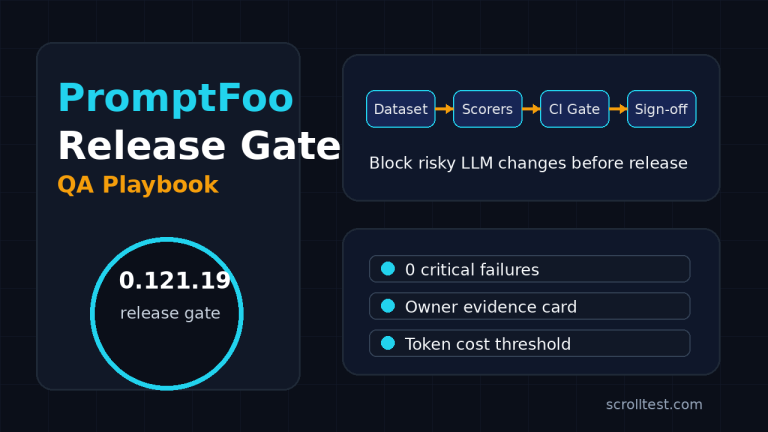
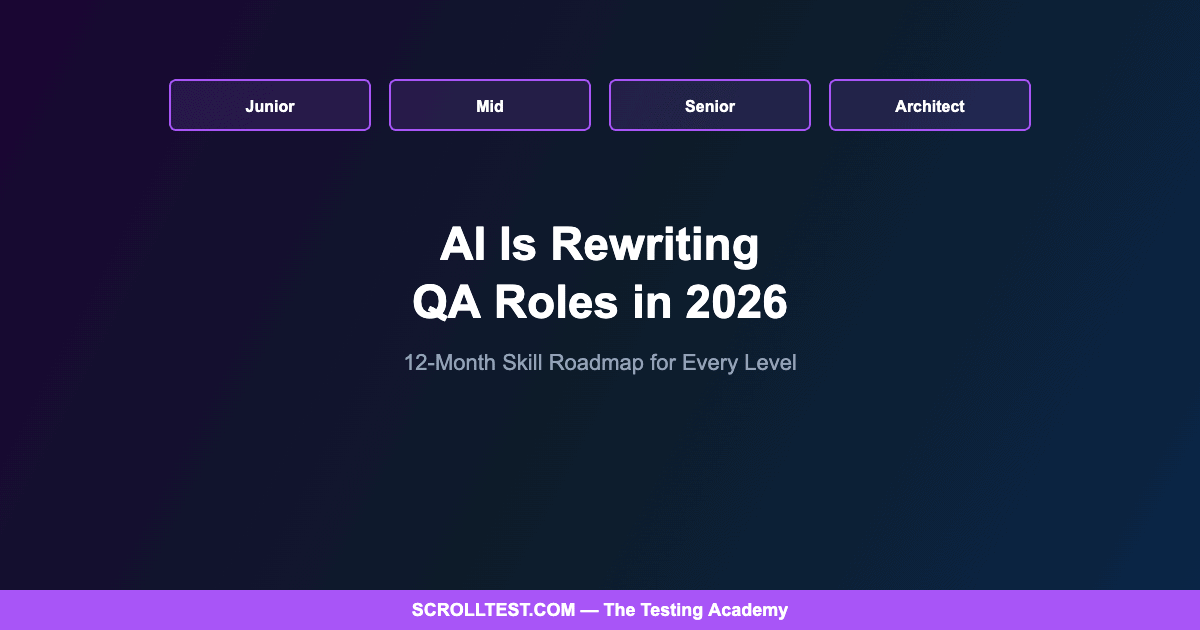
For junior QA engineers (0-2 years): months 1-3, master Playwright fundamentals and build a portfolio project. Months 4-6, learn API testing and build your first hybrid framework. Months 7-9, start using AI coding assistants (GitHub Copilot, Cursor) in your daily automation work and learn to evaluate their output critically. Months 10-12, study the basics of LLM evaluation with PromptFoo and build one AI-testing project for your portfolio.
For mid-level engineers (3-5 years): months 1-3, deepen your framework architecture skills — design patterns, CI/CD integration, test data management. Months 4-6, learn prompt engineering for test generation and experiment with AI-assisted test creation in your daily work. Months 7-9, study MCP and build a prototype AI-augmented testing pipeline. Months 10-12, specialize: choose either AI model testing (LLM evaluation) or agentic automation architecture based on your interests and your company’s direction.
For senior engineers (6+ years): months 1-4, build expertise in AI model testing — PromptFoo, LangSmith, DeepEval — and establish evaluation practices at your organization. Months 5-8, design and implement an MCP + LLM architecture for your team’s testing infrastructure. Months 9-12, develop quality governance frameworks for AI-powered products and position yourself as the AI quality authority in your organization. Write about your experiences — technical blog posts, conference talks, LinkedIn content — to build your professional reputation in this space.
The Honest Caveats
The AI-QA landscape is changing faster than any roadmap can capture. The specific tools I recommend today may be displaced by better alternatives within a year. The underlying skills — critical evaluation of AI output, test strategy design, quality engineering principles — are durable. Invest in principles first, tools second.
Not every QA engineer needs to become an “AI QA Engineer.” Organizations will continue to need skilled manual testers, performance engineers, security testers, and accessibility specialists. The AI specialization is one path, not the only path. Choose it because it aligns with your interests and your organization’s direction, not because of hype.
The premium salaries I reference for AI-QA roles are based on current job postings and may not persist at current levels as more engineers develop these skills. The early-mover advantage is real but temporary. The long-term advantage comes from genuine depth of expertise, not just checking AI-related boxes on a resume.
The complete AI-QA career roadmap — from foundations to advanced specialization — with hands-on projects at every level, is the curriculum backbone of my AI-Powered Testing Mastery course.
🎓 Become an AI-Powered QA Engineer
Join hundreds of SDETs mastering LLM, RAG, and agent testing. Lifetime access, hands-on labs, and a job-ready portfolio.