SDET Salary in India 2026: What You’ll Actually Earn
Every week I get the same question from testers in my DMs: “Dev, what is the actual SDET salary in India right now?” The honest answer is that it depends on three things: your years of experience, the kind of company you join, and whether you have moved past manual test cases into automation and AI testing. I have spent 15 years in this field, and I can tell you the spread is wider than almost anyone expects, from under ₹5 LPA for some freshers to over ₹33 LPA for leads. In this guide I break down the real 2026 numbers from AmbitionBox and PayScale, show you the exact pay ladder from fresher to SDET Lead, and explain the skills that push you into the top band.
Table of Contents
- What Is an SDET, and Why Does It Pay More Than a QA Engineer?
- SDET Salary in India 2026: The Real Numbers
- SDET vs QA Engineer vs Automation Tester: Side-by-Side
- Salary by Experience: Fresher to SDET Lead
- Product Companies vs Service Companies: The Pay Gap
- Salary by City: Where SDETs Earn the Most
- The Skills That Push You Into the Top Pay Band
- The AI Factor: How AI Testing Skills Change the Math
- How to Negotiate a Higher SDET Salary
- Key Takeaways
- FAQ: SDET Salary in India
Contents
What Is an SDET, and Why Does It Pay More Than a QA Engineer?
An SDET, or Software Development Engineer in Test, is a tester who writes code. Instead of only clicking through an app and logging bugs in a spreadsheet, an SDET builds test frameworks, writes automation scripts, and often contributes to the product’s testability at the code level. That is the entire reason the role pays more: you are hiring a developer’s skillset aimed at quality.
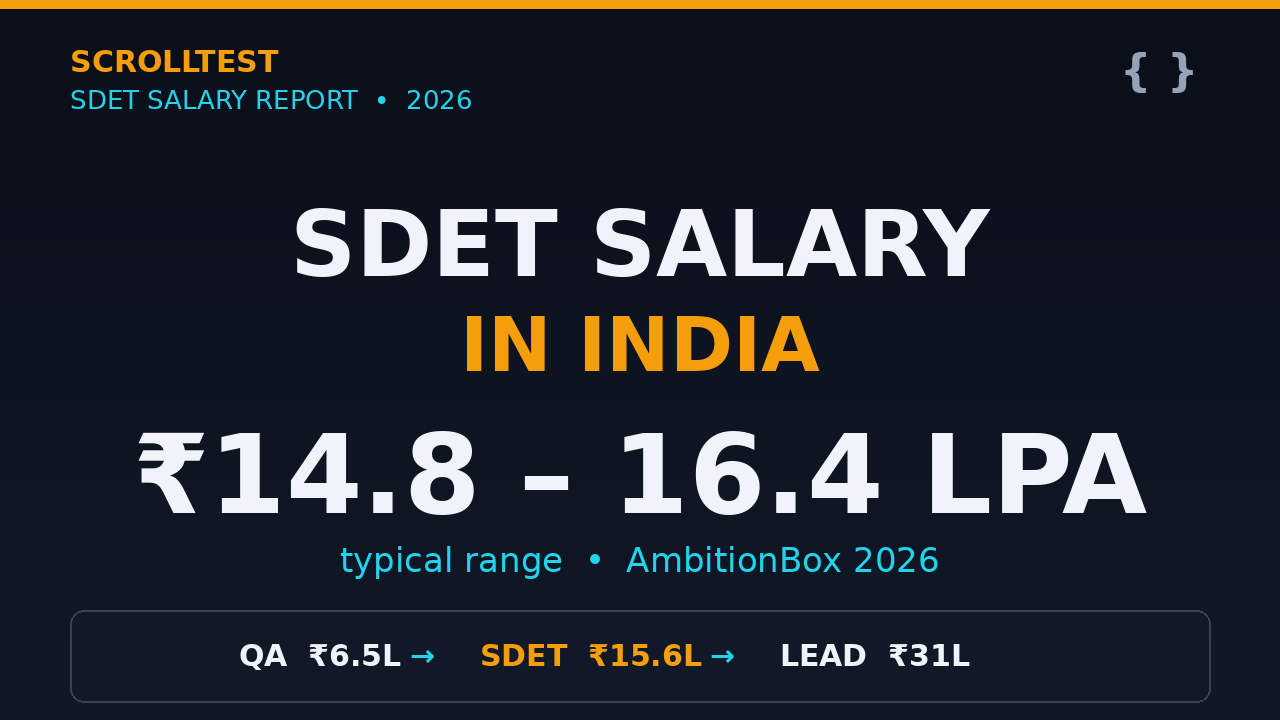
The market agrees. On AmbitionBox, the typical SDET salary in India sits around ₹14.8 to ₹16.4 lakh per year, while a QA Engineer (mostly manual testing) sits around ₹6.2 to ₹6.9 lakh per year. That is more than double for essentially the same years of experience, because one role automates and the other repeats.
SDET vs automation tester: the line most people miss
A lot of testers use “SDET” and “automation tester” as synonyms, but hiring managers do not. An automation tester writes and runs scripts against a framework someone else built. An SDET owns the framework, designs the test architecture, and is comfortable reading and even fixing product code. It is the difference between operating a machine and building it. That ownership is exactly what shows up as a ₹7 to ₹8 LPA gap between the two titles on salary benchmarks.
What SDETs actually do all day
- Build and maintain test automation frameworks in Playwright, Selenium, or Cypress
- Write API and integration tests against REST and GraphQL services
- Wire tests into CI/CD pipelines so every commit gets validated
- Design test data, mock services, and environment setup
- Review developer code for testability and coverage gaps
- Debug flaky tests and own the test suite’s runtime and reliability
Why the title matters
Recruiters treat “SDET” as a separate, higher-budget role from “QA Engineer” or “Manual Tester.” I have seen the same person get a 40 to 60 percent bump just by switching their title and demonstrating the coding skills to back it up. If you are still deciding between a manual testing track and an automation track, this is the clearest argument for automation I can give you. I have written a full QA career roadmap from manual tester to senior SDET if you want the step-by-step path.
SDET Salary in India 2026: The Real Numbers
Let me give you the numbers straight, with sources, so you can use them in your own negotiation and not rely on guesswork.
AmbitionBox, which tracks India salaries, lists the typical SDET salary range as ₹14.8 L/yr to ₹16.4 L/yr based on roughly 4.6k reported salaries, updated in August 2026. That range covers people with about 1 to 9 years of experience.
PayScale gives a different but compatible picture. Its average base pay for an SDET in India is ₹937,176 per year (about ₹9.4 LPA), with a median that rises fast once you pass the five-year mark. The two sources differ because AmbitionBox’s “typical range” reflects the central band of mid-career engineers, while PayScale’s average blends in freshers and early-career profiles. Read both, because the gap between them is exactly where most negotiation mistakes happen.
Here is the PayScale distribution so you can see the spread, not just the middle:
- 10th percentile: about ₹3.9 LPA
- 25th percentile: about ₹5.4 LPA
- Median (50th): about ₹9.4 LPA
- 75th percentile: about ₹14.8 LPA
- 90th percentile: about ₹22.9 LPA
Notice the jump from the 75th to the 90th percentile. The top 10 percent of SDETs in India are pulling in nearly ₹23 LPA or more. That top slice is dominated by people at product companies with strong automation and, increasingly, AI testing skills. That is the band you want to be in, and I cover how to get there later in this guide.
In-hand salary vs CTC: read the fine print
One thing every Indian tester learns the hard way: a quoted CTC is not your in-hand pay. A ₹15 LPA CTC can mean ₹1.0 to ₹1.1 lakh per month in hand once you subtract the employer PF contribution, gratuity, and the variable or performance component that may never fully pay out. When you compare offers, always ask for the fixed component, the variable percentage, and the monthly in-hand number. Two offers with the same CTC can differ by ₹15,000 to ₹25,000 a month in hand. This is why I tell my students to compare total fixed pay, not the headline CTC.
SDET vs QA Engineer vs Automation Tester: Side-by-Side
One of the fastest ways to understand the SDET salary in India is to put it next to the roles people usually come from. Here is the 2026 picture from AmbitionBox:
| Role | Typical Salary (AmbitionBox, 2026) | Reported Salaries |
|---|---|---|
| QA Engineer (manual) | ₹6.2 L/yr to ₹6.9 L/yr | 85.3k |
| Automation Test Engineer | ₹7.3 L/yr to ₹8.1 L/yr | 44.9k |
| SDET | ₹14.8 L/yr to ₹16.4 L/yr | 4.6k |
| SDET Lead | ₹29.8 L/yr to ₹32.9 L/yr | 4.2k |
Two things jump out. First, moving from manual QA to automation test engineer is worth only about ₹1 to ₹1.5 LPA on average. The real jump happens when you cross into full SDET territory, because that is where you stop just writing scripts and start owning frameworks and pipelines. Second, the SDET Lead role nearly doubles again, crossing ₹30 LPA.
AmbitionBox also reports that the average QA Engineer salary grew 23 percent over the last two years, and the automation test engineer average grew 18 percent. Quality roles are not shrinking, they are being repriced upward, especially where automation and AI skills are involved. The same platform lists a 10 percent two-year growth for the SDET Lead band, which tells you the ceiling is rising more slowly than the floor.
Salary by Experience: Fresher to SDET Lead
Experience is the single biggest lever on your pay. Here is the AmbitionBox breakdown of SDET salary by experience band, plus PayScale’s by-experience median for a second data point:
Fresher to 3 years
AmbitionBox puts the typical band for 1 to 3 years at ₹10.2 L/yr to ₹11.3 L/yr. PayScale’s entry-level median (under 1 year) is about ₹4 LPA, climbing to roughly ₹7.85 LPA for 1 to 4 years. The wide gap reflects where you land: a fresher at a service company starts low, while a fresher who codes well and lands at a product company or a strong startup can clear double digits early.
3 to 6 years
This is where most SDETs start to feel the difference. AmbitionBox shows ₹12.9 L/yr to ₹14.2 L/yr for the 3 to 6 year band. You are expected to own a framework by now, not just add test cases to someone else’s. If you are still only writing scripts at this level, your pay will stall, this is the band where ownership separates the people who grow from the people who plateau.
6 to 9 years
The jump here is the steepest on the ladder. AmbitionBox reports ₹21.2 L/yr to ₹23.4 L/yr for 6 to 9 years, and PayScale’s mid-career median (5 to 9 years) is about ₹15.1 LPA. This is the band where senior and staff-level SDETs sit, and where architecture and CI/CD ownership start to matter more than raw scripting speed. Crossing it usually requires leading a framework migration or owning the quality strategy for a team, not just executing well.
9 to 12+ years and SDET Lead
AmbitionBox’s estimate for 9 to 12 years is ₹22.7 L/yr to ₹25.1 L/yr, and the SDET Lead role jumps to ₹29.8 L/yr to ₹32.9 L/yr. PayScale’s experienced median (10 to 19 years) is about ₹20 LPA. In my experience, crossing the ₹30 LPA line in India almost always means moving into a lead or manager title, or becoming the go-to person for a niche like performance engineering or AI agent testing.
Here is the ladder in one glance, so you can see where you sit and what the next band pays:
- Manual QA Engineer: ₹6.2 to ₹6.9 LPA
- Automation Test Engineer: ₹7.3 to ₹8.1 LPA
- SDET (1 to 3 yrs): ₹10.2 to ₹11.3 LPA
- SDET (3 to 6 yrs): ₹12.9 to ₹14.2 LPA
- SDET (6 to 9 yrs): ₹21.2 to ₹23.4 LPA
- SDET Lead: ₹29.8 to ₹32.9 LPA
Product Companies vs Service Companies: The Pay Gap
This is the section that shocks most of my students. The same SDET skillset pays wildly different amounts depending on the type of company, and the gap is bigger than most people realize.
PayScale’s company-level data (median SDET base pay) tells the story:
- Amazon: about ₹16.1 LPA
- Oracle: about ₹14.3 LPA
- Dell: about ₹10.1 LPA
- Cognizant: about ₹8.1 LPA
- TCS: about ₹6.5 LPA
- Infosys: about ₹4.1 LPA
Read that again. An SDET at Amazon earns roughly four times what an SDET at Infosys earns, for the same job title. That is not a small difference, it is the defining one. Service companies pay for billable headcount and client projects. Product companies pay for ownership, scale, and the ability to ship without breaking things.
This is why I keep telling testers in India to treat service-company roles as a stepping stone, not a destination. Get your fundamentals solid, build two or three real projects, and then move. The market is rewarding people who make that move with a 2x to 4x jump. If you want to know which tools matter most when you make that move, I compared Playwright vs Selenium in 2026 and it matters more than most testers think.
Salary by City: Where SDETs Earn the Most
Location is the third lever, and it matters less than it did before remote work, but it still matters. PayScale’s median SDET base by city looks like this:
- Pune: about ₹9.7 LPA
- Hyderabad: about ₹9.5 LPA
- Bengaluru: about ₹9.5 LPA
- Chennai: about ₹7.9 LPA
- Kolkata: about ₹4.2 LPA
AmbitionBox lists Bengaluru as the top-paying metro for QA Engineer roles and Chennai as the top-paying metro for SDET roles specifically, so the exact ranking shifts a little by source and by title. The practical takeaway is that the big tech hubs, Bengaluru, Hyderabad, and Pune, cluster at the top, while tier-2 cities pay meaningfully less for the same work. Remote roles are starting to flatten this, but a remote SDET at a product company still usually negotiates against the top-tier metro band, not their local one.
If you are open to relocation, Bengaluru and Hyderabad give you the largest number of product-company SDET openings, which is where the higher bands actually live. A move from a tier-2 city to one of these hubs can add ₹3 to ₹5 LPA on its own, before you even renegotiate the role.
The Skills That Push You Into the Top Pay Band
Salary data tells you where the money is. Skills tell you how to get it. From the hiring conversations I see every month, these are the skills that separate the ₹8 LPA SDET from the ₹20 LPA SDET.
Non-negotiable automation fundamentals
- Playwright or Selenium with a real language: Python, Java, or TypeScript, not just record-and-playback. Modern teams have largely moved to Playwright for its auto-wait and tracing.
- API testing and test data design: REST Assured, Postman, or Requests, plus the ability to build realistic test data instead of copying production.
- CI/CD ownership: Jenkins, GitHub Actions, or GitLab CI, with your tests actually running on every merge, not on your laptop.
- Containerization: Docker and basic Kubernetes, because that is how test environments are provisioned now.
The skills that multiply your value
- LLM and AI testing: evaluating model outputs, prompt injection testing, and RAG validation. This is the fastest-growing premium skill in QA right now.
- Performance and load testing: k6 or JMeter, with the ability to read results and find bottlenecks.
- Visual regression and self-healing tests: teams pay for people who can cut flaky-test maintenance time.
- Observability: understanding logs, metrics, and traces well enough to debug a failing pipeline, not just report it.
Here is a realistic “skill stack” a strong mid-level SDET should be able to defend in an interview:
role: SDET (4-6 yrs)
language: [Python, TypeScript]
frameworks: [Playwright, Pytest, REST Assured]
infra: [Docker, GitHub Actions, AWS basics]
testing: [API, UI, contract, performance, LLM eval]
differentiator: AI agent testing or RAG validation
The AI Factor: How AI Testing Skills Change the Math
In 2026, the single most valuable skill a QA engineer can add is AI testing. Companies are shipping AI features faster than they can test them, and the pool of people who know how to evaluate an LLM’s output, catch a prompt injection, or validate a RAG pipeline’s retrieval is tiny. That scarcity is showing up in pay.
I am seeing two concrete trends. First, job posts for “AI SDET” and “LLM test engineer” roles in India are regularly quoting ranges at or above the top of the standard SDET band. Second, existing SDETs who add AI evaluation skills to their toolkit are negotiating jumps that look more like a promotion than a raise. The reason is simple: every company with a chatbot or an AI feature now has a compliance and quality problem, and almost no one on staff knows how to solve it.
If you want to start, the entry point is the same as any new testing skill: learn to evaluate outputs with a framework like DeepEval or Promptfoo, and learn the failure modes of RAG systems. I have two resources that will save you hours: a guide on how to evaluate LLM outputs with DeepEval, and a starter guide on AI testing skills for manual testers who are making the jump from manual to AI-augmented testing.
How to Negotiate a Higher SDET Salary
Most testers in India leave money on the table because they walk into a salary discussion with no data and no alternative offer. Here is the playbook I teach my students.
Come armed with a range, not a number
Never say “I want ₹18 LPA.” Say “based on AmbitionBox and PayScale data for my experience band, the market range is ₹14 to ₹21 LPA, and here is why I sit at the top of it.” A range backed by a named source is much harder to dismiss than a single number.
Anchor to the company type, not your current salary
If you are moving from a service company to a product company, do not anchor to your current ₹6.5 LPA. Anchor to what the new company’s peers pay. The product-vs-service gap I showed above is your edge, use it.
Negotiate the full package
Base salary is one line. Also negotiate the joining bonus, the variable, the ESOPs or RSUs, and the learning budget. A ₹15 LPA offer with good ESOPs and a ₹2 LPA joining bonus can beat a ₹16.5 LPA offer with nothing else. Do the math on total compensation, not just the headline number.
What not to do
- Do not reveal your current CTC until you have to, and even then, pivot back to market data.
- Do not accept the first number on the spot; a short, polite “let me review the full package and get back to you” keeps you in the game.
- Do not negotiate against yourself by lowering your ask before they respond.
Here is a message template you can adapt. Keep it short and data-backed:
Hi [Name], thanks for the offer. I'm excited about the role.
Based on AmbitionBox and PayScale data for SDETs with my
experience band, the market range is [X-Y] LPA. Given [specific
skill or project], I was expecting something closer to [Z] LPA.
Is there room to revisit the base or the joining bonus?
Key Takeaways
- The typical SDET salary in India in 2026 is roughly ₹14.8 to ₹16.4 LPA, and SDET Leads cross ₹30 LPA, per AmbitionBox.
- SDETs earn more than double a manual QA Engineer, because the role pays for code-level automation, not test case execution.
- The product vs service company gap is huge: an SDET at Amazon earns about 4x an SDET at Infosys for the same title.
- Experience is the biggest lever, but the steepest jump (to ₹21 LPA+) comes between 6 and 9 years, when you own frameworks and pipelines.
- AI testing skills, LLM evaluation, prompt injection testing, and RAG validation, are the fastest way to break into the top 10 percent of earners.
- Always compare fixed pay and in-hand salary, not the headline CTC, because a ₹15 LPA CTC can mean very different things at two companies.
FAQ: SDET Salary in India
What is the average SDET salary in India in 2026?
AmbitionBox lists the typical range at ₹14.8 to ₹16.4 LPA, while PayScale’s average base is about ₹9.4 LPA across all experience levels. The difference is experience mix and methodology, so use the experience-specific numbers for your own band.
How much does a fresher SDET earn in India?
AmbitionBox shows ₹10.2 to ₹11.3 LPA for the 1 to 3 year band, but PayScale’s entry-level median is closer to ₹4 LPA for under one year. Where you land depends heavily on company type: a fresher at a product company or strong startup can clear double digits while a service-company fresher starts much lower.
Does an SDET earn more than a QA engineer?
Yes, roughly double. A manual QA Engineer averages ₹6.2 to ₹6.9 LPA on AmbitionBox, while an SDET averages ₹14.8 to ₹16.4 LPA. The premium comes from writing code and owning frameworks rather than only executing test cases.
Which skills increase SDET salary the most?
Playwright or Selenium with a real language, API testing, CI/CD ownership, and Docker are the baseline. AI testing, LLM evaluation, prompt injection testing, and RAG validation are the skills that push you into the top pay band in 2026.
Is SDET a good career in India in 2026?
Yes. Quality roles are being repriced upward, with AmbitionBox reporting 23 percent growth in average QA Engineer salary and 18 percent for automation test engineers over two years. The demand is strongest for SDETs who combine automation with AI testing skills.
Why is there a big gap between product and service company SDET pay?
Service companies price roles around billable client headcount, while product companies price around ownership, scale, and shipping velocity. PayScale data shows an SDET at Amazon earns about four times an SDET at Infosys for the same title, which is why moving from a service company to a product company is the fastest single pay jump available.