DeepEval vs Ragas: What QA Engineers Should Learn
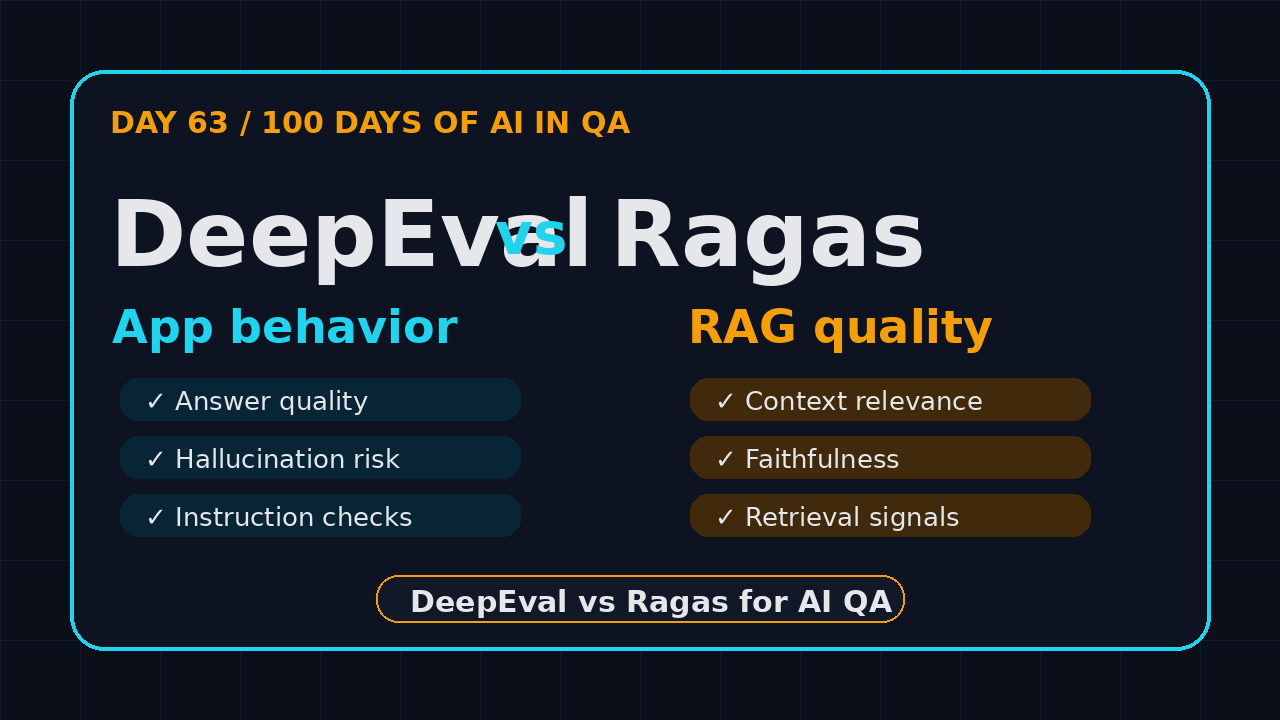
Day 63 of 100 Days of AI in QA and SDET: DeepEval vs Ragas for QA engineers.
DeepEval vs Ragas is the comparison I now use when QA engineers ask, “Which LLM evaluation tool should I learn first?” My short answer: learn both, but do not use them for the same job. DeepEval is stronger when you want to test an AI application’s behavior, while Ragas is strongest when your risk sits inside retrieval augmented generation.
I see teams make one expensive mistake here. They treat every LLM test as a chatbot test and forget that a RAG product can fail because retrieval pulled the wrong chunks before the model even generated an answer. That is why this article is practical: what each framework is good at, what to put in CI, and how an SDET can explain the difference in plain English.
Table of Contents
- Why DeepEval vs Ragas Matters for QA
- The Quick Answer: Use Both, But Separate the Risk
- What DeepEval Tests Well
- What Ragas Tests Well
- A QA Test Strategy for DeepEval vs Ragas
- How to Put LLM Evaluation in CI
- India Career Context for SDETs
- Common Mistakes I See Teams Make
- Key Takeaways
- FAQ
Contents
Why DeepEval vs Ragas Matters for QA
Most QA engineers are comfortable with deterministic software. Click this button, call this API, assert that field. AI products are different because a “pass” can be shallow. The response can be grammatical, confident, and still wrong.
That creates a new job for SDETs. We must test the behavior of the model-facing feature and also test the evidence that feeds the model. If we only evaluate the final answer, we miss retrieval bugs. If we only evaluate retrieval, we miss instruction-following bugs, hallucinations, tone issues, refusal bugs, and unsafe completions.
The current adoption numbers show why this skill is not niche anymore. The PyPI metadata for DeepEval lists version 4.1.7, and PyPIStats showed about 6.06 million recent monthly downloads during research for this article. The Ragas 0.4.3 PyPI release was published on 13 January 2026, and PyPIStats showed about 1.57 million recent monthly downloads. These are not toys sitting in a forgotten GitHub repo.
Why a normal automation mindset is not enough
Traditional automation asks, “Did the system produce the expected output?” LLM evaluation asks a harder question: “Is this output acceptable against a rubric, dataset, policy, and real user intent?” The oracle is no longer one string. It becomes a scoring method.
That does not mean QA should give up discipline. It means QA must be more explicit. You need datasets, thresholds, repeatable prompts, evaluator choice, sample failure reports, and a policy for what blocks a release.
Where the risk hides
In AI QA, failures usually hide in one of five buckets:
- Prompt drift: a prompt change breaks previous behavior.
- Retrieval issue: the system fetches irrelevant or incomplete context.
- Dataset gap: the evaluation set misses an important user path.
- Model variance: the same input behaves differently after a model or parameter change.
- Product bug: the UI, API, auth layer, or workflow around the model is broken.
DeepEval and Ragas touch different parts of that list. That is the real DeepEval vs Ragas decision.
The Quick Answer: Use Both, But Separate the Risk
If I have to explain DeepEval vs Ragas in one line, I say this: DeepEval is for evaluating the AI application’s answer and behavior; Ragas is for evaluating RAG quality, especially retrieval, context, and answer grounding.
The practical split looks like this:
- Use DeepEval when the test asks, “Did the assistant answer correctly, follow the instruction, avoid hallucination, and satisfy the user’s goal?”
- Use Ragas when the test asks, “Did the retriever fetch the right evidence, and was the generated answer faithful to that evidence?”
- Use Playwright or API tests around both when the test asks, “Can the user actually complete the workflow?”
A simple decision table
| Testing need | Better fit | Why |
|---|---|---|
| Chatbot answer quality | DeepEval | Application-level metrics and test cases |
| RAG context relevance | Ragas | RAG-specific evaluation focus |
| Hallucination checks | DeepEval and Ragas | Depends on whether the failure is answer behavior or source grounding |
| CI release gate for AI features | DeepEval plus Ragas | One gate for behavior, one gate for retrieval |
| End-to-end user workflow | Playwright plus evaluation | The browser flow still matters |
This separation saves time. Instead of arguing over one magical framework, your team talks about risk. That is how senior SDETs should frame it.
What I would learn first
If you are a manual tester moving into AI testing, start with DeepEval because it feels closer to test cases and assertions. If you already work on search, knowledge bases, support bots, policy assistants, or enterprise document QA, learn Ragas early. In product companies, RAG quality becomes a production problem quickly because bad retrieval creates confident wrong answers.
What DeepEval Tests Well
DeepEval describes itself as an LLM evaluation framework in its official getting-started documentation. Its strength is the way it lets QA engineers express evaluation as tests. That matters because SDETs already think in fixtures, expected outcomes, test suites, and thresholds.
The DeepEval GitHub repository API showed 17,513 stars during research. Stars are not a quality guarantee, but they tell us the ecosystem has attention and active use. For a QA engineer choosing what to learn, ecosystem momentum matters.
Good DeepEval use cases
I like DeepEval for checks such as:
- Does the assistant answer the customer’s question directly?
- Does it refuse unsafe or unsupported requests?
- Does it stay within the expected tone and policy?
- Does it hallucinate facts not present in the prompt or context?
- Does a new prompt version improve quality without breaking old examples?
That is close to regression testing. You build a dataset of representative prompts, run the suite, compare scores, and block the change when quality drops below the threshold.
A minimal DeepEval-style QA example
# pip install deepeval
# Pattern: evaluate answer quality for an AI support assistant

from deepeval.test_case import LLMTestCase
from deepeval.metrics import AnswerRelevancyMetric, HallucinationMetric

case = LLMTestCase(
    input="How do I reset my password?",
    actual_output="Go to Settings, open Security, and select Reset password.",
    expected_output="User should receive safe password reset instructions."
)

answer_relevancy = AnswerRelevancyMetric(threshold=0.80)
hallucination = HallucinationMetric(threshold=0.20)

answer_relevancy.measure(case)
hallucination.measure(case)

assert answer_relevancy.score >= 0.80
assert hallucination.score <= 0.20
In a real team, I would not start with 500 cases. I would start with 30 high-risk cases: password reset, refund policy, pricing, privacy, account deletion, and edge cases where the model is tempted to invent. Then I would grow the suite from production failures.
Where DeepEval can mislead you
DeepEval can score the answer, but it does not automatically prove your retriever fetched the best documents. If the final answer looks good on a small sample, your retrieval pipeline may still be fragile. That is where Ragas enters the picture.
What Ragas Tests Well
Ragas focuses on evaluating RAG and LLM applications. The Ragas documentation describes it as an evaluation framework for AI applications, and the project metadata for version 0.4.3 specifically summarizes it as an evaluation framework for RAG and LLM applications.
The Ragas GitHub repository API showed 15,266 stars during research. Again, I do not use stars as proof of correctness. I use them as a signal that enough teams care about RAG evaluation for the tool to deserve attention.
Good Ragas use cases
I reach for Ragas when the product has a retrieval layer. Examples:
- A support bot answers from help-center articles.
- An internal assistant answers from Confluence or Notion.
- A legal or HR bot answers from policy documents.
- A QA copilot answers from test cases, logs, and requirements.
- A sales assistant answers from product docs and CRM notes.
In these systems, a wrong answer can come from a good model fed with bad context. Testing only the final response is like testing a payment confirmation page without checking whether the backend charged the right customer.
A minimal Ragas-style QA example
# pip install ragas datasets
# Pattern: evaluate a RAG answer with question, answer, contexts, reference

from datasets import Dataset
from ragas import evaluate
from ragas.metrics import answer_relevancy, faithfulness, context_precision

data = Dataset.from_dict({
    "question": ["What is our refund window?"],
    "answer": ["Customers can request a refund within 14 days."],
    "contexts": [["Refunds are available within 14 days of purchase."]],
    "ground_truth": ["Refunds are available within 14 days of purchase."]
})

result = evaluate(
    data,
    metrics=[answer_relevancy, faithfulness, context_precision]
)

print(result)
If context precision drops after a retrieval change, I want CI to shout before customers do. That is not a nice-to-have. It is the RAG equivalent of catching a broken database query.
Where Ragas can mislead you
Ragas can tell you a lot about retrieval quality and grounding. It will not replace product workflow tests. A RAG answer can be faithful, but the UI can still show the wrong account, the conversation history can be lost, or the API can fail under auth changes. Keep your Playwright and API tests.
If you want an example of AI failure triage around browser tests, see AI Test Failure Triage for Playwright Teams.
A QA Test Strategy for DeepEval vs Ragas
The best DeepEval vs Ragas strategy is not a framework migration. It is a layered test strategy. I would design it like a test pyramid, but with evaluation datasets as first-class assets.
Layer 1: deterministic checks
Start with tests that should never require an evaluator model:
- API returns 200 for valid requests.
- Auth prevents cross-tenant data access.
- Prompt templates render with required variables.
- Retriever returns at least one chunk for known seeded documents.
- Response schema matches the contract.
These checks are cheap, fast, and stable. Do not waste LLM evaluation budget on assertions Python or TypeScript can make directly.
Layer 2: application behavior with DeepEval
Next, use DeepEval-style tests for behavior. Pick high-value journeys. Do not test every random prompt from Slack. Test the prompts that represent money, trust, safety, and compliance.
For example, a fintech assistant should be tested for advice boundaries. A health support assistant should be tested for escalation language. A QA copilot should be tested for whether it invents selectors or mentions files that do not exist.
Layer 3: retrieval quality with Ragas
For RAG systems, keep a separate dataset for retrieval evaluation. Each case should include the question, expected source document, retrieved chunks, answer, and reference answer. When retrieval quality drops, tag it as a retrieval regression, not a generic AI failure.
This separation helps debugging. If DeepEval fails but Ragas passes, the issue is likely prompt, model, instruction, or generation. If Ragas fails first, the issue is likely chunking, embedding, indexing, filters, or ranking.
Layer 4: browser and workflow coverage
Finally, wire the evaluated AI feature into real user flows. A support agent can generate a good answer and still fail because the copy button is broken. A QA copilot can generate a valid test and still fail because the generated file is never saved.
I would connect this to Playwright for browser flows and API tests for service contracts. If your team already maintains Playwright suites, read Playwright Suite Lying? 3 Signs Your Tests Pass Wrong because the same false-confidence problem appears in AI testing.
How to Put LLM Evaluation in CI
A CI gate for LLM evaluation should be boring. If it depends on someone opening a dashboard and “feeling” the quality, it will be skipped during a hotfix. The gate needs a small command, clear thresholds, and a failure report that developers can act on.
My recommended CI flow
- Run deterministic unit and API checks first.
- Run a small smoke evaluation set on every pull request.
- Run the full evaluation set nightly or before release.
- Store scores, prompts, model versions, and dataset versions as artifacts.
- Block only on agreed metrics, not on every experimental score.
This keeps CI useful. If you block on noisy metrics too early, developers will bypass the system. Start with a few metrics that map to real production pain.
A GitHub Actions sketch
name: ai-eval-gate

on:
  pull_request:
  workflow_dispatch:

jobs:
  eval:
    runs-on: ubuntu-latest
    steps:
      - uses: actions/checkout@v4
      - uses: actions/setup-python@v5
        with:
          python-version: "3.11"
      - run: pip install -r requirements-eval.txt
      - name: Run deterministic checks
        run: pytest tests/api tests/prompts
      - name: Run DeepEval behavior suite
        run: pytest evals/deepeval --junitxml=reports/deepeval.xml
      - name: Run Ragas retrieval suite
        run: pytest evals/ragas --junitxml=reports/ragas.xml
      - uses: actions/upload-artifact@v4
        with:
          name: ai-eval-reports
          path: reports/
Notice the split. DeepEval and Ragas produce different signals. I do not want one generic “AI failed” line. I want the report to tell me whether the failure is behavior, retrieval, or product plumbing.
Thresholds that do not create drama
I prefer three threshold bands:
- Pass: above the release threshold for critical metrics.
- Warn: below the target but above the block threshold.
- Fail: below the agreed block threshold or critical policy failure.
India Career Context for SDETs
For India-based QA engineers, this skill has career value. I am not saying one framework will get you a ₹40 LPA offer. That would be fake advice. I am saying AI evaluation is becoming a visible differentiator between someone who only runs automation and someone who can own quality for AI features.
In services companies like TCS, Infosys, Wipro, or Cognizant, the first wave of demand often appears as “add AI testing to existing automation.” In product companies, the expectation is sharper: build evaluation gates, diagnose failures, and work with ML or platform teams. The second path pays better because it is closer to engineering ownership.
What to put on your resume
Do not write “worked on AI testing tools.” Write outcomes and artifacts:
- Built a 120-case LLM evaluation suite for support-bot regression.
- Added RAG faithfulness and context checks to CI.
- Reduced manual prompt review from 4 hours to 25 minutes per release.
- Created failure taxonomy for prompt drift, retrieval issue, and product bug.
- Integrated Playwright smoke tests with AI answer evaluation.
These points sound like SDET ownership. That is what hiring managers understand.
A 14-day learning plan
If I were starting now, I would follow this plan:
- Day 1 to 2: Learn LLM basics, prompts, temperature, context windows, and model variance.
- Day 3 to 4: Build a tiny FAQ bot from five markdown files.
- Day 5 to 6: Add DeepEval tests for answer relevancy and hallucination risk.
- Day 7 to 9: Add retrieval and context checks with Ragas.
- Day 10 to 11: Add Playwright tests for the UI flow.
- Day 12: Put the smoke eval in GitHub Actions.
- Day 13: Write a failure report with screenshots and score changes.
- Day 14: Publish the project and record a short demo.
That portfolio beats another generic Selenium framework clone.
Common Mistakes I See Teams Make
The first mistake is using one metric as a release decision. LLM evaluation is a signal system, not a single magic score. You need multiple metrics tied to user risk.
Mistake 1: no dataset ownership
Teams install a framework, run five sample prompts, and call it evaluation. That is not enough. Your dataset is the product. It should be versioned, reviewed, and expanded after every escaped AI bug.
Mistake 2: mixing retrieval and answer failures
If a RAG assistant answers incorrectly, many teams blame the model. Often the retriever gave the model weak evidence. Keep a failure taxonomy. Mark each issue as prompt drift, retrieval issue, dataset gap, model variance, or product bug.
Mistake 3: ignoring cost and runtime
Evaluation can become expensive and slow. That is why I split smoke and full suites. Run 20 to 50 critical examples on pull requests. Run the larger set nightly or before release.
Mistake 4: skipping human review completely
Automation is not a replacement for judgment. For high-risk AI behavior, human review still matters. The goal is to reduce repeated manual checking, not remove accountability.
Mistake 5: not connecting evals to real workflows
An answer-quality score means little if the product flow is broken. Keep Playwright, API, and accessibility checks in the strategy. AI quality is part of product quality, not a separate island.
Key Takeaways
DeepEval vs Ragas is not about picking a winner. It is about assigning the right tool to the right quality risk.
- Use DeepEval for application behavior, answer quality, instruction following, and hallucination checks.
- Use Ragas when retrieval, context relevance, and grounded answers are the main risk.
- Keep deterministic checks for contracts, auth, schemas, and prompt rendering.
- Put small evaluation suites in CI before trying a large dashboard-first program.
- For SDETs in India, AI evaluation is a strong portfolio skill because it proves engineering ownership.
My recommendation is simple: build one small project that uses both. Create a tiny RAG assistant, evaluate retrieval with Ragas, evaluate final answer behavior with DeepEval, and wrap the user journey with Playwright. That gives you a real story for interviews and a practical starting point for your team.
FAQ
Is DeepEval better than Ragas?
No. DeepEval is better for many application-level LLM evaluation cases. Ragas is better when you need RAG-specific signals such as context quality and grounded answers. Mature teams use both.
Can Ragas replace Playwright tests?
No. Ragas can evaluate retrieval and answer quality signals, but Playwright tests the actual browser workflow. You still need UI coverage for login, forms, permissions, rendering, and user actions.
Can a manual tester learn DeepEval vs Ragas?
Yes, but learn Python basics first. You do not need to be an ML researcher. You need to understand datasets, assertions, thresholds, CI, and how to explain failures clearly.
What should I add to CI first?
Start with 20 high-risk prompts and deterministic checks. Add DeepEval for answer behavior. If the feature uses retrieval, add Ragas for retrieval quality. Keep the first gate small enough that developers trust it.
What is the best portfolio project?
Build a small support bot over five product documents. Add DeepEval tests for answer quality, Ragas tests for retrieval quality, and Playwright tests for the web flow. Publish the repo with a short failure report.