AI Release Watcher for QA: Build a Test Radar
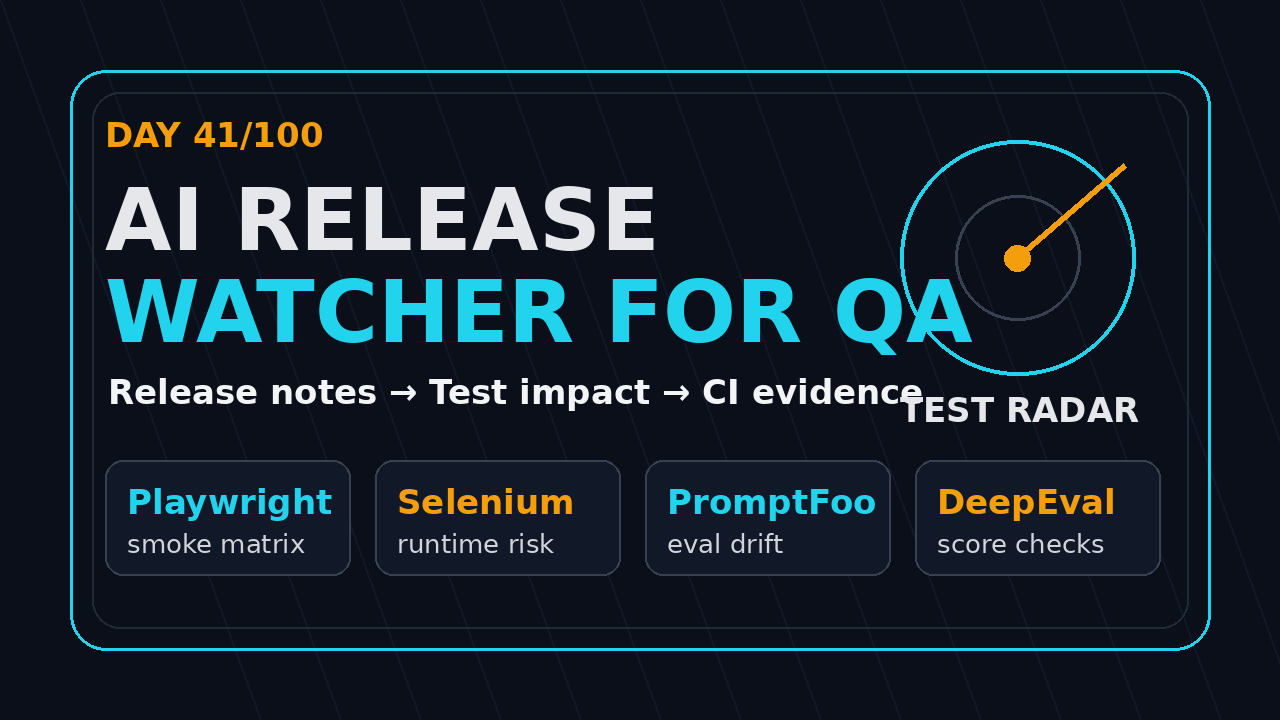
Day 41 of 100 Days of AI in QA & SDET. An AI release watcher for QA is not another dashboard for managers. It is a small operating system for spotting framework, browser, and eval-tool changes before they quietly break your automation pipeline.
I see many teams track defects, pull requests, and flaky tests very seriously. But they treat Selenium, Playwright, PromptFoo, DeepEval, browser-use, Chrome, and Node package updates like background noise. That is where test impact starts hiding.
This article shows how I would build a practical release radar: what to watch, how to classify the change, how to map it to smoke coverage, and how to make the output useful for engineers instead of noisy for Slack.
Table of Contents
- Why Release Intelligence Matters for QA
- What an AI Release Watcher for QA Actually Does
- Signals to Monitor Across the AI QA Stack
- The Test-Impact Model I Use
- Implementation: A Python Release Watcher
- Turning Release Notes into a CI Release Gate
- Team Operating Model for SDETs
- India Context: Why This Skill Matters
- Key Takeaways
- FAQ
Contents
Why Release Intelligence Matters for QA
Most QA teams react to tool upgrades only after a pipeline starts failing. A browser driver changes. A Playwright assertion behaves differently. A Selenium binding ships a fix. An LLM eval library changes a scorer default. Suddenly a green build from yesterday becomes a red build today.
The common mistake is treating this as random flakiness. It is often not random. It is release impact without ownership.
The release stream is already faster than manual tracking
Here are real signals from primary package and release sources at the time of writing:
- Selenium 4.46.0 was published on GitHub on 11 July 2026.
- Playwright v1.61.1 was published on GitHub on 23 June 2026.
- PromptFoo 0.121.19 is listed in npm metadata as the latest release.
- DeepEval 4.1.1 is listed on PyPI as the current package version.
- browser-use 0.13.6 is listed on PyPI for agentic browser automation work.
None of these signals is bad by itself. Releases are healthy. The risk starts when QA has no system to ask: “What changed, which tests prove we are safe, and who owns the follow-up?”
AI testing makes release drift more expensive
Classic UI automation drift is visible. A selector fails. A wait times out. A browser closes early. AI testing drift is quieter. Your eval score changes because a model, prompt, scorer, retrieval step, or package version changed.
That is why I like connecting release notes with evidence. A release watcher should not only say “new version available.” It should say:
- which area is affected: UI, API, eval, browser agent, or CI
- which smoke tests must run
- which owner should review failures
- which changelog or package URL supports the alert
- what evidence must be attached before the upgrade is accepted
If you already read ScrollTest posts like AI Eval Dependency Monitoring for QA Teams and AI Test Evidence in CI/CD Release Gates, this is the natural next step. Dependency monitoring tells you what moved. Release intelligence tells you what to do about it.
What an AI Release Watcher for QA Actually Does
An AI release watcher for QA reads trusted release feeds and converts them into test-impact action items. It is not a replacement for engineering judgment. It is a guardrail that forces the right questions before a dependency update lands in the main branch.
The minimum useful workflow
I keep the first version boring. Boring systems run every day. Fancy systems need babysitting.
A useful release watcher follows this sequence:
- Fetch release metadata from primary sources such as GitHub, npm, PyPI, official docs, or vendor blogs.
- Normalize each item into a common event format.
- Classify the event by tool family and risk area.
- Map risk areas to smoke-test suites, eval suites, owners, and rollback notes.
- Publish a short action summary into CI, Slack, Jira, GitHub Issues, or a markdown report.
- Store the event history so repeated releases do not create duplicate noise.
That is enough for a real team. You can add an LLM later to summarize long changelogs, but do not start with prompt magic. Start with stable data.
What the output should look like
The best output is not a wall of release notes. It is a decision card. For example:
Release: Selenium 4.46.0
Source: https://github.com/SeleniumHQ/selenium/releases/tag/selenium-4.46.0
Risk area: browser automation runtime
Suggested checks:
  - Run cross-browser smoke tests
  - Run WebDriver session lifecycle tests
  - Check grid/container image compatibility
Owner: SDET platform
Evidence required: CI run link + failure triage note
Decision: review before framework upgrade PR merges
This is practical. It gives an SDET a starting point, not a research assignment.
Where AI helps and where it should not decide
AI is useful for summarizing long changelogs and mapping natural language to a test taxonomy. But I do not let AI decide that an upgrade is safe. That decision needs test evidence.
Use AI for:
- summarizing noisy release notes into a short risk note
- classifying the change into known QA buckets
- suggesting smoke suites based on past mappings
- drafting Jira tickets or GitHub issue text
Do not use AI for:
- auto-merging dependency upgrades without tests
- ignoring failures because the summary says “low risk”
- inventing impact when the source has no evidence
- overriding owner judgment for release-critical systems
Signals to Monitor Across the AI QA Stack
The biggest mistake is watching only one layer. QA toolchains are stacked. Your browser automation can be fine while your eval tool silently changes behavior. Your eval tool can be fine while your browser agent package breaks navigation.
Browser automation signals
For browser automation, I watch Playwright, Selenium, browser versions, driver/container images, and test runner plugins. If your team uses Playwright heavily, also read Playwright Upgrade Checklist: 3 Files Before Merge. The upgrade checklist and release watcher complement each other.
Important browser automation fields include:
- release tag and published date
- browser channel changes
- test runner behavior changes
- trace, reporter, fixture, or assertion changes
- Docker image and CI environment notes
- known regressions and migration notes
LLM eval signals
For LLM testing, I watch PromptFoo, DeepEval, model SDKs, tokenizer packages, vector database clients, and embedding-model updates. If your team already has eval gates, read PromptFoo vs DeepEval: QA Guide for LLM Evals and then add release monitoring on top.
Eval drift can come from small changes:
- scorer implementation updates
- new default thresholds
- model-provider SDK changes
- JSON schema parsing changes
- prompt template edits
- dataset changes without version labels
Agentic browser automation signals
Agentic browser automation introduces another layer. Tools like browser-use make websites accessible for AI agents, but an agent workflow has more failure points than a fixed Playwright test. You have planning, perception, action selection, retries, browser state, and final assertions.
Release watcher output for agent tools should ask:
- Did navigation behavior change?
- Did selector or accessibility-tree extraction change?
- Did retry behavior change?
- Did model-provider integration change?
- Are there security or credential-handling notes?
The Test-Impact Model I Use
A watcher becomes useful only when it maps changes to a small and repeatable taxonomy. If every release starts a fresh debate, the system dies after two weeks.
Five impact buckets
I use five buckets for most QA teams:
- Execution risk: test runner, browser driver, grid, container, timeout, retry, fixture, or parallel execution changes.
- Assertion risk: assertion library, matcher behavior, visual comparison, accessibility assertions, or schema validation changes.
- Eval risk: scorer, dataset, threshold, prompt template, model provider, embedding, or retrieval behavior changes.
- Evidence risk: trace, report, screenshot, video, log, metric, or CI artifact behavior changes.
- Security risk: credential handling, token scopes, browser permissions, dependency vulnerability, or external tool integration changes.
This taxonomy is small enough to remember and broad enough for daily use.
Mapping buckets to smoke suites
Each bucket needs a test response. I like a matrix that lives in the repo:
impact_buckets:
  execution_risk:
    suites:
      - ui-smoke-chromium
      - ui-smoke-firefox
      - grid-session-lifecycle
    owner: sdet-platform
  assertion_risk:
    suites:
      - critical-assertion-smoke
      - visual-baseline-check
    owner: qa-framework
  eval_risk:
    suites:
      - promptfoo-regression
      - deepeval-golden-dataset
    owner: ai-qa
  evidence_risk:
    suites:
      - trace-report-artifacts
      - ci-evidence-contract
    owner: release-engineering
  security_risk:
    suites:
      - secret-scan
      - dependency-audit
    owner: devsecops
This matrix changes the discussion. Instead of “Should we test this?” the team asks “Which mapped checks already prove this change?”
Scoring severity without drama
I avoid complex scores in the first version. A simple 1 to 3 severity is enough:
- 1: patch release, docs-only note, or low-risk dependency with no mapped critical path
- 2: runner, assertion, reporting, or eval change that affects a non-critical workflow
- 3: browser/session/eval/security change that can block release or corrupt evidence
The score should drive action. Severity 1 can create a weekly digest. Severity 2 creates a ticket. Severity 3 blocks the upgrade PR until the mapped checks pass.
Implementation: A Python Release Watcher
Here is a small Python implementation pattern. It fetches structured metadata from GitHub, npm, and PyPI, then creates normalized release events. Keep credentials out of this script unless you need private repos.
Step 1: Fetch releases from primary sources
import requests
from datetime import datetime, timezone

HEADERS = {"User-Agent": "qa-release-watcher/1.0"}

def github_latest(owner: str, repo: str) -> dict:
    url = f"https://api.github.com/repos/{owner}/{repo}/releases/latest"
    data = requests.get(url, headers=HEADERS, timeout=20).json()
    return {
        "tool": repo,
        "source": "github",
        "version": data["tag_name"],
        "title": data.get("name") or data["tag_name"],
        "published_at": data.get("published_at"),
        "url": data.get("html_url"),
        "notes": data.get("body", "")[:4000],
    }

def npm_latest(package: str) -> dict:
    url = f"https://registry.npmjs.org/{package}/latest"
    data = requests.get(url, headers=HEADERS, timeout=20).json()
    return {
        "tool": package,
        "source": "npm",
        "version": data["version"],
        "title": f"{package} {data['version']}",
        "published_at": None,
        "url": data.get("homepage") or f"https://www.npmjs.com/package/{package}",
        "notes": data.get("description", ""),
    }

def pypi_latest(package: str) -> dict:
    url = f"https://pypi.org/pypi/{package}/json"
    data = requests.get(url, headers=HEADERS, timeout=20).json()
    info = data["info"]
    return {
        "tool": package,
        "source": "pypi",
        "version": info["version"],
        "title": f"{package} {info['version']}",
        "published_at": None,
        "url": info.get("project_url") or f"https://pypi.org/project/{package}/",
        "notes": info.get("summary", ""),
    }

watchlist = [
    github_latest("microsoft", "playwright"),
    github_latest("SeleniumHQ", "selenium"),
    npm_latest("promptfoo"),
    pypi_latest("deepeval"),
    pypi_latest("browser-use"),
]

for event in watchlist:
    print(event["tool"], event["version"], event["url"])
This is intentionally simple. The first win is reliable collection. Add caching after this works.
Step 2: Classify impact with rules first
Before using an LLM, write rules. They are easier to audit and safer in CI.
IMPACT_RULES = {
    "execution_risk": ["browser", "driver", "session", "timeout", "fixture", "parallel"],
    "assertion_risk": ["assert", "expect", "matcher", "snapshot", "visual"],
    "eval_risk": ["eval", "scorer", "threshold", "prompt", "dataset", "model"],
    "evidence_risk": ["trace", "report", "screenshot", "video", "log", "artifact"],
    "security_risk": ["security", "token", "credential", "permission", "vulnerability"],
}

def classify(notes: str) -> list[str]:
    text = notes.lower()
    hits = []
    for bucket, terms in IMPACT_RULES.items():
        if any(term in text for term in terms):
            hits.append(bucket)
    return hits or ["manual_review"]

def severity(buckets: list[str]) -> int:
    if "security_risk" in buckets or "eval_risk" in buckets:
        return 3
    if "execution_risk" in buckets or "assertion_risk" in buckets:
        return 2
    return 1
Rules will miss nuance. That is fine. They give you a deterministic baseline and a testable contract.
Step 3: Add LLM summarization safely
If you add an LLM, treat it as a summarizer, not an authority. Store the raw source URL, version, and event before sending notes to the model. Then ask the model to return a strict JSON object.
PROMPT = """
You are helping an SDET classify a tool release.
Return JSON only with keys:
summary, qa_risk, impacted_suites, owner_hint, confidence.
Do not invent changelog facts. If unclear, say manual_review.

Release event:
{event}
"""
Then validate the JSON. If it fails schema validation, drop it and keep the rule-based output. CI should not depend on beautiful prose.
Turning Release Notes into a CI Release Gate
The watcher becomes valuable when it affects a real workflow. I do not want daily alerts that nobody reads. I want upgrade pull requests to carry release-impact evidence.
GitHub Actions pattern
A simple GitHub Actions setup can run the watcher daily and also on dependency-update PRs.
name: qa-release-radar

on:
  schedule:
    - cron: "30 3 * * *"
  pull_request:
    paths:
      - "package.json"
      - "package-lock.json"
      - "pyproject.toml"
      - "requirements.txt"

jobs:
  release-radar:
    runs-on: ubuntu-latest
    steps:
      - uses: actions/checkout@v4
      - uses: actions/setup-python@v5
        with:
          python-version: "3.12"
      - run: pip install requests pydantic
      - run: python tools/qa_release_watcher.py --format markdown --out release-radar.md
      - uses: actions/upload-artifact@v4
        with:
          name: qa-release-radar
          path: release-radar.md
For severity 3 events, I prefer a required check. If the release impacts eval scoring or browser execution, make the PR run the mapped smoke suites before merge.
What evidence should be attached
Good release evidence is boring and reviewable:
- release URL from the primary source
- old version and new version
- impact buckets detected
- smoke suites selected
- CI run links
- failure summary, if any
- owner decision: accept, delay, pin, or rollback
This is where SDETs become force multipliers. You are not only writing tests. You are building the decision system around test evidence.
Slack alerts that do not annoy the team
Do not send every patch release to a noisy channel. Use routing:
- Severity 1: weekly digest
- Severity 2: team channel with owner mention
- Severity 3: release channel plus blocking ticket
One clean alert per important release is better than fifteen vague alerts nobody trusts.
Team Operating Model for SDETs
Tools do not fix ownership. If nobody owns the watcher, it becomes another abandoned repo. I like assigning it to an SDET platform rotation.
Weekly review rhythm
A 20-minute weekly review is enough for most teams:
- Review new severity 2 and 3 release events.
- Confirm which dependency upgrades are already open.
- Check whether mapped smoke suites passed.
- Update the impact matrix when a new failure pattern appears.
- Archive accepted events with evidence links.
The key is to keep the meeting tied to decisions. Do not turn it into a changelog reading session.
Definition of done for upgrade PRs
For test-framework and eval-tool upgrades, I use this definition of done:
- primary release URL is linked in the PR
- risk buckets are listed
- mapped smoke or eval suites passed
- evidence artifact is attached
- rollback or pinning instruction is documented
- owner has signed off for severity 3 changes
This turns “please review package upgrade” into an engineering decision with context.
How this connects with QA leadership
QA leaders often ask for predictable release quality. A release watcher gives them a concrete mechanism. It reduces surprise failures from tooling drift and creates an audit trail for why a dependency upgrade was accepted.
This is also a strong portfolio project. A manual tester moving toward AI QA can build a small version in a weekend: fetch five feeds, classify events, generate markdown, run one smoke suite, and publish the report as a GitHub artifact.
India Context: Why This Skill Matters
In India, many QA engineers still get evaluated by the number of test cases executed or automation scripts written. Product companies and serious SaaS teams are shifting the bar. They want people who can protect release flow.
The ₹25-40 LPA SDET gap
For senior SDET roles around the ₹25-40 LPA band, the difference is rarely “knows Selenium” versus “knows Playwright.” The stronger candidate can explain release risk, CI ownership, flaky-test economics, dependency upgrades, and evidence quality.
An AI release watcher for QA is a practical way to show that maturity. It proves you can connect tools, automation, CI, and decision-making.
Service company versus product company expectations
In a large service company, you may have a shared framework team and a release calendar you cannot control. In a product company, one dependency upgrade can hit production velocity this week. The same watcher helps both, but the operating model changes.
- In TCS/Infosys-style delivery teams, use it to standardize framework upgrade evidence across accounts.
- In product companies, use it to protect trunk-based development and weekly releases.
- In startups, use it as a lightweight substitute for a large QA platform team.
Interview story you can tell
If you build this project, your interview story becomes specific:
“I built a release watcher that tracks Playwright, Selenium, PromptFoo, DeepEval, and browser-use. It classifies releases into five risk buckets, maps them to smoke suites, and creates evidence cards in CI. For severity 3 changes, upgrade PRs cannot merge until the mapped checks pass.”
That answer sounds different from “I know AI tools.” It shows ownership.
Key Takeaways
An AI release watcher for QA helps teams convert tool updates into test-impact decisions. It is one of the most practical AI-in-QA projects because it touches real engineering pain: releases, evidence, owners, and CI.
- Watch primary sources: GitHub releases, npm, PyPI, official docs, and vendor release notes.
- Use a small taxonomy: execution, assertion, eval, evidence, and security risk.
- Map every risk bucket to smoke suites and owners.
- Use AI for summarization, but keep final release decisions tied to test evidence.
- For SDETs, this is a strong portfolio project because it shows systems thinking, not just scripting.
My recommendation: start with five tools, one markdown report, and one CI artifact. Make it reliable before making it clever.
FAQ
Do I need an LLM to build an AI release watcher for QA?
No. Start with structured APIs and rule-based classification. Add an LLM later for summarization if release notes are long or messy. The core value is the mapping between release events and test-impact actions.
Which tools should I monitor first?
Start with the tools that can break your release pipeline: Playwright or Selenium, browser images, PromptFoo or DeepEval if you run LLM evals, model SDKs, and any internal framework package used by many teams.
Should the watcher automatically upgrade packages?
I would not do that in the first version. Let Dependabot or Renovate open upgrade PRs. Use the watcher to attach risk classification, mapped smoke suites, and evidence requirements.
How often should the watcher run?
Daily is enough for most teams. Run it on a schedule for visibility and on dependency-update PRs for enforcement. Severity 3 changes should trigger faster review.
What is a good weekend version of this project?
Fetch latest metadata for five tools, classify each release into risk buckets, generate a markdown report, run one mapped smoke suite, and upload the report as a CI artifact. That is enough to demonstrate practical AI QA thinking.