Playwright Smoke Test Matrix from Release Notes
Playwright smoke test matrix work starts before you upgrade the package. I see teams bump Playwright, run the full regression suite once, call it safe, and then spend the next sprint debugging failures that a 30-minute release-note review would have caught.
This guide gives you a repeatable way to read Playwright release notes and convert them into browser smoke coverage, API checks, trace checks, CI gates, and named owner assignments. The goal is simple: every Playwright upgrade should produce a small, focused matrix that tells your team what to test, who owns it, and what failure should block the release.
Table of Contents
- Why release notes need a smoke matrix
- Playwright smoke test matrix inputs
- Classify release notes into risk buckets
- Build the matrix in 30 minutes
- TypeScript example: release impact matrix
- CI gates and owner assignments
- India SDET context
- Common mistakes
- Key takeaways
- FAQ
Contents
Why release notes need a smoke matrix
Most teams treat framework releases as dependency chores. A developer opens a pull request, updates @playwright/test, waits for CI, and asks QA to “check once.” That is not a release process. That is hope with a green checkmark.
The current Playwright release feed makes the risk visible if you read it like a tester. Playwright v1.61.1, published on 23 June 2026, lists fixes around custom matchers, UI mode API request reporting, websocket timings in trace viewer, Node 22.15 sync loader behavior, and extensionless TypeScript subpath imports across pnpm workspace symlinks. None of those lines says “run checkout on Chrome and Safari.” The release note is more specific than that.
That specificity is useful. It tells you which part of your automation stack is exposed. A matcher fix points toward assertion-heavy tests. A UI mode API reporting fix points toward API request diagnostics. A trace viewer websocket timing fix points toward debugging artifacts. A Node loader regression points toward the way your test runner starts. A pnpm workspace symlink issue points toward monorepo import paths.
Without a matrix, these signals disappear inside a large regression run. With a matrix, the same notes become a small list of targeted checks.
Regression suites hide upgrade risk
A full regression suite is useful, but it is a blunt instrument. It tells you that some user journeys still pass. It often does not tell you whether your trace viewer is trustworthy, whether UI mode still reports API byte counts correctly, or whether a custom matcher silently changed behavior.
I prefer a release-impact smoke suite that runs before the wider regression. It is small enough to run on every dependency-upgrade pull request. It is focused enough to fail for the right reason. It is also readable by managers, because every row has an owner and a clear pass rule.
Playwright usage justifies discipline
This is not a niche tool anymore. The GitHub repository API reported 93,126 stars for microsoft/playwright during this run. The npm downloads API reported 261,342,422 downloads for the playwright package between 19 June and 18 July 2026. The @playwright/test npm endpoint reported 181,316,212 downloads in the same window.
When a tool sits in that many CI pipelines, release-note reading becomes a QA responsibility, not a side task. The faster the ecosystem moves, the more you need a boring checklist.
Playwright smoke test matrix inputs
A good Playwright smoke test matrix starts with four inputs. Do not start with browsers. Start with the release note, your framework architecture, your most fragile tests, and your ownership map.
Input 1: the exact release note
Use the official release entry as the source of truth. I usually copy the bullet list into a temporary note and mark every line with one of three labels:
- Runtime risk: anything that affects Node, loaders, workers, projects, fixtures, or imports.
- Test authoring risk: anything that affects matchers, locators, assertions, hooks, or test metadata.
- Diagnostic risk: anything that affects trace viewer, UI mode, reports, screenshots, videos, network logs, or console messages.
Playwright v1.61.1 is a clean example. The sync loader bug is runtime risk. The custom matcher behavior is test authoring risk. The trace viewer websocket timing bug is diagnostic risk. The API request byte reporting line sits between diagnostic risk and API testing risk.
Input 2: your framework map
Write down where your Playwright framework uses the affected feature. For example, if the release note mentions custom matchers, search your repo for expect.extend. If it mentions pnpm workspace symlinks, search for package imports inside your monorepo test packages.
This is where many teams waste time. They read the note, but they do not connect it to their codebase. A release note without repo mapping becomes trivia.
Input 3: fragile journeys
Keep a small list of tests that have failed during past upgrades. I use a “fragility register” with the test name, owner, failure mode, and last incident date. You do not need a new tool for this. A markdown file or Jira label works.
Your upgrade smoke should include only the fragile journeys that intersect with the release note. If the release note is about trace viewer timings, do not add every payment test. Add the websocket-heavy journey where trace timing matters during debugging.
Input 4: ownership
A smoke matrix without owners becomes a polite spreadsheet. Every row needs one primary owner and one backup. In product companies this might be the SDET who owns checkout, onboarding, or billing. In service companies like TCS, Infosys, Wipro, or Accenture projects, it may be the module QA plus the automation lead.
The owner is not responsible for manually clicking everything. The owner is responsible for deciding whether a failure blocks the upgrade.
Classify release notes into risk buckets
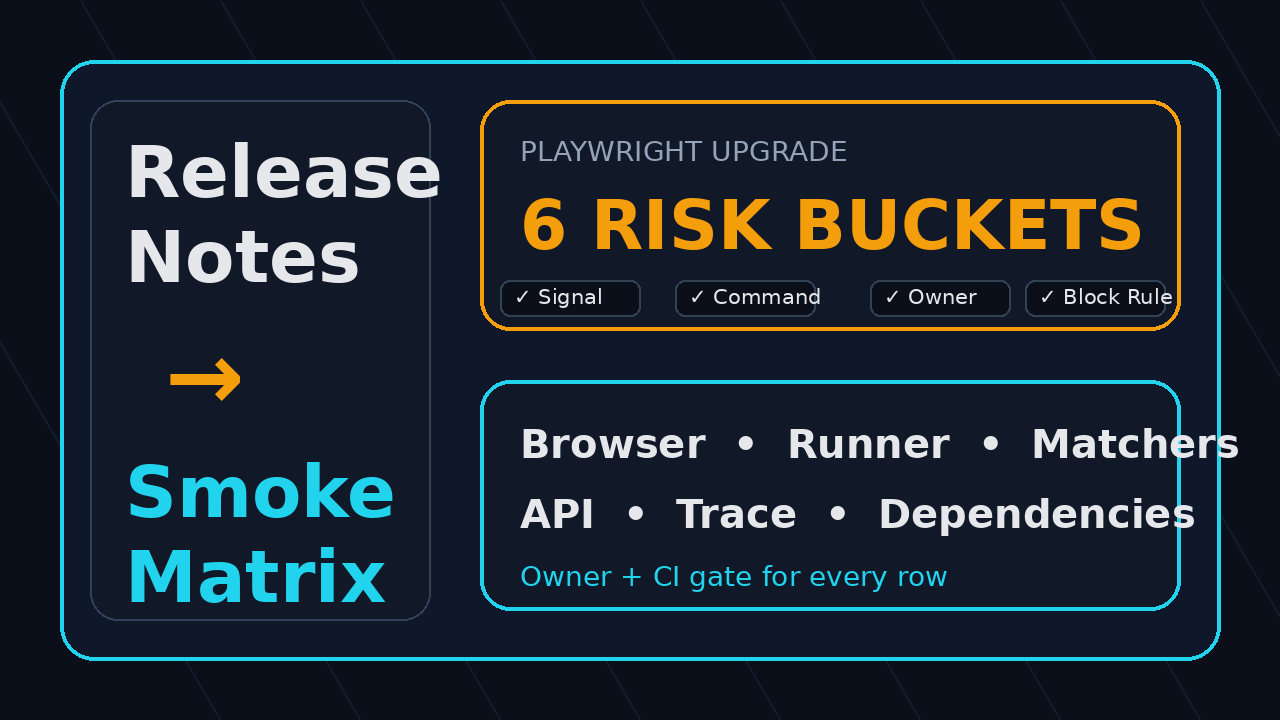
I use six buckets for Playwright upgrade smoke coverage. The buckets keep the conversation practical. They also stop every dependency upgrade from turning into “run everything.”
Bucket 1: browser and device coverage
Browser coverage is still needed, but it should not be the only row. For most teams the minimum smoke is Chromium, Firefox, and WebKit on desktop. Add mobile emulation only if the release note touches emulation, viewport, geolocation, permissions, WebKit behavior, or a journey that your mobile users actually run.
The output should look like this:
- Chromium: one critical login or auth journey.
- Firefox: one business-critical form or search journey.
- WebKit: one checkout, upload, or navigation-heavy journey.
- Mobile WebKit or Chromium: only for impacted responsive features.
This is enough to catch browser-level regressions without burning an hour on every upgrade pull request.
Bucket 2: runner and configuration
Runner risk appears when release notes mention projects, workers, sharding, loaders, config, TypeScript, ESM, fixtures, global setup, or web server behavior. Playwright v1.61.1 includes Node 22.15 and pnpm workspace loader fixes, so this bucket should not be skipped.
The smoke check here is not a user journey. It is a framework boot test:
node --version
npm ls @playwright/test
npx playwright test tests/smoke/framework-boot.spec.ts --project=chromium
If your CI uses Node 22 while your laptop uses Node 20, run the check in CI. Local confidence is not enough.
Bucket 3: assertions and matchers
Any change around expect, matchers, soft assertions, polling, or snapshot behavior needs a focused assertion smoke. For v1.61.1, the custom matcher issue is a direct signal.
Create one tiny spec that proves your custom matcher and a default matcher can live together. If you do not use custom matchers, mark the row as not applicable. Do not run a fake test for a feature your framework does not use.
Bucket 4: API and network diagnostics
Playwright is not only browser automation. Many serious frameworks use request.newContext(), route mocking, HAR files, websocket checks, or API setup calls. A release note about API reporting or websocket trace timing deserves its own row.
Smoke this with a small API test that writes a trace and makes one request. You are not validating the backend here. You are validating that Playwright still captures the diagnostic data your team relies on when a build fails.
Bucket 5: trace, UI mode, and reports
Trace viewer changes are easy to ignore because tests still pass. That is a mistake. When a flaky test fails at 2 AM, trace quality decides how quickly the owner understands the failure.
For every diagnostic-related release note, run one intentionally trace-rich test:
- Open a page with network calls.
- Trigger a UI action.
- Capture console logs and network timing.
- Open the trace artifact in CI or locally.
- Confirm the data needed for debugging is present.
Bucket 6: dependency topology
Monorepos, pnpm workspaces, shared test packages, and internal helper libraries create a different risk profile. A plain sample repo may pass while your real repo fails during module resolution.
If the release note mentions symlinks, loaders, ESM, CJS, TypeScript subpaths, or package exports, add a dependency-topology row. The pass rule should be simple: can the CI runner import your shared test fixtures and run one spec without loader errors?
Build the matrix in 30 minutes
The matrix does not need to be pretty. It needs to be specific. I use a 30-minute routine because dependency upgrades should not become a half-day meeting.
Minute 0 to 5: collect signals
Open the official GitHub release, the Playwright release notes page, and your dependency-upgrade pull request. Copy every relevant release bullet into a note. Ignore marketing copy. Keep bug fixes, breaking changes, browser updates, Node requirements, and diagnostic changes.
For v1.61.1, the five release bullets become five signals:
- Custom matcher collision with default matcher.
- UI mode API request context byte reporting.
- Trace viewer websocket message timing scale.
- Node 22.15 sync loader regression.
- Extensionless TypeScript subpath imports across pnpm symlinks.
Minute 5 to 12: map signals to repo usage
Run simple searches. You are looking for usage, not perfect static analysis.
grep -R "expect.extend" tests packages -n
grep -R "request.newContext" tests packages -n
grep -R "websocket\|WebSocket" tests packages -n
grep -R "from '@company/test" packages tests -n
If your security policy blocks shell searches in CI, use your IDE search. The point is to answer one question: do we use the affected feature?
Minute 12 to 20: choose smoke tests
Pick one test per active risk bucket. If a release note touches five signals but only three apply to your framework, your smoke matrix has three rows. Keep it small.
Here is a practical rule: if the matrix takes longer than 15 minutes to run, teams will bypass it. Keep upgrade smoke under that threshold, then run the full regression after the upgrade passes the focused gate.
Minute 20 to 30: assign owners and blockers
Each row needs four fields: owner, backup, pass rule, and block rule. “Run smoke” is not a pass rule. “Trace opens and websocket event order is readable” is a pass rule. “Any loader error on CI Node 22 blocks the upgrade” is a block rule.
This is the part managers care about. It tells them whether the dependency upgrade can merge today or needs a rollback.
TypeScript example: release impact matrix
A lightweight TypeScript matrix file works better than a spreadsheet because it can live next to the tests. The team can review it inside the same pull request that updates Playwright.
Define the matrix
type RiskBucket =
  | 'runner-config'
  | 'assertions-matchers'
  | 'api-network'
  | 'trace-ui-mode'
  | 'dependency-topology'
  | 'browser-device';

type SmokeRow = {
  releaseSignal: string;
  bucket: RiskBucket;
  owner: string;
  backup: string;
  command: string;
  passRule: string;
  blockRule: string;
};

export const playwrightUpgradeSmoke: SmokeRow[] = [
  {
    releaseSignal: 'Custom matcher collision with default matcher',
    bucket: 'assertions-matchers',
    owner: 'qa-platform',
    backup: 'checkout-sdet',
    command: 'npx playwright test tests/smoke/custom-matcher.spec.ts',
    passRule: 'Custom matcher and default matcher both assert correctly',
    blockRule: 'Any unexpected matcher override blocks the upgrade',
  },
  {
    releaseSignal: 'Trace viewer websocket timing scale',
    bucket: 'trace-ui-mode',
    owner: 'observability-qa',
    backup: 'qa-platform',
    command: 'npx playwright test tests/smoke/websocket-trace.spec.ts --trace=on',
    passRule: 'Trace opens and websocket messages show useful ordering',
    blockRule: 'Missing or misleading trace timing blocks the upgrade',
  },
  {
    releaseSignal: 'Node 22.15 sync loader regression',
    bucket: 'runner-config',
    owner: 'devops-qa',
    backup: 'qa-platform',
    command: 'npx playwright test tests/smoke/framework-boot.spec.ts',
    passRule: 'CI runner starts tests without loader errors',
    blockRule: 'Any loader or module-resolution error blocks merge',
  },
];
Turn the matrix into commands
You can print commands from the matrix and use them in a CI job. Keep it explicit first. Add automation after the team trusts the format.
import { playwrightUpgradeSmoke } from './playwright-upgrade-smoke';

for (const row of playwrightUpgradeSmoke) {
  console.log(`${row.bucket}: ${row.command}`);
  console.log(`Owner: ${row.owner}, Pass: ${row.passRule}`);
}
This is not a replacement for Playwright projects. It is a release-review artifact. It forces the reviewer to connect release notes to coverage.
Add one example custom matcher smoke
import { expect, test } from '@playwright/test';
expect.extend({
async toHaveQaSignal(received: string, expected: string) {
const pass = received.includes(expected);
return {
pass,
message: () => `expected ${received} to include QA signal ${expected}`,
};
},
});
test('custom matcher does not break default matcher behavior', async ({ page }) => {
await page.setContent('');
await expect(page.getByRole('button', { name: 'Pay now' })).toBeVisible();
await expect('release-note:matcher').toHaveQaSignal('matcher');
});If this test fails only after a Playwright upgrade, you have a precise signal. You do not need to debug 400 unrelated tests first.
CI gates and owner assignments
A Playwright smoke test matrix becomes useful when CI understands it. I prefer a separate workflow named playwright-upgrade-smoke. It runs only when package files change or when a maintainer adds a label like dependency:playwright.
GitHub Actions example
name: playwright-upgrade-smoke

on:
  pull_request:
    paths:
      - 'package.json'
      - 'package-lock.json'
      - 'pnpm-lock.yaml'
      - 'tests/**'

jobs:
  smoke:
    if: contains(github.event.pull_request.title, 'playwright')
    runs-on: ubuntu-latest
    steps:
      - uses: actions/checkout@v4
      - uses: actions/setup-node@v4
        with:
          node-version: 22
      - run: npm ci
      - run: npx playwright install --with-deps
      - run: npx playwright test tests/smoke/framework-boot.spec.ts --project=chromium
      - run: npx playwright test tests/smoke/custom-matcher.spec.ts --project=chromium
      - run: npx playwright test tests/smoke/websocket-trace.spec.ts --trace=on
Keep the workflow readable. If the job fails, the owner should know which row failed without opening three dashboards.
Owner assignment pattern
I use this simple ownership model:
- QA platform owner: runner, config, fixtures, reporters, shared utilities.
- Module SDET: business journey smoke for checkout, onboarding, search, billing, or admin.
- DevOps owner: CI image, Node version, browser install, caching, secrets.
- Feature developer: product behavior when a smoke failure is not framework-related.
Do not assign every row to the automation lead. That creates a bottleneck and trains the rest of the team to ignore framework risk.
Block rules that work
Good block rules are boring and binary. Use these:
- Any CI loader error blocks the Playwright upgrade.
- Any custom matcher behavior change blocks the upgrade until reviewed by QA platform.
- Any trace artifact that cannot be opened blocks the upgrade for diagnostic releases.
- Any browser-specific critical journey failure blocks only if the same test passed before the upgrade.
- Any flaky failure gets one rerun, then requires owner sign-off.
The last rule matters. Upgrade smoke should not become a place where flaky tests get hidden. It should expose flakiness and force a decision.
India SDET context
In India, this kind of release ownership separates senior SDETs from “automation script writers.” Companies hiring for ₹25-40 LPA SDET roles do not only ask whether you know Playwright syntax. They ask how you reduce release risk, own CI gates, and debug framework upgrades without slowing product teams.
What service-company teams can adopt
If you work in a service-company project, you may not control the full CI platform. You can still create a release-impact matrix in your test repository and attach it to the dependency-upgrade ticket. Keep the language simple for client stakeholders:
- What changed in Playwright?
- Which project areas are exposed?
- Which smoke tests will run?
- Who signs off if a failure appears?
This gives you a stronger conversation than “automation is failing.” It shows risk ownership.
What product-company teams should expect
Product companies should make this part of platform hygiene. A Playwright upgrade pull request should include the release note link, the matrix, the focused smoke result, and a rollback note. The same pattern works for Selenium, Cypress, Appium, browser versions, and internal testing libraries.
If your team already has a QA-first pipeline, connect this matrix to your CI/CD release gates. ScrollTest has a useful guide on building a QA-first CI/CD pipeline that fits this operating model. For a broader dependency-monitoring pattern, read AI eval dependency monitoring for QA teams. The same discipline applies: dependencies change, tests need ownership, and release notes should become action items.
Common mistakes
I see the same mistakes in Playwright upgrade reviews. They are easy to fix once you name them.
Mistake 1: treating every release as a browser release
Playwright touches browsers, but not every release note is about browser behavior. Some notes are about the runner, API request context, trace viewer, UI mode, or TypeScript loader behavior. If you only run Chrome, Firefox, and WebKit journeys, you miss framework-level problems.
Mistake 2: running too much smoke
A smoke suite that takes 45 minutes will be skipped during urgent upgrades. Keep the release-impact suite small. Run the full regression after the focused suite passes.
Mistake 3: no artifact review
Passing tests are not enough when the release note mentions trace viewer, reports, or UI mode. Open the artifact. If the team cannot debug a future failure from the trace, the upgrade is not safe.
Mistake 4: no rollback note
Every upgrade pull request should include the rollback command. For npm it may be as simple as reverting the lockfile. For larger monorepos, you may need to pin Playwright and browser binaries. Write it before you merge, not during an incident.
Mistake 5: fuzzy owners
“QA team” is not an owner. Name the person or group that can decide. If you use CODEOWNERS, align the smoke matrix with those owners.
Key takeaways
A Playwright smoke test matrix turns release notes into a practical quality gate. It is not extra process for the sake of process. It is how you keep framework upgrades small, visible, and safe.
- Start with the official Playwright release note, not a generic browser checklist.
- Classify each release bullet into runner, matcher, API, trace, browser, or dependency-topology risk.
- Run one focused smoke per active risk bucket, then run the wider regression.
- Assign an owner, backup, pass rule, and block rule for every matrix row.
- Keep the suite under 15 minutes so teams actually use it.
If you want a stronger foundation for Playwright architecture, read the ScrollTest guide on merging multiple Playwright fixtures with mergeTests and the Playwright learning roadmap for 2026. Release discipline works best when the framework itself is clean.
FAQ
How often should I build a Playwright smoke test matrix?
Build one for every Playwright upgrade that touches your automation stack. Patch releases still deserve a quick review. If the release note does not intersect with your framework, document “not applicable” and move on.
Should the matrix replace full regression?
No. The matrix is a focused gate before full regression. It catches upgrade-specific risk quickly. Full regression still validates wider product behavior.
Do small teams need owner assignments?
Yes, but keep it lightweight. In a three-person team, one person can own QA platform risk and another can own product smoke. The point is decision clarity, not bureaucracy.
What if my team uses Selenium or Cypress instead?
Use the same model. Read the release note, map it to your framework, classify risk, pick focused smoke tests, assign owners, and define block rules. The buckets change slightly, but the discipline is the same.
What is the first thing I should implement today?
Create a markdown file named playwright-upgrade-smoke.md with four columns: release signal, smoke command, owner, and block rule. Use it in the next dependency-upgrade pull request. That one habit will improve your Playwright upgrade reviews immediately.