Is Your Test Coverage Keeping Pace with Your AI-Accelerated Dev Team?
Your dev team just shipped 3x more code this quarter — thanks to Copilot, Cursor, and AI pair programming. Your test coverage dropped from 80% to 55%. Sound familiar?
🤖 Learning AI-powered testing? Go hands-on with LLM, RAG, and AI-agent testing in the AI-Powered Testing Mastery course at The Testing Academy.
When development velocity accelerates, testing strategy must evolve. This guide shows QA leads how to recalibrate for the AI-accelerated era.
Contents
Why Traditional Coverage Metrics Break Down
Line coverage measures how much code your tests execute. But when AI generates 40% of your codebase, line coverage becomes misleading. You can have 80% line coverage and still miss every critical business logic bug because AI-generated code inflates the denominator with boilerplate.
Introducing Confidence Coverage
Replace line coverage with a composite metric:
- Critical path coverage — % of revenue-generating flows with E2E tests
- Mutation score — % of injected bugs your tests actually catch
- Risk coverage — % of high-risk code changes with corresponding test updates
- AI code review rate — % of AI-generated PRs that received QA review
🚀 Build Real AI Testing Skills
Stop testing AI by guesswork. Learn DeepEval, RAG evaluation, and agent testing with guided projects.
Scaling Test Authoring to Match AI Dev Speed
- Playwright Codegen — scaffold tests 3x faster by recording
- AI-assisted test generation — use Copilot to generate test boilerplate from requirements
- Contract testing — automatically verify API contracts as they change
- Playwright Repair Agents — auto-fix broken selectors when UI changes
- Risk-based test prioritization — focus manual effort on highest-risk changes
QA Strategy Template for AI-Era Teams
- Per-commit: Unit tests, lint, type checks (automated, <2 min)
- Per-PR: Integration tests, API contract tests, AI code review flag (automated, <10 min)
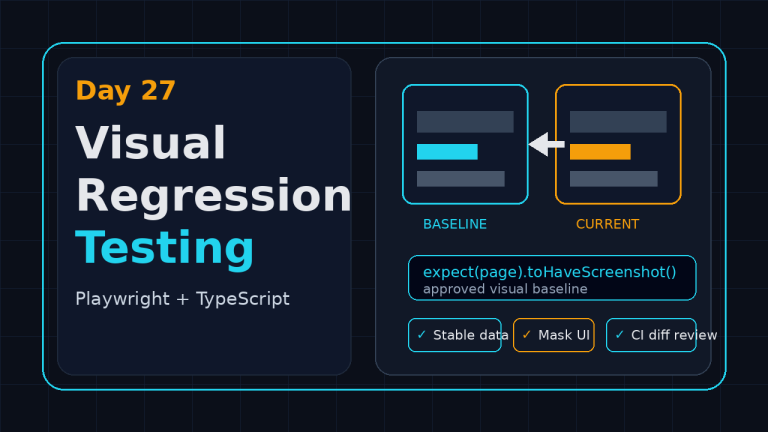
- Nightly: Full E2E suite, visual regression, performance benchmarks (automated)
- Weekly: Exploratory testing sessions, security scans, chaos testing (human-led)
- Per-release: Release confidence score review, regression sign-off (human decision)
🎓 Become an AI-Powered QA Engineer
Join hundreds of SDETs mastering LLM, RAG, and agent testing. Lifetime access, hands-on labs, and a job-ready portfolio.