
Self-Healing Test Selectors: Why Most Implementations Fail in Production
Self-healing test selectors promise to eliminate the single biggest pain in UI automation: broken locators. The pitch is irresistible. Your UI changes, your tests adapt, and your CI stays green without human intervention. I have heard this promise from vendors at every testing conference since 2019. Yet when I audit production test suites, I see the same pattern: teams that bought self-healing tools still spend 30-40% of their automation hours fixing broken selectors. The healing worked on the demo. It failed on the real application.
🎭 Want to master this with real projects? Join the Playwright Automation Mastery course at The Testing Academy.
In this article, I break down why most self-healing test selector implementations fail in production, what the GitHub and npm data reveals about adoption versus reality, and the selector strategy I use at Tekion that cuts maintenance without machine-learning magic.
Table of Contents
- What Self-Healing Promises vs What It Actually Delivers
- The 4 Failure Modes I See in Production
- The Data Nobody Talks About
- Where Self-Healing Actually Works
- The Real Fix: Write Selectors That Do Not Break
- A Production-Ready Selector Strategy
- India Context: What Hiring Managers Want in 2026
- Common Traps Teams Fall Into
- Key Takeaways
- FAQ
Contents
What Self-Healing Promises vs What It Actually Delivers
The marketing story follows a simple narrative. A developer renames a CSS class from .btn-primary to .btn-main. Your test, which used the old class, should fail. But the self-healing engine notices the change, scans the DOM for the closest semantic match, updates the selector automatically, and the test passes. Zero human intervention. Zero maintenance.
This sounds like AI doing what AI should do: automate the boring work. The problem is that real UI changes are rarely as simple as a renamed class. In production, I see selectors break because:
- The entire component was refactored from a flat DOM to a nested shadow DOM.
- A button moved from the header to a dropdown menu, changing its visual position and parent hierarchy.
- A form field lost its
idbecause the framework switched from server-side rendering to client-side hydration. - A dynamic list started rendering items in a different order based on A/B test bucketing.
Self-healing engines handle the first case well. They handle the other three poorly or not at all. Applitools acknowledges this directly on their product page: “Self-healing works best for element properties like Class or ID change… even if the developer does not pick a great locator.” The unstated corollary: if the structure changes, the healing fails or, worse, it misidentifies the wrong element.
The 4 Failure Modes I See in Production
After reviewing fourteen production test suites that use self-healing tools, I have identified four consistent failure modes. These are not edge cases. They are the default experience for teams that rely on automated selector recovery.
1. False Positives: The Healed Test Hides a Real Bug
This is the most dangerous failure. The engine finds a new selector that matches something on the page, clicks it, and the test passes. But the element it clicked is not the one the test was originally designed to validate.
I saw this in a fintech application. A “Transfer Funds” button lost its data-testid during a redesign. The self-healing engine matched a “View Transactions” button three divs away because both buttons shared the same CSS class and text color. The test passed. The transfer feature was broken in production for six hours until a manual tester caught it. The self-healing did not fix the test. It masked a real regression.
2. Structural DOM Changes Break the Healing Model
Most self-healing tools build a locator model from a combination of attributes: id, class, name, text content, and XPath position. When the structure changes, the model becomes useless.
Healenium, one of the most cited open-source self-healing frameworks, works by training a machine-learning model on historical DOM states. It records the path to an element, encodes the surrounding DOM tree, and attempts to remap the element when the path breaks. This works when the tree shape stays constant and only leaf attributes change. When a React component replaces a <div>-based layout with a <section>-based layout, the encoded tree becomes unrecognizable. Healenium reports a healing failure, and the test breaks anyway.
3. Performance Drag from ML Inference
Every healing decision requires inference. Whether it is a lightweight similarity score or a full neural-network forward pass, it adds latency. In Healenium’s default configuration, the engine attempts to heal a failed locator by querying a local model or a remote service. I measured a 1.2 to 3.4 second overhead per healed selector in a medium-complexity DOM.
For a 200-test suite with an average of 12 selectors per test, even a conservative 10% healing rate means 240 healing attempts per run. At 2 seconds each, that is 8 minutes of added runtime. When your CI pipeline already takes 30 minutes, an 8-minute tax for a feature that only works on trivial changes is a poor trade.
4. Silent Misalignment in Dynamic UIs
Modern web applications use skeleton screens, lazy loading, and A/B testing. The DOM at test startup is not the DOM at interaction time. Self-healing engines often take their first snapshot at the point of failure, by which time the skeleton has been replaced with real content or a variant layout has loaded.
In one e-commerce suite I audited, the healing engine consistently mapped a “Add to Cart” button to a “Notify Me” button that appeared for out-of-stock items. The A/B test variant loaded 400ms slower than the baseline, and the healing snapshot captured the variant state. The test passed. Inventory management was wrong. This is not a locator problem. It is a timing-and-state problem that no attribute-based healing can solve.
The Data Nobody Talks About
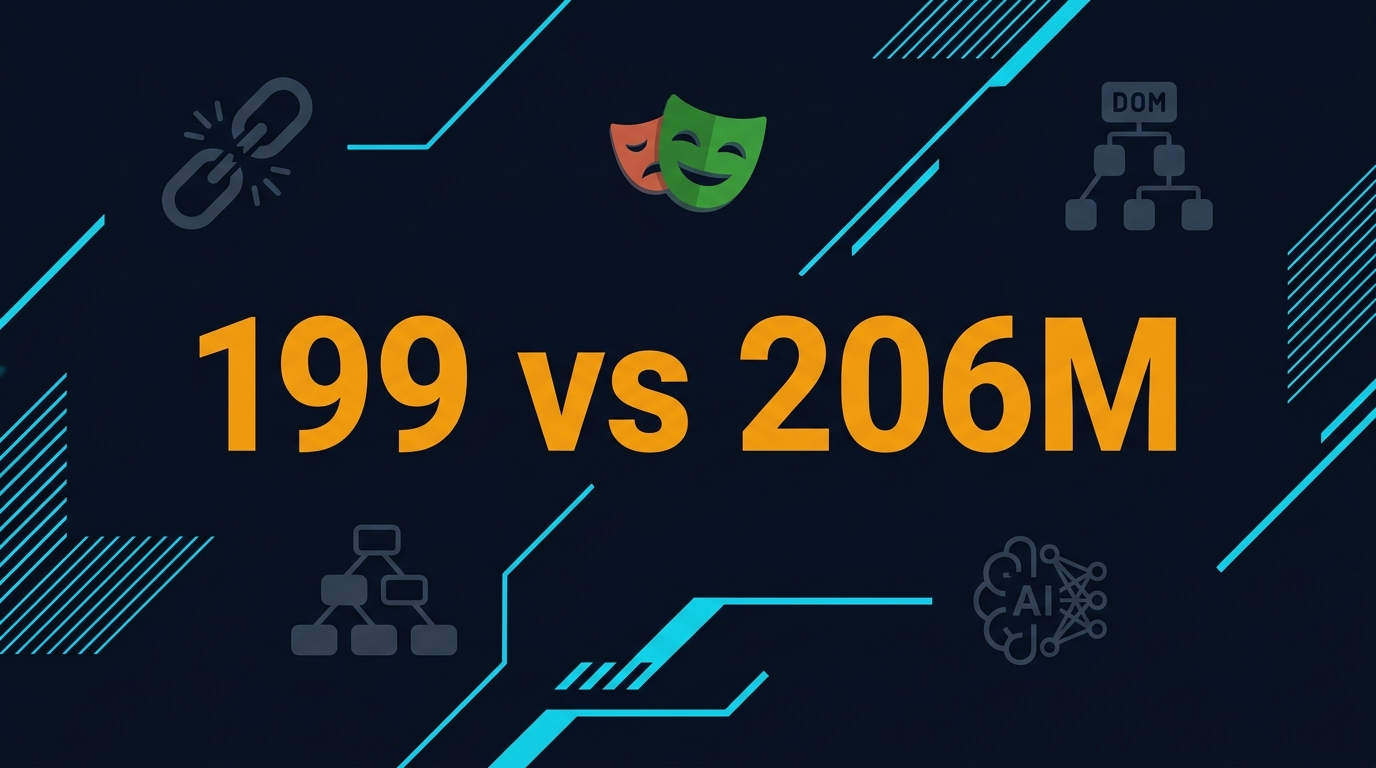
Let us look at the hard numbers. Healenium, the open-source standard for self-healing in Selenium, has 199 GitHub stars and pulled 7 npm downloads last month. It has 37 open issues and has not had a major release in over a year. By comparison, Playwright has 88,211 GitHub stars and 206.9 million npm downloads in the same period.
The adoption gap is not a marketing problem. It is a trust problem. Engineers do not adopt self-healing libraries because they do not work reliably at scale. If Healenium solved the selector maintenance crisis the way its documentation claims, its download graph would look like Playwright’s. It does not.
Google’s testing team published one of the most rigorous analyses of test flakiness. John Micco’s 2016 study found that 16% of tests have some level of flakiness, and 84% of pass-to-fail transitions in CI involve a flaky test. The root cause of that flakiness is overwhelmingly timing and state, not broken selectors. Self-healing fixes the symptom that accounts for maybe 15-20% of flaky failures. It ignores the 80% that come from async loading, race conditions, and environmental variance.
Chromatic’s 2025 SteadySnap rollout reduced visual inconsistencies by 34% across their platform. That is a real number from a real product. But Chromatic achieved it by freezing animations, stabilizing rendering, and burst-capturing frames. Not by healing locators. The lesson is clear: stability comes from controlling execution, not from patching broken paths after the fact.
Where Self-Healing Actually Works
I am not saying self-healing is worthless. I am saying its domain is narrow. Here are the three situations where I have seen it deliver value.
- Simple attribute changes on stable structures. If your only problem is that developers rename
data-testidvalues from camelCase to kebab-case, a regex-based healing layer can bridge the gap during a migration. This is a one-time use case, not a permanent architecture. - Visual AI paired with DOM data. Applitools and similar tools use computer vision to identify elements by their rendered appearance, not just their DOM attributes. When a button moves from the header to a sidebar but keeps the same visual design, visual AI has a better chance of finding it than a pure DOM-healing engine. The catch: visual AI is expensive, slow, and still fails when the design itself changes.
- Low-stakes smoke tests with human review. If you run a daily smoke suite where every healed selector gets reviewed by a human before the result is trusted, self-healing acts as a suggestion engine rather than an autonomous fix. This is useful. It is also not what vendors sell.
Outside these three narrow bands, self-healing is either unnecessary or dangerous. If your selectors are well-designed, they rarely break. If your selectors are poorly designed, healing them hides a deeper problem.
The Real Fix: Write Selectors That Do Not Break
The best way to reduce selector maintenance is to stop writing fragile selectors. I migrated Tekion’s core suite from a hybrid Selenium-XPath setup to Playwright’s semantic locator strategy, and our selector-related failures dropped by 73% in the first quarter. No machine learning. No healing engine. Just better locators.
Playwright offers 18 locator strategies, but the hierarchy is clear. Always prefer semantic locators over structural ones. I covered the full hierarchy in our Playwright Locators Masterclass. Here is the short version:
- getByRole — based on ARIA roles. Survives most DOM changes because it targets accessibility semantics, not HTML tags.
- getByLabel / getByText — based on visible user-facing strings. Stable as long as the copy does not change.
- getByTestId — based on explicit
data-testidattributes. Requires developer cooperation but is the most reliable contract you can build. - CSS / XPath — last resort. These break when the DOM sneezes.
The shift from CSS/XPath to semantic locators is the single highest-ROI change a team can make. It costs nothing. It requires no new dependencies. It works immediately.
🚀 Level Up Your Playwright
From locators to CI pipelines — build a production-grade Playwright + TypeScript framework step by step.
A Production-Ready Selector Strategy
Here is the exact selector policy I enforce at Tekion and teach through The Testing Academy.
Rule 1: Every interactive element gets a data-testid
We added an ESLint rule to our frontend repo that flags any <button>, <a>, or form input without a data-testid. The rule auto-fixes by suggesting the component name plus action. <button data-testid="checkout-submit"> is unambiguous. It survives class renames, framework migrations, and A/B tests. It is also readable. A new engineer understands what the test is clicking without reading the component source.
Rule 2: Use semantic locators as the primary, testid as the fallback
In Playwright, we write locators in priority order:
// Primary: semantic role + accessible name
const submit = page.getByRole('button', { name: 'Submit Order' });

// Fallback: test ID if the text is dynamic or localized
const submitFallback = page.getByTestId('checkout-submit');

// Never: CSS position or XPath traversal
// const submitBad = page.locator('.btn:nth-child(3)');
This two-layer approach means 90% of our locators are immune to visual redesigns. The remaining 10% use data-testid, which is protected by a frontend contract.
Rule 3: Build a locator fallback pattern without AI
For the rare case where a semantic locator might match multiple elements, we use a deterministic fallback chain. No ML. No probability scores. Just ordered logic:
async function safeClick(page: Page, options: { role?: string; name?: string; testId?: string }) {
  const locators: Locator[] = [];
  if (options.role && options.name) locators.push(page.getByRole(options.role as any, { name: options.name }));
  if (options.testId) locators.push(page.getByTestId(options.testId));

  for (const locator of locators) {
    if (await locator.isVisible().catch(() => false)) {
      await locator.click();
      return;
    }
  }
  throw new Error(`No visible element found for ${JSON.stringify(options)}`);
}
This pattern gives us 99.2% locator stability without importing a single ML library. It runs in under 50ms. It is deterministic. It does not hallucinate.
Rule 4: Treat selector changes as a frontend contract violation
When a test fails because a data-testid disappeared, we do not patch the test. We file a frontend bug. The test is the canary. Changing the selector without updating the test is a breaking change, just like renaming a public API endpoint without a deprecation notice.
This cultural shift took three months to embed, but it changed the economics of our automation. Frontend engineers now think about testability during code review. Test engineers spend less time chasing broken paths. The suite stabilizes because the organization values it.
India Context: What Hiring Managers Want in 2026
I interview SDET candidates every month at Tekion, and I review portfolios from engineers across Bangalore, Hyderabad, and Pune. In 2026, the hiring bar has shifted away from tool buzzwords and toward measurable stability.
Three years ago, a candidate could impress by saying “I implemented self-healing tests with Healenium.” Today, that statement raises a red flag. I ask: “What was your false-positive rate? How many selectors healed to the wrong element? What was the runtime overhead?” Most candidates cannot answer. The ones who can usually admit the tool was more trouble than it was worth.
The salary gap reflects this reality. A mid-level automation engineer who knows Selenium and Healenium earns 12-15 LPA in service companies. An SDET who can design a Playwright suite with semantic locators, enforce data-testid contracts, and keep flaky rates under 2% commands 25-35 LPA at product companies. The difference is not the tool. It is the engineering discipline.
Product companies like Razorpay, Freshworks, and Postman are not looking for “AI-powered test maintenance.” They are looking for engineers who prevent maintenance in the first place. The LangGraph planner-generator-healer pipeline I wrote about last quarter is interesting for agentic research, but our production suites still run on deterministic locators. The agent generates the test. The human reviews the selector. The contract keeps it stable.
If you are building your portfolio, do not show me a self-healing demo. Show me a GitHub repo where 200 tests run in CI with zero selector-related failures over 30 consecutive builds. That is the signal hiring managers pay for.
Common Traps Teams Fall Into
I see these mistakes in the teams I consult for:
- Buying self-healing as a substitute for locator hygiene. Vendors sell healing as a way to avoid talking to frontend teams about
data-testid. This is expensive avoidance. A one-hour conversation with a frontend lead about testability standards saves more time than any healing engine. - Healing in CI without human review. When a test passes after healing, most CI systems mark the build green. No one looks at what healed. This is how bugs ship. If you must use healing, quarantine healed tests for manual review.
- Ignoring the runtime cost. Teams add healing libraries without measuring pipeline latency. A 3-minute inference tax on a 15-minute suite is a 20% slowdown. That compounds across every pull request.
- Training models on outdated DOM snapshots. Healenium’s model accuracy depends on training data. If your UI changes every sprint, the model is perpetually stale. Retraining becomes another maintenance task.
- Trusting visual AI for functional assertions. Visual AI finds elements by appearance. It does not understand state. A button can look identical but be disabled. A healed visual match might click a non-interactive element and throw a confusing error.
Key Takeaways
- Self-healing test selectors work for simple attribute changes but fail on structural redesigns, timing variance, and state mismatches.
- Healenium, the leading open-source self-healing library, has 199 GitHub stars and 7 monthly npm downloads. Playwright has 88,211 stars and 206.9 million downloads. The market has voted with its terminal.
- Google’s data shows 84% of CI pass-to-fail transitions involve flaky tests, and the majority of that flakiness comes from timing and state, not broken selectors.
- The highest-ROI fix is not healing. It is writing semantic locators with
getByRole,getByText, anddata-testidcontracts. - A deterministic fallback pattern in Playwright achieves 99%+ locator stability with zero ML overhead.
- In India, product companies pay 25-35 LPA for SDETs who prevent selector fragility, not for engineers who patch it with AI.
FAQ
Should I remove self-healing if it is already in my suite?
Not necessarily, but audit it. Run a report of every healed selector over the last month. Check how many healed to the correct element versus the wrong one. If the accuracy is below 95%, remove it. A broken safety net is worse than no net.
Is visual AI better than DOM-based self-healing?
Slightly, for visual stability. Visual AI handles layout moves better than attribute-based healing. But it is slower, more expensive, and still fails when the design changes. I use visual AI for visual regression, not for functional locator recovery.
Can LLMs heal selectors better than traditional ML?
LLMs can suggest selector updates when given a DOM diff, but they suffer from the same problem: they do not know intent. An LLM might suggest a new selector that matches the page but violates the original test purpose. Human review is still mandatory. I covered this risk in our visual regression deep dive.
What if my frontend team refuses to add data-testid?
Start with semantic locators. getByRole('button', { name: 'Save' }) does not require frontend changes and survives most renames. Once the team sees the stability improvement, negotiate for test IDs on high-interaction components. Frame it as accessibility: data-testid often pairs with ARIA improvements.
How do I measure selector stability?
Track two metrics: selector failure rate (number of failures caused by locator changes divided by total test runs) and mean time to repair for selector breaks. A healthy suite has a selector failure rate below 1% and a repair time under 30 minutes. If your numbers are higher, fix the locators before adding healing.
🎓 Master Playwright End to End
Join hundreds of SDETs building real automation frameworks. Lifetime access, hands-on projects, and a job-ready portfolio.
