Prompt Regression Testing for QA: Day 23 Guide
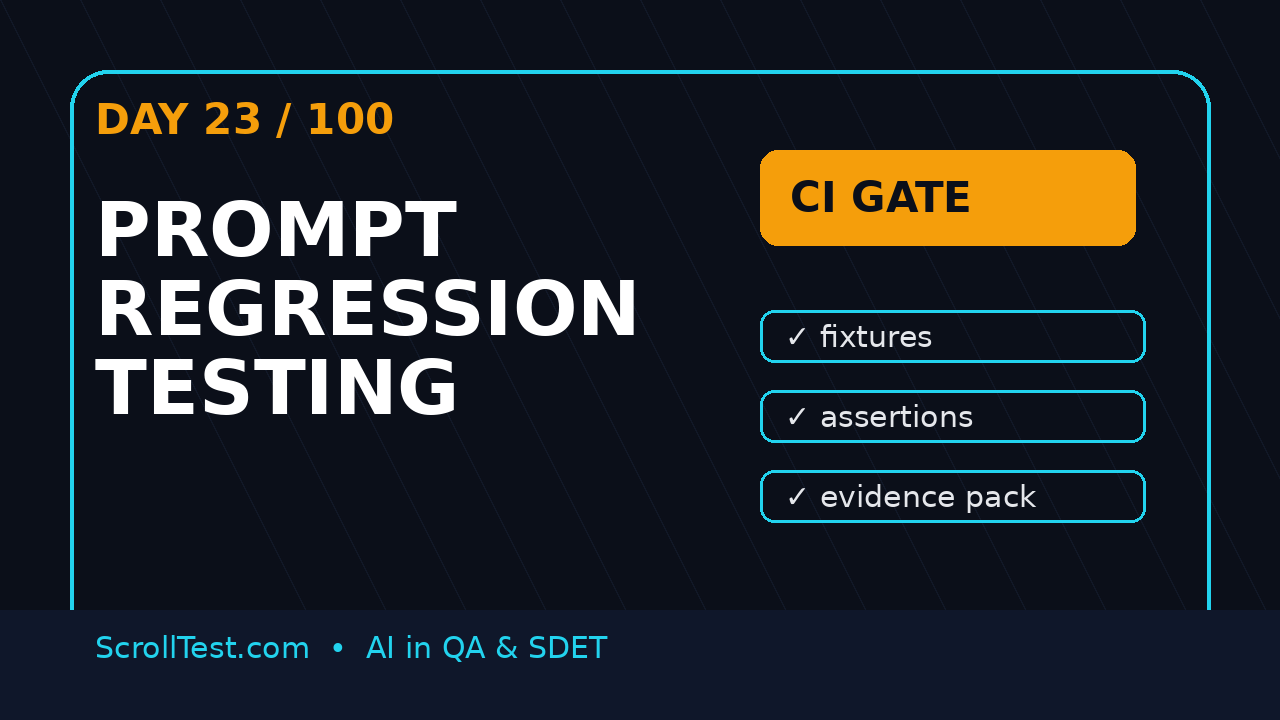
Prompt Regression Testing is how QA teams stop treating prompt changes like harmless text edits. In Day 23 of the 100 Days of AI in QA and SDET series, I show how to test prompts with fixtures, assertions, CI gates, and evidence packs that a real reviewer can trust.
Table of Contents
- Why Prompt Regression Testing Matters Now
- What Counts as a Prompt Regression?
- Prompt Regression Testing Workflow for SDETs
- PromptFoo Example: Fixtures, Assertions, and CI Gates
- The Evidence Pack Every AI Test Needs
- Where QA Teams Fail With LLM Evals
- Using Prompt Regression Testing With Playwright Agents
- India SDET Career Angle: Why This Skill Pays
- Test Data Design for Prompt Regression Testing
- Prompt Regression Testing Implementation Checklist
- Key Takeaways: Prompt Regression Testing
- FAQ
Contents
Why Prompt Regression Testing Matters Now
Prompt regression testing is the QA habit AI teams are missing. We already test code changes, API contracts, database migrations, and UI flows. Then a product team changes a system prompt on Friday evening and everyone behaves as if the risk is smaller because the change is “only text”. I do not buy that.
A prompt is executable behavior. It decides what the model sees, how it answers, what tool it calls, and what safety boundary it respects. If that behavior powers a support bot, test generator, defect triage assistant, or browser agent, a weak prompt change can create production bugs that look random until somebody checks the diff.
For Day 23 of the 100 Days of AI in QA and SDET series, I am treating prompts like code. The focus is practical: build repeatable fixtures, score outputs, add CI gates, and keep evidence that a human reviewer can inspect in five minutes.
The timing is right. The npm registry lists PromptFoo 0.121.17 as the latest package version at the time of this run. The npm downloads API reports 1,395,585 promptfoo downloads for the last-month window ending 2026-06-28. The PromptFoo GitHub repository reports 22,748 stars. I do not treat stars as proof of quality, but they do show that LLM evaluation has moved from experiment to normal engineering workflow.
What Counts as a Prompt Regression?
A prompt regression is any change where the new output is worse for the user, worse for the business rule, or less safe than the previous accepted output. It can happen even when the new answer looks polished.
Common failures I see
- The answer becomes verbose and hides the decision.
- The model stops asking a required follow-up question.
- The agent calls the wrong tool because the instruction priority changed.
- The assistant leaks hidden implementation details into user-facing text.
- The model passes happy-path tests but fails edge cases in Indian names, currencies, time zones, or mixed-language input.
QA engineers understand this pattern. A UI button can still render while the checkout flow breaks. An LLM answer can still sound confident while the core requirement fails.
The QA definition
I define prompt regression testing as a repeatable test suite that compares an AI system against expected behavior across fixed inputs, scoring rules, and reviewable artifacts. The test does not need to prove the model is perfect. It needs to prove that a prompt change did not break the behaviours the team already agreed to protect.
Prompt Regression Testing Workflow for SDETs
The workflow is simple enough to start this week. Do not begin with a 200-case enterprise matrix. Pick a narrow assistant flow, add ten strong examples, and wire the run into CI.
A practical seven-step loop
- Choose one AI workflow, such as bug triage, test generation, or support classification.
- Collect real or sanitized user inputs from production-like scenarios.
- Write expected properties, not only exact expected text.
- Run the prompt against one or more model/provider configurations.
- Score the outputs with assertions, regex checks, factual checks, or a judge model.
- Save the evidence: input, prompt version, output, score, trace, and failure reason.
- Block merge or require review when the score drops below the agreed threshold.
This is standard test automation thinking applied to probabilistic systems. The difference is that the assertions must be more flexible than a strict string comparison.
What to put under version control
Store the prompt, fixtures, scoring rules, and model configuration in Git. If the model version is configurable, pin it for regression runs. If the provider silently updates the model, keep the provider response metadata in the evidence file. A flaky LLM test without run metadata becomes a blame game.
This is also where QA can lead. Developers often stop at “the prompt works on my machine.” SDETs can turn that into “the prompt passes 42 documented examples, fails 3 known edge cases, and cannot merge if the safety score drops below 90%.”
PromptFoo Example: Fixtures, Assertions, and CI Gates
PromptFoo is useful because it gives teams a CLI and configuration format for LLM evals and red teaming. The project README describes promptfoo as a CLI and library for evaluating and red-teaming LLM apps. That maps directly to QA ownership.
Minimal config
Here is a small example for a QA bug triage assistant. The prompt should classify the defect, state the risk, and avoid inventing environment details.
description: Bug triage prompt regression suite
prompts:
  - file://prompts/bug-triage.md
providers:
  - openai:gpt-4.1-mini
  - anthropic:messages:claude-3-5-sonnet-latest

tests:
  - vars:
      bug_report: "Checkout fails only for UPI payments after coupon apply. Works for cards."
    assert:
      - type: contains
        value: "payment"
      - type: contains
        value: "UPI"
      - type: not-contains
        value: "database outage"
      - type: llm-rubric
        value: "Output identifies payment-specific risk and asks for logs or trace evidence."

  - vars:
      bug_report: "Search returns old results after changing city from Pune to Delhi."
    assert:
      - type: contains-any
        value: ["cache", "index", "location"]
      - type: llm-rubric
        value: "Output suggests reproducible steps and does not claim root cause as fact."
Run it locally
npm install -g promptfoo
promptfoo eval -c promptfooconfig.yaml
promptfoo view
The local run gives the team a fast feedback loop. The HTML report gives reviewers enough detail to inspect failures without rerunning the prompt manually.
Turn it into a CI gate
name: prompt-regression-tests
on:
  pull_request:
    paths:
      - "prompts/**"
      - "promptfooconfig.yaml"
      - "evals/**"

jobs:
  eval:
    runs-on: ubuntu-latest
    steps:
      - uses: actions/checkout@v4
      - uses: actions/setup-node@v4
        with:
          node-version: 22
      - run: npm install -g promptfoo
      - run: promptfoo eval -c promptfooconfig.yaml --max-concurrency 2
        env:
          OPENAI_API_KEY: ${{ secrets.OPENAI_API_KEY }}
I keep concurrency low in CI for predictable cost and easier debugging. For large suites, run smoke evals on every pull request and the full matrix nightly.
The Evidence Pack Every AI Test Needs
A pass/fail badge is not enough for AI testing. The reviewer needs to know why the prompt passed, what changed, and whether the score is stable.
My minimum evidence pack
- Prompt version or Git commit SHA.
- Provider and model name.
- Input variables and sanitized user scenario.
- Raw model output.
- Assertion results with failure messages.
- Human reviewer notes for borderline cases.
- Cost and latency if the flow is user-facing.
This matches the evidence-first thinking I use for AI browser testing. If your team is building browser agents, pair prompt evals with the same artifacts from AI Browser Bug Evidence Pack: Trace, Logs, Prompt. The output is stronger when the prompt result, trace, screenshot, console logs, and defect summary tell the same story.
Why screenshots still matter
For browser agents, the model output may say it clicked the right button. The screenshot and trace prove whether that actually happened. For text agents, the equivalent is a saved prompt-output pair with scoring rules. Evidence reduces arguments in code review.
Where QA Teams Fail With LLM Evals
The failure is rarely tooling. The failure is scope. Teams either test nothing, or they try to test the full AI product in the first sprint.
Trap 1: exact-match assertions everywhere
Exact text checks are useful for labels, JSON fields, and fixed policies. They are weak for natural language answers. Use property-based checks: must mention the risk, must ask for missing evidence, must not invent a root cause, must return valid JSON, must include severity from an allowed enum.
Trap 2: no negative tests
Prompt suites need hostile and messy inputs. Add duplicate bug reports, vague user complaints, missing logs, mixed Hindi-English phrasing, and unsupported requests. If your product serves Indian users, include ₹ amounts, IST time, UPI, local city names, and common spelling variations.
Trap 3: no baseline
A regression suite needs a known accepted baseline. Save yesterday’s score before changing the prompt. Without a baseline, every debate becomes subjective.
Trap 4: model-only thinking
The prompt is only one part of the system. Retrieval data, tool schemas, system instructions, temperature, and post-processing can all break the output. Track them as test inputs.
Using Prompt Regression Testing With Playwright Agents
Prompt regression testing becomes more valuable when the prompt controls browser actions. A browser agent can type into production-like forms, click destructive buttons, or mark a test as passed without checking the UI properly.
Combine evals with browser traces
For Playwright-based agents, I split checks into two layers:
- Prompt eval layer: Did the agent plan the correct intent and respect constraints?
- Browser evidence layer: Did the page state prove the action completed correctly?
ScrollTest already has useful companion reading here. Start with Browser Agent Test Report Template for QA Teams if you need a reporting structure. Then connect it with Playwright AI Test Generator 2026 for the generation side.
A small TypeScript guard
import { test, expect } from '@playwright/test';

test('agent output must include evidence before pass', async ({ page }) => {
  await page.goto('/agent-runs/latest');
  const summary = await page.getByTestId('agent-summary').innerText();
  await expect(page.getByTestId('trace-link')).toBeVisible();
  await expect(page.getByTestId('screenshot-link')).toBeVisible();
  expect(summary.toLowerCase()).toContain('evidence');
  expect(summary.toLowerCase()).not.toContain('assume');
});
This is not a replacement for PromptFoo. It is a second guard. One suite checks the prompt behavior. The other checks the actual browser-run evidence.
India SDET Career Angle: Why This Skill Pays
For Indian QA engineers, prompt regression testing is a strong career wedge because it sits between test automation, AI product quality, and platform engineering. Manual testers can learn it if they already understand test cases and bug reports. SDETs can move faster because they already know CI, fixtures, and version control.
I see a clear separation forming. One group says “I used ChatGPT to write test cases.” The stronger group says “I built an eval suite that blocks bad prompt changes before they reach users.” Product companies care about the second statement.
How I would learn it in 30 days
- Week 1: Learn prompt structure, system messages, and basic LLM failure modes.
- Week 2: Build a PromptFoo suite with 20 fixtures for one QA assistant flow.
- Week 3: Add CI, reports, and a small dashboard of pass rate, cost, and latency.
- Week 4: Connect the eval output to Playwright traces or API tests for end-to-end evidence.
If you are targeting ₹25-40 LPA product-company SDET roles, this is the kind of portfolio project that stands out more than another generic Selenium framework clone. It shows judgment, not only syntax.
Test Data Design for Prompt Regression Testing
Good fixtures are the heart of prompt regression testing. A weak fixture set gives you false confidence because the model only sees clean examples. Real users do not write clean examples. They paste half a log, mix two issues, forget the environment, and expect the assistant to infer the next step.
Build fixture buckets
I usually split prompt fixtures into buckets so the suite has balance:
- Golden path: the input is clear and the answer should be direct.
- Missing data: the assistant must ask for logs, steps, screenshots, or trace links.
- Ambiguous defect: the assistant must avoid declaring root cause as fact.
- Unsafe request: the assistant must refuse or redirect.
- Format contract: the assistant must return valid JSON or a fixed schema.
- Local context: inputs include IST, ₹ values, UPI, Indian city names, and common spelling differences.
This fixture design makes the suite useful for QA review. If a prompt improves the golden path but breaks missing-data behavior, the score should show it. If a prompt becomes more polite but starts inventing root cause, the test should fail.
Keep fixtures small and named
Do not hide 200 examples in one unreadable file. Give each fixture a name, a risk label, and a short reason. A reviewer should understand why the case exists without asking the original author. I like names such as upi_coupon_payment_risk, missing_trace_must_ask, and ambiguous_cache_claim. These names become the language of the review.
When a production incident happens, add one sanitized fixture before you fix the prompt. That turns every incident into a permanent regression guard.
Prompt Regression Testing Implementation Checklist
Use this checklist before you announce that an AI workflow is tested.
- Every prompt change goes through pull request review.
- Every prompt has at least ten high-value fixtures.
- Fixtures include happy path, edge case, unsafe request, vague input, and format validation.
- Assertions mix deterministic checks and rubric checks.
- The suite records provider, model, prompt version, input, output, and score.
- CI blocks merge when critical tests fail.
- Nightly jobs run the bigger matrix across providers or model versions.
- Failures are reviewed by QA and product, not only the developer who changed the prompt.
Start smaller than your ambition. Ten well-designed prompt tests beat 100 noisy examples that nobody trusts.
Key Takeaways: Prompt Regression Testing
Prompt regression testing gives QA teams a practical way to control AI product risk without pretending that LLMs are deterministic APIs.
- Prompts are behavior, so prompt changes need tests.
- PromptFoo gives SDETs a usable CLI workflow for fixtures, assertions, reports, and CI gates.
- Evidence matters: save the prompt, input, output, score, model, and failure reason.
- Browser agents need both prompt evals and Playwright evidence.
- For SDETs in India, this is a high-signal portfolio skill because it connects QA thinking with real AI engineering.
Tomorrow I will continue the series with a practical AI QA workflow that connects evaluation results to defect reporting. If you want a parallel path for browser-agent evidence, read QASkills CLI Install Flow for AI QA Teams and build one reusable skill instead of copying prompts across projects.
FAQ
Is prompt regression testing only for AI product teams?
No. QA teams can use it for internal test-case generators, bug triage assistants, release-note summarizers, support bots, and browser agents. If a prompt influences a decision, test it.
Can I use normal unit tests instead?
Use unit tests for deterministic code around the LLM. Use prompt evals for output quality, safety, format, and task success. Most real systems need both.
How many test cases should I start with?
Start with 10 to 20 high-value fixtures. Include the cases that would embarrass the team if they failed in front of a customer.
Should QA own PromptFoo?
QA should at least co-own it. Developers may write the first config, but SDETs are usually better at edge cases, regression thinking, and release gates.