Playwright v1.61.1 Upgrade Test Plan for QA Teams
If your Playwright v1.61.1 upgrade test plan is only “run npm update and watch CI,” it is not a test plan. The Playwright v1.61.1 release is a small patch release, but the fixes touch matchers, UI mode API reporting, trace viewer WebSocket timing, Node 22.15 sync loader behavior, and pnpm workspace TypeScript imports.
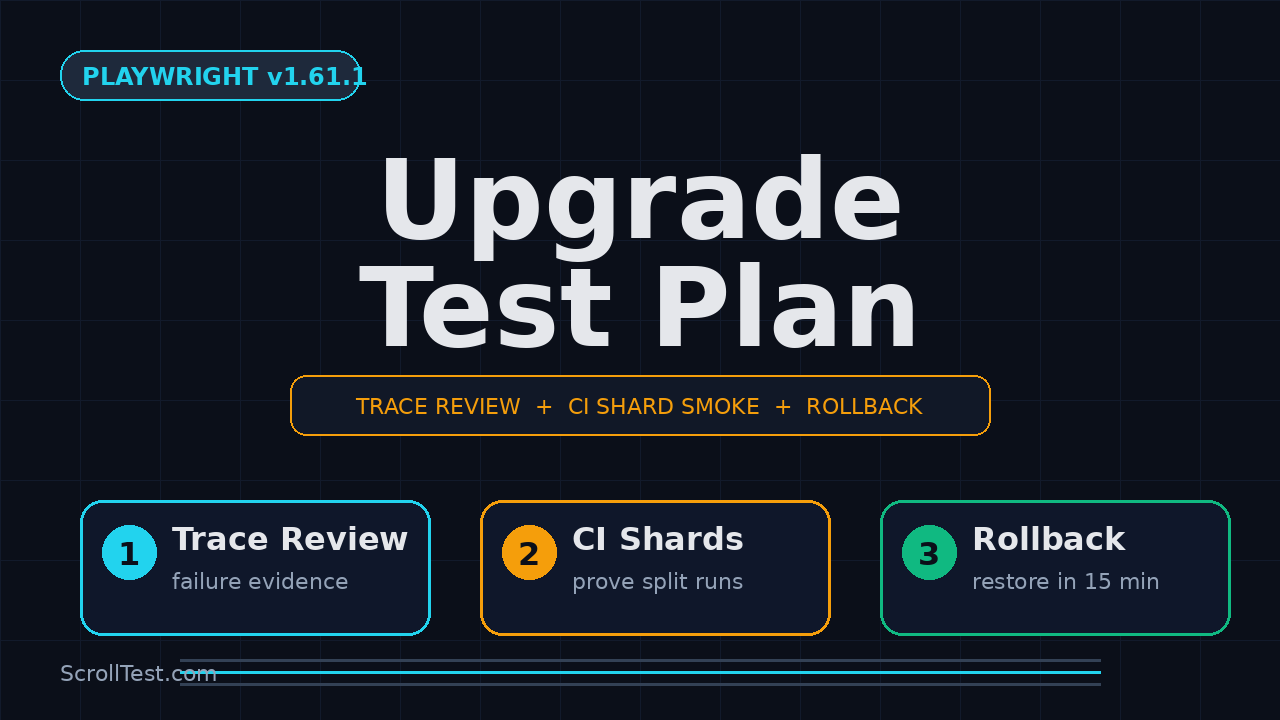
That is exactly the kind of release that looks harmless until a real framework hits it. I see teams upgrade Playwright like a package chore, then spend two days asking why trace evidence, custom assertions, or workspace imports changed. This guide gives you a practical release-note driven plan: trace review, CI shard smoke, and rollback checks before the merge.
Table of Contents
- Why This Release Needs a Plan
- Read Release Notes Like a QA Engineer
- Build the Upgrade Branch
- Trace Review Before Merge
- CI Shard Smoke Plan
- Rollback Checks
- India SDET Context
- Final Checklist
- FAQ
Contents
Why This Release Needs a Plan
Patch releases still change real test behavior
Playwright v1.61.1 was published on GitHub on 23 June 2026, according to the official release entry. The release lists five bug fixes. That number looks small, but every item sits close to daily automation work: assertions, UI mode, trace viewer, Node loading, and pnpm workspaces.
The npm registry currently lists playwright and @playwright/test latest as 1.61.1. The npm downloads API reported 273,232,795 downloads for playwright and 189,139,952 downloads for @playwright/test in the last month window ending 22 July 2026. The GitHub API showed 93,341 stars for microsoft/playwright when I checked. This is not a niche test runner. A tiny change can hit a large set of frameworks.
The release-note risk is not only browser execution
Many QA teams only ask one question: “Do our browser tests pass?” That is too narrow for this release. The v1.61.1 fixes include a trace viewer timing issue for WebSocket messages and a UI mode API request byte-reporting issue. Those are evidence and debugging surfaces. If your tests pass but your trace review is wrong, your release investigation still suffers.
The sync loader fixes are also important. One bug mentions Node 22.15 and the message context.conditions?.includes is not a function. Another mentions extensionless TypeScript subpath imports across pnpm workspace symlinks. If your SDET framework uses a monorepo, shared fixture package, or workspace alias, you need to test the framework shape, not just one happy path spec.
The right goal is confidence, not ceremony
A good Playwright v1.61.1 upgrade test plan should answer four questions:
- Did the upgrade change assertion behavior in any custom matcher or wrapper?
- Can UI mode and trace viewer still explain failures accurately?
- Do CI shards still split, run, and report consistently?
- Can the team roll back in less than 15 minutes if production release testing is blocked?
If you already follow a release-watch process, connect this article with the Playwright smoke test matrix from release notes. That matrix gives the mindset. This post turns the v1.61.1 notes into a concrete plan.
Read Release Notes Like a QA Engineer
Convert each bug fix into a risk question
Do not copy release notes into Slack and call it done. Convert each note into a testable risk. For Playwright v1.61.1, I would use this table during grooming:
| Release note area | Risk question | Smoke check |
|---|---|---|
| Expect matcher override | Do custom matchers collide with default matcher names? | Run assertion wrapper specs and one intentionally failing assertion. |
| UI mode API byte report | Does UI mode show API request details correctly? | Run one API setup call in UI mode and inspect output. |
| Trace viewer WebSocket timing | Are WebSocket event times readable and believable? | Open a trace for a real-time screen and inspect the message timeline. |
| Node 22.15 sync loader | Does the framework boot on the same Node version as CI? | Run config load, fixture import, and one spec with Node 22.15. |
| pnpm workspace imports | Do extensionless TypeScript subpath imports resolve? | Run specs that import shared test utilities from workspace packages. |
Separate product risk from framework risk
A Playwright upgrade rarely changes only product tests. It can change the test runner, reporters, trace artifacts, browser binaries, fixture loading, API helpers, and CI behavior. Keep two buckets:
- Product risk: checkout, login, billing, search, dashboard, and other critical user journeys.
- Framework risk: config loading, projects, retries, reporters, traces, custom matchers, auth setup, and shared packages.
This split matters because a green product smoke can hide a broken framework edge. For example, one project may pass because it does not use the shared matcher. Another project fails only when loaded through a pnpm symlink. I prefer a small framework smoke suite that runs even before the full regression pack.
Use official docs as the control, not memory
For trace behavior, use the Playwright trace viewer documentation as your control. For sharding, use the official sharding documentation. For pipelines, use the official CI documentation. This avoids arguments based on what one engineer remembers from an older version.
I also recommend keeping a release-note checklist in the repo. ScrollTest already has related guidance in Playwright Upgrade Checklist: 3 Files Before Merge and Playwright Upgrade Checklist: Trace, Diff, Rollback. Link those in your internal upgrade issue so reviewers see the expected evidence.
Build the Upgrade Branch
Lock the versions explicitly
Start with a short-lived branch. Do not upgrade Playwright inside a random feature branch. The branch name should make the risk clear:
git checkout -b chore/playwright-1-61-1-upgrade
npm install -D @playwright/test@1.61.1
npm install -D playwright@1.61.1
npx playwright install --with-deps
npx playwright --version
If your framework only depends on @playwright/test, avoid adding an unnecessary direct playwright dependency. If your repo uses pnpm workspaces, run the install from the workspace root and confirm the lockfile changed in one place. The v1.61.1 release note about pnpm symlinks is a direct signal to test workspace resolution.
Record the environment before you run tests
Every upgrade issue should capture these facts before the first smoke run:
- Node version used locally and in CI.
- Package manager and version: npm, pnpm, or yarn.
- Playwright version before and after upgrade.
- Browser channels used by the suite: Chromium, Firefox, WebKit, Chrome, Edge.
- CI runner image and operating system.
The Node 22.15 loader fix in v1.61.1 is the reminder. If local Node is 20 and CI Node is 22.15, your local green run is incomplete. A serious SDET checks the runtime shape first.
Run a framework boot test before product smoke
Add or run a tiny spec that proves configuration, fixtures, custom matchers, and imports load correctly. Example:
// tests/framework/upgrade-boot.spec.ts
import { test, expect } from '@playwright/test';
import { buildLoginPayload } from '@qa/shared-data';

test.describe('Playwright upgrade boot checks', () => {
  test('loads fixtures, shared imports, and custom assertions', async ({ page, request }) => {
    const payload = buildLoginPayload('smoke-user');
    expect(payload.email).toContain('@');

    const response = await request.get('/health');
    expect(response.status()).toBeLessThan(500);

    await page.goto('/login');
    await expect(page.getByRole('heading', { name: /sign in/i })).toBeVisible();
  });
});
This is not meant to test the product deeply. It tests the test framework. If this fails, stop. Do not waste CI minutes on 700 specs.
Trace Review Before Merge
Trace review is part of the upgrade, not a nice extra
Playwright traces are often the first artifact a developer opens when a CI failure appears. That makes trace correctness a release gate. In v1.61.1, the trace viewer fix mentions WebSocket message times being downscaled by 1000. If your app uses chat, live notifications, trading updates, collaborative editing, or streaming dashboards, you need a trace with WebSocket activity.
Use the documented trace options from Playwright, then save a before-and-after trace. I like this config during upgrade branches:
// playwright.config.ts
import { defineConfig } from '@playwright/test';

export default defineConfig({
  retries: process.env.CI ? 1 : 0,
  use: {
    baseURL: process.env.BASE_URL || 'https://staging.example.com',
    trace: 'on-first-retry',
    video: 'retain-on-failure',
    screenshot: 'only-on-failure'
  },
  reporter: [['html'], ['json', { outputFile: 'test-results/results.json' }]],
});
Pick one trace that has timing sensitivity
Do not review a static login trace and claim trace viewer coverage. Pick a spec where timing matters. Good candidates include:
- A WebSocket notification test.
- A polling dashboard test.
- An API setup plus UI verification flow.
- A payment callback simulation.
- A multi-tab workflow where ordering matters.
Open the trace, inspect the action timeline, network entries, console messages, and the exact moment where the assertion runs. If the trace cannot explain what happened, your upgrade is not ready even if the run is green.
Keep a trace review note in the pull request
Your pull request should include a short evidence block:
- Trace generated from v1.61.1 run.
- Spec name and CI job link.
- Browser used for the trace.
- One sentence on WebSocket or API timing if relevant.
- Decision: pass, investigate, or rollback.
This takes two minutes. It saves hours when a release manager asks why the test framework changed during a sprint hardening week.
CI Shard Smoke Plan
Shards test your pipeline assumptions
Playwright sharding is documented as a way to split tests across machines. Most teams use it to reduce wall-clock time. During an upgrade, sharding has a second purpose: it proves your test discovery, project config, retries, and reporting still work when the suite is split.
A minimal CI shard smoke for Playwright v1.61.1 should include at least three jobs: framework boot, one critical product smoke, and one shard pair. Here is a GitHub Actions shape:
name: playwright-upgrade-smoke
on:
  pull_request:
    paths:
      - 'package.json'
      - 'package-lock.json'
      - 'pnpm-lock.yaml'
      - 'playwright.config.ts'
      - 'tests/**'

jobs:
  shard-smoke:
    runs-on: ubuntu-latest
    strategy:
      fail-fast: false
      matrix:
        shard: [1, 2]
    steps:
      - uses: actions/checkout@v4
      - uses: actions/setup-node@v4
        with:
          node-version: 22.15.0
      - run: npm ci
      - run: npx playwright install --with-deps
      - run: npx playwright test --grep @smoke --shard=${{ matrix.shard }}/2
Do not hide flaky failures with retries
Retries are useful in normal CI. They are dangerous during an upgrade review if they become a broom. Keep retries visible. If a smoke spec passes on retry, treat it as a signal. Compare the trace, screenshot, and JSON report between the first failure and the retry pass.
I like this rule: no Playwright upgrade merges with a new retry-only pass in smoke. Either fix the cause, quarantine the test with a ticket, or roll back the upgrade. This rule feels strict, but it protects the team from turning framework upgrades into silent flake generators.
Tag the upgrade smoke suite on purpose
The fastest way to make this repeatable is to tag a small group of specs with @upgrade-smoke. Do not depend on file names or tribal memory. A tag lets every engineer run the same release gate locally and in CI.
// tests/checkout/checkout-upgrade-smoke.spec.ts
import { test, expect } from '@playwright/test';

test('@upgrade-smoke checkout still reaches payment review', async ({ page }) => {
  await page.goto('/products/demo-plan');
  await page.getByRole('button', { name: /add to cart/i }).click();
  await page.getByRole('link', { name: /checkout/i }).click();
  await expect(page.getByRole('heading', { name: /payment review/i })).toBeVisible();
});
Then make the command explicit:
npx playwright test --grep @upgrade-smoke --project=chromiumThis keeps the upgrade gate small enough to run often. It also stops the common argument where one engineer runs login, another runs checkout, and the pull request has no consistent evidence.
Check reporters and artifacts
A CI run is not complete when tests pass. Confirm artifacts exist and open correctly:
- HTML report generated and downloadable.
- JSON report produced for dashboards or quality gates.
- Trace ZIPs attached for failed or retried specs.
- Screenshot and video policy still works.
- Shard results can be merged or compared by your reporting tool.
If your pipeline is QA-first, connect this with How to Build a QA-First CI/CD Pipeline. The pipeline should not only run tests. It should protect release decisions.
Rollback Checks
Rollback is a test case
Most teams write rollback steps after the incident. That is backwards. For a Playwright upgrade, rollback means you can restore the previous package versions, lockfile, browser cache assumptions, and CI behavior quickly. I want the rollback plan in the same pull request as the upgrade.
A simple rollback command set can be enough:
git revert <upgrade_commit_sha>
npm ci
npx playwright install --with-deps
npx playwright test --grep @smoke
For pnpm, use the workspace root and confirm the lockfile returns cleanly. If your CI caches browser binaries, document whether the cache key includes the Playwright version. A stale cache can make rollback slower than expected.
Define the rollback trigger before the run
Do not debate rollback criteria after CI turns red. Define them before the upgrade. For v1.61.1, I would roll back or block merge if any of these happen:
- Custom matcher behavior changes in a way that affects existing assertions.
- UI mode hides or misreports API details needed for debugging.
- Trace viewer timing makes WebSocket analysis unreliable.
- Node 22.15 or workspace imports fail in CI.
- Shard smoke passes only through retries without a known product defect.
Keep the upgrade small
Do not combine the Playwright upgrade with locator rewrites, page-object refactors, reporter changes, and CI image migration. If five things change, no one knows what caused the failure. One release, one branch, one focused review.
India SDET Context
Hiring managers notice release ownership
In India, many SDET resumes still say “created automation framework” and “reduced manual effort.” That is not enough for 2026 hiring conversations. Product companies want engineers who can own quality risk in CI, not only write locators. A Playwright v1.61.1 upgrade test plan is a small but strong portfolio story because it shows release judgment.
For mid-level SDET roles around ₹12-25 LPA and senior automation roles around ₹25-40 LPA, the difference is often ownership. A senior engineer can explain why a patch release needs trace review, shard smoke, and rollback criteria. A junior engineer only says the tests passed locally.
What to show in interviews
If you are preparing for interviews, turn this upgrade into a case study. Show:
- The release note you read.
- The risk matrix you created.
- The CI shard smoke evidence.
- The trace screenshot or trace ZIP location.
- The rollback decision rule.
This is practical proof. It is stronger than saying you know Playwright. It also pairs well with the Playwright learning roadmap for 2026 if you are building a public learning plan.
Source links belong in the issue, not only the article
I like to paste the primary sources into the upgrade issue before asking for review. For this release, the source list is simple: the official Playwright v1.61.1 GitHub release, the trace viewer docs, the sharding docs, and the CI docs. If the reviewer cannot open the same sources, the review becomes opinion-based.
This is also how you build trust with developers. You are not saying “QA feels this is risky.” You are saying “the release fixed these five areas, our framework uses three of them, and here is the smoke evidence.” That language changes how engineering managers hear automation work.
Final Checklist for the Playwright v1.61.1 Upgrade Test Plan
The 30-minute version
If you only have 30 minutes, do this:
- Read the official v1.61.1 release note and map each bug fix to one smoke check.
- Upgrade
@playwright/testto 1.61.1 in a separate branch. - Run one framework boot spec with custom matcher and shared imports.
- Run one trace-heavy smoke and open the trace viewer.
- Run a two-way CI shard smoke on the same Node version used by production CI.
- Write rollback commands in the pull request.
The merge-ready version
For a merge-ready upgrade, add evidence. Attach CI links, note Node version, save trace artifacts, confirm reporter output, and record the rollback trigger. Keep the pull request boring. Boring upgrade PRs are good. They tell the team that the framework can move without drama.
Key takeaways
- A Playwright v1.61.1 upgrade test plan should cover more than browser pass or fail.
- The official release notes point to five risk areas: matchers, UI mode, trace viewer, Node loader behavior, and pnpm workspace imports.
- Trace review matters because debugging artifacts influence release decisions.
- CI shard smoke proves the pipeline still discovers, splits, runs, retries, and reports tests correctly.
- Rollback criteria should be written before the upgrade run, not after CI breaks.
FAQ
Is Playwright v1.61.1 a major upgrade?
No. It is a patch release. But patch releases can still affect test infrastructure. The official GitHub release lists bug fixes in areas many teams use daily, including expect matchers, UI mode, trace viewer, Node loading, and pnpm workspace imports.
Should I update Playwright immediately?
Update quickly if the fixes affect your framework, but do it through a controlled branch. If you use Node 22.15, pnpm workspaces, custom matchers, API testing in UI mode, or WebSocket traces, the upgrade deserves focused smoke coverage.
What is the minimum CI check before merging?
Run a framework boot spec, one product smoke, and a two-shard smoke job. Confirm artifacts: HTML report, JSON report, screenshots, videos, and trace ZIPs. A green run with missing artifacts is not enough.
Do I need to review traces if all tests pass?
Yes, for this upgrade I would review at least one trace. The release includes a trace viewer WebSocket timing fix. A passing test does not prove that the debugging evidence remains useful.
What should I put in the pull request description?
Include the old and new Playwright versions, Node version, package manager, release-note risk matrix, CI smoke links, trace review note, and rollback command. Keep it short, specific, and easy for a release owner to approve.