AI in QA: Are You Using It to Find Bugs or Accidentally Creating New Ones?
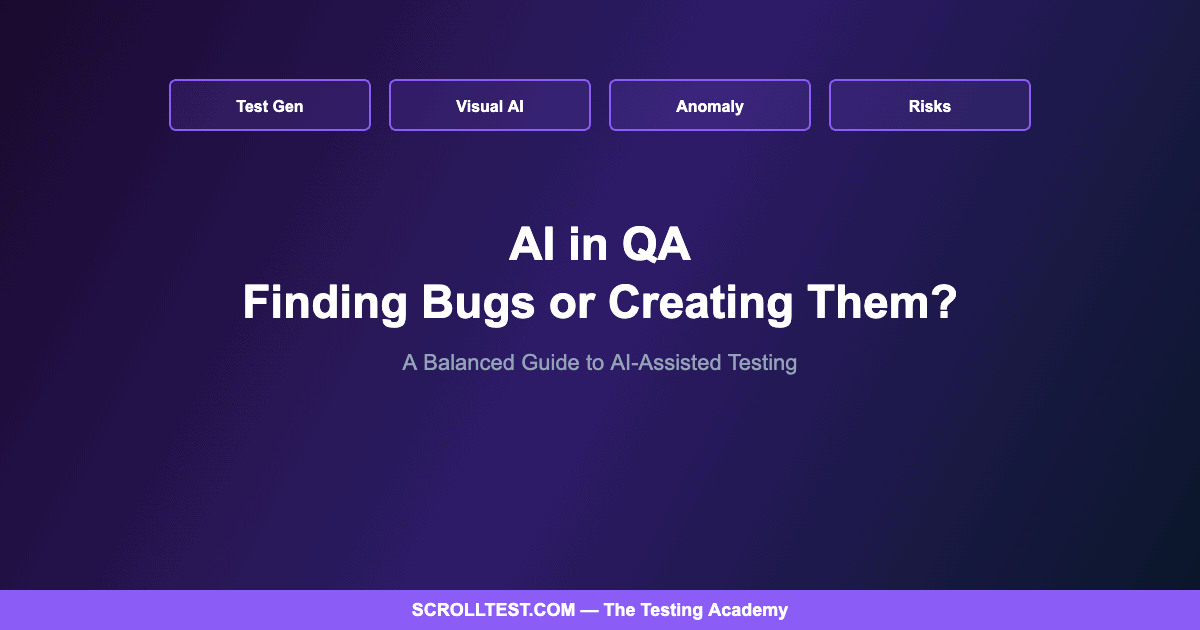
BrowserStack recently hosted a webinar titled “AI in Testing: Finding Bugs or Creating Them?” — and the question itself reveals the tension at the heart of AI-assisted QA. Secure Code Warrior captured it even more sharply: “AI does not make you better at engineering. It just makes you faster at being the engineer you already are.” For QA teams, this means AI can accelerate bug detection for skilled engineers and accelerate the creation of new failure modes for everyone else. This guide maps both sides honestly.
🤖 Learning AI-powered testing? Go hands-on with LLM, RAG, and AI-agent testing in the AI-Powered Testing Mastery course at The Testing Academy.
The AI-in-QA conversation has been dominated by two equally unhelpful extremes. On one side, vendor marketing promises that AI will eliminate manual testing, generate perfect test suites, and find every bug automatically. On the other side, skeptics dismiss AI tools as expensive autocomplete that adds complexity without value. The reality is more nuanced and more interesting than either position allows.
Contents
Where AI Genuinely Helps QA
Test case generation from requirements is the most mature AI-QA use case. Given a user story or specification, AI tools can generate a comprehensive set of test scenarios — including edge cases that human testers might miss — in seconds. The generated tests need human review and refinement, but they provide a strong starting point that saves hours of test design work. In my experience, AI-generated test scenarios cover approximately 70-80% of what an experienced tester would identify, with the remaining 20-30% requiring domain knowledge and creative thinking that AI currently lacks.
Visual regression testing has been transformed by AI. Tools like Applitools use AI to compare screenshots intelligently, distinguishing between meaningful visual changes (a button moved to the wrong position) and irrelevant differences (a timestamp updated, a dynamic ad loaded). This eliminates the false positive problem that plagued pixel-based visual comparison and makes visual testing practical at scale.
Anomaly detection in test results is another strong use case. AI can analyze patterns across thousands of test executions to identify tests whose failure patterns suggest environmental issues (always failing on Mondays), data dependencies (failing after specific other tests), or intermittent infrastructure problems (failing only on specific CI runners). This kind of pattern analysis is tedious and error-prone for humans but natural for machine learning models.
Self-healing selectors — where AI tools automatically update broken locators when UI changes — reduce maintenance burden for UI test suites. The technology works best for simple selector changes (class name renamed, ID updated) and less reliably for structural changes (element moved to a different section of the page).
Where AI Creates New Problems
AI-generated test code can contain subtle logical errors that are harder to detect than obvious failures. An AI might generate a test that appears to verify a checkout flow but actually only checks that the page loads without validating the order was created correctly. The test passes, the team believes the flow is covered, and a real bug in order creation goes undetected. This false confidence is more dangerous than having no test at all.
Hallucination in test data generation is a real problem. AI models asked to generate test data can produce values that look realistic but violate business rules — a birth date in the future, a zip code that does not exist, a product SKU that does not match the format your system expects. These invalid data points can either cause false test failures (the system correctly rejects the invalid data, but the test expected it to be accepted) or miss validation bugs (the test data happens to be valid, so validation edge cases are never tested).
Over-reliance on AI test oracles is perhaps the most insidious risk. When AI determines what the “expected” result should be, you have created a circular dependency — the AI that generates the system under test might share the same assumptions as the AI that generates the test. Both agree, but both are wrong. Human judgment on what constitutes correct behavior remains irreplaceable for non-trivial business logic.
🚀 Build Real AI Testing Skills
Stop testing AI by guesswork. Learn DeepEval, RAG evaluation, and agent testing with guided projects.
The Practical Framework
The teams getting the most value from AI in QA follow a consistent pattern. They use AI for generation and human judgment for validation. AI generates test scenarios — humans review and approve them. AI writes test code — humans verify the assertions are meaningful. AI identifies potential bugs — humans investigate and confirm them. AI suggests test data — humans validate it against business rules.
This human-in-the-loop approach gets the speed benefit of AI without the quality risk of unchecked automation. It also develops a feedback loop where human corrections improve the AI’s future suggestions, gradually increasing the percentage of AI output that is usable without modification.
Thomas F., an SDET and automation specialist, raised a provocative question on LinkedIn: “Would becoming an AI QA Engineer make you more valuable in this volatile software testing industry?” The answer is yes — but only if “AI QA Engineer” means someone who understands both traditional quality engineering and AI’s specific capabilities and limitations. An “AI QA Engineer” who blindly trusts AI output is less valuable than a traditional QA engineer who validates manually.
The Honest Caveats
The AI-in-QA landscape is evolving so rapidly that specific tool recommendations become outdated within months. The principles I describe — human-in-the-loop, AI for generation plus human validation, healthy skepticism toward AI-generated assertions — are durable. The specific tools and capabilities will continue to change.
The productivity gains I have described (70-80% of scenarios generated, significant time savings) come from teams with experienced QA engineers who can effectively evaluate AI output. Junior teams without strong testing fundamentals will get less value and face higher risk from AI tools, because they lack the expertise to identify when AI output is wrong.
Integrating AI tools into your QA workflow responsibly — including evaluation frameworks for AI-generated tests and hands-on labs with current tools — is covered in Modules 9-11 of my AI-Powered Testing Mastery course.
🎓 Become an AI-Powered QA Engineer
Join hundreds of SDETs mastering LLM, RAG, and agent testing. Lifetime access, hands-on labs, and a job-ready portfolio.