Selenium Upgrade Card Pack: Evidence That Matters
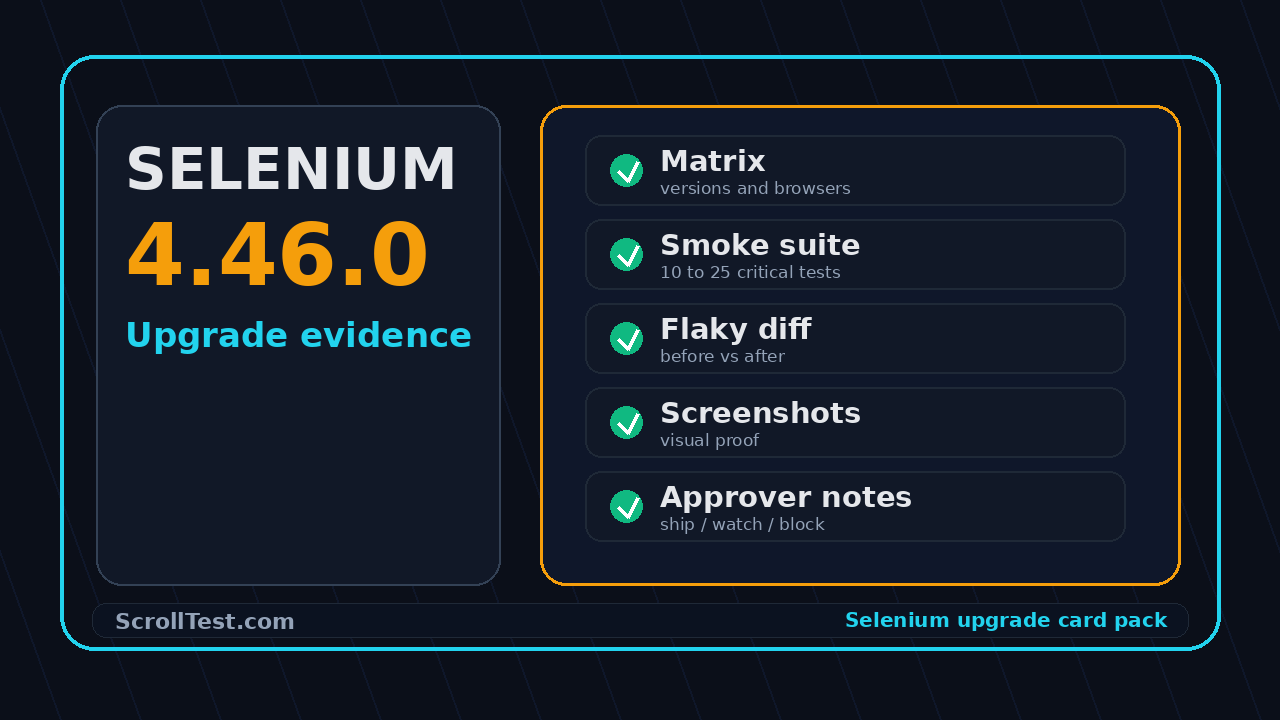
Selenium upgrade card pack is the ScrollTest way to stop treating a Selenium version bump like a blind dependency update. Selenium 4.46.0 shipped on 11 July 2026, and the right QA response is not a Slack message saying “all good”. The right response is a compact evidence pack: upgrade matrix, smoke suite, flaky diff, screenshots, and approver notes.
I see one recurring pattern in automation teams: the test framework changes faster than the release governance around it. A package moves from one version to another, CI passes once, and everyone assumes risk is gone. ScrollTest’s Selenium upgrade card pack exists for the opposite reason: make the upgrade visible, reviewable, repeatable, and easy to approve.
Table of Contents
- What Shipped in the Selenium Upgrade Card Pack?
- Why Selenium 4.46.0 Matters for QA Teams
- The Card Pack Model: 5 Evidence Cards
- Implementation: Generate Upgrade Evidence in CI
- Review Flow for QA Leads and Approvers
- India Context: Why This Helps SDETs
- Rollout Plan for Existing Selenium Suites
- Key Takeaways
- FAQ
Contents
What Shipped in the Selenium Upgrade Card Pack?
The ScrollTest Selenium upgrade card pack is a reusable release-evidence template for Selenium upgrades. It turns a version bump into a set of cards that a tester, SDET lead, engineering manager, or release owner can read in less than 10 minutes. The focus keyword is simple because the artifact is simple: a Selenium upgrade card pack for evidence, not a 40-page migration document nobody opens.
It is built for upgrade evidence, not release marketing
A normal product update says what changed. This pack says what was checked. That difference matters when a browser automation stack has 200, 2,000, or 20,000 tests behind it. The card pack captures five pieces of evidence:
- Upgrade matrix: current version, target version, language binding, browser, driver path, and CI image.
- Smoke suite result: the smallest suite that proves login, navigation, CRUD, file upload, and checkout-style flows still work.
- Flaky diff: tests that changed status between baseline and upgraded runs.
- Screenshot evidence: key pass/fail screens, trace links, and failure thumbnails.
- Approver notes: who reviewed the risk and what still needs follow-up.
Why cards work better than a plain checklist
Checklists are useful before execution. Cards are better after execution because they preserve context. A checkbox saying “Smoke passed” loses the browser version, Selenium binding, CI runner, and failure screenshot. A card keeps those details together.
That is why ScrollTest is treating this as a pack instead of a single template. The upgrade matrix card tells you scope. The smoke card tells you confidence. The flaky diff card tells you risk. The screenshot card gives visual proof. The approver card gives accountability.
Where this fits inside ScrollTest
This product update fits the same evidence-first thinking behind the LLM eval evidence cards for QA teams. AI testing and browser automation look different on the surface, but the governance problem is the same: a pass/fail line in CI is not enough when the system under test or the toolchain changes.
Why Selenium 4.46.0 Matters for QA Teams
Selenium 4.46.0 is not a random patch number. The official Selenium 4.46.0 GitHub release was published on 11 July 2026 and includes changes across Java, Python, .NET, Ruby, JavaScript, build tooling, documentation, and Selenium Manager related work. I do not want teams to panic on every release, but I also do not want them to upgrade a browser automation dependency without proof.
The ecosystem is still huge
The SeleniumHQ/selenium GitHub repository showed 34,325 stars and 8,697 forks during this research run. The npm package selenium-webdriver reported 7,487,114 downloads for the last-month window ending 24 July 2026. Those numbers do not prove quality by themselves, but they prove one thing: Selenium is still a major dependency in real QA stacks.
That scale is exactly why upgrade evidence matters. A breaking change in a niche tool affects a few pipelines. A Selenium upgrade can touch Java teams, TypeScript teams, Python teams, cloud grid teams, Docker images, CI runners, and old helper libraries at the same time.
Official docs still expect careful upgrades
The Selenium documentation has a dedicated Upgrade to Selenium 4 troubleshooting page. The same docs maintain official downloads and Selenium Grid documentation. I cite these because upgrade work should start with primary sources, not random blog snippets copied into Jira.
The practical takeaway is boring but important: read the release notes, confirm the binding you use, confirm the browser path, run a known smoke suite, and keep the evidence. The card pack makes that behavior repeatable.
Selenium Manager and Grid increase the blast radius
Modern Selenium teams often rely on Selenium Manager, browser drivers, remote Grid nodes, and containerized test runners. That means an upgrade does not only touch test code. It can also change driver discovery, timeout behavior, browser startup, node registration, and the way a failure appears in CI logs.
If your tests run only on a laptop, a small checklist may be enough. If your tests run in Jenkins, GitHub Actions, GitLab CI, BrowserStack, LambdaTest, Selenoid, or a self-hosted Grid, you need cards that show environment evidence.
The Selenium Upgrade Card Pack Model: 5 Evidence Cards
The Selenium upgrade card pack uses five cards because five is enough to cover the real risk without creating process theatre. I want a QA lead to open a pull request and understand status, scope, risk, proof, and ownership in one scan.
1. Upgrade matrix card
The matrix card records the exact upgrade surface. This avoids the classic review problem where one person says “Selenium is upgraded” and another person asks “which binding, which browser, which runner?”
| Field | Example | Why it matters |
|---|---|---|
| Language binding | Java, Python, JavaScript | Each binding can have different changelog notes. |
| From version | 4.33.0 | Shows the real jump size. |
| To version | 4.46.0 | Confirms the release under review. |
| Browser set | Chrome, Firefox, Edge | Prevents Chrome-only confidence. |
| Runner | GitHub Actions ubuntu-latest | Explains environment-specific failures. |
2. Smoke suite card
The smoke suite card records a short, stable suite. I prefer 10 to 25 tests for most web products. The suite should cover authentication, one read flow, one write flow, one negative validation, one file or payment-like workflow if relevant, and one logout or session reset.
Do not choose the easiest tests. Choose the tests that would embarrass the team if they failed in production. For many SaaS teams, that means login, dashboard load, create entity, edit entity, delete entity, permission check, and a key report export.
3. Flaky diff card
The flaky diff card compares baseline and upgraded runs. It does not pretend every red test is caused by Selenium. It asks a narrower question: which tests changed behavior after the upgrade?
- Passed before and passed after: low concern.
- Failed before and failed after: existing problem, not upgrade evidence by itself.
- Passed before and failed after: must investigate.
- Failed before and passed after: useful, but still verify if timing changed.
- Skipped after upgrade: review immediately, because hidden risk is worse than visible failure.
4. Screenshot and trace card
Screenshots make upgrade reviews faster. A lead does not need to open a 9 MB log file to understand that the browser loaded a blank page, a consent modal blocked the button, or an element was covered by a cookie banner. If the framework captures video or traces, link them from the card.
This is where teams that already use strong artifacts, like the approach in clean maintainable automation scripts, get a compounding benefit. Clean tests produce better evidence. Messy tests produce confusing screenshots.
5. Approver notes card
The approver notes card is not bureaucracy. It is a short decision record. The person approving the upgrade writes one of three outcomes:
- Approved: ship the version bump.
- Approved with watch items: ship, but track specific flaky tests or environments.
- Blocked: do not merge until listed failures are fixed.
That one line prevents the “who approved this?” problem two weeks later.
Implementation: Generate Upgrade Evidence in CI
A Selenium upgrade card pack is only useful if it can be generated repeatedly. I do not want a human copying CI logs into a document at 11 pm. The first version can be simple: a TypeScript script that reads JSON test results, compares two runs, and writes a Markdown card.
Start with a simple data contract
Use a small JSON file for each run. The fields below are enough for a first implementation:
{
  "runId": "selenium-4-46-upgrade-2026-07-27",
  "seleniumVersion": "4.46.0",
  "browser": "chrome",
  "browserVersion": "126",
  "ciRunner": "github-actions-ubuntu-latest",
  "results": [
    {"test": "login works", "status": "passed", "durationMs": 1284},
    {"test": "checkout creates order", "status": "failed", "durationMs": 9200, "screenshot": "artifacts/checkout.png"}
  ]
}
Generate a flaky diff card with TypeScript
This example compares a baseline run and an upgraded run. It is intentionally boring because boring scripts survive CI.
import fs from "node:fs";

type Status = "passed" | "failed" | "skipped";
type TestResult = { test: string; status: Status; durationMs: number; screenshot?: string };
type Run = { runId: string; seleniumVersion: string; browser: string; ciRunner: string; results: TestResult[] };

function readRun(path: string): Run {
  return JSON.parse(fs.readFileSync(path, "utf-8")) as Run;
}

function byName(results: TestResult[]) {
  return new Map(results.map((r) => [r.test, r]));
}

const baseline = readRun("baseline.json");
const upgraded = readRun("selenium-4.46.0.json");
const oldResults = byName(baseline.results);
const changed = upgraded.results
  .map((newResult) => ({ before: oldResults.get(newResult.test), after: newResult }))
  .filter((row) => row.before && row.before.status !== row.after.status);

const lines = [
  `# Flaky Diff Card`,
  `Selenium: ${baseline.seleniumVersion} -> ${upgraded.seleniumVersion}`,
  `Browser: ${upgraded.browser}`,
  `Runner: ${upgraded.ciRunner}`,
  "",
  "| Test | Before | After | Screenshot |",
  "|---|---:|---:|---|",
  ...changed.map(({ before, after }) =>
    `| ${after.test} | ${before!.status} | ${after.status} | ${after.screenshot ?? "n/a"} |`
  ),
];
fs.writeFileSync("selenium-upgrade-flaky-diff.md", lines.join("\n"));
console.log(`Changed tests: ${changed.length}`);
Run it in CI
Wire the script after your smoke suite. A minimal GitHub Actions step can look like this:
- name: Generate Selenium upgrade evidence
  run: |
    npm ci
    npm run test:smoke -- --reporter=json > selenium-4.46.0.json
    npx tsx scripts/selenium-upgrade-card.ts
  env:
    SELENIUM_VERSION: "4.46.0"
If your stack is Java, keep the same card model and change the collector. The card pack is not tied to TypeScript. It is tied to evidence.
Review Flow for QA Leads and Approvers
The biggest mistake is to treat an upgrade card pack as a document after the merge. It should sit inside the pull request before approval. The reviewer should see the version bump, the card links, and the final decision in one place.
The 10-minute review routine
Here is the review routine I recommend for QA leads:
- Open the upgrade matrix and confirm the target version is Selenium 4.46.0.
- Check that at least one smoke suite ran on the same CI image used by normal regression.
- Scan the flaky diff for newly failing or newly skipped tests.
- Open screenshots for any changed business-critical flow.
- Write an approver note with one owner and one follow-up date if risk remains.
This should not take 2 hours. If it does, your evidence is too scattered or your smoke suite is too noisy.
What approvers should reject
I reject upgrade PRs when the evidence has obvious holes. A green CI badge alone is not enough. I also reject upgrades where the team changed Selenium, browser versions, test data, and CI images in the same pull request. Too many moving parts hide the cause of failure.
- No release-note link: reject.
- No baseline run: reject or ask for a rerun.
- No smoke definition: reject.
- Skipped tests without explanation: reject.
- Only local laptop evidence: reject for production suites.
How this connects to AI-assisted QA
AI can summarize the card pack, but it should not replace the evidence. This matches my view in AI agent testing before CI goes green: let agents help with collection and summarization, then keep humans accountable for the release decision.
India Context: Why This Helps SDETs
In India, many QA engineers are moving from manual testing or basic Selenium scripts toward senior SDET roles. The salary spread is wide: service-company automation roles may sit far below strong product-company SDET roles, while senior SDET and QA platform roles can reach ₹25 to ₹40 LPA depending on company, city, depth, and interview performance. Evidence habits separate script writers from release engineers.
Hiring managers look for ownership
When I interview SDETs, I do not only ask whether they know Selenium. I ask how they prove a framework change is safe. A candidate who can explain an upgrade matrix, smoke suite, flaky diff, screenshots, and approver notes sounds like someone who can own a production automation platform.
This is the same career direction I mapped in the QA career roadmap for 2026. Tools matter, but ownership matters more. A tester who can ship evidence becomes more valuable than a tester who only writes locators.
Service teams can use this with clients
For TCS, Infosys, Wipro, Accenture, and other service environments, upgrade evidence is also client communication. Instead of sending a generic status mail, the team can send a card pack: version matrix, smoke results, flaky diff, screenshots, and approval status. That makes the QA team look structured and reduces back-and-forth during release windows.
Product teams can reduce upgrade fear
Product-company teams often avoid dependency upgrades because regressions are painful. The card pack reduces that fear by making the change measurable. A team can schedule Selenium upgrades every month or every sprint, as long as the smoke evidence stays clean and flaky diffs are reviewed.
Rollout Plan for Existing Selenium Suites
Do not roll this out by rewriting your framework. Start small. The goal is to add evidence around the upgrade path, not to create a new platform project that blocks the actual upgrade.
Week 1: Define the card fields
Pick the first 12 fields for your upgrade matrix. Keep it boring: project, owner, from version, to version, language, browser, runner, grid, smoke command, baseline run, upgraded run, and approver. If you need more than 12 fields on day one, you are probably designing for a committee instead of a release.
Week 2: Choose the smoke suite
Pick 10 to 25 tests that cover the product’s money path. Do not include every flaky test just because it exists. A smoke suite with 18 stable tests is more useful than a 140-test suite that fails twice a day for unrelated reasons.
Week 3: Add flaky diff generation
Add the TypeScript or Java collector. Compare the last known good baseline with the upgrade run. The first version can output Markdown. Later, you can push the cards into ScrollTest, GitHub comments, Confluence, Notion, or a release dashboard.
Week 4: Make approval visible
Add a small approval block to the pull request template:
## Selenium Upgrade Approval

- Target version: 4.46.0
- Smoke suite: PASS / FAIL
- New failing tests: 0 / N
- New skipped tests: 0 / N
- Evidence card pack: [link]
- QA approver: @name
- Decision: Approved / Watch / Blocked
Once this becomes routine, you can use the same model for Playwright, Cypress, Appium, REST Assured, Docker images, and AI evaluation frameworks.
Common Anti-Patterns During Selenium Upgrades
The most expensive Selenium upgrade mistakes are usually process mistakes, not coding mistakes. I see teams merge a dependency bump with locator rewrites, browser image changes, and test-data cleanup in the same pull request. When the suite fails, nobody can isolate the cause.
Changing four variables at once
Keep the first upgrade pull request narrow. Change Selenium first. Keep the browser image, test data, suite selection, and reporting layer stable unless the release notes force a change. A clean experiment gives you clean evidence.
Ignoring skipped tests
A skipped test after an upgrade is not harmless. It may hide a capability change, a timeout problem, or a browser-specific issue. The flaky diff card treats new skips as a review item because silent risk is worse than a loud failure.
Accepting one green rerun
One green rerun can be luck. For critical flows, I prefer one baseline run, one upgraded run, and one rerun for changed tests. That gives the approver enough evidence without turning a patch upgrade into a week-long ceremony.
Key Takeaways: Selenium Upgrade Card Pack
The Selenium upgrade card pack gives QA teams a concrete way to prove that a Selenium version bump is safe enough to ship. It is not a replacement for release notes, test design, or human judgement. It is the bridge between all three.
- Selenium 4.46.0 was published on GitHub on 11 July 2026, so teams should review the official release notes before upgrading.
- The Selenium ecosystem remains large, with 34,325 GitHub stars and 7,487,114 last-month npm downloads recorded during this research run.
- The five-card model covers matrix, smoke suite, flaky diff, screenshots, and approver notes.
- QA leads should reject upgrades that only show a green badge without baseline and artifact evidence.
- SDETs in India can use this evidence habit to move from script execution toward release ownership.
FAQ
What is a Selenium upgrade card pack?
A Selenium upgrade card pack is a reusable set of evidence cards for a Selenium version upgrade. It normally includes an upgrade matrix, smoke suite result, flaky diff, screenshots or traces, and approver notes.
Do I need this for every Selenium patch?
If Selenium is part of a production CI pipeline, yes, use at least a lightweight version. The pack can be short for a small patch and deeper for a major jump, but the evidence habit should stay consistent.
Can this work for Java Selenium suites?
Yes. The article shows TypeScript because it is concise for CI examples. Java teams can generate the same cards from JUnit, TestNG, Allure, Extent Reports, or custom JSON outputs.
Should AI approve the Selenium upgrade?
No. AI can summarize release notes and card evidence, but a human QA lead or release owner should approve the change. The approver notes card exists for that reason.
What is the minimum useful smoke suite size?
For many teams, 10 to 25 stable tests are enough for a first upgrade gate. The suite should cover business-critical flows instead of trying to mimic full regression.