Selenium 4.46 Grid Regression Plan
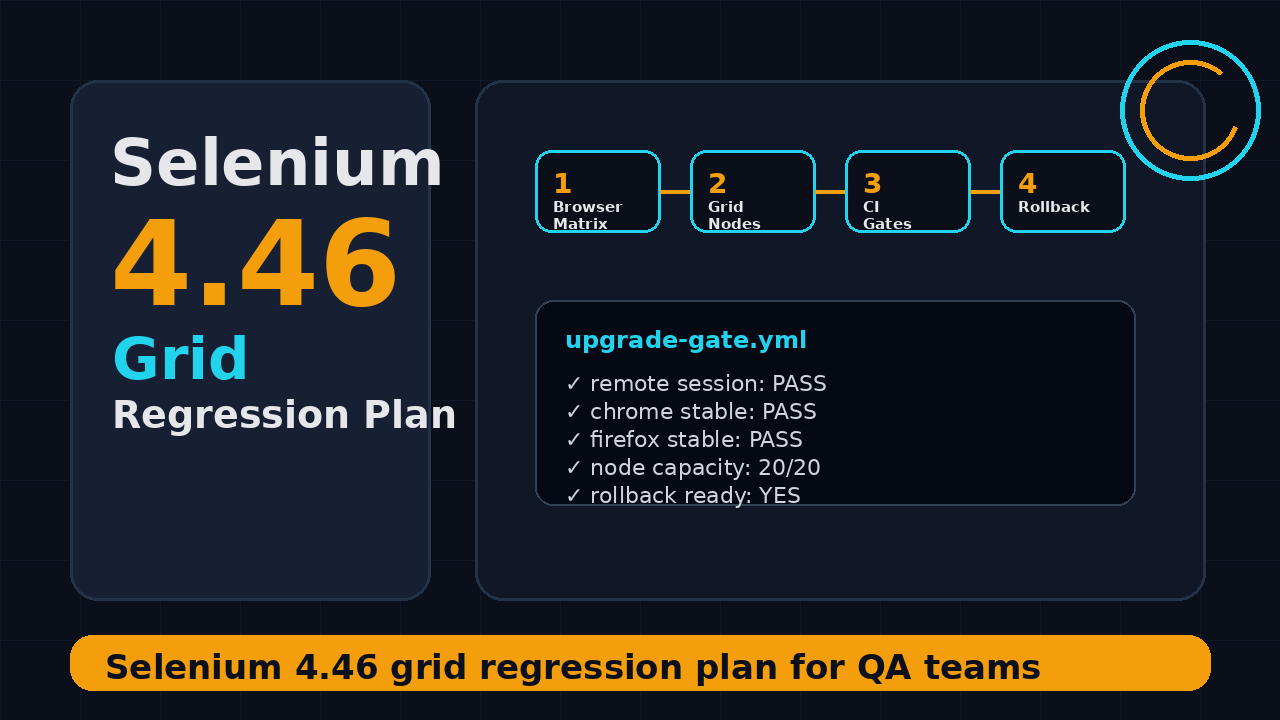
Selenium 4.46 grid regression plan is the difference between a clean framework upgrade and a noisy Monday morning. Selenium 4.46.0 shipped on July 11, 2026, and the safe response is not “update the dependency and hope”; it is a focused browser-grid regression plan that proves your browsers, drivers, Grid nodes, CI lanes, and rollback path still work together.
Table of Contents
- Why This Release Needs a Grid Plan
- Selenium 4.46 Grid Regression Plan Scope
- Build the Browser and Driver Matrix
- Validate Grid Nodes Before Full Regression
- Run a Layered CI Regression
- Quarantine Flaky Tests With Evidence
- Rollback Criteria and Release Gates
- India Team Context for SDET Leads
- Selenium 4.46 Grid Regression Plan Checklist
- FAQ
Contents
Why This Release Needs a Grid Plan
The official Selenium 4.46.0 GitHub release lists changes across Java, Python, .NET, Ruby, JavaScript, build tooling, Rust internals, documentation, and BiDi classes. The release notes also mark current Java BiDi related classes as beta, which is a useful reminder: a Selenium upgrade can touch more than one binding and more than one runtime assumption.
I see teams treat Selenium as a single library. In production test automation, Selenium is a chain. The chain includes client bindings, browser versions, driver resolution, remote session creation, Grid routing, container images, parallel workers, CI agents, test data, retries, reports, and a human who gets paged when the build blocks a release.
That is why a Selenium 4.46 grid regression plan matters. You are not proving that one login test passes on your laptop. You are proving that the upgrade is safe under the same pressure your release pipeline sees every week.
What changed from the QA manager point of view
The release page links component changelogs for Java, Python, .NET, Ruby, and JavaScript. That matters because most companies do not have one automation stack. A product company may run Java Selenium for web regression, Python Selenium for data setup checks, and JavaScript WebDriver tests for a legacy package. A services company may inherit all three across client projects.
The risk is not only a compile error. The risk is a silent behavior change: a capability name ignored by a remote node, a browser driver downloaded differently, a timeout that now fails faster, a beta BiDi path used accidentally, or a Docker image that still carries an older browser version.
Grid raises the blast radius
The Selenium Grid documentation says Grid routes WebDriver commands from a client to browser instances on remote machines and helps run tests in parallel across multiple machines. That routing is powerful, but it also hides problems until volume increases.
A single local Chrome run may pass. Twenty CI lanes across Chrome, Edge, Firefox, Linux containers, and a Windows node may expose a session-creation bug in the first five minutes. A proper plan catches that before your nightly run burns three hours.
Selenium 4.46 Grid Regression Plan Scope
A Selenium 4.46 grid regression plan should be small enough to run quickly and broad enough to catch release-impact bugs. I use three scopes: upgrade smoke, grid confidence, and business regression. Each scope has a different owner, time budget, and pass condition.
Scope 1: Upgrade smoke
Upgrade smoke answers one question: can the framework start sessions and run critical commands after the dependency bump? Keep it under 15 minutes. Run it before you merge the upgrade branch.
- Create one Chrome session locally.
- Create one Firefox session locally if Firefox is supported.
- Create one remote Chrome session through Grid.
- Open a stable internal URL and assert the title.
- Capture a screenshot and browser logs where supported.
- Quit the session and verify no orphan node is left busy.
Scope 2: Grid confidence
Grid confidence checks routing, capacity, parallelism, and observability. It is the layer most teams skip because it is not tied to a user story. That is a mistake. If Grid routing is broken, every user story test becomes noisy.
Use a fixed matrix. Do not start with the full suite. Pick 20 to 40 tests that cover session creation, navigation, file upload or download if used, alerts, tabs, frames, cookies, local storage, screenshots, and failed assertions.
Scope 3: Business regression
Business regression checks the flows that protect revenue or release confidence. For an ecommerce product, that may be search, cart, checkout, payment sandbox, order confirmation, and refund. For SaaS, it may be login, role permissions, project creation, billing page access, audit logs, and export.
Keep this layer selective for the upgrade gate. You can run the full nightly suite later, but the merge decision should not wait for every low-value edge case.
Build the Browser and Driver Matrix
The browser matrix is the heart of the plan. Do not write “latest Chrome” in a test strategy document and call it done. Write exact browser versions, operating systems, container image tags, driver resolution method, and owning team.
The minimum matrix I use
Here is a practical starting point for teams that run Selenium Grid in CI:
| Lane | Browser | OS or image | Purpose | Gate |
|---|---|---|---|---|
| Smoke A | Chrome stable | Linux Grid node | Fast upgrade signal | Required |
| Smoke B | Firefox stable | Linux Grid node | Cross-browser sanity | Required if supported |
| Smoke C | Edge stable | Windows or Linux node | Enterprise user coverage | Required for B2B apps |
| Full | Chrome stable | Parallel Linux nodes | Main regression signal | Required |
| Canary | Next browser channel | Separate node pool | Early warning only | Non-blocking |
If you support Safari through cloud infrastructure, keep it in a separate lane with its own gate. Do not mix Safari signal with Linux Chrome signal and then argue about failure ownership.
Driver assumptions to write down
The W3C WebDriver specification defines the browser automation protocol behavior that Selenium clients rely on. In real frameworks, you still need to document how your drivers are resolved and where the binaries come from.
- Are drivers managed by Selenium Manager?
- Are drivers baked into Docker images?
- Are browser and driver versions pinned together?
- Are CI agents allowed to download binaries at runtime?
- Is outbound network access blocked in secure pipelines?
- Does the Grid node image match the local developer path?
This sounds basic, but it prevents a common failure: local runs pass because the developer machine downloads the correct driver, while CI fails because the Grid node image is stale or network-restricted.
Version capture script
Add a version capture step before the regression starts. It gives you evidence when you compare Selenium 4.45 and 4.46 results.
#!/usr/bin/env bash
set -euo pipefail

echo "Selenium dependency"
mvn dependency:tree | grep selenium || true

echo "Browser versions"
google-chrome --version || true
firefox --version || true
microsoft-edge --version || true

echo "Grid status"
curl -s http://selenium-grid:4444/status | python3 -m json.tool
Store this output as a CI artifact. When a flaky failure appears, you can separate “Selenium upgrade issue” from “Chrome image changed at the same time.”
Validate Grid Nodes Before Full Regression
Do not send 1,000 tests into a Grid that has not passed a node health check. The first gate should validate Grid status, node capacity, browser slots, and session cleanup.
Grid health checks
Start with the Grid status endpoint. The output tells you whether Grid is ready and whether nodes are available. Your CI job should fail fast if Grid is not healthy.
import requests

GRID = "http://selenium-grid:4444"
status = requests.get(f"{GRID}/status", timeout=10).json()

if not status.get("value", {}).get("ready"):
    raise SystemExit("Selenium Grid is not ready")

nodes = status.get("value", {}).get("nodes", [])
print(f"Grid nodes: {len(nodes)}")
for node in nodes:
    print(node.get("uri"), node.get("availability"), node.get("maxSessions"))
If this fails, stop. Do not run a suite and then blame Selenium 4.46. First prove the infrastructure is alive.
Session lifecycle test
Run a small test that creates and quits sessions repeatedly. I prefer 10 loops per browser. You are checking for slow session startup, orphaned sessions, and nodes that remain busy after quit.
for (int i = 0; i < 10; i++) {
    ChromeOptions options = new ChromeOptions();
    options.setCapability("build", "selenium-4.46-grid-smoke");

    WebDriver driver = new RemoteWebDriver(
        URI.create("http://selenium-grid:4444/wd/hub").toURL(),
        options
    );

    driver.get("https://example.com");
    if (!driver.getTitle().contains("Example")) {
        throw new AssertionError("Title check failed");
    }
    driver.quit();
}
The exact URL should be your own stable smoke page. I use example.com above only to show the pattern. In a private network, use an internal static page that has no authentication, no tracking script, and no dependency on a third-party CDN.
Capacity test without business logic
Before full regression, run pure capacity tests. Create N parallel sessions, open the smoke page, wait two seconds, capture a screenshot, and quit. If your Grid claims 20 sessions but fails at 12, the full suite will only hide that problem behind random test failures.
Run a Layered CI Regression
The best Selenium 4.46 grid regression plan is layered. Each layer should answer a different question and produce a clear artifact. Do not run everything at once. You need fast feedback first, then breadth.
A practical 5-step CI sequence
- Dependency compile: build the framework and run unit tests for wrappers, waits, and page objects.
- Local smoke: start one local browser and validate basic WebDriver commands.
- Grid smoke: create remote sessions for each required browser.
- Grid confidence pack: run 20 to 40 tests across features that stress browser behavior.
- Business regression pack: run the release-blocking flows with normal retries and reporting.
Use separate jobs. When everything is inside one giant job, the team loses failure location. Separate jobs give you a clean sentence: “The upgrade passes compile and local smoke, but fails remote Firefox session creation on Grid.” That sentence is actionable.
CI YAML pattern
The exact syntax depends on Jenkins, GitHub Actions, GitLab, Azure DevOps, or Buildkite. The structure stays the same.
stages:
  - compile
  - local_smoke
  - grid_smoke
  - grid_confidence
  - business_regression

variables:
  SELENIUM_VERSION: "4.46.0"
  GRID_URL: "http://selenium-grid:4444"

rules:
  fail_fast: true
  artifacts:
    - grid-status.json
    - browser-versions.txt
    - test-report.html
    - screenshots/
    - traces/
Notice the artifacts. A failed Selenium upgrade without artifacts becomes a Slack debate. A failed upgrade with Grid status, browser versions, screenshots, and logs becomes a debugging task.
Keep retries honest
Retries are useful when the environment is noisy. They are dangerous when they hide an upgrade defect. For the upgrade gate, record first-attempt failures separately from final pass after retry. A test that fails once in Selenium 4.46 and never failed in Selenium 4.45 deserves investigation even if the retry passes.
This is where a release-impact matrix helps. If you already use ScrollTest release cards, connect the Selenium release to owners, lanes, evidence links, and rollback status. The related Selenium 4.46 release impact matrix shows how to convert release notes into concrete QA checks instead of a vague upgrade reminder.
Quarantine Flaky Tests With Evidence
Flaky tests become more expensive during framework upgrades because everyone has a different theory. Developers blame the tests. QA blames the upgrade. DevOps blames the Grid. Managers ask whether the release can go out.
The fix is not to argue. The fix is evidence.
Classify each failure
For each failed test in the Selenium 4.46 branch, assign one of these labels:
- Product bug: the application behavior changed or broke.
- Test bug: locator, wait, assertion, or test data is wrong.
- Framework upgrade issue: behavior changed after Selenium 4.46 with no app change.
- Grid issue: session routing, node health, capacity, or browser image caused the failure.
- Environment issue: network, test data, service dependency, or CI agent caused the failure.
Do not quarantine a test without one of these labels. “Flaky” is not a root cause. It is a symptom.
Evidence bundle for every quarantine
A quarantine decision should include the test name, failure reason, browser, Grid node, Selenium version, previous pass history, screenshot, logs, and owner. If the test blocks release confidence, add an expiry date. A quarantine without expiry becomes permanent technical debt.
{
  "test": "CheckoutTest.shouldApplyCoupon",
  "seleniumVersion": "4.46.0",
  "browser": "chrome-stable",
  "gridNode": "linux-node-03",
  "classification": "grid_issue",
  "evidence": ["screenshot.png", "grid-status.json", "console.log"],
  "owner": "qa-platform",
  "expiresOn": "2026-07-29"
}
This simple JSON object forces discipline. It also gives managers a clean dashboard: how many failures are product bugs, how many are Grid issues, and how many are test debt exposed by the upgrade.
Rollback Criteria and Release Gates
A rollback rule written after the outage is politics. A rollback rule written before the upgrade is engineering. Decide your Selenium 4.46 rollback criteria before the first full regression run.
Suggested release gates
Use gates that connect to business risk, not ego. Here is a simple rule set:
- Block merge if any required browser cannot create a remote session.
- Block merge if Grid smoke pass rate is below 100%.
- Block merge if business regression has any new P0 or P1 failure.
- Block merge if first-attempt failure rate increases by more than your agreed threshold.
- Block merge if screenshots, logs, or reports are missing for failed tests.
- Allow merge with known test-debt failures only when each item has an owner and expiry date.
I like one strict rule: no evidence, no approval. If the team cannot explain a failure with artifacts, the upgrade is not ready.
Rollback plan
The rollback plan should be boring. Pin the old Selenium version, keep the previous Grid image available, and document the exact command to revert. Do not depend on one engineer’s laptop history.
# Maven example
mvn versions:set-property \
  -Dproperty=selenium.version \
  -DnewVersion=4.45.0

# Re-run the same gates after rollback
./ci/run-grid-smoke.sh
./ci/run-business-regression.sh
The second command matters. Rolling back the dependency is not enough. You need to prove the old path still works.
India Team Context for SDET Leads
In India, many QA teams run mixed ownership models. A services team may support Selenium frameworks for multiple clients with different browser policies. A product company in Bengaluru, Pune, Hyderabad, or NCR may have one QA platform team and several feature squads pushing tests into the same Grid.
The Selenium 4.46 grid regression plan gives the SDET lead a common operating model. Instead of asking every squad to “test properly,” you give them a matrix, a smoke pack, a quarantine rule, and a release gate.
What I expect from senior SDETs
For senior SDETs in the ₹25-40 LPA bracket, this is the kind of ownership managers notice. The skill is not only writing locators. The skill is protecting release confidence when a shared tool changes.
- Read release notes and identify affected framework layers.
- Convert changes into a test matrix.
- Separate Grid health from application regression.
- Define rollback gates before the upgrade.
- Communicate status with evidence, not guesses.
If you are preparing for SDET interviews, turn this into a portfolio story. Explain how you upgraded Selenium, validated Grid capacity, captured evidence, quarantined flaky tests, and reduced release risk. That beats a generic answer about knowing Page Object Model.
For a broader automation strategy view, read API automation is non-negotiable in 2026. Browser regression should not carry every quality signal. A healthy test pyramid makes Selenium upgrades less scary because API and contract tests already cover large parts of the product risk.
Selenium 4.46 Grid Regression Plan Checklist
Use this checklist before you merge Selenium 4.46 into your main automation branch. Copy it into Jira, GitHub Issues, Linear, or your release checklist tool.
Before the upgrade branch
- Read the Selenium 4.46.0 release notes and linked component changelogs.
- List every repository that depends on Selenium.
- List bindings used: Java, Python, .NET, Ruby, JavaScript.
- Capture current Selenium version and Grid image tags.
- Capture current browser versions in CI.
- Identify owners for Grid, framework, and business regression.
During validation
- Run compile and wrapper unit tests.
- Run local Chrome and Firefox smoke tests.
- Run Grid status and node capacity checks.
- Run remote session lifecycle tests for required browsers.
- Run grid confidence pack across browser behaviors.
- Run business regression pack with first-attempt failure tracking.
- Classify every new failure with evidence.
Before merge approval
- Confirm required Grid smoke pass rate is 100%.
- Confirm no new P0 or P1 business flow failures remain open.
- Confirm every quarantined test has owner, label, evidence, and expiry.
- Confirm rollback command and previous Grid image are ready.
- Confirm CI artifacts are attached to the upgrade ticket.
- Confirm release notes are shared with support or dev teams if needed.
If your team already has a release note workflow, connect this checklist to it. The Selenium 4.46 QA manager upgrade checklist is a good companion because it frames the same upgrade from the manager and ownership angle.
FAQ
Should every team upgrade to Selenium 4.46 immediately?
No. Upgrade quickly if you need fixes, compatibility, or security-related maintenance. Upgrade deliberately if your current version is stable. The point is not speed. The point is a repeatable process that makes Selenium upgrades safe.
Is a local smoke test enough for Selenium 4.46?
No, not for teams that run Selenium Grid. Local smoke proves the binding can start a browser on one machine. Grid regression proves remote sessions, browser slots, routing, capacity, and CI artifacts work under the real execution model.
How many tests should be in the Grid confidence pack?
Start with 20 to 40 strong tests. Cover browser behaviors, not every user story. Include navigation, waits, windows, frames, downloads if used, screenshots, logs, cookies, and failed assertions. Add more only when the first pack is stable and fast.
Should flaky tests block the Selenium upgrade?
Only when they block release confidence or hide an upgrade risk. A known flaky test can be quarantined if it has an owner, evidence, root-cause label, and expiry date. A new unexplained failure should block until classified.
What is the best artifact for debugging Grid failures?
Use a bundle: Grid status JSON, browser versions, Selenium version, node name, screenshot, console logs, and test report. One artifact rarely tells the full story. The bundle lets QA, DevOps, and developers debug without guessing.
Key Takeaways
The Selenium 4.46 grid regression plan is a release-safety habit, not a document for compliance. It helps QA teams upgrade with evidence, protect CI stability, and avoid blaming Selenium for problems that belong to Grid, browsers, test data, or old flaky tests.
- Selenium 4.46.0 shipped on July 11, 2026, with cross-binding and build-related changes that deserve structured validation.
- Grid upgrades need remote-session, node-capacity, and browser-matrix checks, not only local smoke tests.
- Use layered CI gates: compile, local smoke, Grid smoke, Grid confidence, and business regression.
- Quarantine flaky tests only with evidence, owner, classification, and expiry date.
- Senior SDETs should own release-impact testing as a system, not as a last-minute regression run.
If you do one thing today, write your browser-grid matrix before touching the dependency. That single page will prevent more confusion than another retry wrapper ever will.