Selenium 4.46 Release Impact Matrix in 30 Minutes
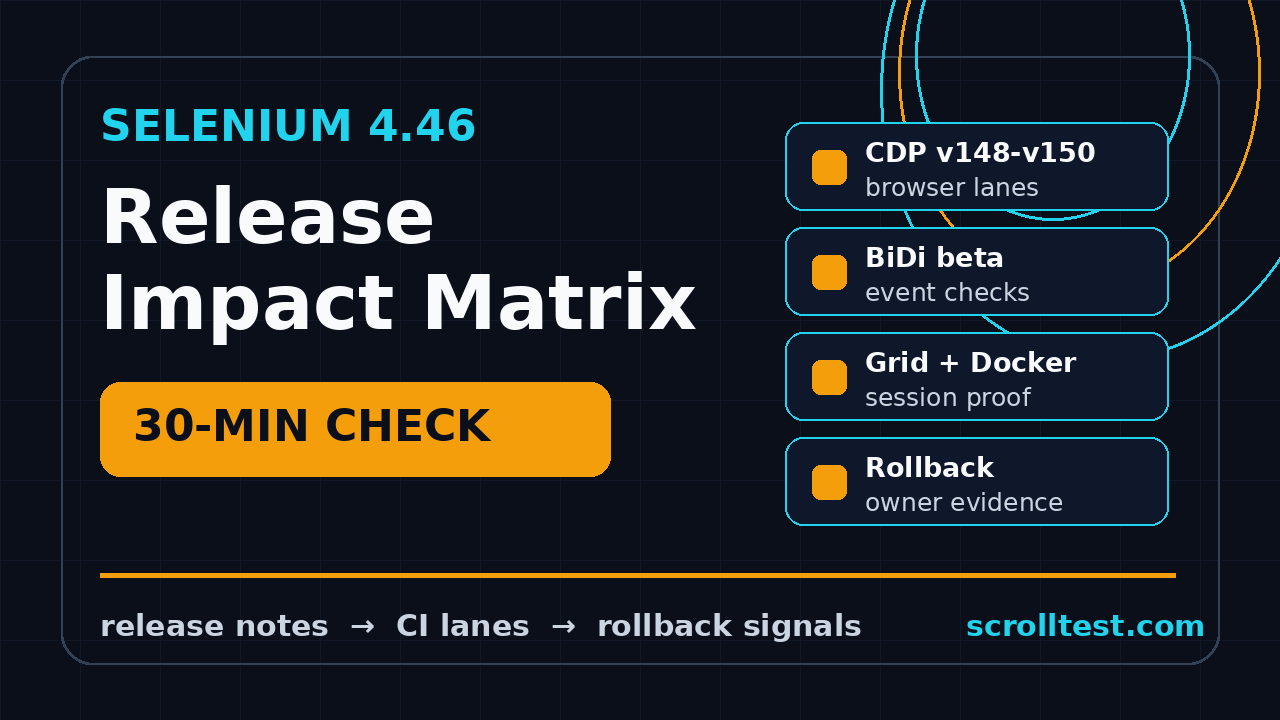
If your team treats every Selenium upgrade like a small dependency bump, Selenium 4.46.0 is a useful reminder to slow down for one hour. A Selenium 4.46 release impact matrix turns release notes into a visible test plan: what changed, which suites feel it, who owns the evidence, and when you roll back.
I am not asking you to create a 12-page QA strategy document. I am asking you to build a matrix in 30 minutes, run the right lanes in CI, and stop arguing in Slack after the build is already red.
Table of Contents
- Why a Selenium 4.46 release impact matrix matters
- What changed in Selenium 4.46.0
- Build the matrix in 30 minutes
- The columns I use in a real matrix
- Map the matrix to CI lanes
- Code examples for upgrade checks
- India team context: owners, handoffs, and proof
- Rollback signals and release notes hygiene
- FAQ
- Key takeaways
Contents
Why a Selenium 4.46 release impact matrix matters
A Selenium upgrade is rarely just a version number. It touches browser protocol support, language bindings, Grid packaging, Docker images, CI machine images, driver assumptions, and the confidence of the person approving the release. Selenium 4.46.0 was published on GitHub on July 11, 2026, and the project repository shows more than 34,000 stars at the time I checked it through the GitHub API. That level of adoption is exactly why casual upgrades create noisy regressions across many teams.
The matrix matters because it forces a simple question before the merge: which test evidence proves this upgrade is safe for our product? If your answer is “the nightly suite passed once,” you are under-testing the upgrade and over-trusting the result.
Most upgrade failures are not framework failures
I see teams blame Selenium when the real issue is an invisible assumption. A test suite may assume one Chrome DevTools Protocol version, one Docker image tag, one proxy configuration, or one Grid classpath shape. When the framework changes, that assumption finally becomes visible.
The Selenium Java changelog lists support for CDP versions v148, v149, and v150, Grid Redis-backed SessionQueue packaging work, JSON parser tightening, BiDi beta labeling, and Selenium Manager proxy handling. Those are not random bullets. They are risk signals. Each signal should map to a suite, a CI lane, or a manual inspection checkpoint.
The cost of a vague upgrade plan
Without a matrix, a team usually does this:
- Update the dependency in one pull request.
- Run the default regression lane.
- Ignore quarantined failures because “they were already flaky.”
- Merge when the build is green enough.
- Spend the next release cycle debugging Grid, driver, or browser-version failures.
That plan feels fast on Monday and expensive on Thursday. A release-impact matrix makes the cost visible before you take the risk.
What changed in Selenium 4.46.0
I start with primary sources, not social posts. The official Selenium 4.46.0 GitHub release points to component-level changelogs for Java, Python, .NET, Ruby, and JavaScript. The Java changelog lists the widest set of release signals, so I use it as my first pass for impact mapping.
Signal 1: CDP support moves to v148, v149, v150
The Java, Python, and JavaScript changelogs all mention CDP support for versions v148, v149, and v150. That is the first row in my matrix because many UI suites still call CDP-backed features, even when teams do not think of them as protocol tests.
Examples include network interception, console log collection, performance log assertions, download behavior, device emulation, permissions, and some authentication flows. If your tests touch any of these, do not rely on one happy-path Chrome run. Run the lane against the actual browser versions used by developers, CI, staging, and production monitoring jobs.
Signal 2: BiDi keeps moving, but beta labels matter
The Java changelog says current BiDi-related classes are marked beta and that BiDi creation moved to RemoteWebDriver with SafariOptions support. The JavaScript changelog mentions binding-neutral BiDi schema work and code generation updates. This is not a reason to avoid BiDi. It is a reason to separate BiDi coverage from your stable WebDriver coverage.
If you already use BiDi for network events, console events, logs, or script evaluation, put it into a dedicated lane. Name it clearly. Do not let beta API behavior hide inside a generic smoke suite where failures look like normal flakiness.
Signal 3: Grid and Docker assumptions need a lane
The Java changelog includes a Grid fix for Redis-backed SessionQueue classpath packaging. It also mentions a Docker version comparator fix. Separately, the Selenium Docker repository has a 4.46.0-tagged release line. If your organization uses Selenium Grid, Selenoid-style infrastructure, Kubernetes, or remote browser nodes, this is enough to justify a Grid lane.
The official Selenium Grid documentation describes Grid as the path for running WebDriver scripts on remote machines and routing commands to remote browser instances. That routing layer is exactly where “works locally” becomes “fails in CI” after a version bump.
Signal 4: JSON parsing is tighter
The Java changelog includes several JSON parser changes: rejecting unescaped control characters, tightening number lexing to match RFC 8259, enforcing commas between JSON elements, and handling a U+FFFF EOF sentinel collision. If you run only browser-click tests, this may not affect you. If your framework serializes capabilities, custom Grid metadata, driver options, or vendor-specific payloads, it matters.
This is where automation frameworks maintained by SDETs in product companies often break. The product tests are fine. The wrapper code around the tests is not.
Build the Selenium 4.46 release impact matrix in 30 minutes
The goal is not completeness. The goal is fast, visible risk triage. I use a 30-minute timer because it prevents the meeting from turning into release-note theatre.
Minute 0 to 5: capture the release signals
Open the release note, the Java changelog, and the changelog for your language binding. Copy only the bullets that can change product evidence. Ignore internal build items unless they affect your packaging or CI process.
For Selenium 4.46.0, my first-pass signals are:
- CDP support for v148, v149, and v150.
- BiDi beta labeling and RemoteWebDriver creation flow.
- SafariOptions BiDi enablement.
- Selenium Manager proxy handling.
- Grid Redis-backed SessionQueue packaging.
- Docker version comparison behavior.
- JSON parser strictness changes.
- Python routing for Safari, Safari Technology Preview, and WebView2 handlers.
Minute 5 to 15: map signals to suites
Do not map everything to “full regression.” That is lazy. Create rows that say exactly which suite owns the risk.
| Release signal | Likely impact | Suite to run | Evidence |
|---|---|---|---|
| CDP v148-v150 | Chrome and Edge protocol calls | Browser tools smoke | Trace, logs, browser version |
| BiDi beta labels | Event and network listeners | BiDi contract suite | Subscription events, failure screenshots |
| Grid Redis SessionQueue | Remote session creation | Grid parallel smoke | Node logs, queue time, pass rate |
| Selenium Manager proxy handling | Corporate proxy and driver download | Clean-agent setup lane | Driver resolution logs |
| JSON parser tightening | Capabilities and custom metadata | Framework config contract tests | Serialized payload samples |
Minute 15 to 25: choose CI lanes and owners
Every row needs an owner. If nobody owns a row, the row is wishful thinking. I prefer one owner for execution and one reviewer for evidence. The reviewer can be an automation lead, release captain, or feature QA owner.
For a team of 15 SDETs, split ownership across dependency updates, local browser checks, Grid or cloud checks, framework wrappers, and feature-suite review. Keep one named owner per row.
Minute 25 to 30: define rollback signals
Rollback should not be emotional. Write the rule before the run starts. Example: “Rollback if Grid session creation failure rate crosses 2% in two consecutive CI runs” is better than “rollback if tests look flaky.”
For Selenium 4.46.0, good rollback signals include session creation failures, driver resolution failures behind proxy, BiDi event subscription misses, new JSON capability parsing errors, and browser-version mismatch warnings.
The columns I use in a real matrix
A useful matrix has fewer columns than a project plan and more structure than a checklist. Here is the shape I recommend for Selenium upgrades.
Column 1: impacted suite
Name the exact suite. “Regression” is too broad. Use names like checkout-chrome-smoke, grid-parallel-20, bidi-network-contract, framework-capability-contract, or selenium-manager-clean-agent.
This forces the team to talk about test evidence instead of test volume. A 40-test contract suite can be more useful than a 2,000-test end-to-end run if it targets the release signal directly.
Column 2: browser and driver assumptions
Write the assumed browser versions and driver resolution path. Selenium Manager reduces a lot of driver pain, but it does not remove enterprise reality. Proxy settings, cached drivers, container images, and security controls still affect results.
A good entry looks like this:
Chrome stable: 150.x in CI container
Edge stable: 150.x on Windows runner
Driver source: Selenium Manager through corporate proxy
Grid image: selenium/standalone-chrome:4.46.0 or pinned internal mirror
Column 3: CI lane
The matrix must point to an executable lane. If the lane does not exist, create a temporary one. Do not hide upgrade checks inside the normal nightly job where nobody can tell which failure belongs to the dependency bump.
I like four lanes:
- Fast local contract: framework wrappers, capabilities, browser startup.
- Browser compatibility smoke: Chrome, Edge, Firefox, and Safari where relevant.
- Grid smoke: session creation, parallel execution, artifact collection.
- Feature confidence lane: selected product flows most likely to feel browser automation changes.
Column 4: owner
Owner means one person who can answer: “What failed, what evidence proves it, and what do we do now?” Do not assign a row to “QA team.” That is how accountability disappears.
Column 5: evidence
Evidence must be shareable. Use CI URLs, trace files, Grid logs, dependency diffs, screenshots, and a small note explaining the result. A green check without evidence is not enough for a framework upgrade.
Column 6: rollback signal
Write the fail-fast rule. This prevents the team from debating every red build from scratch.
| Row | Rollback signal |
|---|---|
| CDP lane | Protocol mismatch warning in Chrome or Edge for supported versions |
| BiDi lane | Event subscription fails in two runs after retry cleanup |
| Grid lane | Session creation error rate above agreed threshold |
| Proxy lane | Selenium Manager cannot resolve driver on clean CI agent |
| JSON lane | Capability payload that worked in 4.45.0 fails parsing in 4.46.0 |
Map the matrix to CI lanes
A matrix without CI is a spreadsheet pretending to be quality. The value comes when each row triggers a focused run and records evidence.
Lane 1: dependency diff and lockfile check
Start with boring proof. Confirm exactly what changed in Maven, Gradle, npm, pip, or NuGet. Do not upgrade Selenium, browser images, cloud provider capabilities, and test framework plugins in the same pull request unless you want a messy investigation.
git diff -- pom.xml package-lock.json requirements.txt build.gradle
mvn -q dependency:tree | grep selenium
npm ls selenium-webdriver
python -m pip show selenium
This lane catches accidental upgrades. I have seen teams upgrade Selenium, WebDriverManager, Chrome image, Allure plugin, and JUnit in one PR, then call the result a Selenium regression. That is not a regression. That is uncontrolled change.
Lane 2: browser compatibility smoke
Run a small set across the browsers your product truly supports. If you support Chrome and Edge only, do not spend half the day debugging Safari. If you sell to enterprise clients who use Edge through policy-controlled machines, do not skip Edge because Chrome passed.
For Selenium 4.46.0, capture browser version, driver version, Selenium version, and CDP version signal in logs. The Java changelog specifically added a change to show browser version and available CDP versions, which makes this evidence easier to review.
Lane 3: Grid parallel smoke
Grid upgrades fail differently from local upgrades. The symptoms often look like timeouts, queue starvation, WebSocket issues, or artifact gaps. Since the release notes mention Redis-backed SessionQueue packaging and Docker comparison behavior, I would run a parallel smoke even if the product tests are simple.
Keep this lane small: five flows, the browsers you support, realistic parallelism, artifact capture for every failure, and Grid logs attached to the CI summary.
Lane 4: framework contract checks
This is the lane many teams skip. Your framework probably has custom capabilities, retry wrappers, screenshots, event listeners, downloads, and test data hooks. Selenium can be fine while your wrapper is broken.
Create tests that validate framework behavior without needing the full product:
- Can we start a local browser?
- Can we start a remote browser?
- Can we set browser-specific options?
- Can we collect console logs or network events if the framework claims it can?
- Can we upload and download files through Grid?
- Can we serialize capabilities without invalid JSON?
Code examples for upgrade checks
These examples are intentionally small. I want checks you can paste into a framework PR today.
TypeScript: log browser and Selenium versions
import { Builder, Capabilities } from "selenium-webdriver";

async function main() {
  const driver = await new Builder()
    .forBrowser("chrome")
    .withCapabilities(Capabilities.chrome())
    .build();

  try {
    const caps = await driver.getCapabilities();
    console.log({
      browserName: caps.get("browserName"),
      browserVersion: caps.get("browserVersion"),
      platformName: caps.get("platformName"),
      chromeOptions: caps.get("goog:chromeOptions")
    });

    await driver.get("https://scrolltest.com");
    console.log(await driver.getTitle());
  } finally {
    await driver.quit();
  }
}

main().catch((error) => {
  console.error(error);
  process.exit(1);
});
Put this in a clean CI agent. If it fails before your product opens, you have a setup problem, not a product regression.
Java: capability JSON contract check
import org.openqa.selenium.chrome.ChromeOptions;
import java.util.Map;

public class CapabilityContractCheck {
  public static void main(String[] args) {
    ChromeOptions options = new ChromeOptions();
    options.addArguments("--headless=new");
    options.setCapability("se:recordVideo", false);
    options.setCapability("buildName", "selenium-4.46-upgrade");

    Map<String, Object> caps = options.asMap();
    if (!caps.containsKey("browserName")) {
      throw new IllegalStateException("browserName missing from capabilities");
    }

    System.out.println(caps);
  }
}
Use this style for custom Grid metadata too. The Selenium 4.46.0 JSON parser changes are a good reason to test your own capability payloads instead of discovering a problem inside a long product run.
GitHub Actions: temporary matrix lane
name: selenium-446-impact-check

on:
  workflow_dispatch:
  pull_request:
    paths:
      - "pom.xml"
      - "package-lock.json"
      - "requirements.txt"
      - ".github/workflows/selenium-446-impact.yml"

jobs:
  browser-smoke:
    runs-on: ubuntu-latest
    strategy:
      fail-fast: false
      matrix:
        browser: [chrome, edge, firefox]
    steps:
      - uses: actions/checkout@v4
      - uses: actions/setup-node@v4
        with:
          node-version: 22
      - run: npm ci
      - run: npm run test:selenium-smoke -- --browser=${{ matrix.browser }}
      - uses: actions/upload-artifact@v4
        if: always()
        with:
          name: selenium-${{ matrix.browser }}-evidence
          path: artifacts/
Keep this lane temporary if you want. Delete it after the upgrade is stable. The point is to make the risk visible while the team needs it.
India team context: owners, handoffs, and proof
In many India-based QA teams, especially services teams moving from TCS or Infosys style delivery into product-company ownership, Selenium upgrades expose a culture gap. One team writes tests. Another team owns CI. Another team owns Docker images. A release manager wants a yes or no answer by evening.
The matrix works because it cuts through that handoff mess. It says: here is the row, here is the owner, here is the evidence, here is the rollback rule.
For SDETs aiming at product roles
If you are aiming for ₹25-40 LPA SDET roles, this is the kind of work that separates automation users from automation owners. Anyone can update a Maven version. Fewer engineers can read release notes, identify framework risk, design a targeted CI lane, and explain rollback signals to an engineering manager.
For managers and leads
Do not ask the team for a generic “Selenium upgrade status.” Ask for the matrix. Review the red rows, evidence, and rollback signals. If the team cannot explain the impacted suites, you are not ready to merge.
Rollback signals and release notes hygiene
A rollback rule is only useful if the team agrees before the failure. After the build is red, everyone has a theory. Before the build runs, the matrix gives you a neutral contract.
Use objective signals
Good rollback signals are measurable:
- Session creation failures increased from 0 to more than 2% in Grid smoke.
- Clean CI agents cannot resolve ChromeDriver through the proxy.
- BiDi network event subscription fails twice without product changes.
- Capability JSON that worked on 4.45.0 fails on 4.46.0.
- Supported browser versions show protocol mismatch warnings.
Bad rollback signals are vibes:
- “The suite feels flaky.”
- “This looks risky.”
- “Developers are worried.”
- “We should wait for the next patch.”
Link release notes to test plans
I have written before about turning release notes into a practical QA workflow in Release Notes to Test Plan: QA Workflow That Works. The same idea applies here. A release note is not documentation to skim. It is input data for a risk model.
If your team already uses a release watcher, connect it to a matrix template. ScrollTest also has a related article on building a Playwright smoke test matrix from release notes. The tool changes, but the habit stays the same: release signal, impacted suite, CI lane, owner, evidence, rollback signal.
Keep the matrix small after the upgrade
FAQ
Do I need this matrix for every Selenium patch?
No. Use the matrix when the release notes touch browser protocol support, Grid, Selenium Manager, Docker images, language binding behavior, or framework wrapper code. For a tiny documentation-only patch, a simpler checklist is enough.
Should I run full regression for Selenium 4.46.0?
Run full regression only after targeted lanes pass. Start with browser compatibility, Grid, framework contract checks, and high-value product flows. Full regression is useful as final confidence, not as the first diagnostic tool.
What if my team uses BrowserStack or Sauce Labs instead of self-hosted Grid?
Keep the same matrix but change the Grid lane to a cloud execution lane. Capture provider capability payloads, browser versions, session creation logs, video, and console logs. The owner still needs evidence and rollback rules.
Is BiDi safe to use after 4.46.0?
Use BiDi where it solves a real testing problem, but isolate the coverage. The Java changelog marking current BiDi classes beta is a signal to track the risk explicitly, not a signal to avoid all BiDi work.
How do I convince leadership this is worth 30 minutes?
Show the cost of one broken CI day. A 30-minute matrix is cheaper than five engineers debugging browser infrastructure with no shared evidence. Leaders respond well when the artifact speeds up go or no-go decisions.
Key takeaways: Selenium 4.46 release impact matrix
A Selenium 4.46 release impact matrix is not process decoration. It is a fast way to convert release notes into the right evidence before a framework upgrade touches your main branch.
- Selenium 4.46.0 includes signals around CDP v148-v150, BiDi, Grid, Selenium Manager, Docker comparison, and JSON parsing.
- Map each signal to an impacted suite instead of dumping everything into full regression.
- Use separate CI lanes for browser smoke, Grid or cloud execution, framework contract checks, and feature confidence.
- Assign one owner per row and require shareable evidence.
- Define rollback signals before the run starts, not after the build turns red.
If your team wants a practical next step, copy the columns from this article into a spreadsheet today: release signal, impacted suite, browser and driver assumptions, CI lane, owner, evidence, and rollback signal. That one artifact will make your next Selenium upgrade calmer, faster, and easier to defend.