Release Notes to Test Plan: QA Workflow That Works
Release notes to test plan is the workflow I want every QA manager to run before a framework upgrade reaches main. A changelog is not a plan. It is raw input that still needs risk scoring, smoke coverage, owners, and a rollback story.
ScrollTest now has a release-note-to-test-plan generator built for this exact gap. Paste a Playwright, Selenium, browser, or LLM eval tool release link, and the workflow turns the notes into prioritized regression tasks that a QA team can actually execute.
Table of Contents
- Why release notes get missed
- Release notes to test plan workflow
- What the generator reads
- Risk scoring model for QA managers
- Selenium and Playwright examples
- CI/CD gates that make it real
- India QA team context
- Implementation playbook
- Key takeaways
- FAQ
Contents
Why release notes get missed
I see a common failure pattern in automation teams. A dependency upgrade is treated like a package bump, not like a product risk. Someone updates Selenium, Playwright, Cypress, browser drivers, or an assertion library. The pipeline stays green for one branch. Everyone relaxes. Two days later, a flaky login flow, Grid capability mismatch, trace viewer issue, or API request bug burns the sprint.
The problem is not laziness. Release notes are written for maintainers and power users. QA managers need a translation layer. They need to know which changes can break the test suite, which product flows deserve a smoke run, which owners need action, and which evidence proves the upgrade is safe.
Changelogs are not execution artifacts
A release note usually answers one question: what changed? A test plan answers five different questions:
- Which user journeys can break because of this change?
- Which test layers need attention: unit, API, UI, visual, mobile, Grid, or CI?
- Which specs must run before merge?
- Who signs off when failures appear?
- How do we roll back if the upgrade damages release confidence?
That difference matters. A changelog is passive reading. A test plan creates action. The ScrollTest generator is designed around that action gap.
Recent releases show why this matters
Selenium 4.46.0 was published on July 11, 2026, and its release page links separate detailed changelogs for Java, Python, .NET, Ruby, and JavaScript bindings. That structure is useful, but it also means a QA lead has to inspect language-specific risk before calling the upgrade safe.
Playwright v1.61.1 was published on June 23, 2026. Its notes include fixes around UI mode, API request context reporting, trace viewer timing, and Node loader regressions. These are not just tool internals. They map directly to the test evidence many teams trust during release review.
GitHub also exposes release data through the REST Releases API. That means teams do not need to scrape pages or depend on manual Slack forwards. A workflow can fetch release metadata, summarize changes, and generate tasks consistently.
Release notes to test plan workflow
The focus keyword here is practical: release notes to test plan. The workflow starts with a release URL and ends with a small, reviewable work package. I do not want a 40-page document. I want a plan that a busy QA lead can inspect in five minutes and assign in Jira, Linear, GitHub Issues, or a plain checklist.
The ScrollTest generator breaks the job into four steps:
- Fetch the release note, title, version, publish date, and source URL.
- Classify changes by risk area: browser, driver, API testing, assertion, Grid, trace, reporter, CI, or language binding.
- Map each risk to product flows, smoke tests, owners, and evidence.
- Export a prioritized checklist that the team can paste into its work tracker.
The output is intentionally boring
I like boring QA artifacts because boring artifacts get used. The generated plan has a title, source link, version, risk summary, task table, smoke matrix, rollback condition, and sign-off section. No fancy theater. No fake certainty. The goal is to make the upgrade conversation concrete.
A useful output looks like this:
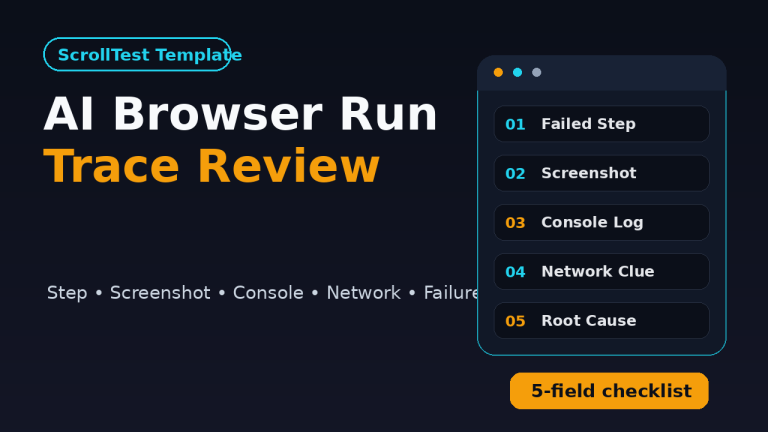
- Upgrade: Playwright v1.61.1
- Primary risk: API request context and trace evidence
- Smoke owner: Web automation lead
- Blocking checks: login, checkout, API health, trace attachment, CI reporter
- Rollback trigger: more than two new framework-level failures in protected smoke
Why this beats a manual checklist
Manual checklists decay. One manager remembers Grid. Another remembers browser channels. A third remembers API tests but forgets trace evidence. The generator standardizes the first draft, then the QA lead edits it with product context.
This is the same mental model behind the Playwright upgrade checklist for three files before merge. You do not need more meetings. You need a repeatable path from tool change to tested evidence.
What the generator reads
The generator is source-first. It reads the release page and keeps the original URL attached to every plan. That matters because release notes change, patches appear, and teams need traceability during audits.
Supported release sources
The first version focuses on sources QA teams already use:
- GitHub Releases for Selenium, Playwright, Cypress plugins, test reporters, and internal tooling.
- Official documentation release pages where GitHub is not the primary source.
- Package registry metadata for npm and PyPI tools when the release page is thin.
- Manual text input when teams have private framework release notes.
The workflow is not limited to UI automation. The same pattern works for PromptFoo, DeepEval, browser versions, Docker images, Allure, ReportPortal, and custom test platform changes.
The fields that matter
The generator extracts a compact set of fields before it writes tasks:
- Version: the exact tag or package version.
- Published date: useful for dependency audit and release cadence.
- Change type: bug fix, feature, breaking change, security fix, deprecation, or regression fix.
- Impacted layer: runner, browser, driver, API, report, trace, selector, grid, fixture, or assertion.
- Evidence needed: smoke test, targeted regression, screenshot, trace, log, dashboard, or rollback validation.
These fields keep the final plan grounded. If the release note does not support a claim, the plan marks it as an assumption instead of pretending the risk is confirmed.
Risk scoring model for QA managers
A release notes to test plan workflow is only useful if it ranks work. QA teams cannot run the full regression suite for every tool patch. They need a score that is simple enough to use and strict enough to catch dangerous upgrades.
The five-factor score
ScrollTest uses a five-factor model. Each factor is scored from 0 to 2. The total score decides the action level.
| Factor | 0 | 1 | 2 |
|---|---|---|---|
| Runtime impact | No test runtime path | Limited runner path | Core runner, browser, Grid, or CI path |
| Product criticality | Non-critical helper | Important but isolated | Login, checkout, payments, auth, onboarding, API contract |
| Evidence dependency | No evidence change | Logs or reports touched | Trace, video, screenshot, reporter, dashboard touched |
| Team exposure | One repo | Two to four repos | Shared framework or many teams |
| Rollback friction | Easy pin | Needs coordinated revert | Image, driver, or framework migration needed |
The action levels are deliberately blunt:
- 0-2: patch note only, run existing CI.
- 3-5: targeted smoke before merge.
- 6-8: smoke plus owner sign-off.
- 9-10: upgrade window, rollback plan, and manager review.
Risk labels keep managers honest
I do not want teams calling everything high risk. That creates alert fatigue. The generator forces a reason for every high label. For example, a Playwright trace viewer timing fix is not automatically high risk for product behavior. It becomes high risk only if your team depends on trace timing to debug WebSocket failures during release sign-off.
That distinction is important for SDET managers in India running mixed teams across TCS, Infosys-style services projects, and product companies. A service team may need client evidence and audit notes. A product team may care more about merge velocity and escaped defect risk. The same release note can produce different plans because the operating context is different.
Selenium and Playwright examples
Let me show how the generator translates real release-note patterns into QA work. These examples are simplified, but they match the style of tasks ScrollTest produces.
Example 1: Selenium binding upgrade
Selenium 4.46.0 links binding-specific changelogs for Java, Python, .NET, Ruby, and JavaScript. That is a signal. A Java-heavy enterprise team and a Python-heavy data platform team do not have the same upgrade surface.
{
  "source": "https://github.com/SeleniumHQ/selenium/releases/tag/selenium-4.46.0",
  "upgrade": "Selenium 4.46.0",
  "risk_area": "language bindings and Grid health",
  "recommended_tests": [
    "Run protected browser smoke suite on Chrome and Edge",
    "Verify RemoteWebDriver capabilities against Selenium Grid",
    "Run one failure case and confirm screenshot plus logs attach",
    "Pin previous Selenium version in rollback branch"
  ],
  "owner": "automation-platform-sdet",
  "risk_score": 7
}
The task is not “upgrade Selenium.” The task is “prove the upgrade does not break the way this team drives browsers, collects evidence, and reports failures.” That phrasing changes behavior.
Example 2: Playwright bug-fix release
Playwright v1.61.1 includes fixes around API request context reporting, trace viewer timing, and Node loader regressions. A team with only basic UI tests may run a small smoke. A team with API-heavy Playwright tests and trace-based debugging needs a different plan.
import { test, expect, request } from '@playwright/test';

test('release-note smoke: API context and trace evidence', async ({ page }) => {
  const api = await request.newContext({ baseURL: process.env.BASE_URL });
  const health = await api.get('/api/health');
  expect(health.ok()).toBeTruthy();

  await page.goto('/login');
  await page.getByLabel('Email').fill('smoke@example.com');
  await page.getByLabel('Password').fill(process.env.SMOKE_PASSWORD!);
  await page.getByRole('button', { name: 'Sign in' }).click();
  await expect(page.getByTestId('dashboard')).toBeVisible();
});
This smoke is small by design. It checks the product path and the evidence path. If the test fails, trace, network, and API evidence must still help the team debug. That is the point of upgrade testing.
Example 3: Reporter or trace change
Many teams treat reporter changes as low risk because they do not touch users. That is dangerous. If a reporter change hides failures, mislabels retries, or drops attachments, release managers lose trust in the pipeline.
The generator flags reporter and trace changes as evidence risk. It recommends one passing test, one failing test, and one retry scenario. That gives the team proof that the pipeline still tells the truth.
CI/CD gates that make it real
A release-note plan has no value if it lives in a document and never blocks bad changes. The workflow needs a CI gate. Not a giant regression gate. A focused gate tied to the risks in the release note.
Minimum gate for framework upgrades
For most web automation teams, I recommend this minimum gate before merging a framework upgrade:
- Install the new dependency version in a dedicated branch.
- Run lint and type checks for framework helpers.
- Run five to ten protected smoke specs across critical flows.
- Run one intentional failure to verify screenshot, video, trace, and report attachments.
- Compare duration, retry count, and flaky test count against the previous baseline.
- Attach the generated test plan and CI URL to the pull request.
That is enough for many patch releases. Bigger upgrades still need targeted regression. The point is to prevent blind merges.
A GitHub Actions pattern
Here is a simple pattern that teams can adapt:
name: framework-upgrade-gate
on:
  pull_request:
    paths:
      - 'package.json'
      - 'package-lock.json'
      - 'playwright.config.ts'
      - 'tests/**'

jobs:
  release-note-smoke:
    runs-on: ubuntu-latest
    steps:
      - uses: actions/checkout@v4
      - uses: actions/setup-node@v4
        with:
          node-version: 22
      - run: npm ci
      - run: npx playwright install --with-deps
      - run: npx playwright test --project=chromium --grep @protected-smoke
      - uses: actions/upload-artifact@v4
        if: always()
        with:
          name: playwright-report
          path: playwright-report/
Connect this gate to the generated plan. If the plan says trace evidence is impacted, the gate must upload the trace or report. If the plan says Grid is impacted, run against Grid. If the plan says API request context is impacted, include an API smoke.
Link the plan to existing ScrollTest practices
This workflow pairs well with the Selenium 4.46 upgrade checklist and the Selenium Grid upgrade risk matrix. Those articles focus on upgrade readiness. The generator turns the same thinking into a reusable production workflow.
India QA team context
India QA teams have a specific problem: ownership is often split across automation engineers, release managers, scrum teams, platform teams, and vendor teams. A release note can fall between chairs. Everyone assumes someone else checked it.
Service company reality
In service environments, a Selenium or Playwright upgrade may need client-facing evidence. The work is not just technical. The team may need to show what changed, what was tested, what failed, what passed, and why the upgrade is safe for the next release train.
The generator helps by creating a task table with owner, evidence, and status. That is useful for TCS, Infosys, Wipro, Cognizant, and similar operating models where governance matters. It reduces “we ran regression” hand-waving and replaces it with traceable checks.
Product company reality
Product companies care about speed, but speed without release confidence is expensive. If a product team is paying ₹25-40 LPA for strong SDETs, those engineers should not spend hours manually reading every upstream release. They should review a generated risk plan, edit the business-critical parts, and spend their attention on the tests that matter.
This is where AI helps QA without replacing QA judgment. The model drafts the plan. The SDET decides whether the product context is right.
Implementation playbook
If you want to start using the release-note-to-test-plan pattern this week, keep it small. Do not begin with every dependency in the company. Pick one automation framework and one team.
Week 1: Pick the release sources
Start with three sources:
- Selenium releases if your team owns WebDriver suites.
- Playwright releases if your team owns modern browser automation.
- One reporting or CI dependency that regularly affects release evidence.
For each source, record the URL, owner, current version, latest version, and upgrade policy. If you do not know the current version, that is the first bug in your quality operating model.
Week 2: Define protected smoke
Protected smoke is not your full regression suite. It is the smallest set of checks that proves the product and the automation platform still work after a risky change. I usually want these buckets:
- Authentication and session handling.
- One money or order flow.
- One API health or contract check.
- One file upload, notification, or async flow if the product depends on it.
- One failure-path test to prove evidence is captured.
Tag these tests clearly. In Playwright, use @protected-smoke. In Selenium frameworks, use TestNG groups, JUnit tags, Pytest markers, or your runner equivalent.
Week 3: Add the generator to upgrade pull requests
Make the generated plan part of the pull request template. The PR should answer:
- What release note triggered this upgrade?
- What is the risk score?
- Which smoke tests ran?
- Where is the CI evidence?
- What is the rollback command or dependency pin?
Here is a pull request block you can copy:
## Release-note test plan

Source release: [paste URL]
Generated plan: [paste ScrollTest plan link or checklist]
Risk score: 0-10
Protected smoke run: [CI URL]
Evidence checked: trace / screenshot / video / report / Grid logs
Rollback: pin dependency to [previous version]
Owner sign-off: @[name]
Week 4: Review misses
After one month, review three numbers:
- How many release notes produced upgrade tasks?
- How many tasks found real breakage before merge?
- How many post-merge failures were caused by framework or tooling changes?
This closes the loop. If the generator creates too much noise, adjust the risk score. If it misses important failures, add better team-specific rules. The workflow should improve with every release.
Key takeaways
Release notes to test plan is not a documentation exercise. It is a release-confidence workflow for QA teams that upgrade automation tools frequently.
- Release notes explain what changed. A test plan explains what must be proven.
- Selenium and Playwright releases often affect language bindings, runners, traces, API testing, reporters, Grid, and CI evidence.
- The ScrollTest generator turns a release link into risk-ranked tasks with owners and smoke coverage.
- Good upgrade gates verify both product behavior and test evidence.
- AI can draft the plan, but SDETs must validate business risk and product context.
If your team still upgrades test frameworks by reading release notes in Slack and hoping CI catches issues, this is the workflow to fix first. Start with one framework, one protected smoke suite, and one generated plan per upgrade.
FAQ
What is a release-note-to-test-plan generator?
It is a workflow that reads a framework or tool release note and converts it into QA tasks. The output includes risk areas, smoke tests, owners, CI gates, evidence requirements, and rollback notes.
Does this replace QA manager judgment?
No. It replaces the first messy draft. The QA manager or SDET still decides which product flows are critical, which failures matter, and whether the upgrade is safe.
Which tools should I track first?
Start with Selenium or Playwright, then add browser versions, Grid, reporters, CI images, PromptFoo, DeepEval, and any internal automation framework used by multiple teams.
How many tests should run for a patch release?
For most patch releases, five to ten protected smoke specs are enough if they cover product behavior and evidence capture. Bigger upgrades need targeted regression based on the risk score.
Where does ScrollTest fit?
ScrollTest provides the release-note-to-test-plan workflow so QA teams can paste a release link and get a practical first draft. The team can then edit the plan, attach it to a pull request, and use it as release evidence.