Playwright Release Notes to Risk Tickets
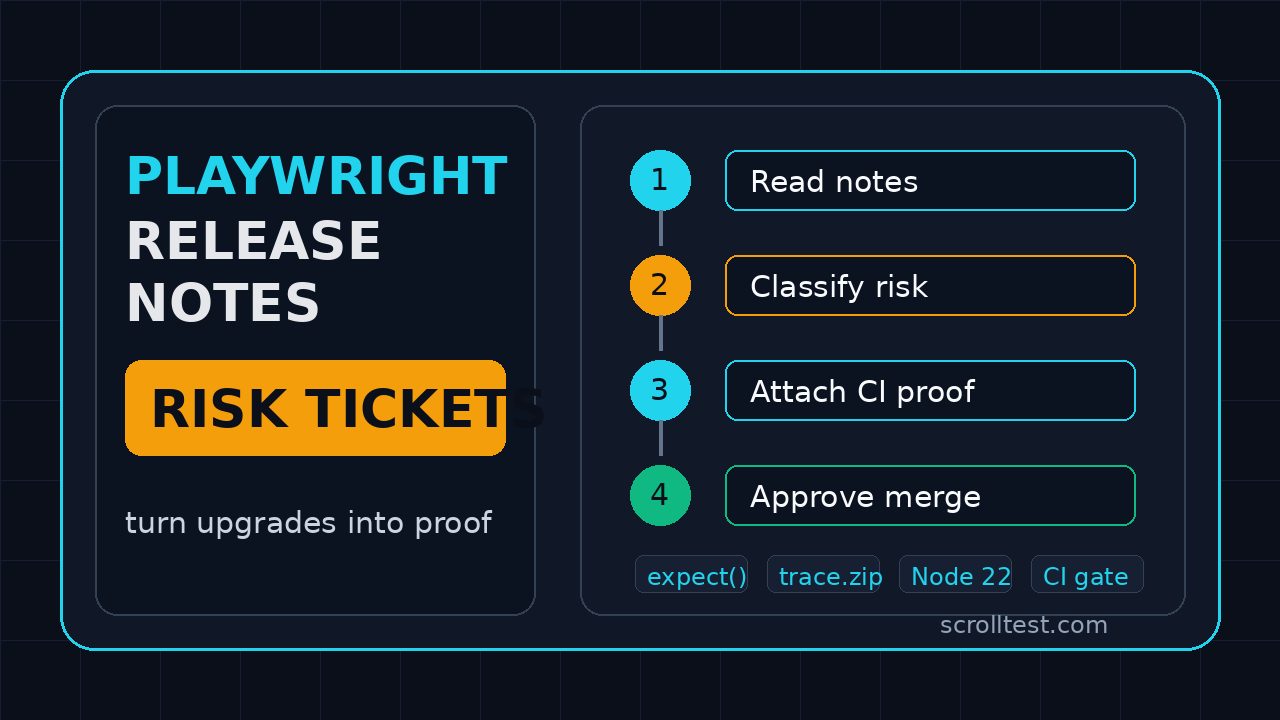
Playwright release notes are not reading material for a quiet Friday. They are raw risk signals. Every browser bump, loader regression, trace viewer fix, API behavior change, and test runner tweak can either be harmless or can break the proof your team depends on before a release.
I see QA teams treat release notes as a single upgrade chore: update the package, run the suite, merge if green. That is too thin for serious automation. A better approach is to convert the notes into small automation risk tickets with owners, impacted specs, evidence, and rollback rules.
This article gives you the workflow I use: how to read Playwright 1.61.1 release notes, split them into risk categories, create tickets, attach CI evidence, and decide whether the upgrade is safe for your team.
Table of Contents
- Why Playwright Release Notes Become Risk
- The Risk Ticket Model for Playwright Release Notes
- A 7-Step Triage Workflow for QA Teams
- The Playwright Upgrade Risk Matrix
- Risk Ticket Template You Can Copy
- CI Evidence: What to Attach Before Merge
- TypeScript Example: Generate Tickets from Release Notes
- India QA Team Context: Who Owns This Work?
- Common Mistakes During Playwright Upgrades
- FAQ
Contents
Why Playwright Release Notes Become Risk
Playwright is now a large testing platform, not just a browser automation library. The GitHub repository has more than 92,000 stars, and npm reported more than 256 million downloads for the playwright package in the last-month window ending 2026-07-13. Those numbers matter because an upgrade affects many test layers: browsers, fixtures, traces, API requests, reporters, locators, and Node runtime behavior.
The Playwright 1.61.1 release is a useful example. The notes list bug fixes around custom expect matchers, API request context byte reporting in UI mode, websocket timing in trace viewer, Node 22.15 sync loader behavior, and extensionless TypeScript subpath imports across pnpm workspace symlinks. None of those sound scary until one maps directly to your framework.
Release notes describe changed assumptions
A test framework is a pile of assumptions. Your team assumes the runner loads TypeScript files correctly. It assumes traces show timings accurately. It assumes custom matchers do not shadow default matchers in surprising ways. It assumes API request evidence from UI mode is trustworthy.
When release notes mention one of these areas, the question is not, “Did Playwright ship a bug fix?” The useful question is, “Which of our test assumptions are touched by this change?” That shift turns a passive upgrade into an active risk review.
Green CI is not always enough
A green suite after an upgrade is necessary. It is not complete proof. If your suite has weak coverage in API assertions, trace review, UI mode, or pnpm workspace imports, the green result might only prove that you did not exercise the changed behavior.
That is why I prefer ticket-level evidence. Each ticket states the change, the impacted area, the specs that prove safety, and the command that generated the evidence. If a manager asks why the upgrade is safe, you show the ticket, not a vague Slack message.
Internal linking for upgrade discipline
If your team already follows a merge checklist, connect this workflow with it. ScrollTest has a practical guide on three files to check before a Playwright upgrade merge. You can pair that checklist with the risk-ticket method here so upgrades create a clear audit trail.
The Risk Ticket Model for Playwright Release Notes
A Playwright risk ticket is a small work item created from one release-note bullet. It is not a generic “Upgrade Playwright” ticket. It captures one specific change and forces the team to answer four questions:
- What changed in Playwright?
- Which part of our automation stack could be affected?
- Which tests or manual checks prove the change is safe?
- Who signs off before the package update is merged?
This model works because it avoids two bad extremes. The first extreme is a monster upgrade ticket with 25 comments and no clear owner. The second is no ticket at all, just a package-lock diff and a green pipeline. Both fail when an upgrade introduces a subtle test-framework issue.
Ticket size matters
One ticket should cover one risk. If Playwright release notes mention trace viewer websocket timing, create a trace evidence ticket. If they mention Node loader regression, create a runtime compatibility ticket. If they mention API request context in UI mode, create an API evidence ticket.
Small tickets make ownership clean. The platform SDET can own Node loader checks. The API automation owner can validate request context evidence. The QA lead can review the final risk matrix before merge.
Risk tickets are not bureaucracy
I use this rule: if a release-note bullet touches code that blocks releases, it deserves a ticket. If it only changes an edge case your team does not use, record it in the matrix and mark it low risk.
Use the official docs as the baseline
The official Playwright release notes page and GitHub releases are the source of truth. Blog posts and social threads are useful for opinions, but the ticket should link to the official release item. That keeps the discussion grounded when engineers disagree about priority.
A 7-Step Triage Workflow for QA Teams
Here is the workflow I recommend for any serious Playwright upgrade. It works for a small startup and for a 40-person QA organization. The difference is only how many owners you assign.
- Read the official release notes. Use GitHub releases and the Playwright docs. Do not depend only on an npm update notification.
- Copy every bullet into a triage sheet. Keep the original text and source URL. Do not paraphrase too early.
- Classify each bullet by automation layer. Runner, browser, locator, trace, API, reporter, fixture, Node runtime, Docker image, or CI.
- Map the layer to impacted files. Search your repository for fixtures, helpers, custom matchers, reporters, Dockerfiles, and project configs.
- Create risk tickets only for touched layers. Skip irrelevant bullets, but record why you skipped them.
- Attach proof commands. Every ticket needs the exact command used to validate the risk.
- Review the matrix before merge. A lead should see risk level, owner, evidence, and rollback plan.
Example classification from Playwright 1.61.1
Take the Node 22.15 sync loader regression mentioned in the Playwright 1.61.1 notes. The classification is not “bug fix.” The useful classification is “Node runtime plus TypeScript loader plus pnpm workspace.” That points to specific files: package.json, pnpm-workspace.yaml, tsconfig.json, shared test utilities, and CI Node version setup.
Now the evidence command becomes obvious:
node --version
pnpm exec playwright test tests/smoke --project=chromium
pnpm exec playwright test tests/framework/imports.spec.ts --reporter=line
If your organization uses multiple Node versions across local machines and CI, add a matrix job. The upgrade is not safe just because it passes on one developer laptop.
Build a release-note owner rotation
Do not make one senior SDET read every release forever. Create a rotation. One engineer triages the notes, one engineer validates high-risk tickets, and the QA lead signs off. This is a good growth path for mid-level SDETs who want to move from test writing to framework ownership.
The Playwright Upgrade Risk Matrix
A risk matrix is the one-page view managers need. It should not contain long essays. It should show changed area, risk level, impacted assets, owner, proof, and status.
Use this simple matrix:
| Release-note area | Risk level | Why it matters | Proof required |
|---|---|---|---|
| Node or loader changes | High | Can break test discovery, imports, and CI startup | Run smoke suite on supported Node versions |
| Trace viewer fixes | Medium | Can affect debugging evidence and timing analysis | Open trace from failed and passed tests |
| API request context changes | Medium | Can affect API evidence collected inside UI flows | Run API plus UI hybrid specs |
| Expect or matcher behavior | High | Can change assertion semantics | Run custom matcher unit tests and key E2E specs |
| Browser binary updates | High | Can change rendering, permissions, downloads, media, and dialogs | Run cross-browser critical path suite |
| Reporter or output changes | Low to medium | Can break CI parsing and dashboards | Validate HTML, JUnit, and custom report consumers |
Use high risk sparingly
If every row is high risk, the matrix becomes noise. I mark a row high risk only when it can block test startup, hide a real product bug, change assertion behavior, or break CI evidence. Most documentation updates and narrow bug fixes are low risk unless your framework depends on that exact behavior.
Connect the matrix to CI release gates
Risk matrices become powerful when they feed your release gate. ScrollTest already covers this mindset in AI test evidence in CI/CD release gates. The same principle applies to Playwright upgrades: the gate should check proof, not vibes.
For example, require these artifacts before the dependency bump merges:
- HTML report from critical path tests
- Trace zip from one intentional failure
- JUnit XML consumed by CI dashboard
- Browser install log after
npx playwright install - Version snapshot for Node, Playwright, browsers, and package manager
Risk Ticket Template You Can Copy
Use this template in Jira, Linear, GitHub Issues, or Azure DevOps. The tool does not matter. The fields matter.
Title: [Playwright Upgrade Risk] Node 22.15 sync loader regression check

Source:
- Playwright release: https://github.com/microsoft/playwright/releases/tag/v1.61.1

Release-note text:
- Sync loader throws "context.conditions?.includes is not a function" on Node 22.15

Risk category:
- Node runtime
- TypeScript imports
- pnpm workspace symlinks

Impacted assets:
- playwright.config.ts
- tests/fixtures/*.ts
- packages/test-utils
- CI Node setup action

Risk level:
- High

Proof commands:
- node --version
- pnpm exec playwright test tests/smoke --project=chromium
- pnpm exec playwright test tests/framework/imports.spec.ts --reporter=line

Evidence links:
- CI run:
- HTML report:
- Trace zip:

Owner:
- Platform SDET

Rollback plan:
- Revert package-lock or pnpm-lock diff
- Pin previous Playwright version
- Re-run smoke suite

Decision:
- Approved / Blocked / Needs follow-up
Make the title searchable
Start every title with the same prefix, such as [Playwright Upgrade Risk]. Six months later, you should be able to search all upgrade evidence in one query. This sounds small, but it saves time during release retrospectives.
Always include rollback
Rollback is not a pessimistic field. It is discipline. If the upgrade breaks CI two hours before a release branch cut, the team should not debate what to revert. The ticket should already say which package version to pin and which smoke command proves rollback safety.
CI Evidence: What to Attach Before Merge
The best Playwright release notes workflow fails if CI evidence is weak. A screenshot of a green GitHub Actions check is not enough. You need artifacts that prove the changed areas were exercised.
Minimum evidence set
For a normal Playwright minor or patch upgrade, I expect this evidence:
- Version snapshot: Playwright version, browser versions, Node version, package manager version, OS image.
- Critical path suite: Login, checkout or equivalent revenue flow, settings flow, and one role-based permission flow.
- API hybrid specs: At least one spec that creates data through API and verifies through UI.
- Trace artifact: One passed trace and one failed trace opened successfully.
- Reporter validation: HTML and JUnit reports generated and consumed by dashboards.
- Flake comparison: Compare retry count with the last stable baseline.
Command block for CI
Here is a compact CI step I like for upgrade PRs:
name: playwright-upgrade-risk-check

on:
  pull_request:
    paths:
      - 'package.json'
      - 'pnpm-lock.yaml'
      - 'playwright.config.ts'

jobs:
  risk-check:
    runs-on: ubuntu-latest
    strategy:
      matrix:
        node: [20, 22]
    steps:
      - uses: actions/checkout@v4
      - uses: actions/setup-node@v4
        with:
          node-version: ${{ matrix.node }}
      - run: corepack enable
      - run: pnpm install --frozen-lockfile
      - run: pnpm exec playwright install --with-deps
      - run: pnpm exec playwright test tests/smoke --reporter=html,junit
      - run: pnpm exec playwright test tests/api-ui --reporter=line
      - uses: actions/upload-artifact@v4
        if: always()
        with:
          name: playwright-risk-evidence-node-${{ matrix.node }}
          path: |
            playwright-report
            test-results
Adapt the paths to your repository. The key idea is simple: Playwright dependency changes trigger a stronger check than normal application-only PRs.
Measure flake, not only pass rate
A Playwright upgrade can keep the suite green while increasing retries. That is a cost. If your pipeline hides retries, the team will feel the pain later as longer builds and weaker trust.
Store retry count per run and compare it with the last stable baseline. If a 600-test suite usually has 4 retries and the upgrade PR has 31 retries, do not wave it through. Create a follow-up ticket or block the merge depending on affected flows.
TypeScript Example: Generate Tickets from Release Notes
You do not need a fancy AI agent to start. A small script can convert a release note into draft tickets. Human review stays mandatory, but automation removes copy-paste work.
type RiskLevel = 'low' | 'medium' | 'high';

type RiskTicket = {
  title: string;
  sourceUrl: string;
  releaseNote: string;
  category: string;
  risk: RiskLevel;
  proofCommands: string[];
};

const rules = [
  {
    category: 'Node runtime and TypeScript loading',
    risk: 'high' as const,
    keywords: ['node', 'loader', 'esm', 'typescript', '.ts', 'pnpm'],
    commands: [
      'node --version',
      'pnpm exec playwright test tests/smoke --project=chromium',
      'pnpm exec playwright test tests/framework/imports.spec.ts --reporter=line'
    ]
  },
  {
    category: 'Trace and debugging evidence',
    risk: 'medium' as const,
    keywords: ['trace', 'viewer', 'websocket', 'timing'],
    commands: [
      'pnpm exec playwright test tests/smoke --trace=on',
      'pnpm exec playwright show-trace test-results/**/*.zip'
    ]
  },
  {
    category: 'Assertions and custom matchers',
    risk: 'high' as const,
    keywords: ['expect', 'matcher', 'assertion'],
    commands: [
      'pnpm exec vitest tests/matchers',
      'pnpm exec playwright test tests/assertions --reporter=line'
    ]
  },
  {
    category: 'API request evidence',
    risk: 'medium' as const,
    keywords: ['apiRequestContext', 'api request', 'bytes'],
    commands: [
      'pnpm exec playwright test tests/api-ui --reporter=html',
      'pnpm exec playwright test tests/api --reporter=line'
    ]
  }
];

export function createRiskTickets(notes: string[], sourceUrl: string): RiskTicket[] {
  return notes.map((note) => {
    const normalized = note.toLowerCase();
    const rule = rules.find((item) =>
      item.keywords.some((keyword) => normalized.includes(keyword.toLowerCase()))
    );

    const fallback = {
      category: 'General Playwright behavior',
      risk: 'low' as const,
      commands: ['pnpm exec playwright test tests/smoke --reporter=line']
    };

    const match = rule ?? fallback;

    return {
      title: `[Playwright Upgrade Risk] ${match.category}`,
      sourceUrl,
      releaseNote: note,
      category: match.category,
      risk: match.risk,
      proofCommands: match.commands
    };
  });
}
Where AI can help safely
An LLM can summarize release notes and propose risk categories, but I would not let it auto-approve upgrades. Use it as a draft assistant. The final ticket should still be reviewed by an SDET who understands your framework.
If your team is already experimenting with AI testing, connect this to a broader release watch workflow. ScrollTest has a related post on AI browser release radar for QA teams, which pairs well with this Playwright-specific ticketing approach.
India QA Team Context: Who Owns This Work?
In many India-based QA teams, Playwright upgrades fall into an awkward gap. Manual testers assume automation engineers own it. Automation engineers assume DevOps owns CI. Managers assume a senior SDET will notice if something is risky. That unclear ownership is how upgrade problems reach release week.
For service-company projects, I would assign this to the automation lead and keep the evidence simple. For product companies, especially teams paying ₹25 to ₹40 LPA for strong SDETs, I expect framework ownership as part of the role. A senior SDET should be able to read Playwright release notes and translate them into engineering risk.
A practical ownership split
- Junior QA or SDET: Copy release notes, run baseline commands, collect artifacts.
- Mid-level SDET: Classify notes, create risk tickets, map impacted specs.
- Senior SDET: Decide risk level, review evidence, approve or block merge.
- QA manager: Check release timing, communicate risk to engineering leadership.
- DevOps engineer: Validate CI images, caching, browser installation, and artifact upload.
This split creates a visible growth ladder. A manual tester moving into automation can start by collecting evidence. A mid-level SDET can prove ownership by classifying risks. A senior engineer can show judgment by blocking unsafe upgrades without creating drama.
Portfolio value for SDETs
Common Mistakes During Playwright Upgrades
I see the same upgrade mistakes across teams. Most are easy to avoid once you create a repeatable risk-ticket workflow.
Mistake 1: Updating Playwright and browsers at the worst time
Do not combine a Playwright upgrade with a major release branch cut unless the upgrade fixes a blocker. Browser and runner changes need breathing room. Schedule upgrade PRs early in the sprint so failures do not compete with product release pressure.
Mistake 2: Testing only Chromium
Many teams say they support WebKit and Firefox, but upgrade validation only runs Chromium. That is a false signal. If your production support matrix includes multiple browsers, the upgrade risk check should cover at least one critical path in each browser.
Mistake 3: Ignoring custom matchers
The Playwright 1.61.1 notes mention an expect matcher case. If your framework has custom matchers, treat assertion behavior as high risk. A broken assertion utility can create false positives, which are worse than visible failures.
Mistake 4: Not opening traces
Teams generate trace artifacts but never open them during upgrade review. That misses UI evidence regressions. Open at least one trace from a passed test and one from a failed test. Confirm timings, console logs, network events, and screenshots render as expected.
Mistake 5: No rollback plan
If rollback means “someone will revert something,” you do not have a rollback plan. Write the exact version pin, lockfile revert, and smoke command in the ticket. During an incident, clarity beats confidence.
Key Takeaways: Turn Playwright Release Notes into Proof
Playwright release notes are one of the best early-warning systems a QA team has. The mistake is treating them as announcements. Treat them as structured input for release risk management.
- Convert each relevant release-note bullet into a small automation risk ticket.
- Classify changes by layer: runner, browser, API, trace, assertion, Node runtime, reporter, or CI.
- Attach proof commands and artifacts before merging the dependency bump.
- Use a risk matrix so managers can see owner, status, evidence, and rollback plan in one place.
- Make this a growth path for SDETs who want to own framework reliability, not just write specs.
My simple rule: if an upgrade can change the evidence you use to approve releases, it deserves a ticket. That one habit turns Playwright upgrades from a package update into an engineering control.
FAQ
Do we need risk tickets for every Playwright patch release?
No. You need a triage pass for every release and tickets for relevant risks. If a patch release only touches behavior your framework does not use, record it as low risk and move on. The value is in the review discipline, not in creating unnecessary work.
Should QA or DevOps own Playwright upgrade validation?
QA should own test behavior and release evidence. DevOps should own CI images, caching, browser installation, and artifact upload. The best setup is shared ownership with one SDET accountable for the final risk matrix.
Can AI generate these tickets automatically?
AI can draft ticket descriptions and suggest categories. I would still keep human approval for risk level and proof commands. Release-note interpretation depends on your framework, and that local context matters.
What is the minimum proof before merging a Playwright upgrade?
Run critical path tests, one API plus UI hybrid flow, trace generation, reporter validation, and a version snapshot. If the release notes mention Node, matchers, or browser-specific behavior, add targeted checks for those areas.