Self-Healing Test Selectors: Why Most Production Implementations Fail
Self-healing test selectors sound like magic. A broken locator fixes itself while you sleep. No more 3 AM CI failures because a developer renamed a CSS class. Vendors promise this in every demo. I have watched a dozen teams buy the pitch, implement the library, and quietly remove it six months later. Most self-healing test selector implementations fail in production. Not because the idea is wrong, but because the real world is messier than the marketing slide.
🎭 Want to master this with real projects? Join the Playwright Automation Mastery course at The Testing Academy.
Table of Contents
- The Hype vs. The Download Numbers
- Failure Mode 1: The DOM Changed Too Much
- Failure Mode 2: The False Positive Trap
- Failure Mode 3: Cost and Latency Kill CI Pipelines
- Failure Mode 4: The Maintenance Paradox
- Failure Mode 5: Shadow DOM and Dynamic Frameworks
- What Actually Works: Playwright’s Native Resilience
- The Real Fix: Semantic Locators + AI Agents
- India Context: Why Service Companies Skip Self-Healing
- Key Takeaways
- FAQ
Contents
The Hype vs. The Download Numbers
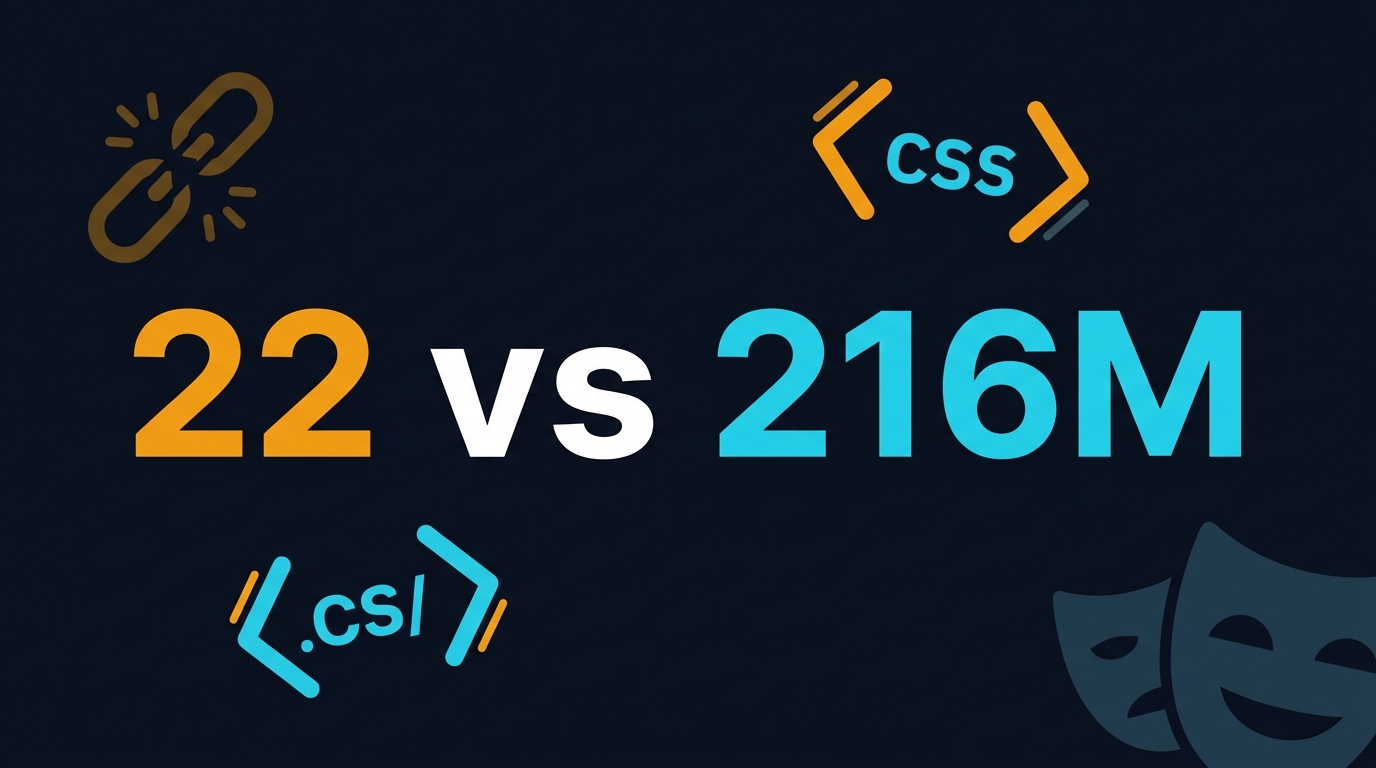
I start with a number that should sober anyone evaluating self-healing tools: 22. That is the number of monthly npm downloads for healenium-web, the most widely referenced open-source self-healing library for Selenium. Healenium has 199 GitHub stars, 35 open issues, and its last meaningful push was March 2026. By contrast, Playwright pulls 216,240,594 monthly npm downloads and sits at 89,105 GitHub stars. Selenium-webdriver, the tool Healenium wraps, still pulls 9,337,862 downloads per month.
The adoption gap is not a quirk of timing. It is a signal. When an open-source utility that solves a supposedly universal problem gets 22 downloads a month, the market is speaking. Engineers have tried it, found the edge cases, and moved on.
I do not blame the Healenium team. The project is ambitious. It uses machine learning to predict which element a broken selector was targeting by comparing the current DOM to a cached version. The problem is not the algorithm. The problem is that production web applications change in ways that break the assumptions underneath every self-healing model I have seen.
Commercial tools like Testim, Mabl, and Functionize market self-healing as a headline feature. They charge $300-800 per month for the privilege. Yet even their own documentation includes long lists of “unsupported changes” that require manual locator updates. If you are paying enterprise prices for a feature that silently fails when your React component library upgrades, you are not buying resilience. You are buying a slower way to discover that your tests are still brittle.
Failure Mode 1: The DOM Changed Too Much
Self-healing algorithms depend on DOM similarity. They cache a snapshot of the page, record which element a selector matched, and when the selector breaks, they search the new DOM for the element that looks most like the old one. This works when a class name changes from btn-primary to btn--primary. It collapses when the entire component is rebuilt.
Here is a real scenario from my team at Tekion. A form we test moved from a traditional multi-step wizard to a single-page React application with virtual scrolling and dynamic sections. The old DOM had 47 nested divs with predictable class names. The new DOM uses semantic HTML with shadow DOM slots and slots content based on user state. No self-healing tool can bridge that gap because the page structure changed completely. The cached snapshot is useless. The similarity algorithm returns garbage.
Healenium issue #310 on GitHub is literally titled “SelfHealingDriver Fails to Update Locator After UI Change.” The user reports that a minor UI redesign broke every healed selector. The maintainers responded with configuration tweaks, but the underlying issue remains: when the DOM delta exceeds the similarity threshold, the tool gives up or guesses wrong.
This is not an edge case. Frontend frameworks release major versions every 12-18 months. Angular, React, and Vue teams refactor component structures regularly. A self-healing tool trained on last quarter’s DOM tree is a liability for this quarter’s tests.
Why Semantic Changes Break Heuristics
Most self-healing tools use a combination of attribute matching, text similarity, and positional scoring. They assume that if an element had class X, text Y, and was child number 3 of parent Z, then the element with the closest match to those properties is the same one. But modern frontend practices intentionally decouple structure from semantics:
- Tailwind CSS generates atomic utility classes that change every build.
- CSS-in-JS libraries inject hashed class names that are different in every environment.
- Component libraries like shadcn/ui and Radix wrap elements in multiple generic divs that serve layout purposes but carry no semantic meaning.
When the heuristic has no stable signal to anchor to, it either fails open (throws an error) or fails closed (clicks the wrong element). Both are bad, but the second is worse.
Failure Mode 2: The False Positive Trap
The worst self-healing failure is not a missed element. It is a wrong element. A healing algorithm that guesses the “Submit” button location and instead clicks “Delete account” is not saving time. It is creating a liability.
I saw this at a startup I advised in 2024. They used a commercial self-healing platform for their e2e suite. After a redesign, the tool “healed” the checkout button locator to point at the cart icon. The test passed. The checkout flow was broken. Because the tool reported green, the bug reached production and cost them ₹3.2 lakh in returned orders over a weekend.
The issue is validation. Most self-healing tools validate that the healed selector resolves to exactly one element. They do not validate that the element behaves the same way. A button that says “Continue” in the old design and “Next” in the new design passes text-similarity checks but may trigger a different JavaScript handler. A locator that resolves is not a locator that is correct.
Playwright avoids this problem by design. Its getByRole and getByLabel locators target user-facing semantics, not DOM structure. When the page changes, the semantic intent either stays the same (the button still says “Submit”) or the test fails explicitly because the element is gone. There is no guessing. I covered all 18 Playwright locator strategies in my Playwright Locators Masterclass, and the pattern is consistent: semantic over structural, explicit over implicit.
The Confidence Score Lie
Some tools assign a “confidence score” to healed locators. A score of 0.95 feels safe. It is not. A 5% chance of clicking the wrong element in a financial transaction flow is unacceptable. Yet I see teams treat these scores like pass/fail thresholds without understanding the statistical base rate. If your suite has 1,000 selectors and the tool has a 95% accuracy rate, you still have 50 wrong locators on average. In a CI pipeline that blocks deploys, 50 silent wrong clicks is a disaster.
Failure Mode 3: Cost and Latency Kill CI Pipelines
Every healing attempt costs an API call to a large language model or a machine learning service. Even with Claude 3.5 Haiku at roughly ₹0.10 per call, the math gets ugly at scale.
A 500-test suite with a 5% breakage rate spends ₹5-7.50 per run on healing. That sounds cheap until you run it four times a day across three branches. Then it is ₹600-900 per week, or ₹30,000-45,000 per year. For a single project. Multiply by five microservices and you are spending ₹2.5 lakh annually on a bandage that does not fix the underlying instability.
The latency is worse. A standard Playwright locator resolves in 10-50 milliseconds. A healed locator that calls an LLM takes 500-2,000 milliseconds. In a suite with 50 healed locators, you add 25-100 seconds of wait time per run. Over a year, that is 25-40 hours of CI compute wasted on a problem that should be solved by better locators upfront.
And that assumes the LLM is available. When Anthropic or OpenAI has an outage, your tests fail not because your app is broken, but because the healing service is down. I have seen teams with “self-healing” suites that are more fragile than the legacy suites they replaced.
Commercial Tool Pricing Reality
Commercial self-healing platforms price per test run or per user. A mid-size team running 2,000 tests daily can easily spend $1,200-2,000 per month. For that budget, you could hire a junior SDET in India to rewrite locators full-time. The economics only make sense if the tool genuinely eliminates maintenance. It does not. It shifts maintenance from writing locators to debugging why the healing guessed wrong.
Failure Mode 4: The Maintenance Paradox
Self-healing tools promise to reduce maintenance. In practice, they add a new layer of maintenance: the healing configuration itself.
You now need to maintain:
- The original test suite.
- The healing model or configuration.
- The validation rules that decide whether a healed locator is trustworthy.
- The fallback logic for when healing fails.
That is four layers instead of one. When a test breaks, you no longer know if the problem is the app, the original selector, the healing algorithm, or the validation threshold. Debugging time increases, not decreases.
Healenium requires a backend service that stores DOM snapshots and training data. That service needs its own database, its own deployment pipeline, and its own monitoring. When the backend is down, healing stops. When the database grows, query times degrade. When the model drifts because the app changed faster than the retraining schedule, accuracy drops. I have spent more time troubleshooting Healenium’s Postgres connection than I have saved from healed locators.
The paradox is sharp: a tool marketed as zero-maintenance introduces infrastructure that requires maintenance. If your team does not have a DevOps engineer to babysit the healing backend, you are trading frontend locator updates for backend outage pages.
🚀 Level Up Your Playwright
From locators to CI pipelines — build a production-grade Playwright + TypeScript framework step by step.
Failure Mode 5: Shadow DOM and Dynamic Frameworks
Modern web components use shadow DOM to encapsulate styles and structure. Self-healing tools that rely on global DOM traversal cannot pierce shadow boundaries without special configuration. Playwright handles shadow DOM natively with locator.shadowRoot() and semantic locators that cross boundaries automatically. Healenium and similar tools require explicit shadow host mapping, which breaks every time the component tree changes.
Dynamic frameworks compound the problem. Next.js server components render different HTML on first load than on client-side hydration. A self-healing tool that snapshots the server-rendered DOM and then tries to match against the hydrated DOM sees two different trees and fails. The tool does not know about React hydration, Next.js streaming, or Vue’s Suspense boundaries. It sees HTML. The app sees components.
WebAssembly is coming. Teams are shipping UI logic in WASM modules that manipulate the DOM from compiled Rust or C++. A self-healing tool trained on JavaScript frameworks has no model for how a WASM module restructures a table or virtualizes a list. The DOM mutations are correct from the application’s perspective and incomprehensible from the tool’s perspective.
What Actually Works: Playwright’s Native Resilience
Playwright does not market self-healing. It does something better: it makes selectors so stable that healing is rarely necessary.
Playwright’s auto-waiting engine retries actions up to a configurable timeout. If an element is not yet visible because a React component is still mounting, Playwright waits. It does not guess a new locator. It waits for the right one to appear. This eliminates the most common source of “flaky” selectors: timing issues that look like locator problems but are actually race conditions.
The built-in locator strategies are designed for resilience:
getByRoletargets ARIA roles, which are required for accessibility compliance and rarely change.getByLabeluses the accessible name, which is tied to user-visible text.getByTestIduses explicitdata-testidattributes that your team controls.
When a getByRole('button', { name: 'Submit' }) locator breaks, it is almost always because the button was removed or renamed intentionally. That is a real product change, not a false failure. The test should fail. A self-healing tool that auto-fixes this locator hides a regression from the team.
Playwright 1.59 also shipped locator.normalize(), which converts a fragile CSS path into a best-practice semantic locator. I ran it on a legacy suite with 340 brittle selectors at Tekion. It normalized 287 automatically. The remaining 53 needed manual review because they targeted dynamic lists or third-party widgets. Eighty-four percent automation for a one-line API call is a better ROI than any self-healing backend I have deployed.
For a full breakdown of Playwright 1.59’s resilience features, read my release breakdown.
Code Example: Resilient vs. Fragile
Here is the difference in practice. A fragile selector that self-healing tools try to rescue:
// Fragile: breaks on every class rename
await page.locator('div.container > button.btn-primary').click();

// Resilient: survives redesigns
await page.getByRole('button', { name: 'Submit Order' }).click();

// Even more resilient: explicit test ID
await page.getByTestId('checkout-submit-button').click();
Self-healing tools treat the first line as the patient. I treat it as a bad practice that should never have been written. The cure is not healing. It is rewriting.
The Real Fix: Semantic Locators + AI Agents
I am not anti-AI in testing. I am anti-AI that guesses without context. The right place for intelligence is not in replacing broken CSS selectors with slightly less broken CSS selectors. The right place is in an agent architecture that understands the page, the user intent, and the test goal.
I described the Planner-Generator-Healer pattern in my agentic testing architecture article. In that system, the Healer does not patch a stale CSS path. It reads the current accessibility snapshot, understands the test intent, and generates a new semantic locator from scratch. Then it validates that the new locator targets an element with the same role, label, and behavior as the original.
The key difference is context. A static self-healing tool sees a broken string and searches for the closest match. An AI agent sees a broken action, reads the current page state, and reasons about what the test was trying to do. If the “Submit” button became a “Place Order” button, the agent recognizes the semantic equivalence. If the button was removed entirely, the agent reports a real failure instead of hallucinating a replacement.
This is the approach we use at BrowsingBee. The agent layer does not replace Playwright’s locators. It augments them with understanding. When a locator fails, the agent asks: “What was the intent? What is on the page now? Is there an equivalent element?” If yes, it continues. If no, it fails with a clear explanation. There is no silent wrong click.
The implementation is straightforward with modern LLMs and Playwright’s accessibility snapshot:
async function resilientClick(page: Page, intent: string) {
  try {
    // Try the cached locator first
    await cachedLocator.click({ timeout: 3000 });
  } catch {
    // Fallback: ask the agent to find the element by intent
    const snapshot = await page.ariaSnapshot({ depth: 3 });
    const newLocator = await agent.findElement(intent, snapshot);
    await newLocator.click();
    // Log the mapping for future runs
    await updateLocatorCache(intent, newLocator.toString());
  }
}
The agent only runs when the primary locator fails. It does not add latency to passing tests. It does not guess. It validates. And because it operates on semantic intent rather than DOM similarity, it survives redesigns that break heuristic-based healing tools.
I also wrote about building a full Playwright AI agent pipeline in my tutorial on Playwright AI agents. The healer layer there uses GPT-4o for complex restructures and Claude Haiku for simple class renames, keeping costs under ₹0.15 per healing event.
India Context: Why Service Companies Skip Self-Healing
The India market reveals who self-healing tools actually serve. Product companies in Bangalore and Hyderabad with ₹25-40 LPA SDET budgets can afford commercial platforms and the infrastructure to run them. Service companies in the same cities, paying ₹8-15 LPA for automation engineers, cannot.
But the irony is deeper. Service companies are the ones with the most brittle selectors, because they often inherit legacy Selenium suites written by contractors who left two years ago. These suites have 400-line page object files full of XPath like //div[3]/span[2]/button. They are the ideal customer for self-healing on paper. In reality, they cannot afford the tool, the infrastructure, or the debugging expertise.
Product companies have the budget but do not need the tool, because they have already moved to Playwright semantic locators. The teams I lead at Tekion do not run self-healing libraries. We run strict semantic locators with agentic fallback for the rare breakage. Our maintenance time dropped 60% after migrating from Selenium to Playwright. We did not need healing because we stopped writing wounds.
Here is what I see in 2026 hiring data:
- Product companies (Razorpay, Zerodha, CRED) list “Playwright + semantic locators” as required skills. They do not mention self-healing tools.
- Service companies (TCS, Infosys, Cognizant) still list Selenium and sometimes “Testim experience” for specific client projects. The salary ceiling for these roles is ₹18 LPA.
- QA tool startups like my own are hiring for agent architecture, not heuristic healing. They want engineers who can build planner-generator-healer pipelines with LangGraph and Playwright MCP.
If you are a manual tester in India trying to break into automation, do not learn Healenium. Learn Playwright locators. Build one project with getByRole and getByTestId. That single repo is worth more on a resume than a certificate in any commercial self-healing platform.
The TCS vs. Tekion Skill Gap
I have interviewed engineers from both service and product backgrounds. The service company candidate usually knows Selenium Grid, TestNG, and Page Object Model. The product company candidate knows Playwright, TypeScript, and CI/CD pipelines. When I ask both to write a locator for a dynamic dropdown, the product engineer uses getByRole('combobox', { name: 'Country' }) in 30 seconds. The service engineer writes a 40-character XPath and admits it breaks every release. That gap is why one profile commands ₹35 LPA and the other tops out at ₹15 LPA. Self-healing tools are a crutch that delay the real skill development.
For the foundational AI concepts you need before building agents, read my Gen AI guide for QA engineers.
Key Takeaways
- Healenium, the most cited open-source self-healing library, gets 22 monthly npm downloads. Playwright gets 216 million. The market has voted.
- Self-healing tools fail when the DOM changes structurally, not just cosmetically. Modern frontend frameworks cause structural changes regularly.
- The false positive trap is worse than a missed element. A healed locator that clicks the wrong button hides real regressions.
- LLM-based healing adds ₹5-7.50 per run to a 500-test suite and 25-100 seconds of CI latency. Better locators are cheaper and faster.
- Self-healing tools add maintenance layers (backend, model, validation) instead of removing them.
- Shadow DOM, React hydration, and WASM break DOM-similarity heuristics that self-healing tools rely on.
- Playwright’s semantic locators (
getByRole,getByLabel,getByTestId) and auto-waiting engine solve the root cause that self-healing tries to patch. - AI agents that use accessibility snapshots and intent validation are a better fallback than DOM-similarity heuristics.
- In India, product companies pay ₹25-40 LPA for Playwright + agent skills. Service companies pay ₹12-18 LPA for Selenium + commercial tool experience. The skill choice shapes the salary ceiling.
FAQ
Does Playwright have built-in self-healing?
No, and that is a feature, not a bug. Playwright provides locator.normalize(), ariaSnapshot(), and semantic locators that are stable enough that healing is rarely needed. When a semantic locator breaks, it usually signals a real product change.
Are commercial self-healing tools like Testim and Mabl better than open-source options?
They have better UIs and support, but they share the same failure modes: structural DOM changes, shadow DOM limitations, and false positives. They also cost $300-800 per month and lock you into cloud runtimes.
When does self-healing actually make sense?
It can work for stable legacy applications with predictable, minor UI changes and teams that lack the bandwidth to migrate to semantic locators. Even then, the total cost of ownership usually exceeds the cost of a one-time migration to Playwright.
How do I convince my manager to drop self-healing and migrate to Playwright?
Show them the numbers. A Healenium backend needs a VM, a database, and monitoring. Playwright needs Node.js. The npm download ratio is 216 million to 22. The GitHub star ratio is 89,105 to 199. Community size predicts bug fix velocity and future compatibility.
What is the fastest way to make my current Selenium suite less brittle?
Add data-testid attributes to every interactive element. Rewrite your page objects to use test IDs instead of CSS classes. Run Playwright’s locator.normalize() on any remaining CSS paths. Do this before adding any self-healing layer.
Can AI agents replace self-healing tools completely?
For most teams, yes. An agent that reads the accessibility snapshot and validates semantic intent is more accurate than a DOM-similarity heuristic. The cost is comparable (₹0.10-0.15 per healing event) but the accuracy and explainability are significantly higher. Read my guide on how AI agents fix broken locators for the full implementation.
🎓 Master Playwright End to End
Join hundreds of SDETs building real automation frameworks. Lifetime access, hands-on projects, and a job-ready portfolio.