The 2026 Playwright Automation Blueprint: 5 Phases From Scripts to Production Framework
Anyone can write a Playwright test. Top engineers build scalable frameworks. This blueprint covers the 5-phase journey from first test to production-ready automation architecture.
🎭 Want to master this with real projects? Join the Playwright Automation Mastery course at The Testing Academy.
Contents
Phase 1: Foundations (Week 1-2)
- Playwright installation and project setup with TypeScript
- Page fixtures:
page.goto(),page.locator(),page.fill(),page.click() - Assertions with
expect: toBeVisible, toHaveText, toHaveURL - Screenshots, videos, and trace recording for debugging
- Deliverable: 10 tests covering login, navigation, and form submission
Phase 2: Real Engineering (Week 3-4)
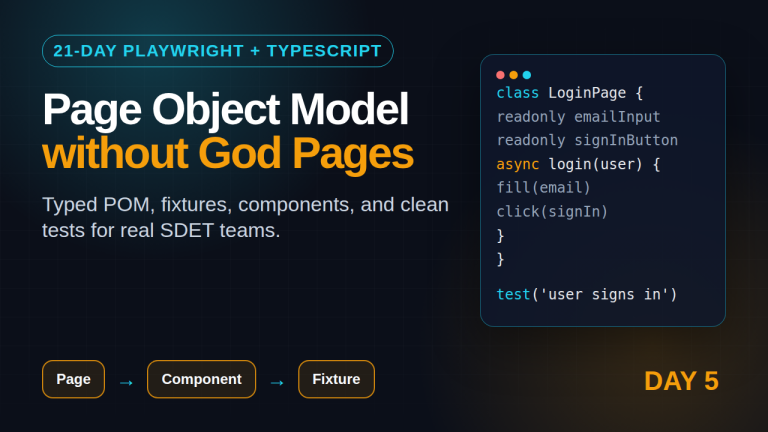
- Page Object Model: lightweight components, not monolithic classes
- API testing with
requestcontext alongside UI tests - Test data management: API-based setup, factory patterns
- Network interception: mocking external APIs with
page.route() - Deliverable: Hybrid UI+API test suite with Page Objects
Phase 3: Advanced Mastery (Week 5-6)
- Custom fixtures for authentication, test data, and browser contexts
- Parallel execution with sharding across CI workers
- Visual regression testing with
toHaveScreenshot() - Mobile emulation and responsive testing
- Deliverable: Cross-browser, cross-device test suite
🚀 Level Up Your Playwright
From locators to CI pipelines — build a production-grade Playwright + TypeScript framework step by step.
Phase 4: AI-Driven Testing (Week 7-8)
- Playwright MCP integration for AI agent testing
- Using Codegen with AI-assisted refinement
- Self-healing locator strategies
- Playwright 1.59 features: Screencast API, Browser.bind(), CLI debugger
- Deliverable: AI-augmented test generation pipeline
Phase 5: Production Framework (Week 9-12)
- Config-driven execution (environments, browsers, parallelization)
- Custom reporters: Allure, HTML dashboards
- GitHub Actions pipeline with artifact upload
- Test data seeding and cleanup strategies
- Deliverable: Open-source framework template on GitHub
Common Mistakes That Keep Engineers Stuck
- Overusing Page Object Model — keep components lightweight
- Hardcoded waits instead of auto-wait assertions
- Ignoring the API layer for test data setup
- No test data isolation strategy for parallel execution
- Skipping CI integration until “later” (later never comes)
🎓 Master Playwright End to End
Join hundreds of SDETs building real automation frameworks. Lifetime access, hands-on projects, and a job-ready portfolio.