AI Test Generation: Who Validates the Tests Your AI Writes?
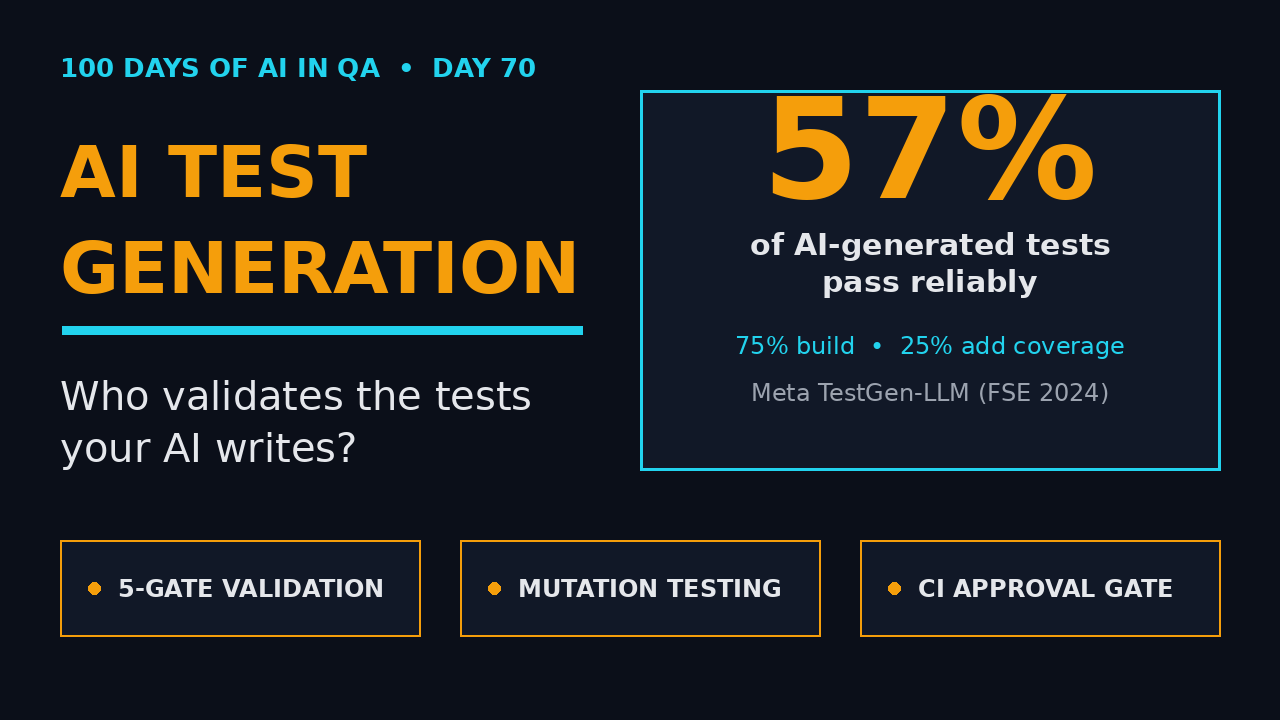
Table of Contents
- The AI Test Generation Landscape in 2026
- The Data That Should Scare You
- Five Ways AI-Generated Tests Fail
- What a Validated Test Looks Like
- The Five-Gate Validation Framework
- Mutation Testing Is Your Honest Judge
- Wiring AI Test Generation Into CI
- India Context: What This Means for SDET Careers
- Key Takeaways
- FAQ
When Meta pointed its own LLM at its unit tests, the results were humbling. TestGen-LLM, the company’s in-house AI test generation tool, produced test cases where only 75% built correctly, 57% passed reliably, and 25% actually increased coverage. That is the best-funded AI test generation effort on the planet, run by the company that ships some of the largest LLM pipelines in production. Now ask yourself: what does the test suite your team’s Copilot just generated look like when nobody reviews it?
I have spent the last year reviewing AI-written test code across Playwright, Selenium, and API suites, and the pattern is always the same. Teams treat AI test generation like a shortcut that skips review, when it should be treated like a new engineer whose output always needs a gate before it ships. This article gives you the data, the failure modes, and a five-gate framework you can wire into CI today.
Contents
The AI Test Generation Landscape in 2026
AI test generation is not one tool; it is four overlapping categories, and each one fails in a different way.
- Code assistants — GitHub Copilot, Cursor, and Claude Code write tests inline as you type. They are fast, but they hallucinate selectors, invent APIs, and copy your worst testing habits back at you.
- Dedicated test generators — Testim, mabl, TestRigor, and Diffblue sell “autonomous” or “AI-native” test creation. They reduce authoring time, but they lock you into their runtime and their idea of what an assertion should be.
- Framework-native codegen — Playwright’s
codegenrecords your clicks and emits locators. It is deterministic and genuinely useful, but it records what you did, not what should be asserted. - Research systems — Meta’s TestGen-LLM improves existing human-written tests and verifies each candidate before it suggests it. This is the model to copy: generate, then prove improvement before you accept.
Playwright remains the engine most teams generate against. It sits at 94,700+ GitHub stars and pulls in roughly 310 million npm downloads a month for the core package and another 201 million for @playwright/test (npm registry, August 2026). That scale means AI code assistants have seen enormous amounts of Playwright code, which makes their generated tests look plausible — and makes their mistakes harder to spot. Plausible is the dangerous part.
If you want the fuller picture of how AI is reshaping the QA toolkit beyond test generation, I covered the ten tools from generation to autonomous testing in the 2026 QA AI toolkit guide.
The Data That Should Scare You
Let me stay on the Meta numbers, because they are the only industrial-scale, peer-reviewed benchmark we have for AI test generation quality. From the paper “Automated Unit Test Improvement using Large Language Models at Meta” (FSE 2024), on the Reels and Stories products for Instagram:
- 75% of TestGen-LLM’s generated test cases built correctly — one in four did not even compile.
- 57% passed reliably — nearly half of the tests that compiled did not consistently pass.
- 25% increased coverage — only a quarter delivered the thing tests are actually for.
- 73% of its recommendations were accepted by Meta engineers — because Meta ran every candidate through a verification filter first.
Read that again. This is not a startup with a thin wrapper around GPT. Meta ran a dedicated LLM pipeline with build, pass, and coverage filters before a human ever saw the output, and it still only got a quarter of its tests to add coverage. The gap between “the AI generated a test” and “the test is worth committing” is enormous, and that gap is exactly what most teams ship straight to main.
The key insight is not that AI test generation is bad. It is that verification is the product. Meta did not win by prompting harder; it won by filtering harder. Everything in my framework below is a version of that filter.
Five Ways AI-Generated Tests Fail
Before you can gate AI test generation, you need to know what you are looking for. Here are the five failure modes I see most often in real suites.
1. Hallucinated selectors and invented APIs
The AI confidently writes page.getByTestId('checkout-button') for an element that does not exist, or calls page.expectNavigation() because it blended Playwright and Selenium APIs. The test compiles, then fails at runtime on a selector that was never in your app.
2. Tests that pass for the wrong reason
This is the scariest one. The AI asserts expect(response.status()).toBe(200) against a mocked endpoint, or checks that a button exists instead of checking that clicking it did the right thing. The test is green, the bug ships, and your CI reports a pass. A passing test with a weak assertion is worse than a failing test, because it quietly lowers your team’s trust in the whole suite.
3. Missing negative and edge cases
AI models are great at the happy path and bad at the paths that actually catch regressions. The generated test covers a valid login and stops. Nobody tests the empty password, the locked account, the expired token, or the 429 rate-limit response. Your coverage percentage looks fine while the risky code paths stay untested.
4. Flaky waits and timing assumptions
Generated tests love page.waitForTimeout(5000) and Thread.sleep(3000). They substitute hard-coded pauses for real synchronization, which makes the suite slow today and flaky tomorrow when CI is under load. AI copies this pattern because most of the training data is full of it.
5. Maintenance and security smells
Duplicated locators, hard-coded credentials in the test body, no page-object separation, and assertions tied to copy that marketing changes every sprint. AI test generation amplifies whatever habits already exist in your codebase — it does not fix them.
None of these are exotic. I hit at least three of them in every AI-generated test file I review, which is why the gate has to be structural, not just “a senior looked at it once.”
What a Validated Test Looks Like
Concrete examples beat abstractions. Here is a test an AI assistant will happily generate for a checkout flow, and the version that survives the gates.
The AI version — it passes and proves nothing:
test('checkout works', async ({ page }) => {
  await page.goto('https://shop.example.com');
  await page.waitForTimeout(2000);
  await page.getByRole('button', { name: 'Checkout' }).click();
  await page.waitForTimeout(2000);
  expect(page.locator('body')).toBeVisible();
});
It compiles, it passes, and it catches nothing. The selector is plausible but unverified, the waits are hard-coded, and the assertion checks that the body is visible — which was true before the click ever happened. This is exactly the false positive Gate 5 exists to catch.
The gated version — asserts real behavior:
test('checkout shows a summary with the correct total', async ({ page }) => {
  await page.goto('/cart');
  await page.getByTestId('item-qty').fill('2');
  await page.getByTestId('checkout-button').click();

  // synchronization, not sleeps
  await expect(page.getByTestId('order-summary')).toBeVisible();
  await expect(page.getByTestId('order-total')).toHaveText('₹4,198');

  // negative path: empty cart must not proceed
  await page.getByTestId('remove-item').click();
  await expect(page.getByTestId('checkout-button')).toBeDisabled();
});
The difference is not prettiness; it is testability. The second test uses stable test IDs, waits on real state, asserts a specific total, and covers the failure branch. Run both through mutation testing and the first kills nothing while the second catches the mutations that matter. When you review AI test generation output, this is the gap you are closing.
The Five-Gate Validation Framework
Here is the framework I use. Every AI-generated test has to clear all five gates before it gets merged. Run them in order, because each gate is cheaper than the one after it.
- Gate 1 — It builds. Run the test file through your type checker and test runner’s dry-run. If it does not compile or parse, it goes back to the AI with the error message as context. No human should spend time on a test that does not even build.
- Gate 2 — It passes, repeatedly. Run the new test ten times in isolation. One pass is luck; ten is evidence. Any test that flakes in this loop gets sent back with the failure trace.
- Gate 3 — It kills mutants. Run the test against mutation testing. If the test cannot catch a deliberately introduced bug, it is not actually testing anything. This is the gate that catches “passes for the wrong reason.”
- Gate 4 — Coverage quality, not percentage. Check what got covered, not just the line number. Did the test exercise the failure branch, the retry logic, the edge case? A test that covers one line on the happy path earns zero credit here.
- Gate 5 — Human review of intent. A senior reads the assertion, not the syntax. The question is simple: “If this assertion passed, would I be confident the feature works?” If the answer is no, the test is decoration.
The order matters because the cost of each gate climbs as you go down. A compile error costs the model a regeneration cycle. A flaky test costs CI minutes. A weak assertion that slips through to production costs you a customer. Run the cheap gates first so your expensive human attention only lands on tests that are already mechanically sound.
Gates 1 through 4 can be automated end to end. Gate 5 is where your judgment lives, and it is the only gate the AI cannot run for you. Most teams skip straight from generation to merge and call it “AI-accelerated.” That is how you get a green suite that does not catch anything.
Mutation Testing Is Your Honest Judge
Of the five gates, mutation testing is the one that separates teams that use AI test generation from teams that trust it. The idea is simple: a mutation testing tool changes your code in small, bug-like ways — flips a > to >=, deletes a statement, swaps a return value — then runs your tests. If your tests still pass, they did not catch the mutation, and your suite has a hole.
In Python, mutmut does this in two commands:
# install and generate a baseline
pip install mutmut
mutmut run                    # runs your tests against every mutation

# show surviving mutants that your AI-generated tests missed
mutmut show
For TypeScript and JavaScript, Stryker is the standard, and it slots directly into a Playwright or Vitest setup:
// stryker.config.json — a minimal Playwright + Stryker setup
{
  "$schema": "https://raw.githubusercontent.com/stryker-mutator/stryker-js/master/packages/api/schema/stryker-core.json",
  "testRunner": "command",
  "commandRunner": {
    "command": "npx playwright test"
  },
  "mutator": "typescript",
  "reporters": ["html", "clear-text"],
  "coverageAnalysis": "off"
}
Run Stryker against a freshly generated AI test and watch the survivors pile up. A test that passes on the first try but kills zero mutants is a test that reads well and proves nothing. That single run will tell you more about the quality of AI test generation than any code review.
Mutation score is also a great regression signal. If you track it over time, you catch the moment your suite starts accumulating dead tests — including the ones your AI keeps regenerating with the same weak assertion.
A word on targets. On a greenfield service, I push for a mutation score above 80%. On a legacy monolith that nobody has mutation-tested before, the baseline might be 20%, and the win is the trend, not the absolute number. The point of the gate is not to hit a vanity score; it is to make “the test passes” mean something again after a year of AI test generation quietly padding the suite.
Wiring AI Test Generation Into CI
The framework only works if it runs automatically, so the AI output cannot sneak past the gates when the team is busy. Here is a GitHub Actions job that takes AI-generated test output, runs the first four gates, and blocks the merge if any fail:
# .github/workflows/ai-test-gate.yml
name: ai-test-gate
on:
  pull_request:
    paths:
      - 'tests/generated/**'
jobs:
  validate-ai-tests:
    runs-on: ubuntu-latest
    steps:
      - uses: actions/checkout@v4
      - uses: actions/setup-node@v4
        with: { node-version: 20 }
      - run: npm ci
      - name: Gate 1 — type-check and dry run
        run: npx tsc --noEmit && npx playwright test tests/generated --list
      - name: Gate 2 — run each test 10x, fail on flake
        run: npx playwright test tests/generated --repeat-each=10 --retries=0
      - name: Gate 3 — mutation testing
        run: npx stryker run
      - name: Gate 4 — coverage quality report
        run: npx playwright test --reporter=html
      - name: Gate 5 — require human approval
        uses: hmarr/auto-approve-action@v3
That last step is the important one, and it is where most pipelines stop short. Gates 1 through 4 are filters; Gate 5 is a human decision. Put a required reviewer on every PR that touches tests/generated/**, and make the review checklist concrete: is the assertion asserting the right thing? Not “is the syntax clean.”
For observability on what your AI-generated tests are actually doing in production and CI, pair this with the tracing and logging setup in my AI observability guide. You cannot improve a test suite you cannot see.
One more thing worth budgeting for: AI test generation is a loop, not a one-shot. Every time a test fails Gate 1 or Gate 2, you feed the error trace back to the model and regenerate. That loop costs tokens, and it only converges when the error messages are specific — the failing selector, the stack trace, the exact assertion that flaked. Generic “make it better” prompts burn tokens and still return the same weak test. Treat the feedback message as part of your test code, and version it like everything else.
India Context: What This Means for SDET Careers
Here is the part that matters if you are building a career in QA in India right now. AI test generation is not going to replace testers; it is going to replace testers who cannot judge a test. And the market is already pricing that difference.
Senior SDET roles in product companies — think the BrowsingBee, Razorpay, and startup tier rather than the TCS and Infosys services tier — now routinely pay ₹25-40 LPA for engineers who can build an AI test generation pipeline and prove the output is trustworthy. The interview question has shifted from “write a Playwright test for this login page” to “here is an AI-generated test suite; tell me which tests are lying to me.” That is a Gate 5 skill, and it is the exact skill the average automation engineer does not have.
If you want to build this into a portfolio piece this weekend, the spec is small. Take one feature from an open-source app, ask Copilot or Cursor to generate the test suite, then run it through all five gates and publish a short write-up of what you caught. Mutation score before and after, the hallucinated selectors you found, the flaky waits you removed. That one repo will say more about your judgment than a hundred “I know Selenium” bullets on a resume. For the broader roadmap on how this fits a manual-tester-to-SDET transition, see my QA career roadmap for 2026.
Key Takeaways
- Even Meta’s best AI test generation only produced tests that built 75% of the time, passed 57% reliably, and added coverage 25% of the time — so verification is non-negotiable.
- AI-generated tests fail in five predictable ways: hallucinated selectors, false positives, missing edge cases, flaky waits, and maintenance smells.
- Use the five-gate framework — build, pass repeatedly, kill mutants, cover the right lines, and get human sign-off on assertion intent.
- Mutation testing (mutmut for Python, Stryker for TypeScript) is the cheapest way to expose tests that pass for the wrong reason.
- Automate the gates in CI with a required reviewer, and treat the AI like a junior engineer whose output always needs a gate.
FAQ
Is AI test generation good enough to ship without review?
No. Meta’s own data shows that even with build, pass, and coverage filters, only 57% of generated tests passed reliably. Unreviewed AI test generation produces a green suite that hides real gaps. Always run at least the automated gates before merge.
What is the fastest way to check if an AI-generated test is actually useful?
Run mutation testing on it. If the test passes but kills zero mutants, it is not catching real bugs. This takes minutes with mutmut or Stryker and gives you a signal no code review can.
Which gate catches the most problems?
Gate 5 — human review of assertion intent — catches the false positives that automation cannot see, like a test that asserts a mock returns 200 instead of checking the real behavior. But Gate 3 (mutation testing) catches the most problems per minute of effort.
Should I generate tests with Copilot or Playwright codegen?
Use both for different jobs. Playwright’s codegen is deterministic and great for scaffolding locators you know are real. Copilot and Cursor are better for edge-case and negative-path ideas, but their selectors and APIs need the five-gate check. Neither is a replacement for the gates.
Does this apply to API and integration tests, not just UI?
Yes. The same five failure modes show up in API test generation — invented endpoints, weak status-code assertions, and missing error cases. The framework is identical; only the runner changes. If you are generating test data to feed those API tests, check my guide on AI test data generation.