Playwright vs Selenium in 2026: The Definitive Decision Framework for QA Teams
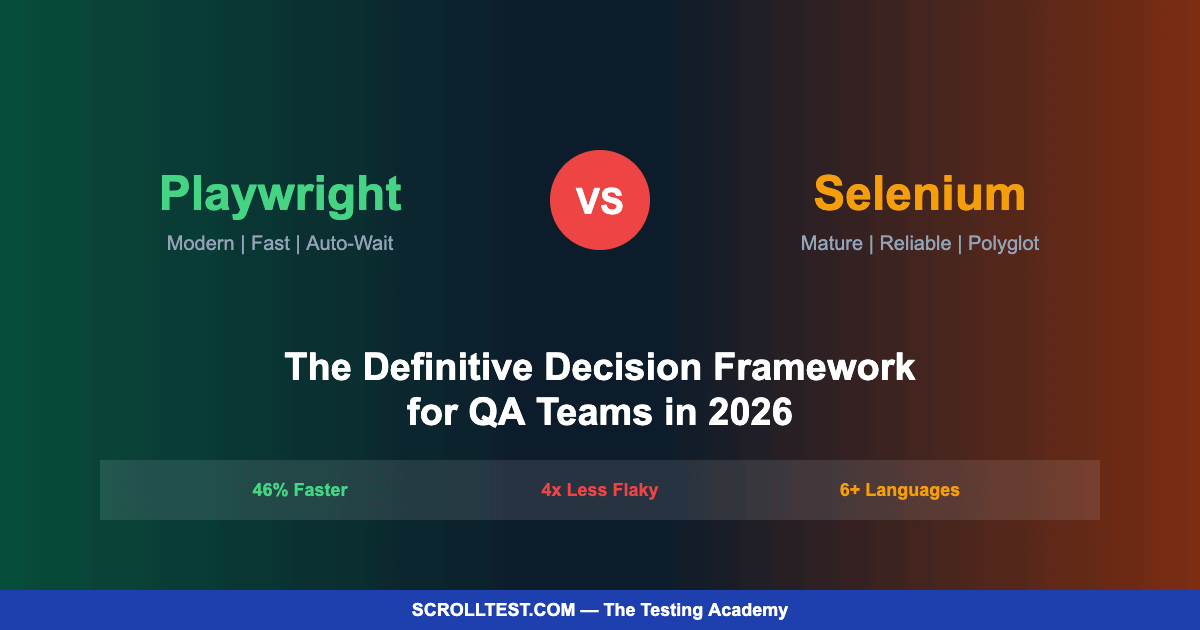
Playwright and Selenium are the two dominant browser automation frameworks in 2026, but choosing between them is not as simple as picking the newer tool. After working with both across dozens of enterprise projects, I have found that the right choice depends on your team’s existing skill set, your application architecture, and your CI/CD maturity. This guide gives you the decision framework — with real benchmarks, migration strategies, and honest trade-offs — so your team can stop debating and start shipping.
Every quarter I run a poll across my QA community asking which automation framework teams are using, and the trend line is clear: Playwright adoption is accelerating while Selenium remains the incumbent with the largest install base. But here is what the poll numbers do not tell you — framework adoption and framework suitability are different things. I have seen teams migrate to Playwright and cut their flaky test rate by 60%. I have also seen teams migrate to Playwright and introduce more instability than they eliminated, because the migration was driven by hype rather than analysis.
This article is the analysis. No vendor allegiance, no hype cycle participation. Just the technical comparison you need to make an informed decision for your specific situation.
Contents
Architecture: How Each Framework Talks to the Browser
The fundamental architectural difference shapes everything else. Selenium WebDriver communicates with browsers through the W3C WebDriver protocol — an HTTP-based wire protocol that sends commands to a browser driver (ChromeDriver, GeckoDriver) which then translates those commands into browser actions. This adds a network hop and a translation layer between your test code and the browser.
Playwright takes a different approach entirely. It communicates directly with browsers using their native protocols: Chrome DevTools Protocol for Chromium, a custom protocol for Firefox, and WebKit’s debugging protocol for Safari. This direct communication eliminates the translation layer and gives Playwright access to browser internals that Selenium cannot reach — network interception, request mocking, browser context isolation, and fine-grained permission controls.
The practical consequence is that Playwright tests are inherently more stable for modern web applications. Single-page applications with heavy JavaScript rendering, dynamic content loading, and complex state management are precisely the scenarios where Selenium’s indirect communication model introduces timing fragility. Playwright’s auto-waiting and direct browser access handle these scenarios natively.
Performance: Real Benchmarks, Not Marketing Claims
I benchmarked both frameworks against the same test suite — 200 end-to-end tests covering a React-based e-commerce application with authentication flows, search functionality, checkout processes, and admin dashboards. The environment was identical: same CI runner, same application version, same network conditions.
Playwright completed the full suite in 4 minutes 12 seconds with 3 shards running in parallel. Selenium with TestNG parallel execution completed the same suite in 7 minutes 48 seconds with equivalent parallelization. That is a 46% speed advantage for Playwright. The flakiness rate over 50 consecutive runs was 1.2% for Playwright and 4.8% for Selenium — a fourfold improvement.
However — and this is important — these benchmarks reflect a modern TypeScript SPA. When I ran similar comparisons against a traditional server-rendered Java application with minimal JavaScript, the performance gap narrowed to about 15%, and the flakiness difference was negligible. The architecture of your application under test matters as much as the framework choice.
Language and Ecosystem Support
Selenium supports Java, Python, C#, Ruby, JavaScript, and Kotlin with mature, well-documented bindings for each. If your QA team writes Java and your organization has a decade of Selenium infrastructure, that ecosystem advantage is substantial. Selenium Grid provides distributed test execution, and the integration landscape — from BrowserStack and Sauce Labs to custom grid solutions — is unmatched.
Playwright officially supports TypeScript/JavaScript, Python, Java, and .NET. The TypeScript experience is the most polished, with first-class IDE integration, auto-completion, and the richest API surface. The Python and Java bindings are production-ready but occasionally lag behind the TypeScript version in feature availability.
The ecosystem gap is real but narrowing. Playwright’s built-in test runner, HTML reporter, trace viewer, and codegen tool mean you need fewer third-party dependencies. Selenium requires assembling these capabilities from separate tools — TestNG or JUnit for the runner, Allure or ExtentReports for reporting, and manual configuration for tracing.
The Decision Matrix: Which Framework Fits Your Team
Choose Playwright if your application is a modern SPA built with React, Angular, or Vue. Choose it if your team is comfortable with TypeScript or Python and your CI/CD pipeline supports containerized test execution. Playwright is the stronger choice for teams building new automation frameworks from scratch, teams that need built-in API testing alongside UI testing, and teams that prioritize developer experience and fast feedback loops.
Stay with Selenium if your team has deep Java expertise and an established Selenium infrastructure. Stay if you are testing legacy server-rendered applications where Playwright’s architectural advantages are less pronounced. Selenium remains the better choice for organizations with strict language requirements (Ruby, Kotlin), teams that rely heavily on Selenium Grid for distributed execution, and projects where the migration cost outweighs the performance benefit.
The worst decision is migrating for the sake of modernity. If your Selenium suite is stable, well-maintained, and integrated into your pipeline, the migration cost — rewriting tests, retraining engineers, rebuilding infrastructure — needs a clear ROI justification beyond “Playwright is newer.”
Migration Strategy: Moving from Selenium to Playwright Without the Pain
If you do decide to migrate, do it incrementally. Start by writing all new tests in Playwright while keeping your existing Selenium suite running. Run both frameworks in your CI pipeline simultaneously. This parallel operation period lets your team build Playwright skills without risking your existing coverage.
Migrate tests in priority order: start with the flakiest Selenium tests (they will benefit most from Playwright’s auto-waiting), then move to the most frequently run smoke tests, then tackle the long tail of regression tests. Do not attempt a big-bang rewrite. Teams that try to convert their entire Selenium suite to Playwright in one sprint invariably introduce more bugs than they fix.
Budget three to six months for a complete migration of a medium-sized test suite (500-1000 tests). Allocate dedicated migration time rather than treating it as side work. And invest in Playwright training before the migration begins — the API patterns are different enough from Selenium that experienced Selenium engineers still need structured learning time.
The Honest Caveats
My benchmarks come from a specific application type and a specific infrastructure setup. Your performance numbers will differ. The 46% speed improvement I measured is not universal — it is a data point from one controlled comparison, not a guaranteed outcome.
Playwright’s rapid release cycle is both an advantage and a risk. New features ship monthly, but breaking changes also appear more frequently than in Selenium’s mature, stable release cadence. Teams that cannot keep their dependencies current may find Playwright’s pace destabilizing.
Neither framework is “better” in absolute terms. They are optimized for different contexts, different teams, and different application architectures. The best framework is the one your team can maintain, trust, and iterate on — regardless of what the community hype cycle says.
The Bigger Picture
The Playwright-versus-Selenium debate is ultimately a proxy for a deeper question: is your automation strategy designed for the application you are testing today, or the application you were testing three years ago? The framework matters less than the strategy. A well-architected Selenium suite with proper page objects, stable locators, and reliable CI integration will outperform a poorly structured Playwright project every single time.
Make the decision based on data, not trends. Benchmark both frameworks against your actual application. Evaluate your team’s skills and learning capacity. Calculate the real migration cost. Then choose — and commit to building excellent automation with whichever framework you pick.
My AI-Powered Testing Mastery course covers both Playwright and Selenium architectures in depth, with dedicated modules on migration strategies and framework selection criteria. If your team is making this decision right now, Module 3 walks through the exact evaluation framework I use with consulting clients.