LLM Testing Pipelines: DeepEval vs PromptFoo
LLM testing pipelines are now part of serious QA work. If your product ships prompts, RAG answers, support bots, AI agents, or test-generation copilots, you need a repeatable way to catch regressions before users do.
The question I hear from SDETs is simple: should we build the pipeline with DeepEval or PromptFoo? My answer is direct: choose PromptFoo when you need fast configuration-driven regression gates, choose DeepEval when you need Python-native metrics, datasets, and deeper model-quality tests.
Table of Contents
- Quick Verdict for QA Teams
- What DeepEval and PromptFoo Actually Do
- Current Data Points That Matter
- LLM Testing Pipelines: How I Design the Gate
- Where PromptFoo Wins
- Where DeepEval Wins
- CI Implementation With TypeScript and Python
- India Career Context for SDETs
- Decision Matrix and Migration Plan
- FAQ
Contents
Quick Verdict for QA Teams
Use PromptFoo when the risk is prompt regression
PromptFoo feels like a test runner for prompts. You define prompts, providers, test cases, assertions, and thresholds in config. Then you run the same checks locally and in CI.
That makes it strong for teams that already think in tables: input, expected behavior, assertion, pass or fail. If the product risk is a changed system prompt, a weaker refusal rule, a broken routing prompt, or a model upgrade that shifts output format, PromptFoo is usually the faster first gate.
- Best fit: prompt regression suites.
- Best user: QA engineer or developer who wants a CLI-first workflow.
- Best output: a readable matrix of prompts, providers, and assertions.
- Best starting point: a YAML file checked into the same repo as the product.
Use DeepEval when the risk is answer quality
DeepEval feels closer to a Python test framework for LLM systems. It gives you metrics, test cases, datasets, and integrations that fit naturally beside pytest-style automation.
That matters when your AI feature is more than a single prompt. RAG answer quality, faithfulness, contextual relevancy, hallucination checks, summarization quality, and agent task success often need richer evaluation logic than simple string or JSON assertions.
- Best fit: RAG evaluation and model-quality gates.
- Best user: SDET, ML engineer, or backend engineer comfortable in Python.
- Best output: metric scores with thresholds and test-case evidence.
- Best starting point: a small eval dataset and 5 to 10 metric checks.
The practical answer is not either-or
In my projects, I rarely treat this as a religious choice. PromptFoo catches prompt and provider drift early. DeepEval gives a stronger quality signal when the feature depends on retrieval, reasoning, and answer consistency.
The mistake is trying to build one giant evaluation suite on day one. Start with 20 high-risk examples, run them on every pull request, and store the failures like you store Playwright traces.
What DeepEval and PromptFoo Actually Do
PromptFoo in plain English
PromptFoo is an open-source tool for testing and evaluating LLM prompts. The official docs describe a workflow where you define prompts, providers, test cases, and assertions, then run evaluations from the CLI or CI. Source: PromptFoo introduction docs.
The core idea is familiar to QA teams: build a repeatable regression pack. A prompt becomes testable code. A model response becomes an artifact. A scoring rule becomes a gate.
PromptFoo can compare providers, run assertions, support red-team style checks, and produce reports. For teams already using Playwright or Cypress, this mental model is easy: a spec file checks behavior, and failed behavior blocks the merge.
DeepEval in plain English
DeepEval is an open-source LLM evaluation framework. The PyPI package summary calls it “The LLM Evaluation Framework”, and the official quickstart presents it as a way to write test cases and run metrics for LLM outputs. Source: DeepEval quickstart docs.
DeepEval is strongest when you want tests expressed in Python. You create an LLM test case, attach one or more metrics, set thresholds, and run the suite. That is close to how SDETs already think about API tests and service-level checks.
If your AI system has retrieval context, expected output, actual output, tools, and intermediate steps, Python becomes useful. You can load fixtures, query a test database, generate cases, and compare the result with custom rules.
Why this matters for SDETs
The biggest shift is ownership. QA teams cannot wait for a data-science team to bless every prompt change. If the bot is in production, QA needs a CI signal that says: this change breaks refund policy answers, this model update changes JSON shape, or this retrieval chunk creates a hallucination.
That is why I like framing this as AI quality engineering, not random prompt testing. The job is to convert ambiguous AI behavior into checked, versioned, reviewable evidence.
Current Data Points That Matter
GitHub activity gives a useful adoption signal
I checked the public GitHub API before writing this article. The promptfoo/promptfoo repository shows 23,671 stars and 2,128 forks, with the repository updated on 2026-07-28. The confident-ai/deepeval repository shows 17,211 stars and 1,732 forks, also updated on 2026-07-28.
Stars are not quality by themselves. They do show developer attention, community pull, and search demand. Both tools are active enough that a QA team can justify a proof of concept without betting on a dead project.
Package ecosystem tells you the operating style
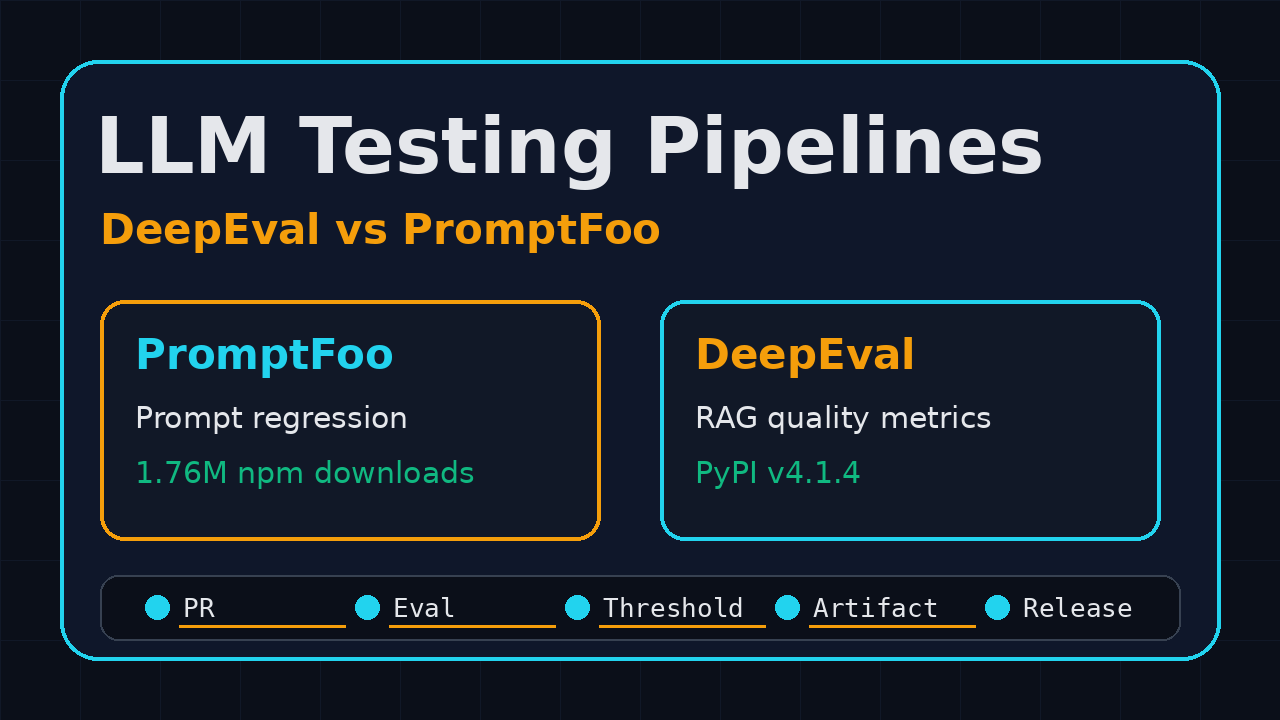
PromptFoo is distributed heavily through npm. The npm downloads API reported 1,765,105 downloads for the package promptfoo in the last-month window from 2026-06-25 to 2026-07-24. Source: npm downloads API for promptfoo.
DeepEval is Python-first. PyPI reports the current DeepEval package version as 4.1.4 at the time of this run. Source: PyPI JSON metadata for deepeval.
This split matters more than the headline numbers. If your app repo, test repo, and CI image are Node-heavy, PromptFoo is low-friction. If your evaluation data, RAG checks, and ML utilities already live in Python, DeepEval fits naturally.
Licensing and team adoption
The GitHub API lists PromptFoo under MIT and DeepEval under Apache-2.0. For most internal QA pipelines, both licenses are friendly. Your legal team still gets the final call, especially if you ship the tool inside a commercial product.
I care more about operational fit: who will maintain the tests after the first demo? A Node team with TypeScript automation may keep PromptFoo healthy. A Python SDET team with pytest habits may keep DeepEval healthy. The best tool is the one your team updates after sprint 3.
LLM Testing Pipelines: How I Design the Gate
Start with risk, not tool names
Most weak LLM testing pipelines fail because the team starts with a tool and then hunts for tests. I do the reverse. I list the product risks first.
- Output format breaks a downstream parser.
- The model ignores a safety or compliance instruction.
- RAG answers cite the wrong policy or stale context.
- The agent completes the wrong browser action.
- A model upgrade makes answers slower, longer, or less deterministic.
- A prompt edit fixes one flow but breaks another.
Once the risks are clear, tool selection becomes simple. PromptFoo covers the first, second, fifth, and sixth risks very quickly. DeepEval covers the third and parts of the fourth risk with stronger evaluation depth.
Use layers instead of one mega-suite
I prefer 3 layers for AI testing work:
- PR gate: 20 to 50 fast cases, strict assertions, low cost.
- Nightly eval: 100 to 500 cases, richer metrics, provider comparison.
- Release audit: curated cases from production failures, customer complaints, and support tickets.
PromptFoo is excellent for the PR gate because config is easy to review. DeepEval is excellent for the nightly eval because Python gives you more control over datasets, thresholds, and metrics.
Evidence must be reviewable
A failing AI eval that says “score 0.61” is not enough. The reviewer needs input, prompt version, model name, retrieval context, actual output, expected behavior, metric score, and the reason for failure.
This is where QA discipline beats tool hype. Store eval results as build artifacts. Link them from the pull request. Treat them like Playwright reports or API contract diffs. If you need a broader QA workflow, read this eval CI gate project.
Where PromptFoo Wins
Config-driven tests are easy to review
PromptFoo shines when a reviewer can open one YAML file and understand the change. That is a real advantage in product teams where prompts change often.
description: refund-policy-regression
prompts:
  - file://prompts/refund-policy.txt
providers:
  - openai:gpt-4.1-mini
  - anthropic:messages:claude-3-5-haiku-latest
tests:
  - vars:
      question: "Can I get a refund after 45 days?"
    assert:
      - type: contains
        value: "30 days"
      - type: not-contains
        value: "guaranteed refund"
  - vars:
      question: "Return my subscription in JSON"
    assert:
      - type: is-json
      - type: javascript
        value: output.plan !== undefined
This is readable. A product manager can review the intent. A QA engineer can add edge cases. A developer can run it in CI.
Provider comparison is a first-class habit
Modern AI teams switch models often. One sprint uses GPT-4.1-mini for cost. Another sprint tests Claude, Gemini, or a local model. PromptFoo makes provider comparison feel normal, not like a custom experiment.
That matters when the release manager asks, “What breaks if we change the model?” You can answer with a table instead of a guess.
Red-team checks fit security-minded QA
Prompt injection, jailbreak attempts, policy bypasses, and unsafe content are not only security problems. They are quality problems because users experience them as broken product behavior.
If your QA team owns pre-release checks for an AI assistant, PromptFoo gives you a direct way to add adversarial cases. Start with 10 known bad inputs from your domain, then add every production miss to the suite.
Where DeepEval Wins
Python metrics work better for RAG quality
RAG evaluation is rarely a simple contains check. You may need to compare the answer against retrieved context, check faithfulness, score relevancy, and fail when the model answers from memory instead of the document.
DeepEval fits this style because tests are code. You can load context, attach metrics, and tune thresholds in Python.
from deepeval import assert_test
from deepeval.test_case import LLMTestCase
from deepeval.metrics import AnswerRelevancyMetric, FaithfulnessMetric

def test_refund_answer_uses_policy_context():
    case = LLMTestCase(
        input="Can I get a refund after 45 days?",
        actual_output="Refunds are allowed only within 30 days of purchase.",
        retrieval_context=["Refund policy: customers may request refunds within 30 days."],
    )
    assert_test(case, [
        AnswerRelevancyMetric(threshold=0.7),
        FaithfulnessMetric(threshold=0.8),
    ])
This feels close to unit testing. That is powerful for teams that already use pytest, fixtures, and CI containers.
Datasets become reusable test assets
The best AI QA teams build datasets the same way traditional teams build regression suites. Every escaped defect becomes a new eval case. Every support complaint becomes a scenario. Every risky product policy gets examples.
DeepEval supports this mindset well because you can keep test cases in files, generate cases from fixtures, and run metrics programmatically. If your team is serious about DeepEval regression evidence for LLM QA, this is the direction I recommend.
Custom checks are easier in Python
Not every failure fits a built-in metric. You may need to check if an answer mentions the correct invoice ID, avoids a forbidden medical claim, or returns a remediation plan with exactly 3 steps.
Python makes custom checks straightforward. You can combine regex, JSON schema validation, database lookups, and metric scores in one test. That is harder to keep clean in pure config once the rules become domain-specific.
CI Implementation With TypeScript and Python
A PromptFoo GitHub Actions gate
GitHub Actions is the standard CI entry point for many teams, and the official docs cover workflow files and jobs. Source: GitHub Actions documentation.
Here is a simple PromptFoo gate you can adapt. Keep API keys in repository secrets. Do not print raw prompts containing customer data in logs.
name: llm-prompt-regression
on:
  pull_request:
    paths:
      - "prompts/**"
      - "promptfooconfig.yaml"
      - ".github/workflows/llm-prompt-regression.yml"
jobs:
  eval:
    runs-on: ubuntu-latest
    steps:
      - uses: actions/checkout@v4
      - uses: actions/setup-node@v4
        with:
          node-version: 22
      - run: npm install -g promptfoo
      - run: promptfoo eval --config promptfooconfig.yaml --no-progress-bar
        env:
          OPENAI_API_KEY: ${{ secrets.OPENAI_API_KEY }}
This gate is cheap and direct. If a prompt change breaks JSON shape or policy wording, the pull request fails before merge.
A DeepEval GitHub Actions gate
DeepEval fits a Python pipeline. I normally keep the test cases under evals/ and run them beside unit tests.
name: rag-quality-eval
on:
  pull_request:
    paths:
      - "app/rag/**"
      - "evals/**"
      - "requirements-eval.txt"
jobs:
  eval:
    runs-on: ubuntu-latest
    steps:
      - uses: actions/checkout@v4
      - uses: actions/setup-python@v5
        with:
          python-version: "3.11"
      - run: pip install -r requirements-eval.txt
      - run: deepeval test run evals/test_refund_policy.py
        env:
          OPENAI_API_KEY: ${{ secrets.OPENAI_API_KEY }}
The key is scope. Do not run 500 expensive examples on every pull request. Run the 20 cases that protect revenue, compliance, and user trust.
TypeScript wrapper for a product repo
If your main repo is TypeScript, you can wrap eval execution so developers use one command.
import { execa } from "execa";

type EvalMode = "prompt" | "rag";

async function runEval(mode: EvalMode) {
  const command = mode === "prompt"
    ? ["promptfoo", ["eval", "--config", "promptfooconfig.yaml"]]
    : ["python", ["-m", "deepeval", "test", "run", "evals"]];

  const [bin, args] = command as [string, string[]];
  const result = await execa(bin, args, { stdio: "inherit" });
  return result.exitCode;
}

runEval(process.argv[2] === "rag" ? "rag" : "prompt")
  .then(code => process.exit(code));
This is not fancy, and that is the point. QA pipelines survive when the command is boring: npm run eval:llm.
India Career Context for SDETs
Why this skill changes interview conversations
In India, many QA engineers still describe AI testing as “I used ChatGPT to write test cases.” That is not enough for 2026 interviews. Product companies want engineers who can control risk, not just generate scripts.
If you can explain LLM testing pipelines with PromptFoo, DeepEval, CI thresholds, datasets, and failure triage, you sound like an AI quality engineer. That is a different signal from manual QA plus prompt usage.
How I would position this in a resume
Use numbers. A weak bullet says, “Worked on AI testing.” A strong bullet says, “Built a 42-case LLM regression gate using PromptFoo and DeepEval, blocking 7 prompt regressions before release.” If the numbers are real, they make your resume credible.
For mid-level SDETs aiming at ₹25-40 LPA product roles, this is the kind of portfolio proof that helps. The Indian market has many automation resumes. It has far fewer resumes that show AI eval ownership with CI evidence.
A 7-day practice plan
- Day 1: Pick one AI feature, such as a refund-policy assistant.
- Day 2: Write 20 prompt regression cases in PromptFoo.
- Day 3: Add 5 JSON shape checks and 5 refusal checks.
- Day 4: Build a 10-case RAG dataset in CSV or JSON.
- Day 5: Add DeepEval relevancy and faithfulness checks.
- Day 6: Run both tools in GitHub Actions.
- Day 7: Publish a portfolio README with screenshots and failure examples.
If you want more structure, this ScrollTest guide on DeepEval for QA engineers is a good next read.
Decision Matrix and Migration Plan
Choose based on the system under test
| Situation | Better first choice | Reason |
|---|---|---|
| Prompt wording changes every sprint | PromptFoo | Config review is fast and visible. |
| RAG answers must match retrieved context | DeepEval | Python metrics handle richer context. |
| Team is Node and TypeScript-heavy | PromptFoo | CLI and npm workflow fit naturally. |
| Team is Python and pytest-heavy | DeepEval | Test code and fixtures stay simple. |
| Security prompt injection checks matter | PromptFoo first | Adversarial prompt suites are quick to start. |
| Custom domain scoring is required | DeepEval first | Python custom logic is easier to maintain. |
My recommended 30-day rollout
Do not announce a huge AI QA transformation. Ship a small gate, prove it catches regressions, and expand from there.
- Week 1: collect 20 risky examples from support tickets, product docs, and previous bugs.
- Week 2: create a PromptFoo suite for format, policy, and refusal checks.
- Week 3: create a DeepEval suite for RAG answer quality and faithfulness.
- Week 4: run both in CI, publish reports as artifacts, and add failures to release notes.
This plan is intentionally small. A working 30-case suite beats a 300-case spreadsheet that nobody runs.
Common mistakes I see
- Testing only happy-path prompts and calling it AI QA.
- Using one metric score without reading the failed output.
- Running expensive evals on every commit and then disabling the job.
- Forgetting to version prompts, datasets, and model names together.
- Mixing production user data into eval logs without redaction.
The fix is boring engineering: scoped cases, clear thresholds, clean artifacts, and regular review.
Conclusion: Build the Gate Before the AI Bug Escapes
LLM testing pipelines are not optional once AI behavior touches customers. PromptFoo and DeepEval solve different parts of the same QA problem, and the strongest teams use the right layer for the right risk.
- Use PromptFoo first for prompt regression, provider comparison, JSON shape checks, and quick CI gates.
- Use DeepEval first for RAG quality, faithfulness, relevancy, datasets, and Python-native metric checks.
- Start with 20 to 50 high-risk examples instead of a giant eval plan.
- Store eval reports as build artifacts so reviewers see the evidence.
- For SDETs in India, this is a strong portfolio skill because it proves AI quality ownership.
If I had to pick one starting point for most QA teams, I would begin with PromptFoo for the PR gate, then add DeepEval for nightly RAG quality checks. That gives fast feedback and deeper signal without slowing every merge.
FAQ
Is PromptFoo better than DeepEval?
PromptFoo is better for config-driven prompt regression and provider comparison. DeepEval is better for Python-native metrics, RAG quality, and custom evaluation logic. The better tool depends on the risk you need to catch.
Can I use both tools in the same LLM testing pipeline?
Yes. I recommend that pattern for serious teams. Use PromptFoo as a fast pull-request gate and DeepEval as a deeper nightly or release gate for retrieval and answer-quality checks.
How many eval cases should a QA team start with?
Start with 20 to 50 cases. Pick cases from production bugs, support tickets, policy rules, and high-value user journeys. Add more only after the first suite runs reliably in CI.
Do SDETs need Python for LLM evals?
Python helps when you use DeepEval or build custom metrics. TypeScript is enough for many PromptFoo workflows. A strong SDET should be comfortable running both if the product uses AI heavily.
What is the biggest mistake in LLM eval automation?
The biggest mistake is treating a model score as truth without reviewing the evidence. Always store the prompt, input, output, metric result, model name, and failure reason. QA needs traceability, not magic numbers.