AI Coding Agent Testing: A QA Sprint Plan
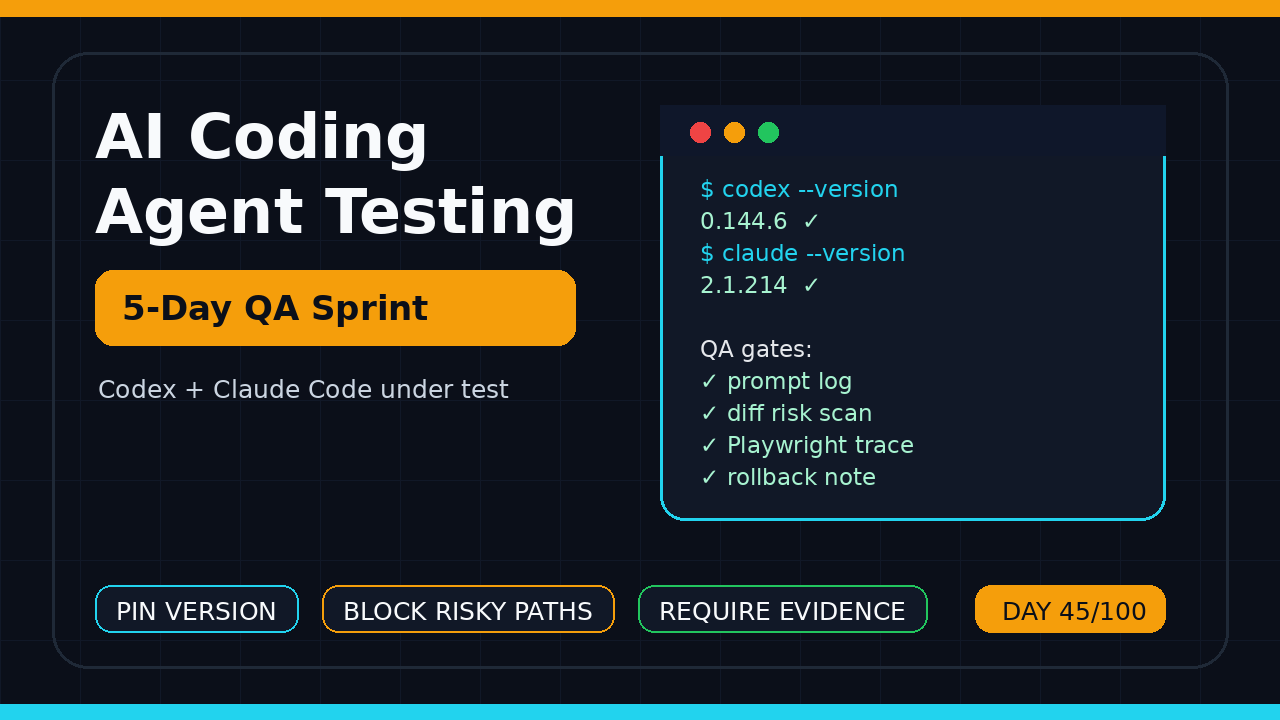
AI coding agent testing is becoming a real SDET responsibility because agent-written code now enters pull requests, test suites, and release branches. I do not treat Codex, Claude Code, or any coding agent as magic. I treat them as junior contributors that need a tight sprint, strong evidence, and boring release gates.
This Day 45 guide gives you a practical sprint plan for validating AI coding agents before your QA team depends on them. The goal is simple: measure what the agent changes, prove what still works, catch silent regressions, and teach testers how to review AI-generated code without becoming a bottleneck.
Table of Contents
- Why AI Coding Agent Testing Matters Now
- What Changed in Codex and Claude Code
- AI Coding Agent Testing Sprint Goals
- Risk Model for Agent-Written Code
- Hands-On Sprint Backlog
- Evidence Pack for Every Agent PR
- CI Gates and Playwright Checks
- India SDET Career Angle
- Key Takeaways
- FAQ
Contents
Why AI Coding Agent Testing Matters Now
I see many QA teams using AI coding tools in a casual way. A developer asks the agent to fix a flaky test. A tester asks it to generate selectors. A lead asks it to refactor a helper. The output looks clean, the diff looks small, and everyone moves fast. Then a hidden assumption breaks production-like flows two days later.
That is the real issue. The risk is not that an AI agent writes obviously bad code. The risk is that it writes code that looks reasonable, passes the nearest test, and weakens an edge case nobody reviewed. AI coding agent testing exists to catch that gap.
Agents are now part of the delivery chain
OpenAI’s Codex CLI and Anthropic’s Claude Code are not side toys for many engineers anymore. The npm registry API showed @openai/codex at version 0.145.0 on 21 July 2026, and @anthropic-ai/claude-code at version 2.1.218 on 22 July 2026 when I validated this post. The last-month npm API also reported more than 53 million downloads for @openai/codex and more than 44 million downloads for @anthropic-ai/claude-code for the 22 June to 21 July 2026 window.
Those numbers do not prove every download is a production developer. They do prove one thing: these tools are being pulled into real machines at serious volume. QA cannot wait until the agent has already changed 200 test files.
The testing surface is different
Traditional automation testing asks, “Does the product still work?” Agent testing asks an extra question: “Can I trust the contributor that changed the code?” That contributor may:
- Update selectors without understanding the product contract.
- Delete retries that were hiding real environment timing.
- Mock an API too aggressively and reduce test value.
- Change assertions to match current behavior instead of expected behavior.
- Create helpers that pass one scenario and fail under parallel execution.
This is why I want a sprint, not a random experiment. One week of focused validation gives the team a shared language: approved prompts, allowed tasks, review rules, evidence requirements, and CI gates.
What Changed in Codex and Claude Code
The current trigger for this sprint is simple. The queue topic points to OpenAI Codex rust-v0.144.6 and Claude Code v2.1.214. I validated both with primary package or release sources before writing.
Codex rust-v0.144.6 validation
The OpenAI Codex rust-v0.144.6 GitHub release was published on 18 July 2026. Its release note lists bug fixes around refreshed bundled instructions for GPT-5.6 model metadata and corrected context windows to 272,000 tokens.
For QA, the interesting part is not the model name. The interesting part is instruction metadata. If the tool’s bundled instructions or model metadata change, the same prompt can produce different planning behavior, context usage, or file-editing choices. That means agent upgrade testing should include prompt regression tests, not only binary install checks.
Claude Code v2.1.214 validation
The npm registry records @anthropic-ai/claude-code v2.1.214 on 18 July 2026. The package had newer versions by the time I wrote this, so I do not claim v2.1.214 is latest. I treat it as a pinned sprint baseline.
That distinction matters. In agent testing, “latest” is a moving target. A QA sprint needs a locked tool version, a known model setting, a fixed repo state, and a repeatable task set. Otherwise every failure becomes an argument about whether the code changed, the model changed, or the prompt changed.
What QA should record before any experiment
Before the first agent task, capture this baseline:
- Tool name and version, for example Codex 0.144.6 or Claude Code 2.1.214.
- Model name or profile if the tool exposes it.
- Repository commit SHA before the agent starts.
- Prompt text used for the task.
- Allowed files and blocked files.
- Test commands run before and after the edit.
- Human reviewer and final decision.
This looks boring. That is the point. Boring logs beat screenshots of a green terminal when a release manager asks what changed.
AI Coding Agent Testing Sprint Goals
A good AI coding agent testing sprint does not try to prove that one agent is “better” than another. That becomes a demo contest. I prefer a more practical goal: identify which tasks are safe enough for the team, which tasks need senior review, and which tasks are not allowed yet.
Goal 1: define safe task classes
Start with task classes instead of random tickets. A coding agent may be useful for one class and dangerous for another. I use four buckets:
- Green tasks: documentation updates, test data cleanup, duplicate helper removal, simple locator rename.
- Yellow tasks: Playwright spec generation, assertion strengthening, API mock cleanup, CI script updates.
- Red tasks: authentication changes, payment flows, data deletion logic, security-sensitive code.
- Research tasks: explain code ownership, map flows, propose refactors without committing changes.
Your first sprint should produce a task policy. It can be one page. It should tell every SDET what the agent can edit without approval and what requires a senior reviewer.
Goal 2: measure review cost
An AI agent is not useful if it saves 20 minutes of typing and adds 90 minutes of review anxiety. Measure review cost honestly. For every agent PR, log:
- Prompt time.
- Agent execution time.
- Human review time.
- Number of files touched.
- Number of reviewer comments.
- Number of test failures caused by the agent.
I like review minutes per changed file as a simple first metric. If agent-generated code needs 15 minutes per file while human code needs 5, the team has not found the right task type yet.
Goal 3: create a reusable evidence pack
The sprint should end with a template, not a vague conclusion. Every future agent PR should attach a short evidence pack. You can connect this with an existing ScrollTest pattern from AI Browser Agent Evidence Checklist for QA Teams, where the focus is not trust but proof.
Evidence is what separates professional QA from agent hype. If the agent touched a Playwright test, show the spec run. If it touched API mocks, show contract checks. If it touched helpers, show parallel execution. If it touched CI, show a pipeline run and rollback note.
Risk Model for Agent-Written Code
I use a small risk model because most teams overcomplicate this. Agent-written code has five common failure modes. If your sprint covers these five, you are already ahead of teams that only run unit tests.
Failure mode 1: prompt drift
Prompt drift happens when the agent solves a nearby problem instead of the real problem. Example: you ask it to reduce flakiness in checkout tests. It relaxes assertions, increases timeouts, and marks retries as acceptable. The suite becomes green, but the product signal becomes weaker.
Test prompt drift with a simple rubric:
- Did the agent preserve the original test intent?
- Did it remove or weaken assertions?
- Did it add sleeps instead of waiting for a product signal?
- Did it explain trade-offs in the final note?
Failure mode 2: context overreach
Coding agents can inspect multiple files and build a plan. That is useful, but it also creates overreach. A selector task suddenly edits a page object, a fixture, a helper, and a config file. The diff becomes hard to review.
Use file boundaries. Tell the agent exactly which files it can edit. If it needs another file, it must stop and ask through the PR comment or task note. In unattended runs, make this a hard rule: reject commits that modify blocked paths.
Failure mode 3: fake confidence
Agents often sound confident after partial validation. “All tests pass” may mean one local command passed. It may not include mobile viewport tests, API contract checks, cross-browser runs, or test data cleanup.
The fix is to require command output. I want the exact command, exit code, and a short log excerpt. No command means no claim.
Failure mode 4: dependency noise
Some agent tasks pull packages or change lockfiles to solve a small issue. That is expensive in enterprise repos. Lockfile changes affect security review, cache behavior, and reproducibility.
Add a rule: no new dependency without human approval. If a dependency changes, CI should label the PR and require an owner review.
Failure mode 5: test theater
Test theater is the worst one. The agent adds tests that assert implementation details, duplicate existing coverage, or check mocks instead of product behavior. It looks productive, but it bloats the suite.
Compare new tests against existing coverage. If the new test does not fail against the old bug, it is probably not valuable. This pairs well with the thinking in LLM Regression Testing for QA: regression tests need failure evidence, not just green runs.
Hands-On Sprint Backlog
Here is the sprint backlog I would run with a QA team. Keep it five working days. Do not turn this into a quarter-long governance project. The best output is a working policy and three repeatable checks.
Day 1: baseline the tools
Install the pinned tools on a clean branch. Record versions. Run your existing test suite before any agent edits. Pick a small repo area with enough test coverage but low product risk.
node --version
npm view @openai/codex version
npm view @anthropic-ai/claude-code version
git rev-parse HEAD
npm test -- --runInBand
npx playwright test --reporter=line
Do not skip the baseline run. If tests already fail, the agent sprint becomes noisy. Fix or quarantine known failures first.
Day 2: run controlled green tasks
Give each agent two low-risk tasks. Example tasks:
- Rename a Playwright locator helper without changing behavior.
- Add missing alt text checks to an existing accessibility spec.
- Generate a README section for running tests locally.
- Remove duplicate test data builders.
Each task should include a strict prompt. A good prompt says what to change, what not to change, which tests to run, and what evidence to return.
Day 3: test yellow tasks
Yellow tasks are where the sprint becomes useful. Ask the agent to strengthen a flaky test without increasing timeout values. Ask it to add an API contract assertion. Ask it to refactor a helper used by three specs.
This is where I expect failures. That is fine. The sprint is not a marketing demo. It is a safe place to learn what the agent should not touch yet.
Day 4: compare agents on the same tasks
Run Codex and Claude Code against the same task set on separate branches. Do not compare vibes. Compare numbers:
- Files changed.
- Lines added and removed.
- Tests passed before review.
- Reviewer comments.
- Rejected changes.
- Time to acceptable PR.
For ScrollTest readers who already test browser agents, the same discipline applies to agent coding workflows. The AI Browser Agent Testing checklist is a useful companion because it frames trust as observable behavior.
Day 5: publish the team policy
The sprint ends with a policy. Keep it short:
- Allowed agent tasks.
- Blocked agent tasks.
- Prompt template.
- Evidence pack template.
- CI gates.
- Reviewer rules.
- Rollback process.
If the policy is longer than three pages, nobody will read it. Put the rules in the pull request template where developers actually work.
Evidence Pack for Every Agent PR
Here is the minimum evidence pack I expect for agent-written code. Copy this into your PR template and tune it for your team.
## AI Agent Evidence Pack

Agent/tool:
Version:
Model/profile:
Prompt used:
Repo commit before edit:
Files allowed:
Files changed:

## Validation
- Unit tests:
- Playwright tests:
- API contract checks:
- Lint/typecheck:
- Manual review notes:

## Risk review
- Assertions weakened? yes/no
- New dependency? yes/no
- Lockfile changed? yes/no
- Blocked paths modified? yes/no
- Rollback plan:
Why this template works
It forces the author to separate generation from validation. The agent can generate code. The human and CI system validate code. That boundary is important for mature QA teams.
It also creates a dataset for later decisions. After 20 agent PRs, you can review patterns. Maybe Codex does better on repo-wide refactors. Maybe Claude Code produces cleaner test explanations. Maybe both fail on auth flows. You do not need opinions when you have evidence.
Store prompts like test assets
Prompts are now part of your engineering system. Store successful prompts in the repo. Version them. Review them like test utilities. If a prompt produces unsafe behavior twice, retire it.
A simple folder structure works:
/qa-agent-prompts
  playwright-selector-fix.md
  api-contract-assertion.md
  flaky-test-triage.md
  readme-test-setup.md
This gives manual testers and junior SDETs a safe starting point. They do not need to invent prompts under pressure.
CI Gates and Playwright Checks
Agent code should face stricter CI, not weaker CI. The reason is simple: the author is partly non-human, so the process needs better evidence.
Gate 1: blocked path detection
Create a small script that fails when an agent branch changes protected paths. This is basic, but it catches many accidental edits.
# scripts/check_agent_paths.py
import subprocess
import sys

blocked = [
    "src/auth/",
    "src/payments/",
    "infra/prod/",
    "package-lock.json",
]

changed = subprocess.check_output(
    ["git", "diff", "--name-only", "origin/main...HEAD"],
    text=True,
).splitlines()

violations = [p for p in changed if any(p.startswith(b) for b in blocked)]

if violations:
    print("Agent branch touched blocked paths:")
    for path in violations:
        print(f" - {path}")
    sys.exit(1)

print("Agent path check passed")
Gate 2: assertion weakening scan
This is not perfect, but it catches obvious mistakes. Scan diffs for removed assertions, increased timeouts, and skipped tests.
// scripts/agent-diff-smoke.ts
import { execSync } from "node:child_process";

const diff = execSync("git diff origin/main...HEAD", { encoding: "utf8" });
const riskyPatterns = [
  /test\.skip\(/,
  /expect\([^\n]+\)\.toBeTruthy\(\)/,
  /setTimeout\((?:[6-9]\d{4}|\d{6,})\)/,
  /timeout:\s*(?:[6-9]\d{4}|\d{6,})/,
];

const hits = riskyPatterns.filter((pattern) => pattern.test(diff));
if (hits.length) {
  console.error("Agent diff needs QA review. Risky patterns found:", hits.length);
  process.exit(1);
}

console.log("Agent diff smoke check passed");
Gate 3: focused Playwright run
If the agent changes browser tests, run the nearest specs and one related smoke path. Do not only run the edited file. A locator helper change can break sibling specs.
npx playwright test tests/checkout --project=chromium --reporter=line
npx playwright test tests/smoke --project=chromium --reporter=line
npx playwright show-report playwright-report
For deeper Playwright debugging practices, connect this sprint with Playwright Debugging TypeScript. Agent code becomes much safer when traces, videos, and network logs are part of normal review.
India SDET Career Angle
For Indian QA engineers, this skill is career capital. I see the market splitting into three groups: testers who only use AI chat, automation engineers who ask agents to write snippets, and SDETs who design safe AI-assisted delivery systems.
The third group will stand out in product companies and serious startups. TCS, Infosys, Wipro, and service-company projects may adopt strict rules slowly, but product teams move faster when a workflow cuts review time without cutting quality. If you can walk into an interview and explain an AI agent evidence pack, a CI risk gate, and a Playwright validation strategy, you sound different from someone who says, “I use ChatGPT for test cases.”
What to put in your portfolio
Create one public demo repo. Keep it clean. Show:
- A pinned agent version in the README.
- Three prompt templates for QA tasks.
- A sample agent PR with evidence pack.
- A path-blocking CI script.
- A Playwright trace from an agent-generated test.
- A short write-up on one rejected agent change.
How managers should roll this out
If you lead a QA team, do not announce a giant AI transformation. Pick two senior SDETs, two automation engineers, and one manual tester who is learning automation. Run the five-day sprint. Measure review cost. Publish a simple policy. Then scale to one more squad.
Key Takeaways
AI coding agent testing is now part of modern QA because agent-written code can change tests, helpers, mocks, CI, and product logic. Treat agents as contributors that need evidence.
- Validate tool versions before comparing agent behavior.
- Use a five-day sprint to define safe, risky, and blocked task classes.
- Require an evidence pack for every agent PR.
- Reject agent changes that weaken assertions or touch blocked paths.
- Measure review cost, not only generation speed.
- For SDETs in India, agent testing policy is a strong portfolio differentiator.
My simple rule: if an AI agent writes code, QA must test both the product behavior and the contributor behavior. Green tests are useful. Traceable evidence is better.
FAQ
What is AI coding agent testing?
AI coding agent testing is the practice of validating code changes made by tools such as Codex, Claude Code, Cursor agents, or similar coding assistants. It checks the changed product behavior, the prompt, the diff, the evidence, and the review process.
Should QA teams allow agents to edit test automation code?
Yes, but start with low-risk tasks. Documentation, selector cleanup, and small Playwright spec improvements are safer starting points. Auth, payments, security logic, and production infrastructure should stay blocked until the team has strong review gates.
How do I compare Codex and Claude Code fairly?
Use the same repo, same baseline commit, same task, same allowed files, and same validation commands. Compare files changed, tests passed, reviewer comments, rejected changes, and time to acceptable PR. Do not compare only the final explanation.
What is the biggest mistake in agent-written tests?
The biggest mistake is accepting tests that only make the suite green. Watch for weakened assertions, test.skip, oversized timeouts, excessive mocks, and tests that would not fail against the original bug.
Can manual testers learn from this sprint?
Yes. A controlled sprint is a practical bridge from manual QA to AI-assisted automation. Manual testers can review prompts, inspect evidence, run Playwright reports, and learn how code changes affect product risk.