AI Agent Testing Sprint: 7-Day QA Plan
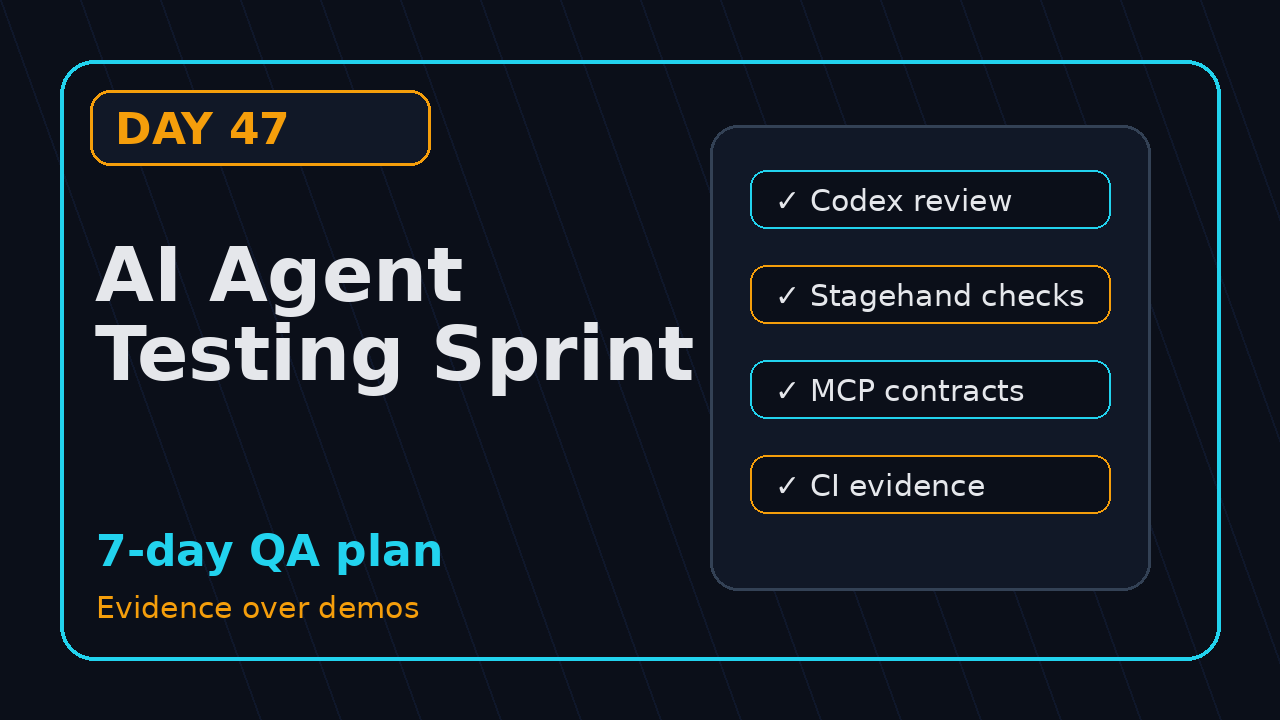
AI agent testing sprint is the missing operating model between “we tried an AI tool” and “we trust an AI-assisted QA workflow in production.” I see many QA teams demo Codex, Stagehand, MCP tools, or Playwright agents in isolation, but they rarely collect the evidence that a release manager needs before approving the workflow.
This Day 47 guide gives you a 7-day sprint that a QA lead, SDET, or ambitious manual tester can run without waiting for a platform rewrite. The goal is simple: prove where AI agents help, prove where they fail, and leave behind portfolio-ready artifacts that hiring managers can inspect.
Table of Contents
- Why an AI Agent Testing Sprint Beats Random Tool Experiments
- What This AI Agent Testing Sprint Should Prove
- The 7-Day AI Agent Testing Sprint Plan
- Codex Safety Reviews for Test Code
- Stagehand and Browser-Agent Checks
- MCP Contract Tests for Agent Tools
- Evidence, CI Gates, and Release Decisions
- Portfolio Artifacts for SDETs in India
- FAQ
Contents
Why an AI Agent Testing Sprint Beats Random Tool Experiments
Most AI testing experiments fail for a boring reason: nobody defines the decision before the tool demo starts. One engineer tries a browser agent on a login flow. Another asks a coding agent to write Playwright tests. A third person connects an MCP server to a local tool. Everyone sees something impressive, but nobody can answer the release question: What evidence says this is safe enough to use next week?
An AI agent testing sprint fixes that. It turns AI adoption into a bounded QA experiment with a scope, a baseline, a risk log, and exit criteria. Instead of asking, “Is this AI tool good?”, the sprint asks sharper questions:
- Can the agent generate useful tests from a stable product story?
- Can it run browser checks without hallucinating selectors?
- Can it explain failures with trace, screenshot, and network evidence?
- Can the team block unsafe agent actions in CI?
- Can a human reviewer reproduce the result without reading prompt history?
What changed for QA teams
Browser agents and coding agents are no longer side toys. OpenAI describes Codex as a “lightweight coding agent that runs in your terminal” on its official GitHub repository, and that repository showed 101,270 stars during this run. Browserbase describes Stagehand as “The SDK For Browser Agents” on the Stagehand GitHub repository, with 23,627 stars during this run. These numbers are not a quality guarantee, but they show serious developer attention.
For QA, attention is not enough. We need trace files, prompts, test diffs, failure taxonomy, and a rollback plan. I treat these tools like a junior automation engineer with super speed and weak judgment. That sounds harsh, but it is the right mental model. You can get useful output, but you still need review discipline.
The right sprint mindset
Do not start with a full regression suite. Start with one thin vertical slice: one critical user journey, one API dependency, one role, and one environment. A tight scope protects you from fake success. If an agent cannot handle a small flow with clean evidence, it will not magically succeed across 700 cases in a flaky staging environment.
What This AI Agent Testing Sprint Should Prove
The sprint is not about replacing testers. It is about proving which parts of the QA workflow deserve agent assistance. If you are a QA lead, your output should be a decision document. If you are an SDET, your output should be a working repository. If you are a manual tester transitioning into AI-enabled QA, your output should be a portfolio artifact that shows structured thinking.
Define success in evidence terms
Use measurable outcomes. “The AI helped” is not a result. “The agent generated 18 Playwright test candidates, 11 passed review, 4 needed selector fixes, 3 were rejected for wrong assertions” is a result. A sprint report should include the following evidence:
- Baseline manual or existing automation coverage for the selected flow.
- Agent-generated test cases and rejected test cases.
- Human review notes with reason codes.
- Execution report from Playwright or your current runner.
- Trace, screenshot, video, and network artifacts for failures.
- CI gate status and the exact rule that passed or failed.
- Recommendation: adopt, limit, retry later, or reject.
Pick a realistic target flow
Good candidates are stable enough to test but important enough to matter: login with MFA disabled in test, checkout with a mock payment provider, search filters, profile update, invoice download, or role-based access. Avoid highly visual experimentation in the first sprint unless your team already has visual baselines. Keep the scope boring. Boring scopes reveal whether the agent is useful.
If you need a browser-agent risk checklist before you choose the flow, use the ScrollTest guide on AI browser agent testing checks before trust. That post is a good companion because it separates demo quality from production readiness.
Score the agent like a QA reviewer
I use a five-column scorecard: correctness, reproducibility, safety, maintainability, and evidence quality. Give each column a score from 1 to 5. A tool can be fast and still fail because the evidence is weak. A generated test can pass and still be rejected because the assertion checks text that changes every deployment.
The 7-Day AI Agent Testing Sprint Plan
This is the sprint I would run with a team that already knows basic Playwright and wants to add AI agents without chaos. You can compress it into three days for a hackathon, but do not skip the review and evidence steps. That is where the learning happens.
Day 1: Baseline the target journey
Write down the target journey in plain English and automate the simplest happy path manually. If there is already automation, run it and capture the current failure rate. The baseline prevents the agent from taking credit for work the team already had.
- Choose one journey and one environment.
- Record preconditions, test data, and known flaky points.
- Run the current test suite or manual checklist.
- Save one clean Playwright trace as the reference artifact.
Day 2: Generate candidate tests with a coding agent
Use Codex or your preferred coding agent to generate candidate Playwright tests from the Day 1 notes. Keep the prompt small. Ask for a test file, not a framework rewrite. OpenAI’s Codex repository was updated on 2026-07-25 during this run, which is a useful reminder that these tools move fast. Your sprint needs reproducible prompts and pinned dependency versions.
Prompt:
You are assisting an SDET. Generate Playwright TypeScript tests for the checkout happy path.
Rules:
- Use getByRole and getByTestId when possible.
- Do not invent test data. Use the data block below.
- Add comments for assumptions.
- Return only one spec file.

Data:
- user: qa.checkout@example.com
- product: QA Sprint Hoodie
- payment provider: mock-card-success
Review the generated tests manually. Do not merge them yet. Mark each test as accepted, fixed, or rejected. The rejection reasons matter more than the accepted count because they tell you where the agent misunderstands the product.
Day 3: Run browser-agent exploration
Use a browser-agent SDK such as Stagehand to explore the same flow. Stagehand’s official repository calls it an SDK for browser agents, and it was updated on 2026-07-25 during this run. Treat its output as exploration, not final regression coverage. The best result is not a pretty demo. The best result is a list of observations a human tester can verify.
For a deeper ScrollTest example, read the Stagehand browser-agent trust report. The key lesson is the same: an agent should produce evidence, not just narration.
Day 4: Add MCP tool boundaries
The Model Context Protocol specification lives at modelcontextprotocol.io and describes a standard way for applications to provide context and tools to language models. In QA terms, MCP is powerful because agents can call tools. It is also risky because tools can read files, query systems, or trigger actions if you expose them carelessly.
On Day 4, define allowed and blocked tool actions. The sprint should test whether the agent respects those boundaries. If your agent can call a “create bug” tool, a “delete test data” tool, or a “run deployment” tool, put that behind explicit approval in the experiment.
Day 5: Convert results into CI evidence
Wire the accepted tests into CI with clear gates. The gate should not say “AI passed.” The gate should say something concrete: all accepted tests pass, no unreviewed generated tests are included, trace artifacts are uploaded on failure, and the scorecard file exists.
Day 6: Run a red-team review
Ask one engineer who did not build the experiment to break it. Give them 45 minutes. Their job is to find false positives, fake assertions, missing cleanup, unsafe tool access, and unclear evidence. This is where teams often discover that the AI-generated test checked that a button exists, not that the business outcome happened.
Day 7: Write the decision memo
Finish with a one-page memo. Do not produce a 40-slide deck. The memo should say what you tested, what worked, what failed, what is safe to adopt, and what needs another sprint. If the result is “not ready,” that is still a win. You saved the team from scaling a weak workflow.
Codex Safety Reviews for Test Code
In an AI agent testing sprint, coding agents are useful for speed, but the review bar must stay high. I never accept generated test code just because it compiles. I check selectors, assertions, cleanup, data isolation, and whether the test proves the user outcome.
Review generated diffs like production code
Use a checklist before merging any agent output:
- Does the test assert a business result, not only a UI element?
- Are selectors stable and readable?
- Is test data created and cleaned safely?
- Can the test run in parallel?
- Does the failure message help the next engineer?
- Did the agent add hidden waits, sleeps, or broad timeouts?
This review style is familiar to good SDETs. The difference is volume. A coding agent can generate more code in 10 minutes than a junior engineer writes in a day. That makes review discipline more important, not less.
A practical Playwright review helper
Here is a small TypeScript pattern I use to force generated tests to attach evidence. It is not a full framework. It is a guardrail.
import { test, expect } from '@playwright/test';

test('checkout happy path records evidence', async ({ page }, testInfo) => {
  await page.goto('/shop');
  await page.getByRole('link', { name: /QA Sprint Hoodie/i }).click();
  await page.getByRole('button', { name: /Add to cart/i }).click();
  await page.getByRole('link', { name: /Checkout/i }).click();

  await test.step('complete mock payment', async () => {
    await page.getByTestId('mock-card-success').click();
    await page.getByRole('button', { name: /Place order/i }).click();
  });

  const orderId = page.getByTestId('order-id');
  await expect(orderId).toBeVisible();
  await expect(page.getByText(/payment successful/i)).toBeVisible();

  await testInfo.attach('checkout-url', {
    body: page.url(),
    contentType: 'text/plain'
  });
});
When an agent produces a test, ask it to explain which assertion proves the business outcome. If the answer is vague, reject the test. This one question catches many weak generated tests.
Stagehand and Browser-Agent Checks
Browser agents are strong at exploration and weak at silent assumptions. They can click through a flow, summarize a page, and propose coverage ideas. They can also misunderstand a modal, miss a disabled state, or keep going after a hidden failure. That is why I separate exploration artifacts from regression artifacts.
Use browser agents for discovery first
Give the agent one task: explore the target journey and produce observations. Do not ask it to validate everything in one prompt. A clean prompt looks like this:
Explore the checkout flow as a QA analyst.
Return:
1. Step-by-step path followed.
2. Data entered.
3. Assertions a deterministic test should check.
4. Screenshots or trace references.
5. Any uncertainty or blocked step.
Do not mark the flow as passed unless confirmation is visible.
The “uncertainty” line is important. Agents often sound confident. Good QA prompts force them to report doubt. If the agent cannot identify uncertainty, I do not trust its pass/fail status.
Turn observations into deterministic tests
After exploration, convert only the useful observations into Playwright tests. Keep the agent out of final release judgment until the deterministic tests pass. This hybrid flow is practical: humans define risk, agents explore quickly, Playwright verifies repeatably, and CI stores evidence.
MCP Contract Tests for Agent Tools
MCP makes agent workflows more useful because the model can work with tools and context. For QA teams, the testing question is not “Can the agent call a tool?” The question is “Can we prove the tool behaves within a contract when the agent calls it?”
Define tool contracts
Write a small contract for each exposed tool. The contract should include input schema, allowed environment, side effects, approval requirement, and expected evidence. For example, a “create_test_case” tool can write to a test management system in staging, but a “delete_customer_data” tool should be blocked or mocked in the sprint.
{
  "tool": "create_bug_draft",
  "allowed_environment": "staging",
  "side_effect": "creates draft only",
  "requires_human_approval": true,
  "evidence_required": ["screenshot", "network-log", "steps-to-reproduce"],
  "blocked_fields": ["customer_email", "payment_token"]
}
Test bad prompts, not only happy prompts
A useful MCP contract test includes negative prompts. Ask the agent to do something outside the allowed scope and confirm the tool refuses. This is similar to API negative testing, but the caller is a model instead of a human client.
If your team already works on LLM evaluation, connect this sprint with an eval gate. The ScrollTest article on building an AI QA portfolio eval CI gate shows how to convert fuzzy model behavior into repeatable checks.
Evidence, CI Gates, and Release Decisions
The sprint should end in a release decision. Not a feeling. Not a Slack thread. A release decision based on evidence. This is where QA leadership earns trust with engineering managers.
Build the evidence folder
Use a predictable folder structure in your repository:
ai-agent-sprint/
  prompts/
    day-2-codex-checkout.md
    day-3-browser-agent-exploration.md
  generated-tests/
    checkout.generated.spec.ts
  accepted-tests/
    checkout.spec.ts
  reviews/
    review-scorecard.md
    rejection-reasons.csv
  evidence/
    playwright-report/
    traces/
    screenshots/
  decision-memo.md
This folder is simple, but it changes the conversation. Instead of arguing whether AI is useful, the team reviews artifacts. Managers like this because it is auditable. Engineers like it because it does not hide risk behind a demo.
Suggested CI gate
Your first CI gate can be basic:
name: ai-agent-sprint
on: [pull_request]

jobs:
  evidence-gate:
    runs-on: ubuntu-latest
    steps:
      - uses: actions/checkout@v4
      - uses: actions/setup-node@v4
        with:
          node-version: 22
      - run: npm ci
      - run: npx playwright install --with-deps
      - run: npx playwright test tests/accepted-tests
      - run: test -f ai-agent-sprint/reviews/review-scorecard.md
      - run: test -f ai-agent-sprint/decision-memo.md
Portfolio Artifacts for SDETs in India
For Indian QA engineers, this sprint is more than a team experiment. It can become a strong portfolio project. Hiring managers are tired of resumes that say “AI tools” with no proof. A GitHub repository with prompts, tests, traces, rejected cases, and a decision memo is different.
What to show in interviews
If you are targeting SDET roles in product companies, show how you think about risk. The salary gap between service-company automation roles and stronger product SDET roles often comes from ownership, not tool names. A candidate who can explain agent safety, deterministic verification, CI evidence, and MCP tool boundaries sounds more senior than someone who only says “I used ChatGPT to write tests.”
Use this portfolio structure:
- README with the sprint goal and selected flow.
- One short video or GIF showing the flow.
- Accepted Playwright tests with trace evidence.
- Rejected agent output with reasons.
- MCP tool contract examples.
- CI screenshot showing the evidence gate.
- Decision memo with adopt/limit/reject recommendation.
How I would pitch it
In an interview, I would say: “I ran a 7-day AI agent testing sprint on a checkout flow. The agent generated candidate tests, but I accepted only the tests that proved a business outcome. I added MCP contract checks for tool safety and wired accepted tests into CI with trace evidence.” That is specific. It shows judgment.
If you want a broader skill path, pair this sprint with the AI Quality Engineer roadmap for PromptFoo and DeepEval. The roadmap helps you connect browser automation, LLM evaluation, and release gates into one career story.
FAQ
Is an AI agent testing sprint useful for manual testers?
Yes, if you focus on evidence and risk instead of coding tricks. Manual testers can define flows, identify edge cases, review generated tests, and write decision memos. Add basic Playwright later, but do not wait to learn agent review skills.
Should I use Codex, Stagehand, or Playwright first?
Use Playwright as the deterministic base. Use Codex for candidate test generation and refactoring. Use Stagehand or another browser agent for exploration. Do not let an agent become the only source of truth for pass/fail decisions.
How do I stop agents from taking unsafe actions?
Limit tools, mock risky actions, require approval for side effects, and write MCP-style tool contracts. Test blocked actions deliberately. If the agent can create or delete real data without a gate, the sprint is not ready for production use.
What is the minimum output after seven days?
You need a working test or a clear rejection, a prompt log, a review scorecard, CI evidence, and a decision memo. If you have only a demo video, you have not completed the sprint.
Key Takeaways
- An AI agent testing sprint turns AI QA experiments into auditable evidence.
- Use agents for generation and exploration, but keep deterministic Playwright tests as the release gate.
- Review generated code for business assertions, selectors, cleanup, and parallel safety.
- MCP tool contracts matter because agent tool access creates real side-effect risk.
- For SDETs in India, a sprint repository with prompts, traces, and a decision memo is a stronger portfolio signal than generic “AI testing” claims.