PromptFoo Release Gate Playbook for QA Teams
I see QA teams add LLM features to releases, then treat prompt changes like copy edits. A PromptFoo release gate fixes that mistake: every prompt, model, provider, and scorer change gets a repeatable check before it reaches users.
This playbook turns the PromptFoo 0.121.19 release into a practical QA workflow. You will get a dataset structure, assertion strategy, CI gate, owner sign-off template, and rollback rule that an SDET can run this week.
Table of Contents
- Why a PromptFoo Release Gate Matters Now
- What Changed in PromptFoo 0.121.19
- PromptFoo Release Gate Architecture
- Dataset Design for QA Teams
- Scorers, Assertions, and Thresholds
- PromptFoo Release Gate CI/CD Implementation
- Triage, Ownership, and Evidence
- India SDET Career Context
- Common Failures I Watch For
- Key Takeaways and FAQ
Contents
Why a PromptFoo Release Gate Matters Now
A prompt change can break production while every unit test stays green. The UI loads, the API returns 200, and the response schema still validates. The failure hides in meaning: unsafe advice, missing context, hallucinated policy, bad routing, or a tool call that looks valid but uses the wrong argument.
That is why a PromptFoo release gate belongs in the QA checklist for LLM applications. It gives teams a controlled way to compare prompt versions, model versions, retrieval inputs, and safety rules before merge. I do not want testers to approve an AI feature because the demo looked fine once. I want evidence across realistic cases.
LLM releases create a different kind of regression
Classic regression testing asks, “Did the product still do what it did before?” LLM regression adds another question: “Did the product still answer within the boundary we promised?” That boundary includes factuality, tone, refusal behavior, tool-use correctness, latency, and cost.
PromptFoo’s own documentation describes it as an open-source CLI and library for evaluating and red-teaming LLM apps, with matrix views across prompts and inputs. That matters because QA needs comparison, not one-off screenshots. Source: PromptFoo introduction documentation.
The market signal is clear
PromptFoo is no longer a niche utility for a few prompt engineers. The GitHub API listed promptfoo/promptfoo at 23,545 stars when I researched this article, and the npm downloads API reported 1,714,192 downloads in the last month for the promptfoo package. I treat those numbers as a signal that teams are standardizing AI evaluation in normal delivery pipelines.
ScrollTest has already covered the broader comparison in PromptFoo vs DeepEval: QA Guide for LLM Tests and the evidence mindset in AI Testing Evidence: Stop Trusting Green Checks. This article goes narrower: how to make PromptFoo a release gate, not just a local experiment.
My simple rule
If a model output can influence a user decision, a support answer, a payment path, a compliance message, or an automated tool action, it needs a release gate. Manual spot checks are still useful, but they should sit on top of a repeatable baseline. The gate gives the team a shared language for risk.
- Product owners define unacceptable outcomes.
- QA owns datasets, assertions, and evidence quality.
- Developers wire the gate into CI and fix regressions.
- Security reviews red-team cases and abuse paths.
What Changed in PromptFoo 0.121.19
The PromptFoo 0.121.19 release shipped on July 14, 2026 according to the GitHub release metadata. The release notes include provider additions, token-usage work, red-team changes, and assertion bug fixes. Source: PromptFoo 0.121.19 release notes.
Provider changes expand the test matrix
The release notes mention support for Bedrock GPT-5.6 frontier, GPT-5.6 GA, Meta Model API, Open Interpreter, and xAI Grok 4.5. For QA, that is not just a feature list. It means the same business prompt may now run against more providers, more response styles, and more failure modes.
When a product team says, “We only changed the provider,” I hear, “We changed the behavior surface.” Provider changes can affect tool-call format, refusal patterns, cost, latency, and how the model handles edge cases. Your release gate should make those differences visible before the merge button is clicked.
Token usage became easier to track
The release notes include token-usage helpers and optional token-usage fields on public types and schemas. That is useful for QA because cost and latency are part of quality for AI systems. A response can be correct and still fail the release if it doubles token usage for a high-volume path.
I like to treat token usage as a non-functional test signal. Add it to your report next to pass rate, refusal rate, and critical failures. When the new prompt adds long reasoning to every answer, the gate should catch it.
Assertion fixes are release-gate fixes
One bug fix in 0.121.19 allows numeric 0 as a contains or icontains value. Another returns pass:false for tool calls missing a function object. These sound small until they hit a test suite. If your eval uses zero as a valid expected value, or if your agent relies on function calls, those details decide whether the gate catches a real defect.
This is why QA teams should read AI testing tool release notes like they read Selenium, Playwright, Cypress, or Appium release notes. A scoring bug can hide a product regression. A provider update can create a new blind spot. ScrollTest’s AI Eval Release Watch for QA Teams is a useful companion workflow for that reason.
PromptFoo Release Gate Architecture
A PromptFoo release gate should be small enough to run on every pull request and serious enough to block bad changes. I prefer a two-layer design: a fast PR gate and a deeper nightly gate. The PR gate protects the main branch. The nightly gate searches for drift, cost creep, and wider model behavior changes.
Layer 1: Pull request gate
The PR gate should run a stable set of 40 to 100 cases. These are not random prompts copied from chat logs. They are curated examples linked to product risk. The gate should finish quickly, produce a clear report, and fail for defects that the team agreed are release blockers.
Use this PR gate when the pull request changes:
- System prompts or prompt templates
- RAG retrieval logic or chunking
- Model names, provider configuration, or temperature
- Tool schemas and function-calling code
- Safety rules, refusal policies, or guardrails
- Eval datasets, assertions, or scorers
Layer 2: Nightly regression gate
The nightly gate can run a bigger matrix. I usually split it by product flow: support bot, test-case generator, bug triage assistant, release-note summarizer, and browser agent. It can compare the current main branch against the last known good baseline and send a report to Slack, Teams, or a release dashboard.
This layer is where you add broad paraphrases, adversarial variants, longer RAG contexts, and provider comparison. It is also where you detect slow quality erosion. One failed PR is obvious. A two-week pattern of lower factuality needs a trend report.
Layer 3: Human sign-off
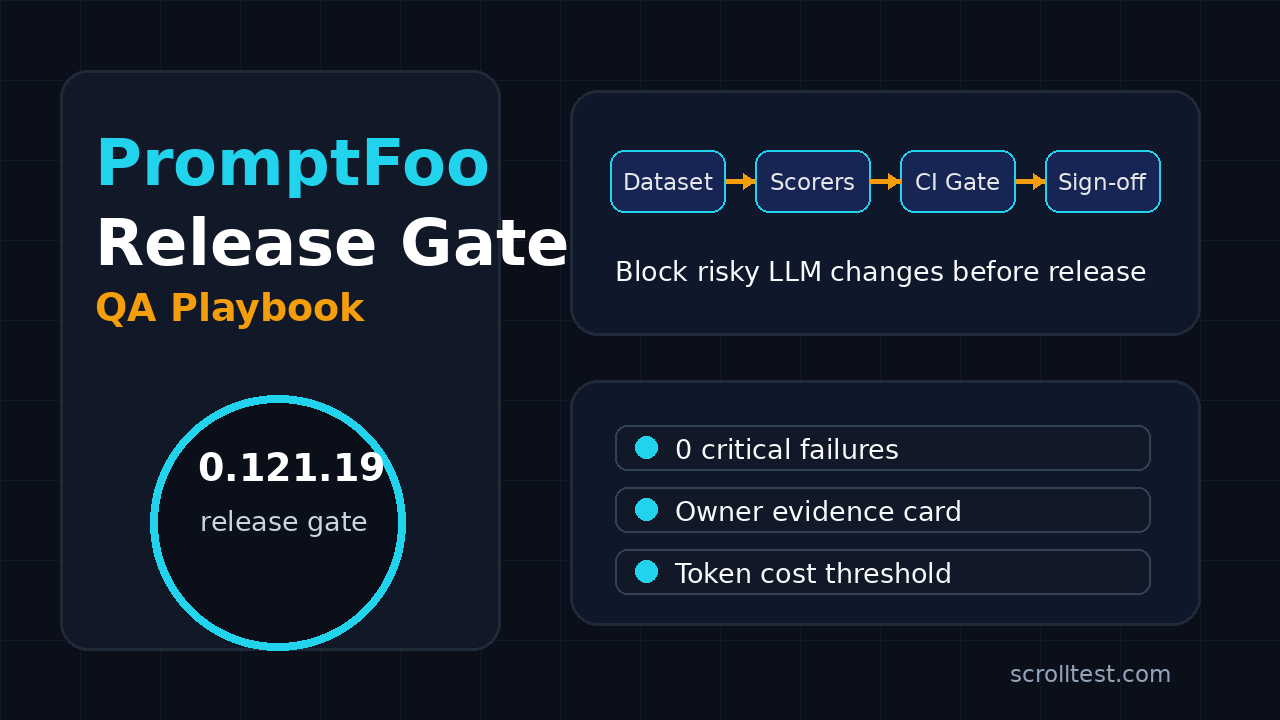
The gate should not replace judgment. It should reduce guesswork. The final release card should show what changed, what was tested, what failed, who accepted the risk, and where the evidence lives. If nobody wants to sign the card, the gate is doing its job.
- Developer opens a prompt or model change.
- PromptFoo PR gate runs the critical dataset.
- Failures are triaged by severity and owner.
- Release owner reviews evidence and risk notes.
- Only then does the change move to staging or production.
Dataset Design for QA Teams
The dataset is the heart of the release gate. Weak datasets create fake confidence. Strong datasets turn product risk into executable checks. I want QA engineers to own this part because testers are trained to think in edge cases, user intent, and failure modes.
Start from product risk, not prompt examples
Do not begin by asking the team for “some prompts.” Begin with risk buckets. What could hurt the user, the company, or the workflow if the AI answer is wrong? Then write cases that represent those risks.
For a QA assistant that generates test cases, I would start with these buckets:
- Missing coverage: ignores negative, boundary, or accessibility cases.
- Wrong domain assumption: invents fields that do not exist.
- Unsafe automation: suggests deleting data in a shared environment.
- Bad prioritization: treats a cosmetic issue as critical and a payment bug as minor.
- Tool misuse: calls the wrong API or omits required arguments.
Create a dataset schema QA can review
A dataset row should explain intent, not just input and expected output. I use fields like id, risk, user_input, context, expected_behavior, forbidden_behavior, severity, owner, and source. The source can be a requirement, bug, support ticket, production incident, or product decision.
tests:
  - vars:
      case_id: QA-GEN-001
      risk: missing-boundary-coverage
      user_input: "Generate tests for checkout discount validation"
      context: "Discount percentage must be between 0 and 50"
      expected_behavior: "Includes valid, min, max, over-max, negative, and decimal cases"
      forbidden_behavior: "Claims discounts above 50 are valid"
      severity: critical
    assert:
      - type: contains
        value: "50"
      - type: icontains
        value: "negative"
      - type: not-contains
        value: "above 50 is valid"
This structure makes reviews easier. A product owner can read the row and understand why it exists. A developer can reproduce it. A tester can add variants without rewriting the whole suite.
Keep the dataset small but sharp
More cases do not automatically mean better coverage. I prefer a small high-signal gate that everyone respects over a huge suite that fails randomly and gets ignored. Start with 50 cases and grow only when a new risk appears.
Use this split for the first version:
- 20 happy-path cases for core value
- 15 edge cases for boundaries and missing context
- 10 safety or refusal cases
- 5 tool-call or structured-output cases
Scorers, Assertions, and Thresholds
Assertions decide whether the gate means anything. A brittle assertion creates noise. A vague assertion lets bad answers pass. The trick is to mix deterministic checks with semantic scoring where it adds value.
Use deterministic checks for non-negotiables
If the output must include a policy number, reject unsafe advice, return JSON, or call a specific tool, use deterministic assertions. Do not ask an LLM judge to decide if required JSON exists. Parse it. Validate it. Fail fast.
assert:
  - type: is-json
  - type: javascript
    value: |
      const data = JSON.parse(output);
      return data.priority === 'P1' && Array.isArray(data.testCases);
  - type: not-icontains
    value: "delete production data"
PromptFoo documentation covers assertions and expected outputs as part of eval configuration. Source: PromptFoo expected outputs documentation.
Use semantic scorers for judgment-heavy outputs
Some answers need judgment. A test plan can be correct without using exact phrases. A bug summary can be useful without matching a golden sentence. For those cases, use rubric-based scoring and review the rubric like production code.
A good rubric should be specific:
- Does the answer mention critical user flow risk?
- Does it separate functional, API, accessibility, and data checks?
- Does it avoid unsupported claims?
- Does it ask for missing context instead of inventing details?
Set thresholds by severity
Do not use one pass-rate threshold for every case. A critical safety case should block the release on one failure. A low-severity tone issue can create a warning. Your gate should encode that difference.
# Example policy outside promptfoo config
release_policy:
  critical: "0 failures allowed"
  high: "at least 98% pass rate"
  medium: "at least 95% pass rate"
  low: "warn only unless repeated for 3 runs"
  cost: "fail if median token usage increases by more than 25%"
The 25% cost threshold is not universal. It is a starting point I use when the team has no history. After four weeks, replace it with your own baseline.
PromptFoo Release Gate CI/CD Implementation
A release gate only works if it runs where engineering decisions happen. Local evals are useful during development, but CI makes the result visible and enforceable. PromptFoo documentation includes CI/CD usage guidance, and the key principle is simple: run the eval command in the pipeline, publish the artifact, and fail the job when the policy fails.
Minimal PromptFoo configuration
Here is a small example for a QA assistant. It compares a local app endpoint with a stable baseline prompt and checks basic behavior. Replace the provider and prompts with your stack.
description: "QA assistant release gate"

prompts:
  - file://prompts/qa-assistant-system.txt

providers:
  - id: openai:gpt-5.6
    config:
      temperature: 0.2
  - id: openai:gpt-5.6
    label: baseline
    config:
      temperature: 0.2

tests:
  - file://evals/critical-qa-cases.yaml

outputPath: reports/promptfoo-release-gate.html
Keep configuration readable. If the eval file becomes a maze, the team will stop reviewing it. Split datasets by risk or feature area and keep the gate entry point short.
GitHub Actions example
This example installs PromptFoo, runs the gate, uploads the report, and fails the build when PromptFoo exits with a non-zero status. Use secrets for provider keys. Never put keys in the repository.
name: promptfoo-release-gate

on:
  pull_request:
    paths:
      - "prompts/**"
      - "evals/**"
      - "src/ai/**"
      - ".github/workflows/promptfoo-release-gate.yml"

jobs:
  eval:
    runs-on: ubuntu-latest
    steps:
      - uses: actions/checkout@v4
      - uses: actions/setup-node@v4
        with:
          node-version: 22
      - name: Install PromptFoo
        run: npm install -g promptfoo
      - name: Run PromptFoo release gate
        env:
          OPENAI_API_KEY: ${{ secrets.OPENAI_API_KEY }}
        run: promptfoo eval -c promptfooconfig.yaml --output reports/promptfoo-release-gate.html
      - name: Upload eval report
        if: always()
        uses: actions/upload-artifact@v4
        with:
          name: promptfoo-release-gate-report
          path: reports/promptfoo-release-gate.html
Make the pipeline explain failures
A red pipeline with no context wastes time. The CI summary should show failed case id, risk bucket, severity, prompt version, provider, score, and link to the full report. If the report is hard to read, developers will bypass the gate under schedule pressure.
I also add one human sentence to each failure: “Why this blocks release.” That sentence often comes from the dataset row. It turns a scoring result into a product risk statement.
Triage, Ownership, and Evidence
The release gate should create accountability, not a wall of red text. Every failure needs an owner. Every accepted risk needs a reason. Every fix needs a rerun. This is where QA leadership matters.
Use four triage buckets
I use four buckets because they keep the conversation practical:
- Product bug: The AI output violates expected behavior.
- Dataset gap: The test is valid, but coverage needs expansion.
- Scorer issue: The assertion is wrong, too strict, or too weak.
- Provider drift: The behavior changed after a model or provider update.
This connects well with ScrollTest’s AI Test Failure Classification: 4 Buckets for QA. The point is to avoid vague labels like “AI failed.” That label teaches nobody anything.
Evidence card template
Create one release card per prompt or model change. Store it in your release tool, GitHub issue, Jira ticket, or ScrollTest-style evidence board. The card should be boring and complete.
## PromptFoo Release Gate Evidence
Change: Checkout QA assistant prompt v17
Pull request: #1842
PromptFoo version: 0.121.19
Dataset version: critical-qa-cases-2026-07-24
Providers tested: GPT-5.6 GA, baseline GPT-5.6
Critical failures: 0
High failures: 1
Token usage delta: +12%
Decision: Approved after fix and rerun
Owner: QA lead
Evidence: reports/promptfoo-release-gate.html
Do not hide flaky evals
LLM evals can be noisy. That does not mean you ignore them. It means you separate deterministic failures from probabilistic signals. For unstable semantic scores, run the case multiple times, lower temperature where possible, improve the rubric, or move the case to nightly until it becomes reliable.
The worst habit is silently deleting failing cases because the team is busy. If a case is wrong, fix it in review. If a case is right, fix the product. If nobody knows, mark it as an investigation with a due date.
India SDET Career Context
This is where I see career upside for SDETs in India. Many teams at service companies still measure automation skill by Selenium scripts, API tests, and CI knowledge. Product companies are moving faster toward AI-assisted support, code generation, QA copilots, and internal agents. The testers who can evaluate those systems will stand out.
Eval thinking is becoming a career moat
A QA engineer who can say “I know PromptFoo” is useful. A QA engineer who can say “I designed a release gate with risk-based datasets, semantic scorers, token-cost checks, and owner sign-off” is much harder to replace. That is the difference between tool usage and quality engineering.
For mid-level SDETs aiming at ₹25-40 LPA roles in India, this matters. Product companies do not only want someone who clicks through AI demos. They want someone who can prove the release is safe enough to ship, explain the remaining risk, and build a repeatable system.
Common Failures I Watch For
I see the same mistakes when teams first add a PromptFoo release gate. Most are process problems, not tool problems. Fix these early and the gate becomes a normal part of delivery.
Failure 1: Golden answers that are too exact
If the expected answer is one perfect paragraph, useful responses will fail. Use exact checks only for facts, schema, tool calls, and forbidden behavior. For explanation quality, use rubrics or multiple acceptable patterns.
Failure 2: No baseline comparison
A release gate should answer, “Did the change improve or degrade behavior?” If you only test the new prompt, you miss the comparison. Keep a baseline provider, prompt version, or last known good report. Compare before deciding.
Failure 3: Ignoring retrieval inputs
RAG systems fail when retrieved context is missing, stale, duplicated, or misleading. If your eval only sends user prompts and ignores retrieval context, it is incomplete. Add cases with correct context, partial context, and poisoned or irrelevant context.
Failure 4: Treating all failures equally
A typo and unsafe advice are not the same. Severity must drive the release decision. Critical failures block. Medium failures create work items. Low failures can be warnings unless they repeat. Without severity, the gate becomes political.
Key Takeaways and FAQ
A PromptFoo release gate gives QA teams a practical way to test LLM behavior before release. It moves the conversation from “the prompt looked good” to “the critical dataset passed, the risk is documented, and the owner signed off.” That is the standard I want AI features to meet.
- PromptFoo 0.121.19 adds provider support and fixes that matter for eval reliability.
- QA should own risk-based datasets, not only execute prompts from developers.
- Use deterministic assertions for hard requirements and semantic scorers for judgment-heavy output.
- Run a fast PR gate and a deeper nightly gate.
- Record evidence: versions, failures, owners, decisions, and report links.
FAQ: Is PromptFoo enough for AI testing?
No single tool is enough. PromptFoo is strong for prompt, provider, dataset, assertion, and red-team workflows. You still need API tests, UI tests, observability, security review, and human review for high-risk flows.
FAQ: Where should QA store eval evidence?
Store the HTML report as a CI artifact and link it from the release ticket. Also save the dataset version, prompt version, model provider, PromptFoo version, and owner decision. Evidence without versions is weak evidence.
FAQ: What should I learn next?
Read AI QA Portfolio Project: Build an Eval CI Gate and then build a small public repo. The skill is not running PromptFoo once. The skill is designing a release gate that your team can trust.