
AI Eval Release Watch for QA Teams
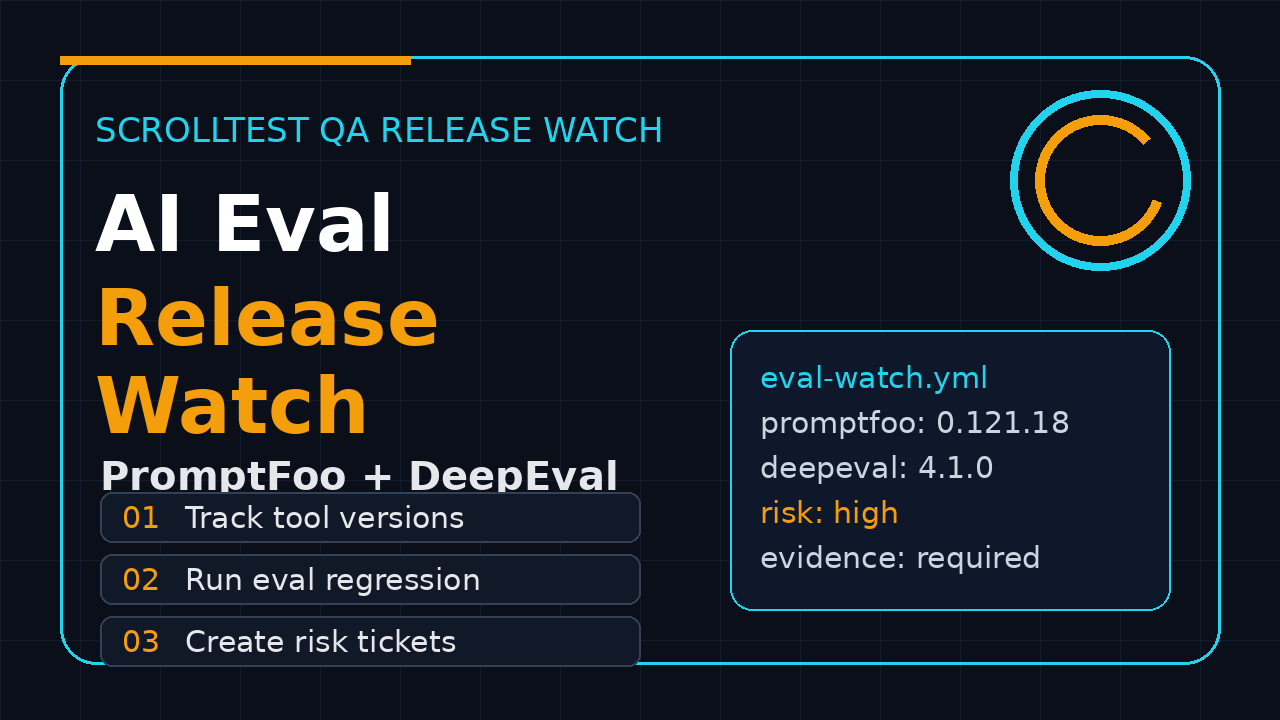
AI eval release watch is the habit QA teams need before LLM apps become another flaky production dependency. PromptFoo shipped 0.121.18 on July 8, 2026, DeepEval lists 4.1.0 on PyPI, and both tools now move fast enough that a monthly “we should check evals” reminder is not enough.
I see the same failure pattern in AI testing teams: the product team updates a prompt, the model provider changes behavior, an eval library changes a matcher, and QA only finds the regression after users complain. This article gives you a practical release watch process that converts eval-tool changes into test evidence, CI gates, and clear risk tickets.
Table of Contents
- What Is an AI Eval Release Watch?
- Why Release Notes Matter for LLM Testing
- Signals to Track Every Week
- PromptFoo and DeepEval Workflow
- CI Release Gate Template
- Risk Ticket Format for QA Leads
- India SDET Career Angle
- Common Mistakes
- Key Takeaways
- FAQ
Contents
What Is an AI Eval Release Watch?
An AI eval release watch is a lightweight operating rhythm where QA tracks changes in LLM evaluation tools, model behavior, prompts, datasets, and CI thresholds. The goal is not to read every changelog like a hobby. The goal is to spot changes that can make your eval suite lie.
Traditional automation has a familiar watch list: browser versions, Selenium or Playwright releases, grid images, driver compatibility, and CI runners. LLM testing adds a second watch list. You now track model versions, prompt templates, retrieval chunks, metric definitions, judge prompts, and eval framework releases.
Why this is a QA responsibility
Developers can own implementation. Product can own user intent. QA should own evidence. When a chatbot answer shifts from correct to risky, the QA team must explain what changed, which checks caught it, and whether the release should proceed.
That evidence does not appear by magic. It comes from a repeatable process:
- Track eval framework releases and model changes.
- Run a stable regression dataset on every risky change.
- Compare output quality, not only pass or fail counts.
- Write release tickets in language product managers understand.
- Keep rollback instructions beside the test evidence.
The boring version wins
The best release watch is boring. It uses a small spreadsheet, a GitHub issue template, or a daily Slack digest. You do not need a giant platform on day one. You need a habit that forces the team to ask, “Did our eval result change because the product improved, or because our test tool changed?”
ScrollTest readers have already seen this pattern in browser automation. In AI Browser Release Radar for QA Teams, I covered why QA should treat browser and framework releases as test-risk events. AI evals deserve the same discipline.
Why AI Eval Release Watch Matters for LLM Testing
AI eval release watch matters because LLM tests are more sensitive than normal UI tests. A CSS selector usually passes or fails. An LLM answer can be partially correct, confidently wrong, unsafe, too vague, or correct in a format your parser rejects.
PromptFoo reports more than 23,000 GitHub stars through the GitHub repository API, and the npm registry reported about 1.58 million downloads for the last month at the time of this run through the npm downloads API. DeepEval’s public repository also shows strong adoption, with more than 16,000 stars through the GitHub repository API. These are not tiny side tools anymore.
LLM regressions are not always code regressions
In a normal web app, a failing test often points to a code diff. In an AI feature, the diff can live outside your repository. The model provider can change routing. A safety filter can become stricter. A retrieval pipeline can return a different chunk order. An eval framework can change how it scores similarity.
That creates four types of risk:
- Product risk: The answer no longer meets user intent.
- Safety risk: The answer exposes private, harmful, or non-compliant content.
- Measurement risk: The eval tool gives a pass for weak output or a fail for acceptable output.
- Release risk: CI blocks teams without explaining the business impact.
Release notes are test inputs
I treat release notes as test inputs. If PromptFoo changes a provider adapter, I want to know which suites use that provider. If DeepEval changes a metric, I want to know which score thresholds depend on that metric. If a model changes structured output behavior, I want a fresh run against JSON-heavy scenarios.
This is the same mindset behind AI Test Evidence in CI/CD Release Gates. A CI gate is only useful when the evidence behind it is current, readable, and tied to release decisions.
Signals to Track Every Week
A good watch process focuses on a few signals. If you track everything, the team ignores everything. I prefer a weekly review that takes 30 minutes and a release-blocking review when a high-risk change lands.
1. Eval framework releases
Start with the tools that run your checks. For most QA teams, that means PromptFoo, DeepEval, OpenEvals, Ragas, custom pytest wrappers, or a vendor platform. Record the current version, latest version, release date, and a one-line risk note.
Example risk notes:
- Provider adapter changed. Re-run provider-specific suites.
- Metric scoring changed. Compare score distribution before updating thresholds.
- CLI output changed. Check CI parser and report artifacts.
- Dataset handling changed. Verify examples are loaded in the same order.
2. Model and provider changes
Model versions are release dependencies. A prompt that works with one model can fail with another because of verbosity, safety behavior, token limits, or JSON compliance. Track model IDs as carefully as package versions.
The minimum fields are:
- Provider name and model ID.
- Prompt template hash.
- Dataset version or commit SHA.
- Eval tool version.
- Pass rate and score distribution.
- Top five failed cases with links to examples.
3. Dataset drift
Many teams add examples to an eval dataset without versioning the dataset. That makes the trend chart useless. If Monday’s run has 80 examples and Friday’s run has 112 examples, a pass-rate drop can be real or just a larger dataset.
Use a dataset ID. A simple value like support-bot-regression-2026-07-14 is enough. Better teams store examples in Git and include the commit SHA in the report.
4. CI stability
LLM evals cost money and time. If a CI job times out twice a week, engineers will bypass it. Track runtime, retry count, provider errors, and cost per run. The release watch should flag infrastructure pain before teams disable the gate.
PromptFoo and DeepEval Workflow for AI Eval Release Watch
PromptFoo and DeepEval solve different parts of the same QA problem. PromptFoo is strong when you want config-driven prompt, provider, and dataset checks. DeepEval is strong when you want Python-native metrics, custom assertions, and test-style ownership.
I like using both in a layered workflow:
- PromptFoo for broad regression sweeps and adversarial prompt checks.
- DeepEval for metric-rich checks owned by QA automation engineers.
- CI summary artifacts that product and engineering managers can read.
PromptFoo watch file
Create a small watch file in the repository. It keeps the current eval tool version close to the suite it affects.
# eval-watch.yml
suite: support-bot-regression
owner: qa-platform
promptfoo_version: "0.121.18"
provider_models:
  - openai:gpt-4.1-mini
  - anthropic:claude-3-5-sonnet
risk_level: high
last_reviewed: "2026-07-14"
required_artifacts:
  - promptfoo-report.html
  - failed-examples.json
  - release-risk.md
This file is not complex. That is the point. A QA lead can open it and see what matters without reading every config file.
DeepEval smoke check
For DeepEval, I keep the watch logic inside a normal Python test. It checks the installed version, runs a tiny smoke dataset, and prints the version into CI logs.
import importlib.metadata
from deepeval import assert_test
from deepeval.test_case import LLMTestCase
from deepeval.metrics import AnswerRelevancyMetric

DEEPEVAL_EXPECTED = "4.1.0"

def test_deepeval_version_is_reviewed():
    actual = importlib.metadata.version("deepeval")
    assert actual == DEEPEVAL_EXPECTED, (
        f"DeepEval changed from {DEEPEVAL_EXPECTED} to {actual}. "
        "Run the AI eval release watch before merging."
    )

def test_support_answer_relevancy():
    case = LLMTestCase(
        input="How do I reset my password?",
        actual_output="Use the password reset link on the login page.",
        expected_output="Guide the user to reset the password safely."
    )
    metric = AnswerRelevancyMetric(threshold=0.75)
    assert_test(case, [metric])
This is not enough for full AI quality. It is enough to stop silent dependency drift. When the version changes, QA gets a deliberate review step instead of a surprise score shift.
When to run which suite
Do not run every expensive eval on every commit. Use tiers:
- Pull request: Run smoke examples and schema checks.
- Nightly: Run broad regression datasets across key prompts.
- Release candidate: Run safety, hallucination, and domain-specific tests.
- Tool upgrade: Run old version and new version side by side on the same dataset.
That fourth tier is the missing habit. If the eval tool changes, compare the tool versions before you change thresholds. Otherwise you may tune the test to hide the regression.
CI Release Gate Template
An AI eval release watch becomes useful when it blocks or warns in CI with a clear reason. I do not like mysterious red builds. I want the build to tell me which release signal failed and what to do next.
GitHub Actions example
Here is a simple GitHub Actions workflow you can adapt. It runs a watch script, uploads evidence, and fails only when the risk is high.
name: ai-eval-release-watch

on:
  pull_request:
    paths:
      - "prompts/**"
      - "evals/**"
      - "package-lock.json"
      - "requirements.txt"
  workflow_dispatch:

jobs:
  eval-watch:
    runs-on: ubuntu-latest
    steps:
      - uses: actions/checkout@v4
      - uses: actions/setup-python@v5
        with:
          python-version: "3.11"
      - uses: actions/setup-node@v4
        with:
          node-version: "22"
      - run: npm ci
      - run: pip install -r requirements.txt
      - name: Run PromptFoo regression
        run: npx promptfoo@0.121.18 eval -c promptfooconfig.yaml --output ./artifacts/promptfoo-report.html
      - name: Run DeepEval smoke
        run: pytest tests/evals/test_deepeval_smoke.py -q
      - name: Build release risk summary
        run: python scripts/build_eval_release_risk.py
      - uses: actions/upload-artifact@v4
        with:
          name: ai-eval-release-watch
          path: artifacts/
Risk scoring that humans can understand
A release gate should not say “eval failed” and stop there. It should say what failed in release language.
Use a simple scoring model:
- Low: Tool release has docs or UI changes only. No CI block.
- Medium: Provider, parser, dataset, or metric changed. Require QA review.
- High: Safety, hallucination, PII, payment, legal, or medical flows changed. Block release until evidence is attached.
In my experience, this language works better than a pure score. A product manager may not understand cosine similarity. They do understand “payment support bot gave the wrong refund policy in 3 of 20 critical cases.”
Artifact checklist
Every release watch run should produce evidence. No evidence, no trust.
- HTML report from PromptFoo or equivalent tool.
- DeepEval or pytest output with versions printed.
- Failed examples as JSON for debugging.
- Dataset version or commit SHA.
- Model IDs and prompt hashes.
- One-page risk summary for the release owner.
Risk Ticket Format for QA Leads
The release watch must end in a ticket when there is real risk. A ticket forces ownership. It also creates a history of why a release was blocked or allowed.
Use this ticket template
## AI Eval Release Risk

Feature: Support bot refund answer
Risk level: High
Detected by: AI eval release watch
Tool versions:
- PromptFoo: 0.121.18
- DeepEval: 4.1.0
Model: openai:gpt-4.1-mini
Dataset: refund-policy-regression@8f3a12c

What changed:
- Prompt template updated for shorter answers.
- Refund policy retrieval returned older FAQ chunk in 3 cases.

Evidence:
- PromptFoo report: artifacts/promptfoo-report.html
- Failed examples: artifacts/failed-examples.json
- CI run: https://github.com/org/repo/actions/runs/123

Release decision:
- Block until retrieval filter is fixed.
- Re-run high-risk refund scenarios after fix.

Rollback:
- Restore prompt hash 3a91e0b.
- Pin retrieval index to 2026-07-10 build.
Keep the ticket small
The ticket should fit on one screen. If it needs five pages, the release owner will skim it and miss the risk. Put raw reports in artifacts. Put the decision in the ticket.
For another practical QA workflow, read DeepEval Quick Start for QA Engineers. It pairs well with this release watch because it shows how Python-style eval tests can sit beside normal automation.
India SDET Career Angle
For SDETs in India, AI eval release watch is a strong portfolio skill. Many engineers say they know AI testing. Fewer can show a working CI gate that catches prompt, model, and eval-tool risk.
If you work in a services company like TCS, Infosys, Wipro, or Cognizant, this can separate you from the crowd because clients are asking for AI assurance but many teams still talk only about Selenium scripts. If you target product companies, the skill becomes even more useful because teams ship AI features faster and expect QA to speak product risk.
What to build for your portfolio
Build a small public project:
- Create a fake customer support bot with 30 questions.
- Add 10 high-risk cases for refunds, privacy, and account access.
- Run PromptFoo against two model configurations.
- Add one DeepEval metric-based test file.
- Publish a GitHub Actions artifact with the report.
- Write one release risk ticket from a failing case.
This project is more credible than another generic “AI chatbot” demo. It shows release ownership. It also gives you interview stories for SDET, QA lead, AI quality engineer, and automation architect roles.
Salary conversation
I avoid promising salary outcomes because market data changes by company, city, and interview bar. Still, I do see a clear pattern: QA engineers who can connect automation, CI, and AI evaluation have a better story for ₹25 to 40 LPA product-company interviews than engineers who only list tool names. The difference is evidence.
Common Mistakes
The release watch is simple, but teams still break it in predictable ways.
Mistake 1: Only tracking pass rate
A pass rate hides distribution changes. If your average relevancy score drops from 0.91 to 0.78 but the threshold is 0.75, CI stays green while quality gets worse. Track score trend, not only pass or fail.
Mistake 2: Changing thresholds after every failure
Thresholds are not painkillers. If a threshold moves every time the model changes, the eval suite loses meaning. First inspect failed examples. Then decide whether the product, prompt, dataset, metric, or threshold needs work.
Mistake 3: No pinned versions
If PromptFoo, DeepEval, and model aliases all float at the same time, debugging becomes guesswork. Pin what you can. Record what you cannot pin.
Mistake 4: No owner
A release watch with no owner becomes another abandoned dashboard. Assign a weekly owner. Rotate it across QA engineers. Make the output a short note in the release channel.
Mistake 5: Treating AI evals as only a data science task
Data scientists bring strong evaluation thinking. QA brings release discipline. The best teams combine both. QA should not wait for someone else to define what counts as safe enough to ship.
Weekly Operating Cadence
The easiest way to keep AI eval release watch alive is to put it on the calendar. I prefer a fixed 30-minute slot every Monday or the first working day after a release candidate branch opens. The meeting is not for theory. It is a working review with one owner sharing one screen.
Before the meeting
The owner collects five items: latest eval tool versions, model IDs used in production, changed prompts, changed datasets, and the last CI evidence artifact. If any item is missing, that is the first ticket. Missing evidence is not a small admin problem. It means the team cannot explain whether quality moved.
During the meeting
Keep the agenda strict:
- Five minutes for version and model changes.
- Ten minutes for failed or weak examples.
- Five minutes for CI runtime, cost, and flaky provider errors.
- Five minutes for release risks that need product input.
- Five minutes to assign owners and due dates.
This format stops the meeting from becoming a long AI debate. QA brings evidence. Engineering explains implementation changes. Product confirms the business impact of weak answers.
After the meeting
Publish a short note in the release channel. Include the current versions, risk level, blocked flows, and links to reports. If the risk is low, say that clearly. If the risk is high, name the blocking ticket and the exact evidence needed to unblock it.
Over four weeks, this creates a valuable audit trail. When someone asks why a release was delayed, you do not search Slack for opinions. You open the watch notes and show the evidence.
Key Takeaways
AI eval release watch is not about reading changelogs for fun. It is about protecting releases when prompts, models, datasets, and eval tools move under your feet.
- Track the right signals: eval tool versions, model IDs, dataset versions, prompt hashes, CI stability, and score trends.
- Compare before upgrading: run old and new eval-tool versions on the same dataset before changing thresholds.
- Attach evidence: every release decision needs reports, failed examples, versions, and a readable risk summary.
- Use simple risk levels: low, medium, and high work better than complex scores for release conversations.
- Build career proof: a public AI eval CI gate is a strong SDET portfolio project, especially for engineers moving toward AI quality roles.
If your team already tracks browser automation releases, extend that habit to AI evals this week. Start with one suite, one PromptFoo report, one DeepEval smoke check, and one risk ticket. That is enough to make the next LLM regression easier to explain and faster to fix.
FAQ
What is an AI eval release watch?
An AI eval release watch is a recurring QA process that tracks changes in eval tools, models, prompts, datasets, and CI evidence so LLM regressions are caught before release.
Should QA teams use PromptFoo or DeepEval?
Use PromptFoo when you want config-first regression checks across prompts, providers, and datasets. Use DeepEval when you want Python-native tests, custom metrics, and tighter integration with pytest-style automation. Many teams benefit from both.
How often should an AI eval release watch run?
Run a small check on pull requests, a broader regression nightly, and a full release-candidate run before production. Also run a side-by-side comparison whenever you upgrade the eval framework or model.
What should block a release?
Block releases for high-risk failures: safety, privacy, legal, payment, medical, identity, or other flows where a wrong LLM answer can harm the user or the business. Medium-risk failures should require QA review and a documented decision.
Can manual testers learn this workflow?
Yes. Start by reading reports, labeling failed examples, and writing risk tickets. Then learn basic YAML, Python, and CI. The fastest growth path is to own the evidence, not just the tool command.


