DeepEval for QA Engineers: LLM Evals That Work
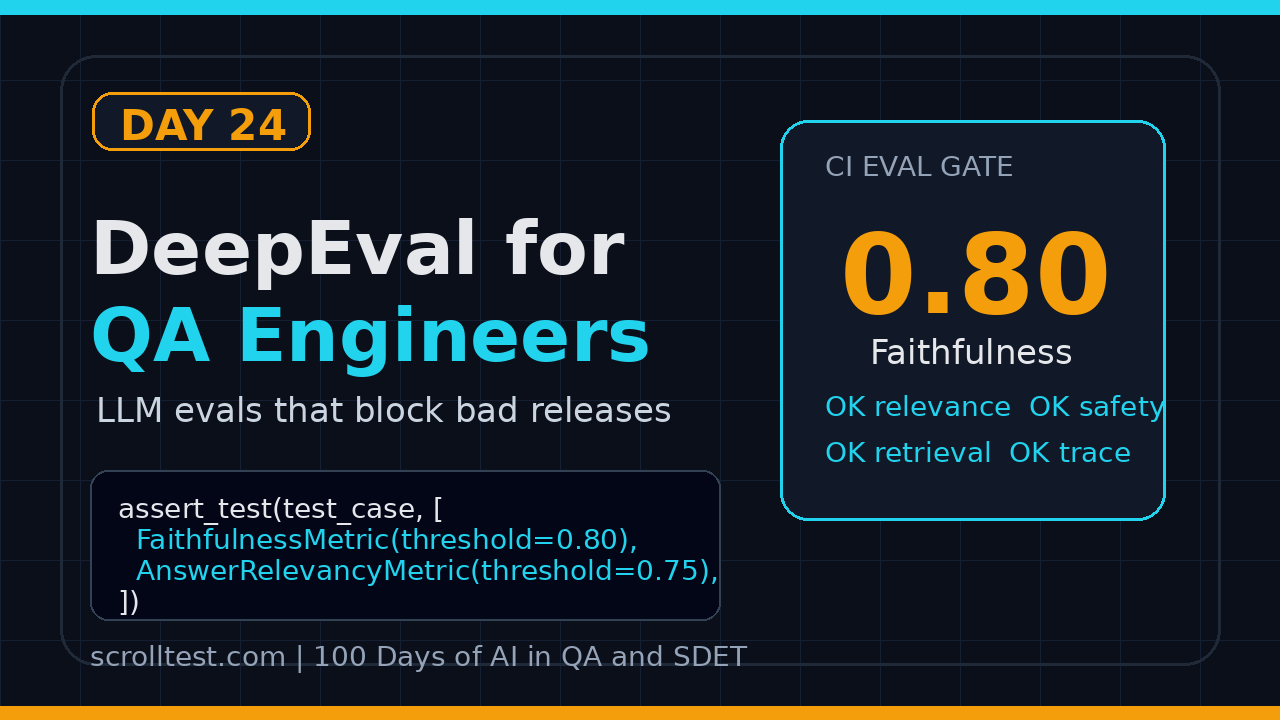
I see QA teams adding chatbots, RAG search, AI summaries, and browser agents without one basic habit: repeatable evaluation. DeepEval for QA engineers gives us a testing vocabulary for LLM features: inputs, expected outputs, metrics, thresholds, and CI gates instead of screenshots in Slack.
This is Day 24 of the 100 Days of AI in QA & SDET series. The goal is simple: treat LLM behavior like software behavior, not like magic.
Table of Contents
- What Is DeepEval for QA Engineers?
- Why LLM Evals Feel Familiar to Testers
- DeepEval for QA Engineers: The Test Case Model
- Metrics That Matter for QA Teams
- Hands-On: Build a DeepEval Smoke Suite
- CI Gates and Release Workflow
- India SDET Career Context
- Common Mistakes I See Teams Make
- Key Takeaways
- FAQ
Contents
What Is DeepEval for QA Engineers?
DeepEval 4.0.7 on PyPI describes the project as an LLM evaluation framework. That sounds like a data science tool, but I find the mental model very close to QA: define a test case, run the system, score the output, and fail the build when the score drops below a threshold.
The difference is that the assertion is not always actual === expected. LLM features are probabilistic. A good answer may use different words every run, but it still needs to be faithful, relevant, safe, and complete.
Where DeepEval fits in the QA stack
DeepEval sits between unit tests and human exploratory testing. Unit tests confirm that your retrieval function, prompt template, API contract, and logging code still work. Human testers still explore edge cases and judge UX. DeepEval covers the middle layer where the question is: did the AI feature answer well enough for release?
The DeepEval GitHub repository showed more than 16,500 stars when I checked it for this article, which is a strong signal that LLM evals are becoming a normal engineering practice. I do not treat stars as quality proof, but I do treat them as adoption signal.
What QA teams can evaluate
- AI support bots that answer product questions
- RAG search over help docs, release notes, or internal test cases
- Bug report summarizers that convert logs into a defect draft
- Test case generators that propose Playwright or Selenium scenarios
- Browser agents that plan actions and explain what they changed
If your team is already experimenting with reusable QA agent skills, connect this article with QA Agent Skill Library: Reusable Skills Beat Prompts. Skills reduce prompt chaos. Evals prove whether those skills still work after the prompt, model, or retrieval source changes.
Why LLM Evals Feel Familiar to Testers
I do not buy the argument that AI testing is a completely new discipline. The tooling is new. The tester thinking is not.
A QA engineer already knows how to convert risk into checks. We already ask: what input matters, what output is acceptable, what data should be isolated, what threshold blocks release, and what evidence helps a developer debug the failure?
Classic QA mapping
Here is the simplest mapping I use with teams:
- Requirement becomes an evaluation intent.
- Test data becomes the prompt, context, expected facts, and expected behavior.
- Assertion becomes a metric score and threshold.
- Regression suite becomes a set of eval cases committed to Git.
- CI gate becomes a build rule that blocks risky prompt or model changes.
The biggest shift is tolerance. In a normal API test, a status code is either 200 or not. In an LLM eval, faithfulness may be 0.82, relevance may be 0.91, and toxicity may be near zero. You need product-specific thresholds.
Why screenshots are not enough
Screenshots are useful for UI evidence, but they are weak for AI behavior. A screenshot captures one answer at one moment. A useful eval suite captures many prompts, reruns them, and tells you whether quality moved up or down.
This matters when a product manager changes a system prompt from 300 words to 80 words, or when engineering swaps the model to cut cost. Without evals, the QA team is forced to read random outputs manually. That does not scale.
The promptfoo comparison
DeepEval is not the only tool in this space. Promptfoo 0.121.17 on npm positions itself as an LLM eval and testing toolkit, and the npm downloads API reported 1,395,585 downloads for the last month window I checked. Promptfoo is popular for config-driven prompt testing and red-team workflows. DeepEval feels natural when your team lives in Python and wants test-case style code.
DeepEval for QA Engineers: The Test Case Model
The core DeepEval idea is easy for testers: an LLM test case has an input, an actual output, and sometimes context plus expected output. The DeepEval test case documentation explains this model directly.
That structure matters because it forces the QA team to stop debating AI quality in vague terms. You write down the scenario. You write down what good means. Then the metric decides if the output passes.
A practical test case format
For a QA chatbot that answers questions about a checkout flow, I would track each case like this:
- Input: User asks how to retry a failed UPI payment.
- Context: Retrieved help-center chunk about payment retry rules.
- Expected output: Mentions retry after failure, does not ask for full card details, points to order history.
- Risk: Financial guidance and customer trust.
- Threshold: Faithfulness 0.8 or higher, answer relevancy 0.75 or higher.
This is just test design. The LLM wrapper and metric names change, but the QA skill is still scenario selection.
Start small: 20 cases, not 2,000
I prefer a small smoke suite first. Pick the 20 prompts most likely to embarrass the team in production: pricing, refunds, login, security, medical or financial wording, account deletion, and anything that touches compliance.
For a product company, I would make this suite mandatory before each release. For a services team in TCS, Infosys, Wipro, or Accenture, I would package the same idea as an AI QA accelerator: client domain prompts, expected policies, evaluator metrics, and a weekly regression report.
Metrics That Matter for QA Teams
The DeepEval metrics documentation covers the broader metric system. QA teams do not need every metric on day one. You need the few that map to release risk.
Faithfulness
Faithfulness checks whether the answer is grounded in the supplied context. In RAG testing, this is usually the first metric I care about. If the bot invents a refund policy that is not present in the retrieved document, the answer may sound confident but still be a release blocker.
QA translation: this is close to checking whether the system obeyed the source of truth.
Answer relevancy
Answer relevancy checks whether the output responds to the user’s question. Many AI failures are not wild hallucinations. They are polite answers that dodge the point.
QA translation: this is close to requirement coverage. Did the answer cover the actual user intent?
Context precision and recall
If your RAG system retrieves five chunks, not all five are useful. Context precision and recall help you test the retrieval layer, not just the generated answer.
QA translation: this is like checking test data setup. If the wrong fixture feeds the application, the final assertion tells only half the story.
Bias, toxicity, and safety
Safety metrics matter when the answer may insult a user, reveal private data, or produce risky instructions. These checks should be stricter for fintech, health, hiring, education, and support products.
For most QA teams, the correct first step is not a giant safety lab. It is a small set of dangerous prompts that must never pass: personal data requests, credentials, discriminatory wording, and prompt injection attempts.
Hands-On: Build a DeepEval Smoke Suite
Here is a minimal pattern you can adapt. I am keeping the example small so the structure is clear. In a real project, read cases from YAML or JSON and run them in CI.
python -m venv .venv
source .venv/bin/activate
pip install deepeval==4.0.7 pytest
Now create a test file. Your production app may call OpenAI, Gemini, Claude, Bedrock, or an internal gateway. The wrapper does not matter. The pattern matters.
# tests/test_ai_support_bot.py
from deepeval import assert_test
from deepeval.test_case import LLMTestCase
from deepeval.metrics import AnswerRelevancyMetric, FaithfulnessMetric


def ask_support_bot(question: str, context: str) -> str:
    # Replace this with your real app call.
    # Keep logging enabled so failed evals include request IDs.
    return (
        "You can retry the failed UPI payment from Order History. "
        "Do not share card or UPI PIN details with support."
    )


def test_upi_payment_retry_answer_is_grounded():
    context = "Customers can retry failed UPI payments from Order History. Support must never ask for UPI PIN."
    question = "My UPI payment failed. What should I do?"
    actual = ask_support_bot(question, context)

    test_case = LLMTestCase(
        input=question,
        actual_output=actual,
        retrieval_context=[context],
        expected_output="Tell the user to retry from Order History and avoid sharing UPI PIN."
    )

    assert_test(
        test_case,
        [
            AnswerRelevancyMetric(threshold=0.75),
            FaithfulnessMetric(threshold=0.80),
        ],
    )
What to log when an eval fails
A failed LLM eval without evidence wastes time. Store these fields for every run:
- Prompt template version
- Model name and model version if available
- Retrieved document IDs
- Actual output
- Metric scores and thresholds
- Request ID, trace ID, or CI build URL
This is where AI QA meets normal automation discipline. If you cannot reproduce or inspect the failure, the eval is only a complaint.
Use eval fixtures like test data
Put your most important cases in version control. Review changes in pull requests. If a product owner changes refund policy, update the expected behavior in the eval fixture at the same time as the docs change.
This connects nicely with the idea in QA Agent Skills: One Command Every Tester Should Try: repeatable QA workflows should live as assets, not as private prompt notes.
CI Gates and Release Workflow
DeepEval becomes valuable when it runs before production. A local demo is useful for learning, but the habit pays off in CI.
A simple GitHub Actions gate
name: ai-evals
on:
  pull_request:
    paths:
      - "prompts/**"
      - "rag/**"
      - "tests/evals/**"
      - "app/ai/**"

jobs:
  evals:
    runs-on: ubuntu-latest
    steps:
      - uses: actions/checkout@v4
      - uses: actions/setup-python@v5
        with:
          python-version: "3.11"
      - run: pip install -r requirements.txt
      - run: pytest tests/evals -q
        env:
          LLM_API_KEY: ${{ secrets.LLM_API_KEY }}
I like path filters because they keep eval cost under control. Do not run expensive AI checks on every CSS change. Run them when prompts, retrieval, model wrappers, safety rules, or AI endpoints change.
Suggested release policy
Use a policy that a QA lead can explain in one minute:
- Every AI feature gets a smoke eval suite before public beta.
- Every prompt or retrieval change triggers the smoke suite.
- Critical safety cases have higher thresholds than normal FAQ cases.
- Failures create a defect with prompt, output, score, and trace link.
- No production release if critical evals fail without sign-off.
This is not bureaucracy. This is how you stop AI regressions from becoming customer screenshots.
Where browser testing connects
For browser agents, pair DeepEval with Playwright traces. Playwright proves what happened in the UI. DeepEval scores the agent’s reasoning, summary, or defect report.
If you are building this kind of workflow, read QA Agent Skill Library and think about packaging the eval run as a reusable agent skill. The best QA teams will not rely on one-off prompts. They will build repeatable pipelines.
India SDET Career Context
For SDETs in India, LLM evals are a practical career upgrade. Many testers are learning prompt writing, but fewer can design an AI regression suite and wire it into CI. That gap is where senior value appears.
In product companies, the SDET who can test AI features will sit closer to architecture discussions. In service companies, the engineer who can create reusable eval templates can help multiple client teams. This is the difference between using an AI tool and owning AI quality.
What to learn in 30 days
- Week 1: Learn LLM test cases, metrics, and prompt versioning.
- Week 2: Build 20 eval cases for one support bot or RAG feature.
- Week 3: Add CI, reporting, and defect evidence.
- Week 4: Pair evals with Playwright or API tests for end-to-end coverage.
If you are targeting ₹25-40 LPA SDET roles, do not pitch yourself as someone who “knows AI tools.” Pitch yourself as someone who can build release gates for AI behavior. That is a stronger sentence in interviews.
Common Mistakes I See Teams Make
Most eval failures start before the tool runs. The team has not agreed what good means.
Mistake 1: Testing only happy prompts
Happy prompts make demos look good. Risk prompts protect production. Add confusing, short, angry, multilingual, and policy-sensitive prompts.
Mistake 2: One metric for every feature
A refund bot, a code generator, and a defect summarizer should not use the same thresholds blindly. Tie metrics to product risk.
Mistake 3: No owner for eval maintenance
Eval suites age like Selenium suites. Product rules change, documents move, and prompts evolve. Assign ownership. Review failures weekly.
Mistake 4: Hiding scores from developers
Developers need fast evidence. Show the input, context, actual output, metric score, and threshold. Do not send only “eval failed” in a chat message.
Key Takeaways
DeepEval for QA engineers is not about replacing testers with a metric. It is about giving testers a repeatable way to judge AI behavior before users do.
- LLM evals map naturally to QA thinking: cases, data, assertions, thresholds, and release gates.
- Start with 20 high-risk prompts before building a huge eval suite.
- Use faithfulness and answer relevancy first for RAG and support bot workflows.
- Run evals in CI when prompts, retrieval, models, or AI code changes.
- The career opportunity is clear: AI products need SDETs who can prove behavior, not just click through demos.
Tomorrow’s QA stack will still need Playwright, API tests, logs, traces, and exploratory testing. The new layer is evaluation. Learn it now while most teams are still arguing over screenshots.
My practical recommendation: pick one AI feature this week and create a release checklist with five columns: scenario, input, expected behavior, metric, and blocking threshold. Then add the first ten cases to Git. You will learn more from one failing eval report than from ten generic AI testing webinars.
FAQ
Is DeepEval only for machine learning engineers?
No. ML engineers may tune models, but QA engineers can own scenario design, regression cases, thresholds, CI gates, and failure evidence. That is testing work.
How many eval cases should a QA team start with?
Start with 20 high-risk cases. Cover the prompts that would hurt trust, money, privacy, or compliance if the answer is wrong. Expand after the first CI workflow is stable.
Can DeepEval replace manual testing?
No. It reduces repetitive judgment work for known scenarios. Human testers still explore new risks, judge UX, and catch failures the suite does not yet model.
Should I use DeepEval or promptfoo?
If your team prefers Python and test-code style workflows, DeepEval is a strong fit. If your team wants config-heavy prompt comparison and red-team workflows, promptfoo may fit better. Many mature teams can use both for different layers.
What should I add to my portfolio?
Build a small RAG FAQ app, write 20 DeepEval cases, run them in GitHub Actions, and publish a short report with failures and fixes. That proves you understand AI quality beyond prompt experiments.