Gen AI for QA Engineers: What Every SDET Must Know in 2026
Contents
Gen AI for QA Engineers: What Every SDET Must Know in 2026
If you are still writing test scripts the same way you did in 2022, you are already behind. Generative AI is not a future trend for QA. It is the current reality. In 2026, the SDETs who understand how to work with AI agents, LLM evaluation frameworks, and prompt engineering are the ones getting hired, promoted, and paid the premium salaries. Everyone else is scrambling to catch up.
🤖 Learning AI-powered testing? Go hands-on with LLM, RAG, and AI-agent testing in the AI-Powered Testing Mastery course at The Testing Academy.
This guide is your starting point. I will break down exactly what Gen AI means for QA engineers, which tools matter, what skills you need, and how to build an AI-first testing practice without drowning in hype.
Table of Contents
- What Is Gen AI in QA?
- Why 2026 Is Different From 2023
- The AI QA Stack Every SDET Needs
- AI Agents for Test Automation
- LLM Evaluation and Why It Matters
- Prompt Engineering for Testers
- RAG Systems and Retrieval Testing
- The AI Testing Tools Landscape
- What This Means for Your Career
- The India Context: Salaries and Hiring
- How to Start Today: A 7-Day Plan
- 5 Mistakes QA Engineers Make With AI
- Key Takeaways
- Frequently Asked Questions
What Is Gen AI in QA?
Generative AI in QA refers to the use of large language models (LLMs), AI agents, and related technologies to automate, augment, or transform software testing activities. This is not just about using ChatGPT to write test cases. It is about building systems that can plan tests, generate scripts, execute them, heal broken selectors, report bugs, and evaluate their own output.
The distinction matters. A tester who uses ChatGPT to draft manual test cases is using AI as a writing assistant. An SDET who builds an agentic pipeline that reads a Jira ticket, generates a Playwright test, runs it in CI/CD, and opens a bug report if it fails is operating at a completely different level. Both are “using AI,” but the impact on productivity and career trajectory is not even close.
Here is what Gen AI in QA actually covers in 2026:
- Test case generation from requirements, user stories, or production logs
- Script generation in Playwright, Selenium, Cypress, or API testing frameworks
- Self-healing tests that adapt when UI changes break locators
- Intelligent test prioritization based on code changes and bug history
- Automated bug reporting with reproduction steps and screenshots
- Visual regression powered by multimodal AI models
- LLM output evaluation for applications built on generative AI
- Synthetic test data generation that is realistic and privacy-compliant
If your current testing practice covers zero of these eight areas, you have work to do. The good news is that the tools are more accessible than ever. The bad news is that the learning curve is real, and the window for being an early adopter is closing.
Why 2026 Is Different From 2023
In 2023, AI in testing was mostly a curiosity. A few startups were selling “AI-powered test automation,” but the products were thin wrappers around basic heuristics. The LLMs were not reliable enough for production test generation. The tooling was fragmented. And most QA teams were rightly skeptical.
In 2026, the landscape has shifted dramatically. Here is what changed:
1. LLMs Became Reliable Enough for Code Generation
Models like Claude 3.7 Sonnet, GPT-4.1, and Gemini 2.5 Pro can now generate working Playwright scripts from natural language descriptions with accuracy rates above 80 percent for standard web applications. They understand selectors, async patterns, and page object models. They are not perfect, but they are good enough to be force multipliers.
2. AI Agents Moved From Demo to Production
The “planner-generator-healer” pattern I use in production frameworks is now a recognized architecture. Agents can plan a testing strategy, generate the scripts, execute them, detect failures, heal the broken parts, and retry. This is not theoretical. Teams at mid-size product companies are running these pipelines in CI/CD today.
3. Evaluation Frameworks Matured
Tools like DeepEval, PromptFoo, and OpenEval have turned LLM evaluation from an art into a repeatable engineering practice. You can now measure hallucination rates, answer relevance, and bias with the same rigor you apply to code coverage.
4. The MCP Standard Emerged
The Model Context Protocol (MCP), popularized by Anthropic, has become the standard way for LLMs to interact with external tools. For QA, this means your AI agents can now natively control browsers, query databases, call APIs, and interact with Jira or TestRail through a standardized interface.
5. Playwright Hit 88,000 GitHub Stars
Microsoft’s Playwright has become the dominant browser automation framework, and its AI integrations are deepening. The Playwright team has released native support for AI-driven locators, visual comparisons, and agentic execution modes. If you are not building on Playwright in 2026, you are swimming against the current.
The AI QA Stack Every SDET Needs
You do not need to learn everything. But you do need a coherent stack. Here is what I recommend for SDETs building an AI-first testing practice in 2026:
Layer 1: Foundation Models
- Claude 3.7 Sonnet — Best for complex reasoning and code generation
- GPT-4.1 — Strong for general-purpose automation and API interactions
- Gemini 2.5 Pro — Excellent for multimodal tasks (visual testing, screenshot analysis)
- Llama 3 / Mistral — For on-premise or cost-sensitive deployments via Ollama
Layer 2: Orchestration Frameworks
- LangChain — For chaining LLM calls with tools and memory
- LangGraph — For state-machine-based test workflows with branching logic
- LangFlow — Visual, low-code AI workflow builder for rapid prototyping
- n8n — Workflow automation with visual node-based execution
Layer 3: Evaluation and Observability
- DeepEval — Comprehensive LLM evaluation metrics (hallucination, bias, relevance)
- PromptFoo — Prompt regression testing and red-teaming
- OpenEval — Open-source evaluation for custom pipelines
- LangSmith — Tracing and observability for LangChain applications
Layer 4: Browser and API Automation
- Playwright — Primary browser automation framework (88,000+ GitHub stars)
- Playwright MCP — Model Context Protocol integration for agentic browser control
- REST Assured / requests — API testing fundamentals
Layer 5: Infrastructure
- Docker — Containerized test environments
- GitHub Actions — CI/CD integration
- Astra DB / Pinecone / Chroma — Vector databases for RAG-based test knowledge
This stack looks intimidating, but you do not need to master every layer on day one. Start with Playwright and one LLM. Add LangChain when you need agentic behavior. Add DeepEval when you are testing LLM outputs. Build incrementally.
AI Agents for Test Automation
AI agents are the single biggest shift in test automation since Selenium replaced manual QA. An AI testing agent is a system that can perceive the state of an application, make decisions about what to test, execute those tests, and learn from the results.
The architecture I use and teach follows a three-stage pattern:
1. The Planner
The planner takes a high-level goal like “test the checkout flow” and breaks it into specific steps. It uses the LLM’s reasoning capability to identify edge cases, dependencies, and preconditions. A good planner does not just generate happy-path tests. It thinks about invalid credit cards, expired sessions, network failures, and concurrent users.
2. The Generator
The generator translates the planner’s steps into executable code. This is where Playwright shines. The generator produces TypeScript or Python scripts with proper selectors, waits, assertions, and error handling. It can also generate API tests, database validations, and performance checks.
3. The Healer
The healer detects when a test fails because the application changed, not because of a real bug. It analyzes the failure, compares the current DOM with the expected state, and generates a fix. This is the “self-healing” capability that vendors have promised for years but only AI agents deliver reliably in 2026.
I have built this pattern into AgentQA, and I see teams reducing test maintenance time by 60 to 70 percent when they implement it correctly. The key is not the technology itself. It is the feedback loop. The agent must learn from each execution, each failure, and each fix.
LLM Evaluation and Why It Matters
Here is a truth most QA teams miss: if your company ships an AI feature, you are not just testing software. You are testing a non-deterministic system. The same input can produce different outputs. The output can be wrong but sound confident. The output can be biased, toxic, or hallucinated.
Traditional test automation assumes deterministic behavior. A login button either works or it does not. An LLM-powered chatbot can give a correct answer 95 percent of the time and dangerously wrong advice the other 5 percent. Your job as an SDET is to measure and mitigate that 5 percent.
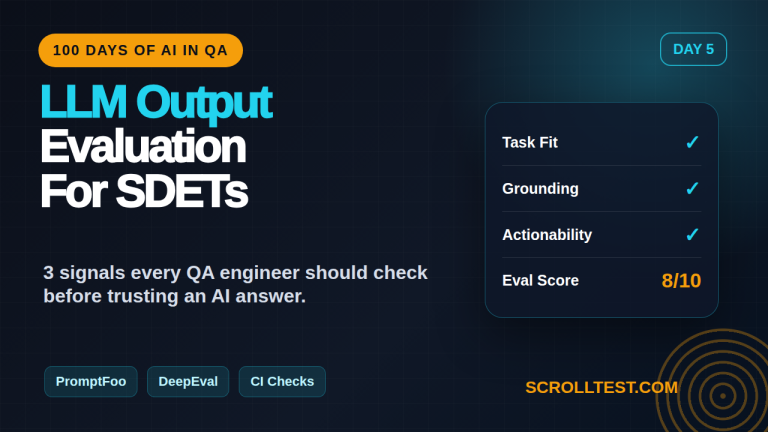
This is where LLM evaluation frameworks come in. DeepEval provides metrics like:
- Answer Relevancy — Does the response address the question?
- Faithfulness — Is the response grounded in the provided context?
- Hallucination — Does the response contain fabricated information?
- Bias — Does the response show demographic or cultural bias?
- Toxicity — Does the response contain harmful content?
PromptFoo takes a different angle. It helps you test prompts against a battery of inputs and catch regressions when you update them. If you change your system prompt and suddenly the model starts giving worse answers, PromptFoo catches it before production.
If your company builds on LLMs and your QA team is not running these evaluations, you have a blind spot the size of a highway.
Prompt Engineering for Testers
Prompt engineering is not about writing clever sentences for ChatGPT. It is about designing inputs that produce consistent, verifiable, and useful outputs from LLMs. For QA engineers, this skill translates directly into better test generation, better bug reports, and better automation.
The three patterns I use daily are:
1. Chain-of-Thought Prompting
Instead of asking “write a test for the login page,” I ask the model to think step by step:
"Analyze the login page. List the input fields and their validation rules.
Identify three positive test cases and five negative test cases.
For each case, write a Playwright test in TypeScript."
The structured reasoning produces better results than a single-shot request.
2. Few-Shot Prompting
I provide two or three examples of the output format I want before asking for new content. This is especially effective for generating consistent test scripts across a large application.
3. ReAct (Reasoning + Acting)
This pattern combines reasoning with tool use. The LLM thinks about what it needs to do, decides which tool to use (browser, API, database), executes the action, observes the result, and repeats. This is the foundation of agentic testing.
If you master these three patterns, you are ahead of 90 percent of QA engineers who treat LLMs like advanced search engines.
RAG Systems and Retrieval Testing
Retrieval-Augmented Generation (RAG) is how most companies deploy LLMs in production. Instead of trusting the model’s training data, you give it access to your own documents, knowledge bases, and test artifacts. When a tester asks “how do I test the payment flow,” the RAG system retrieves the relevant documentation and generates an answer grounded in your actual practices.
But RAG systems can fail in subtle ways:
- Bad chunking splits documents in the wrong place, losing context
- Poor embedding models retrieve irrelevant documents
- Context overload stuffs too much information into the prompt, confusing the model
- Hallucinated answers appear when the retrieved context is insufficient
Testing RAG systems requires a new discipline. You need to evaluate retrieval accuracy (are we finding the right documents?), answer faithfulness (is the response supported by the context?), and end-to-end quality (does the user get what they need?). Tools like DeepEval and custom metrics like MRR and NDCG are becoming standard in QA teams that test AI products.
🚀 Build Real AI Testing Skills
Stop testing AI by guesswork. Learn DeepEval, RAG evaluation, and agent testing with guided projects.
The AI Testing Tools Landscape
The market for AI testing tools exploded in 2025 and 2026. Here is where the major players stand:
BrowsingBee
My own platform, focused on AI-powered browser testing with Playwright agents. It combines the planner-generator-healer architecture with visual regression and self-healing selectors. Built for teams that want agentic testing without building the infrastructure from scratch.
QASkills.sh
A curated directory of AI skills for QA engineers. Think of it as a marketplace for reusable agent capabilities: test data generation, bug classification, test prioritization. You install a skill and drop it into your LangChain or LangGraph pipeline.
Testim / Mabl / Applitools
The established AI testing vendors. Testim and Mabl focus on low-code test creation with AI healing. Applitools dominates visual AI testing. All three are solid but expensive and less flexible than open-source stacks for teams with strong engineering capacity.
PromptFoo / DeepEval / OpenEval
The evaluation layer. These are essential if you are building or testing LLM-powered applications. They are not test automation tools in the traditional sense, but they are QA tools in the modern sense.
LangFlow / n8n
Visual workflow builders that let non-coders assemble AI testing pipelines. I see manual testers using these to build automation without writing code. The results are not as robust as engineered pipelines, but the barrier to entry is close to zero.
What This Means for Your Career
The QA profession is splitting into two tracks. On one side, there are testers who treat AI as a threat and resist change. On the other side, there are SDETs who treat AI as a tool and learn to wield it. The gap between these two groups is widening fast.
In 2026, the SDETs who get promoted are the ones who can:
- Build and maintain AI agent pipelines
- Evaluate LLM outputs with rigorous metrics
- Design prompt strategies for consistent test generation
- Integrate AI testing into CI/CD at scale
- Debug failures in distributed, agentic systems
These are not “soft skills.” These are technical capabilities that require coding, systems thinking, and a willingness to learn new tools every quarter. The stability of knowing one framework for five years is gone. The new stability comes from knowing how to learn.
The India Context: Salaries and Hiring
For my audience in India, here is the hard data. In 2026, AI-skilled SDETs command a 40 to 60 percent salary premium over traditional automation engineers. A senior SDET with Playwright and AI agent experience can expect ₹25 to 40 LPA at product companies and well-funded startups. Service companies like TCS and Infosys are still catching up, but even there, the AI designation adds a significant bump.
Hiring managers I speak with consistently list three requirements:
- Can you build automation that reduces manual effort?
- Can you work with AI tools to accelerate testing?
- Can you evaluate the quality of AI-generated output?
If you can answer yes to all three, you are in the top 10 percent of the QA talent market in India.
How to Start Today: A 7-Day Plan
You do not need a PhD in machine learning. You need a structured approach. Here is what I recommend for the first week:
Day 1: Set up Ollama with Llama 3 on your local machine. Run your first prompt for test case generation.
Day 2: Install Playwright if you have not already. Generate a basic script using an LLM and run it.
Day 3: Learn chain-of-thought prompting. Write a prompt that generates five test cases for a login form.
Day 4: Install LangChain. Build a simple chain that takes a user story and outputs a Playwright script.
Day 5: Install DeepEval. Run your first LLM evaluation on the output from Day 4.
Day 6: Set up a GitHub Actions pipeline that runs your AI-generated tests on every pull request.
Day 7: Document what you learned. Write a one-page summary. This becomes your interview story.
If you complete this plan, you have more hands-on AI testing experience than most QA engineers with “AI” in their job title.
5 Mistakes QA Engineers Make With AI
I have watched hundreds of testers try to adopt AI. Here are the mistakes I see most often:
1. Treating AI as a Magic Wand
AI does not replace thinking. It amplifies it. If you feed a vague requirement to an LLM, you get a vague test. Garbage in, garbage out still applies.
2. Ignoring Evaluation
Teams generate tests with AI but never check if those tests are good. They celebrate quantity over quality. A suite of 500 auto-generated tests with 30 percent false positives is worse than 100 hand-written tests.
3. Chasing Every New Tool
The AI tooling landscape changes monthly. If you try to learn everything, you learn nothing. Pick a stack and stick with it for six months.
4. Forgetting the Basics
AI is exciting, but solid test design, clean code, and good assertions still matter. An AI-generated test with a bad assertion is still a bad test.
5. Working in Isolation
AI testing is not a solo activity. You need to collaborate with developers on testability, with product managers on requirements, and with DevOps on infrastructure. The best AI testing pipelines are built by teams, not heroes.
Key Takeaways
- Gen AI in QA is not a future trend. It is the present reality in 2026.
- The AI QA stack has five layers: foundation models, orchestration, evaluation, browser automation, and infrastructure.
- AI agents using the planner-generator-healer pattern can reduce test maintenance by 60 to 70 percent.
- LLM evaluation is mandatory if your product uses generative AI. DeepEval and PromptFoo are the leading tools.
- Prompt engineering is a core SDET skill, not a niche activity.
- RAG systems require specialized testing for retrieval accuracy and answer faithfulness.
- AI-skilled SDETs in India earn ₹25 to 40 LPA, a 40 to 60 percent premium over traditional automation roles.
- Start small. Master Playwright, one LLM, and one evaluation tool before expanding your stack.
Frequently Asked Questions
Do I need to learn Python to work with AI in QA?
Python is the dominant language for AI tooling, but TypeScript is equally viable for Playwright-centric workflows. I recommend Python for LangChain and evaluation frameworks, TypeScript for browser automation. Knowing both is ideal.
Will AI replace QA engineers?
No. AI replaces repetitive tasks, not critical thinking. The QA engineers who learn to work with AI will replace the ones who do not. The job is evolving, not disappearing.
How long does it take to become proficient in AI testing?
If you already know automation, 90 days of focused practice gets you to a productive level. The 7-day plan in this article gets you to “conversational” level.
What is the best LLM for test generation?
Claude 3.7 Sonnet and GPT-4.1 are the most reliable for code generation in 2026. For on-premise or cost-sensitive setups, Llama 3 via Ollama is a strong alternative.
Is LangChain necessary, or can I use the OpenAI API directly?
You can start with direct API calls. LangChain becomes valuable when you need chaining, memory, tool integration, or agentic behavior. Most serious AI testing pipelines graduate to LangChain or LangGraph within a few months.
🎓 Become an AI-Powered QA Engineer
Join hundreds of SDETs mastering LLM, RAG, and agent testing. Lifetime access, hands-on labs, and a job-ready portfolio.