Testing AI Products: The New QA Playbook When AI Policies Replace Traditional Test Cases
When AI becomes part of your product, the definition of quality changes fundamentally. It is no longer just “does it work?” — it becomes “does it behave safely, fairly, and predictably?” QA engineers testing AI-powered features need a completely different mental model, a new set of test types, and tools that most testing teams have never encountered. This is the playbook for making that transition.
🤖 Learning AI-powered testing? Go hands-on with LLM, RAG, and AI-agent testing in the AI-Powered Testing Mastery course at The Testing Academy.
For fifteen years, QA engineers have operated with a relatively stable mental model: define expected behavior, write tests that verify it, flag deviations as bugs. The input-output relationship was deterministic. Given the same input, the system should produce the same output. If it did not, something was broken.
AI-powered features shatter that model. A large language model given the same prompt twice may produce different responses. A recommendation engine may surface different results depending on the time of day, the user’s recent behavior, or the model’s latest fine-tuning. The system is not broken when outputs vary — it is working as designed. The question for QA shifts from “is the output correct?” to “is the output within acceptable boundaries?”
Contents
The Five New Test Types for AI Products
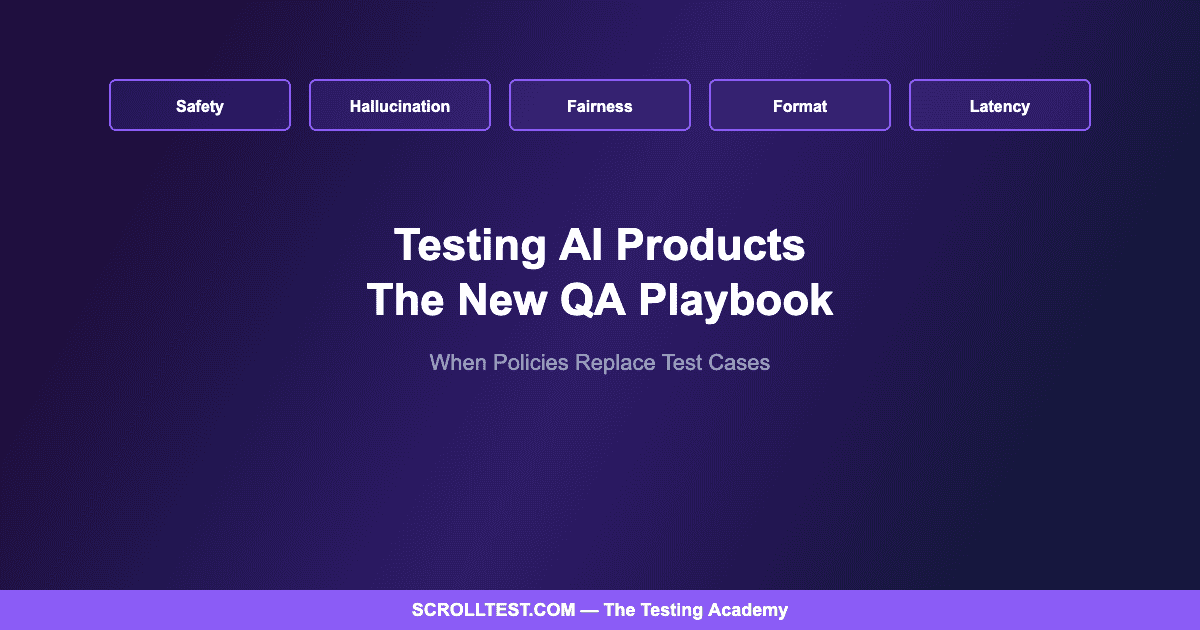
Traditional functional testing does not disappear when you add AI features, but it becomes insufficient. Five new test categories emerge that QA teams must add to their repertoire.
Safety and boundary tests verify that the AI system refuses to engage with harmful requests, stays within its defined role, and does not leak sensitive information. These are the guardrails. If your AI chatbot is designed to answer product questions, a safety test confirms it declines to provide medical advice, refuses to generate offensive content, and does not reveal internal system prompts when cleverly prompted.
Hallucination resistance tests check whether the model fabricates information. This is especially critical for products where the AI presents factual claims — customer support bots, documentation assistants, data analysis tools. You provide prompts about topics the model should not have information on and verify it responds with appropriate uncertainty rather than confident fabrication.
Fairness and bias tests evaluate whether the AI treats different demographic groups equitably. This requires building test datasets that represent diverse inputs and analyzing whether the model’s outputs show systematic bias. A hiring tool that scores resumes differently based on gender-associated names is not functionally broken — every function call returns a result — but it is qualitatively defective.
Format adherence tests verify that the model produces output in the expected structure. When your application expects JSON responses from an LLM, you need tests confirming the model consistently returns valid JSON rather than narrative text. When your chatbot should respond in specific languages based on user locale, you test that it actually does.
Performance and latency tests matter differently for AI features. An LLM response that takes 8 seconds is not a bug in the traditional sense, but it may be unacceptable for a real-time chat interface. Establishing latency budgets for AI features and testing against them is a new QA responsibility.
Tools for AI Testing: PromptFoo, LangSmith, and Beyond
The tooling landscape for AI testing is emerging rapidly. PromptFoo has become a go-to framework for evaluation-driven testing of LLM behavior. It allows you to define test cases with expected outcomes, run them against any model endpoint, and generate pass/fail reports. A senior QA engineer recently demonstrated a PromptFoo setup evaluating a local Llama-3.2 model with results showing 4 passed, 2 failed, and 1 partial test across role boundary, hallucination resistance, and JSON extraction categories — exactly the kind of structured evaluation QA teams should be doing before any AI feature reaches production.
LangSmith provides observability and tracing for LLM applications, letting you inspect the full chain of prompts, retrievals, and responses that produce a final output. For QA engineers, this is the equivalent of having detailed logs for every step of a complex business process — essential for debugging when an AI feature produces unexpected results.
DeepEval and RAGAS focus on evaluating RAG (Retrieval-Augmented Generation) systems specifically, measuring metrics like faithfulness (does the response accurately reflect the retrieved documents?) and relevance (did the retrieval system find the right documents?). These tools address the unique failure modes of AI systems that combine retrieval and generation.
🚀 Build Real AI Testing Skills
Stop testing AI by guesswork. Learn DeepEval, RAG evaluation, and agent testing with guided projects.
Building AI Test Harnesses into CI/CD
AI evaluations should not be manual, one-time exercises. They belong in your CI/CD pipeline, triggered on every model version change, every prompt template update, and every configuration modification. The integration pattern is similar to traditional test automation: define your evaluation suite, run it automatically, gate deployments on pass rates.
The key difference is that AI test results are probabilistic rather than binary. A traditional test either passes or fails. An AI evaluation might show a 92% pass rate on safety tests — which sounds good until you realize that 8% failure rate means 1 in 12 users might receive an unsafe response. QA teams need to define acceptable thresholds for each evaluation category and treat threshold violations as deployment blockers, just like they would treat a failing integration test.
The Honest Caveats
AI testing is a nascent field. The tools are improving rapidly but are not yet as mature as traditional testing frameworks. PromptFoo, LangSmith, and DeepEval are all actively developing, and their APIs and capabilities change frequently. What I describe here reflects the state of these tools as of early 2026.
Comprehensive AI testing is expensive. Running evaluation suites against LLM endpoints consumes API credits. Running them locally requires GPU hardware. The cost-per-evaluation is orders of magnitude higher than running a unit test, and QA teams need to budget accordingly.
Most importantly, AI testing requires QA engineers to develop new skills — prompt engineering, statistical analysis, and a basic understanding of how language models work. This is not a weekend upskill. It is a genuine expansion of the QA discipline that will take months of learning and practice to develop proficiency.
The Career Opportunity
The flip side of that learning curve is career opportunity. Job postings for “AI-SDET Engineer,” “AI QA Engineer,” and “Principal QA Engineer – AI Testing” are appearing with increasing frequency and commanding premium salaries. The QA engineers who invest in AI testing skills now are positioning themselves for the highest-demand roles in the industry over the next three to five years.
The transition from traditional QA to AI testing is not a replacement — it is an expansion. Every skill you have built in test strategy, test design, and automation engineering transfers directly. You are adding a new dimension to your existing expertise, not starting over. And the teams that have QA engineers who understand both traditional testing and AI evaluation will have a significant quality advantage over those that treat AI features as untestable black boxes.
AI testing — from your first PromptFoo evaluation to a full CI/CD-integrated LLM quality pipeline — is the fastest-growing module in my AI-Powered Testing Mastery course. Module 10 walks through building a complete AI test harness from scratch.
🎓 Become an AI-Powered QA Engineer
Join hundreds of SDETs mastering LLM, RAG, and agent testing. Lifetime access, hands-on labs, and a job-ready portfolio.