AI Test Data Generation: Synthetic Data QA Can Trust
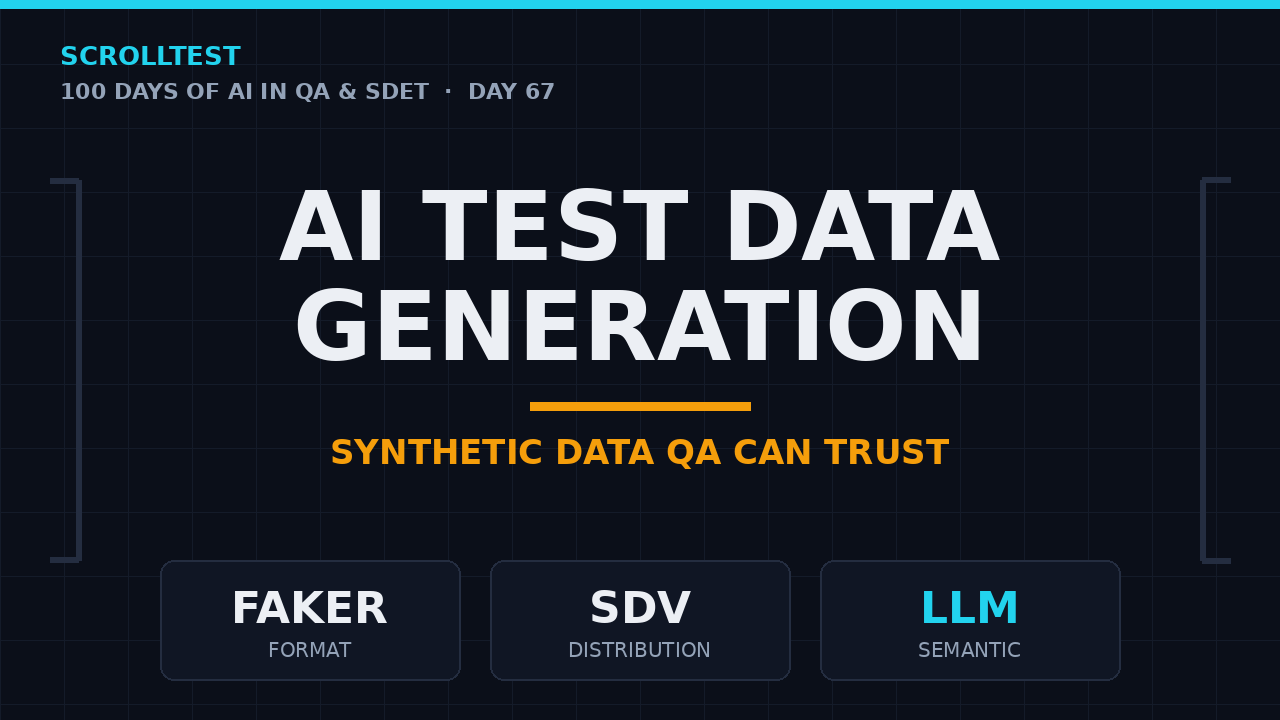
Most QA teams still build test data the same way they did in 2015: a spreadsheet of fake names, a few hardcoded edge cases, and a production dump pasted into staging. AI test data generation changes that, but only if you treat the generated data as something to test, not something to trust. In this guide I will walk you through the three tiers of synthetic test data, a working Python example, and the exact checklist QA teams need before any of it ships.
Table of Contents
- What AI Test Data Generation Actually Means
- Why Your Test Data Is Your Weakest Link
- The Three Tiers of AI Test Data
- Generating Test Data With an LLM: Working Code
- LLMs Lie. Here Is How QA Validates the Output
- Schema and Constraint Validation With Pydantic
- The QA Checklist for AI Test Data
- Where Synthetic Data Breaks Down
- Wiring It Into CI
- India Context: What This Means for Your Career
- Key Takeaways
- FAQ
Contents
What AI Test Data Generation Actually Means
AI test data generation is the practice of using machine learning models, statistical generators, or large language models to create the records your tests run against. It is not one thing. It is a spectrum, and most of the confusion I see in teams comes from treating the whole spectrum as interchangeable.
At one end you have deterministic fake data. A library like Faker produces a name, a phone number, or an address from fixed templates. There is no intelligence in it. There is no model. It is a glorified random string generator with a dictionary, and that is exactly why it is useful.
At the other end you have generative synthetic data. A model learns the shape and distribution of a real dataset, then produces new rows that look statistically similar but are not copies of real people. This is what SDV (Synthetic Data Vault) and Gretel do for tabular data, and what an LLM does for unstructured or semantic data like emails, support tickets, and product descriptions.
The useful mental model is this: fake data looks the part, synthetic data behaves the part. A Faker email is a plausible string. A synthetic support ticket, generated by an LLM, contains the same angry-tone-and-typo patterns your real customers produce. That distinction decides which tool you reach for.
Why Your Test Data Is Your Weakest Link
I watch teams pour months into framework architecture and then feed the whole thing production data they copied to staging. That is a data leak waiting to happen, and a weak test suite waiting to be exposed.
Three problems show up over and over.
First, production data is radioactive. Real names, real phone numbers, real addresses, real payment details. If your test environment gets breached, you have exposed customer data, and under India’s Digital Personal Data Protection (DPDP) Act, 2023, that can mean penalties up to ₹250 crore for significant breaches. Masking is a bandage; most teams mask inconsistently and a determined engineer can still re-identify people from a few unmasked fields.
Second, production data is boring. Your production database is full of the happy path. The interesting test cases, the 300-character name, the negative balance, the address with a pincode that does not exist, the phone number in the wrong country format, are rare. They sit at the long tail of the distribution, and copying the most common rows gives you none of them.
Third, hand-written test data does not scale. A manual tester can type 50 customer records in a day. A performance test needs 100,000. A good synthetic data pipeline generates the 100,000, and it generates the specific 3 nasty rows your happy-path copy missed.
The Three Tiers of AI Test Data
I group the tools into three tiers. Each tier answers a different question, and a mature team uses all three.
Tier 1: Faker, the deterministic workhorse
Faker is the most popular data library in the Python and JavaScript ecosystems by a wide margin. The Python package crossed 80.5 million downloads in the last month alone, and @faker-js/faker on npm pulls about 71.6 million downloads a month. That is not niche adoption; that is the default.
Use Faker when you need a value that passes a format check. A credit card number, an IBAN, a latitude, a job title. It is fast, it is seedable (so your tests are reproducible), and it makes no claims about realism. That last part is a feature. You want it to be dumb.
Tier 2: Statistical synthetic data, SDV and Gretel
When you need the distribution to match reality, reach for SDV. It is the most established open-source project in the space, with over 3,500 stars on GitHub, and it learns the correlations in your real table so the synthetic table keeps them. If your real customers show a correlation between age group and average order value, the SDV output keeps that correlation instead of generating age and order value independently.
Gretel is the commercial cousin, and it adds differential-privacy modes that give you a measurable privacy guarantee rather than a vague “we masked it.” For regulated data, that matters.
Tier 3: LLM-generated semantic data
This is where AI test data generation gets interesting. An LLM can produce data that carries meaning: a customer complaint that actually complains, an onboarding flow that references the right product, a bug report written the way a real engineer writes one. Faker and SDV cannot do this. They have no semantics.
The cost is control. An LLM will happily invent a pincode that does not exist, a date in the wrong format, or a name that is 200 characters long. Which is why Tier 3 always ships with a validation layer. More on that below.
Generating Test Data With an LLM: Working Code
Here is a minimal generator that produces customer records with an LLM and returns them as JSON. I use the OpenAI-compatible chat API because it works with OpenAI, Azure OpenAI, and most self-hosted endpoints through Ollama or vLLM.
import json
from openai import OpenAI

client = OpenAI()  # set OPENAI_API_KEY, or point base_url at your endpoint

SYSTEM = (
    "You generate synthetic test data. Return only a JSON array. "
    "No markdown, no explanation. Follow the schema exactly."
)

def generate_customers(n=20):
    prompt = (
        f"Generate {n} synthetic customer records for an Indian e-commerce QA suite. "
        "Each record must be an object with these keys: name, email, phone, "
        "city, pincode, order_total, and a support_ticket string that reads like "
        "a real angry or confused customer wrote it in 2 sentences. "
        "Pincode must be a valid 6-digit Indian pincode. "
        "phone must match Indian mobile format starting with 6, 7, 8, or 9. "
        "Include at least 2 records that break the happy path: "
        "one with a 300-character name and one with a negative order_total."
    )
    resp = client.chat.completions.create(
        model="gpt-4o-mini",
        messages=[{"role": "system", "content": SYSTEM},
                  {"role": "user", "content": prompt}],
        temperature=1.0,
    )
    text = resp.choices[0].message.content.strip()
    return json.loads(text)
Notice the prompt asks for specific failure rows, not just random records. That is the part most teams skip. If you let the model generate freely, it gives you 20 average customers. If you tell it to break the happy path, it gives you the rows your suite actually needs.
LLMs Lie. Here Is How QA Validates the Output
Every claim an LLM makes about its own output is unverified. The generation step is only half the work. The other half is a validation pass that rejects bad rows before they reach your tests.
Validity checks
Format is the easiest thing to check and the first thing models get wrong. A pincode must be six digits. A phone number must match the Indian mobile pattern. An email must contain one @. Here is a compact validator:
import re

PINCODE = re.compile(r"^\d{6}$")
MOBILE = re.compile(r"^[6-9]\d{9}$")
EMAIL = re.compile(r"^[^@\s]+@[^@\s]+\.[^@\s]+$")

def validate(record):
    errors = []
    if not PINCODE.match(str(record["pincode"])):
        errors.append("bad pincode")
    if not MOBILE.match(str(record["phone"])):
        errors.append("bad phone")
    if not EMAIL.match(record["email"]):
        errors.append("bad email")
    if not (0 < len(record["name"]) <= 300):
        errors.append("name length out of range")
    return errors

for r in generated:
    errs = validate(r)
    if errs:
        print("REJECT", r["name"], errs)
Distribution checks
A valid row can still be a bad row. If you asked for 20 customers and 19 of them live in Mumbai, the model over-fit to a single example. Check the spread of categorical fields and the range of numeric ones, and reject or regenerate when they cluster.
PII leakage checks
Synthetic data should contain no real people. Before you load generated rows into a shared environment, run a scan for identifiers that match your real customer base: exact name matches, real phone numbers, real email addresses. A generated record that accidentally reproduces a real customer is a privacy incident, and DPDP does not care that you meant well. This is the same security mindset I apply to prompt injection testing: assume the adversarial case, then prove it cannot happen.
Schema and Constraint Validation With Pydantic
For anything that lands in a test database, I prefer Pydantic. It turns the implicit schema in your head into code that fails loudly and gives you a line number.
from pydantic import BaseModel, Field, field_validator
import re

class Customer(BaseModel):
    name: str = Field(min_length=1, max_length=300)
    email: str
    phone: str
    city: str
    pincode: str
    order_total: float
    support_ticket: str

    @field_validator("phone")
    @classmethod
    def check_phone(cls, v):
        assert re.fullmatch(r"[6-9]\d{9}", v), f"invalid Indian mobile {v}"
        return v

    @field_validator("pincode")
    @classmethod
    def check_pincode(cls, v):
        assert re.fullmatch(r"\d{6}", v), f"invalid pincode {v}"
        return v

clean = [Customer(**r) for r in generated]  # raises on the first bad row
This is the part that makes AI test data generation safe to use in CI. The generator proposes, Pydantic disposes. If the model drifts and starts emitting a new field or a wrong type, the pipeline stops instead of quietly writing garbage into your database.
The QA Checklist for AI Test Data
Before any generated dataset goes anywhere near a shared environment, I run it through this checklist. Print it and stick it on the monitor.
- Seed everything. A generator that cannot reproduce yesterday’s failing row is a debugging nightmare. Fix the seed in CI.
- Validate schema on ingest. Pydantic, JSON Schema, or a database constraint. Never trust the model’s word.
- Check format, not just presence. A pincode field that contains “Bangalore” is worse than a missing field.
- Check the distribution. Categorical spread and numeric range. Regenerate if everything clusters.
- Ask for failure rows explicitly. Happy-path-only data hides bugs.
- Scan for PII leakage. Compare generated identifiers against your real customer base.
- Tag synthetic rows. Mark them in the database so nobody mistakes them for production and nobody ships them to a real customer.
- Review a human sample. Read 10 generated support tickets. If they all sound like a polite chatbot, your model is not representing real users.
Where Synthetic Data Breaks Down
I am not going to sell you synthetic data as a magic fix, because it has real limits and pretending otherwise is how teams get burned.
It does not catch unknown unknowns. Synthetic data is only as good as the distribution it was trained on. If your generator learned from a dataset that never contained a certain class of bug, it will not invent that class. You still need a small set of real, curated edge cases.
LLM data is non-deterministic by default. Two runs produce different rows. Without a fixed seed and a schema gate, your “flaky test” investigation might actually be a data generation problem in disguise. I have watched teams chase a UI bug for two days that turned out to be a generated name with an emoji in it.
Cost and latency are real. Calling an LLM for 100,000 rows is slow and not free. That is why the three tiers matter: Faker for the bulk, SDV for the distribution, LLM only for the semantic slice that actually needs meaning.
Wiring It Into CI
The generator should live in your repo, not in someone’s head. Here is a pytest fixture that generates, validates, and tears down the data per run:
import pytest

@pytest.fixture(scope="session")
def customers():
    rows = generate_customers(n=20)
    clean = [Customer(**r).model_dump() for r in rows]
    load_into_test_db(clean, tag="synthetic")
    yield clean
    wipe_test_db(tag="synthetic")
And in GitHub Actions, pin the seed and run the validation as a gate before your suite executes:
- name: Generate and validate test data
  run: |
    python -m scripts.generate --seed 42 --n 20
    python -m scripts.validate --strict
- name: Run tests
  run: pytest -q
If the data generation step fails, the suite never runs. That is the correct order. A test suite is only as trustworthy as the data behind it, so data quality becomes a first-class CI gate, the same way you already gate linting and unit tests.
India Context: What This Means for Your Career
If you are a manual tester or an automation engineer in India, synthetic data is one of the fastest ways to move up the value chain, because it is a skill companies genuinely need and most candidates do not have.
Think about it from a hiring manager’s side. Every Indian product company and every GCC (global capability centre) of a US firm is handling customer data under DPDP now. They cannot copy production into staging the way they used to. The engineer who can build a compliant synthetic data pipeline, with validation and a PII scan, is solving a legal problem and a testing problem at the same time. That is exactly the profile that maps to the ₹25 to 40 LPA senior SDET band, and it is a concrete, demonstrable skill you can show in an interview with a GitHub repo and a 15-minute walkthrough.
If you want to stay on the practical side of AI in QA instead of the hype side, this is one of the best places to start. Build one generator, validate it with Pydantic, run it in CI, and you have a portfolio piece that beats another generic “I did a Playwright course” line.
Here is a weekend-sized version of that portfolio piece. Take one API or one database schema you already test, write a generator that produces 20 valid records plus 3 deliberate failure rows, wrap it in a Pydantic model, and run it from a pytest fixture with a fixed seed. Put the repo on GitHub and record a 10-minute walkthrough showing the generated data, the validation output, and the CI gate. That one artifact answers the three questions every AI QA interviewer asks: can you generate it, can you validate it, and can you ship it in a pipeline.
Key Takeaways
- AI test data generation spans three tiers: Faker for format, SDV/Gretel for distribution, LLMs for semantic meaning. Use all three, not one.
- Production data in staging is a privacy incident under India’s DPDP Act. Synthetic data is the compliant alternative, but it must be validated.
- LLM output is unverified by default. Always run schema, format, distribution, and PII checks before loading generated rows.
- Ask the generator for failure rows explicitly. Happy-path-only data hides the bugs you are paid to find.
- Make data generation a CI gate with a fixed seed. A suite is only as trustworthy as the data behind it.
FAQ
Is synthetic test data better than masked production data?
For most non-production environments, yes. Masked production data still carries re-identification risk and still skews toward the happy path. Synthetic data gives you control over edge cases and removes the PII risk, at the cost of some realism.
Can I trust LLM-generated test data in a regulated environment?
Only after validation. Run schema checks, a PII scan, and a human review of a sample before it touches any shared environment. For regulated data, pair LLM generation with a statistical tool like Gretel’s differential-privacy mode for a measurable guarantee.
How much does AI test data generation cost?
It depends on the tier. Faker is free and local. SDV is free and open source. LLM generation costs per token, so reserve it for the semantic slice, typically hundreds of rows, not hundreds of thousands. Generating 20 realistic support tickets costs a fraction of a cent.
Does synthetic data replace real edge cases from production?
No. Synthetic data cannot invent a bug class it never saw. Keep a small, curated set of real anonymised edge cases alongside your generated data.
Where does AI test data generation fit in the broader AI QA stack?
It is the upstream input. The data you generate feeds your tests, and the quality of that data is measured with the same eval and observability tooling you already use for LLM features. See my earlier pieces on running eval gates in CI with PromptFoo and observability for LLM apps for the rest of the loop.
This is Day 67 of the 100 Days of AI in QA and SDET series. The full running list lives on ScrollTest.