MCP Server Testing: Compatibility Checks for AI QA
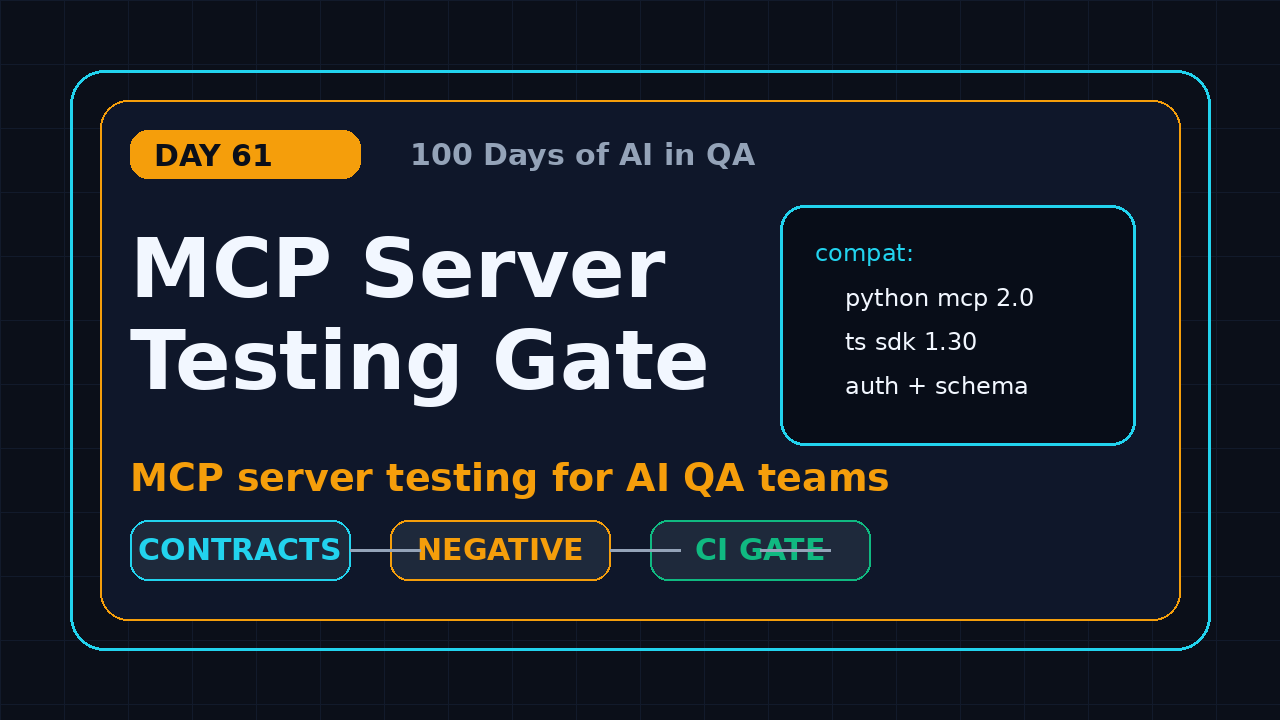
Day 61 of 100 Days of AI in QA and SDET. MCP server testing is now a real QA responsibility, not a side task for platform engineers. If your agent can call tools, read resources, or touch production-like data through Model Context Protocol, your test plan needs compatibility checks before the next SDK upgrade reaches CI.
I see the same pattern on AI projects: the demo works, the agent calls a tool once, everyone celebrates, and then the first SDK update exposes weak schemas, missing auth tests, broken streaming behavior, or silent JSON-RPC errors. This article gives you a practical MCP server testing plan you can run as an SDET, QA lead, or automation engineer.
Table of Contents
- Why MCP Server Testing Matters Now
- What Changed in the Recent MCP SDK Releases
- MCP Server Testing Strategy for AI QA Teams
- Contract Tests for Tools, Resources, and Prompts
- Negative, Auth, and Safety Cases
- Compatibility Matrix for Python and TypeScript Clients
- CI Gate Example for MCP Server Testing
- Observability and Debugging
- India Context for SDETs
- Key Takeaways
- FAQ
Contents
Why MCP Server Testing Matters Now
The Model Context Protocol has moved from interesting AI plumbing to production integration work. The official MCP documentation describes the protocol as a standard way for applications to provide context and tools to large language models. That sounds simple, but the QA impact is large: the agent is no longer just generating text. It can call your internal search, issue tracker, browser automation layer, data store, payment sandbox, or deployment workflow.
Once an agent has tools, the quality problem changes. You are not only testing prompts. You are testing a distributed system with a probabilistic caller, typed tool contracts, permissions, transport behavior, version negotiation, and observability gaps. A normal API smoke test is not enough.
What breaks first in real teams
The first failures I usually see are boring, expensive, and avoidable:
- A tool schema accepts a string in documentation but the server expects an enum.
- A client sends valid JSON-RPC, but the server returns an unhelpful error object.
- A resource endpoint leaks data because the auth test only covered the happy path.
- A streaming response works locally but fails behind a proxy or CI container.
- An SDK upgrade changes validation behavior and your agent silently loses a tool.
These are QA problems. They affect release confidence, not just developer experience.
The QA mental model
Treat an MCP server like a contract-heavy API with an LLM-facing user interface. Your test plan should answer five questions:
- Can every supported client discover the server capabilities?
- Do tool, resource, and prompt schemas match the documented behavior?
- Do bad requests fail safely with useful errors?
- Does auth block the wrong user, not just allow the right one?
- Can CI detect compatibility drift before production agents hit it?
If you already build API automation, this is a natural extension. The difference is that the consumer may be an AI agent that retries, reformulates, and calls tools in surprising order.
What Changed in the Recent MCP SDK Releases
This day is anchored on the recent MCP SDK movement. The MCP Python SDK v2.0.0 release was published on 2026-07-28. The release notes say it is the stable v2 release, supports the 2026-07-28 protocol revision, serves earlier revisions from the same server, and makes pip install mcp install the 2.x line. PyPI also lists mcp 2.0.0 with Python >=3.10.
On the TypeScript side, the @modelcontextprotocol/sdk 1.30.0 release was published on 2026-07-27. The release notes include validation, end-to-end test suite, streamable HTTP, protocol version header, and auth-related changes. The npm registry lists @modelcontextprotocol/sdk latest as 1.30.0, published on 2026-07-27.
Why these details matter for QA
Release notes are not just developer trivia. They tell you where regression risk lives. If a release mentions validation, transport, auth, protocol headers, and E2E coverage, your test plan should include those same areas.
For MCP server testing, I would not approve an upgrade by running only one manual Claude Desktop connection. I would build a small compatibility matrix and test both SDK families because many teams write servers in Python but clients or test harnesses in TypeScript.
Source-backed facts to keep in your release note
- Python SDK v2.0.0 is the stable v2 release and supports the 2026-07-28 protocol revision, per the GitHub release notes.
- PyPI shows
mcp==2.0.0and Python>=3.10. - TypeScript SDK 1.30.0 is the current npm latest version from the registry data checked for this article.
- The official MCP docs should be treated as the canonical source for protocol concepts and tutorials.
MCP Server Testing Strategy for AI QA Teams
A good MCP server testing strategy has layers. Do not jump straight to an end-to-end agent scenario. Start with deterministic checks, then add agent behavior only after the contract is stable.
Layer 1: server capability smoke tests
Start by proving the server starts, accepts the intended transport, and advertises the capabilities you expect. This is your build breaker. If this fails, nothing above it matters.
- Server process starts in a clean CI environment.
- Expected transport works: stdio, streamable HTTP, or the approved deployment transport.
- Client can initialize with the expected protocol revision.
- Tool list contains only approved tools.
- Resource list does not expose test-only or internal-only resources.
Layer 2: schema and contract tests
Every tool is a contract. If the contract is loose, the model will discover the loose edges faster than your developers expect. Validate required fields, optional fields, enum values, nested objects, default behavior, and descriptions.
Descriptions matter because agents use them to decide what to call. A misleading description is a functional bug in an AI system.
Layer 3: behavior tests
After schema checks, test the real behavior. For a search tool, verify ranking, empty result handling, page limits, and forbidden queries. For a ticket creation tool, verify idempotency, duplicate detection, attachment behavior, and audit events. For a browser testing tool, verify selectors, timeouts, screenshots, and failure artifacts.
Layer 4: agent workflow tests
Only now bring in the agent. Ask the agent to complete tasks that require one or more tool calls. The goal is not to prove that the model is smart. The goal is to prove that your MCP server gives the model a safe, predictable interface.
If you need a related AI QA baseline, read AI Regression Testing Checklist for PromptFoo Pipelines. The same release-gate thinking applies here, but MCP adds tool contracts and protocol compatibility.
Contract Tests for Tools, Resources, and Prompts
MCP has multiple surfaces. Most teams test tools and forget resources and prompts. That is a mistake. If the agent sees stale resources or bad prompt templates, the tool calls may still pass while the workflow produces wrong outcomes.
Tool contract checklist
For each tool, write a table with these fields:
- Tool name and owner.
- Purpose in one sentence.
- Input schema with required fields.
- Output schema with success and error shapes.
- Allowed roles or scopes.
- Rate limits and timeout budget.
- Audit events expected after execution.
- Rollback or compensation behavior, if the tool mutates state.
Then convert the table into automated tests. The table is not documentation theater. It is a compact spec.
Resource contract checklist
Resources often become the hidden data leak. Your server may expose project files, tickets, wiki pages, logs, or test reports. Check the following:
- Only approved resource URIs are discoverable.
- Resource content is scoped by tenant, project, and user role.
- Large resources paginate or truncate predictably.
- Binary resources have correct media type handling.
- Deleted or archived resources return safe errors.
Prompt contract checklist
Prompts should have tests too. A prompt template can break when a variable is renamed, when a default instruction changes, or when a model-facing instruction contradicts a tool description.
Validate prompt names, arguments, required variables, rendered output, and safety boundaries. If the prompt asks the agent to call a tool that no longer exists, that is a release blocker.
TypeScript example: schema-level MCP tool check
import { describe, expect, test } from "@playwright/test";

type Tool = {
  name: string;
  description?: string;
  inputSchema?: {
    type: string;
    properties?: Record<string, unknown>;
    required?: string[];
  };
};

async function listTools(): Promise<Tool[]> {
  // Replace this with your MCP client initialization.
  // Keep the helper deterministic so CI can run it without a real LLM.
  return globalThis.__MCP_TEST_CLIENT__.listTools();
}

describe("MCP tool contracts", () => {
  test("approved tools are discoverable with strict schemas", async () => {
    const tools = await listTools();
    const names = tools.map(t => t.name).sort();

    expect(names).toEqual([
      "create_test_case",
      "search_requirements",
      "summarize_failure_log"
    ]);

    const createTestCase = tools.find(t => t.name === "create_test_case")!;
    expect(createTestCase.description).toContain("test case");
    expect(createTestCase.inputSchema?.type).toBe("object");
    expect(createTestCase.inputSchema?.required).toEqual(
      expect.arrayContaining(["title", "steps", "expectedResult"])
    );
  });
});
The point is simple: test the server without asking a model to behave. Models are useful later. Contract tests should be boring and deterministic.
Negative, Auth, and Safety Cases
The happy path proves the demo. The negative path protects production. MCP server testing must include malicious, mistaken, and low-permission callers because agents can create weird input without bad intent.
Negative input cases
Start with basic invalid data and move toward model-shaped mistakes:
- Missing required fields.
- Wrong type, such as array instead of string.
- Unknown enum values.
- Oversized payloads and long strings.
- Unicode edge cases and control characters.
- Conflicting fields, such as
startDateafterendDate. - Prompt-injection text inside a field that should be treated as data.
Your expected result should not be “server fails.” It should be a precise error code, safe message, no state mutation, and a useful audit log.
Auth cases that teams skip
Auth bugs are more serious when an agent can call tools. Test these cases before every release:
- No token or missing session.
- Expired token.
- Valid user without tool permission.
- Valid user from a different tenant or project.
- Read-only user attempting a write tool.
- Admin-only resource requested by a normal user.
- Token replay across environments.
Safety cases for tool-calling agents
Safety testing is not only about dramatic jailbreaks. It includes everyday guardrails. Can the agent create 100 tickets in a loop? Can it delete data when the user asked for a summary? Can it send private logs to a summarization tool? Can it call a production tool from a staging session?
I like adding a simple “dangerous action requires confirmation” test. If a tool mutates state, the server or surrounding agent workflow should enforce confirmation, role checks, or dry-run mode. This is where QA leadership matters.
Compatibility Matrix for Python and TypeScript Clients
MCP compatibility is not a feeling. It is a matrix. Keep it small enough to run on every pull request, then run a larger version nightly.
Minimum matrix for Day 61
| Area | Python SDK v2 | TypeScript SDK 1.30 | Expected signal |
|---|---|---|---|
| Initialize | Required | Required | Protocol negotiation succeeds |
| List tools | Required | Required | Approved tools only |
| Call read tool | Required | Required | Stable JSON result |
| Call write tool | Required | Required | Permission and audit checks pass |
| Invalid payload | Required | Required | Structured error, no mutation |
| Transport timeout | Required | Required | Clear timeout behavior |
The Python release notes say v2 serves earlier revisions from the same server. That is useful, but do not treat it as a reason to skip tests. Backward compatibility should be proven against the client versions your team actually ships.
Version policy
For QA teams, I recommend this policy:
- Pin SDK versions in test runners.
- Run a scheduled job against latest SDK versions once per day.
- Open an upgrade ticket when latest differs from pinned.
- Attach the compatibility matrix result to the ticket.
- Promote the new version only after contracts, auth, and transport checks pass.
This is the same mindset behind PromptFoo DeepEval CI Gate: QA Template. Release gates should be evidence, not optimism.
CI Gate Example for MCP Server Testing
A useful CI gate has three qualities: deterministic, fast, and loud. It should fail within minutes when an MCP contract changes. It should not depend on a paid model call for every pull request.
Suggested CI stages
- Install pinned Python and TypeScript MCP SDK dependencies.
- Start the MCP server with test credentials.
- Run capability and schema tests.
- Run negative and auth tests.
- Run one small agent workflow test in a sandbox.
- Upload logs, tool lists, and contract snapshots as artifacts.
GitHub Actions example
name: mcp-server-compatibility

on:
  pull_request:
  workflow_dispatch:

jobs:
  mcp-gate:
    runs-on: ubuntu-latest
    timeout-minutes: 12
    steps:
      - uses: actions/checkout@v4

      - uses: actions/setup-python@v5
        with:
          python-version: "3.11"

      - uses: actions/setup-node@v4
        with:
          node-version: "22"

      - name: Install MCP test dependencies
        run: |
          python -m pip install "mcp==2.0.0" pytest
          npm ci

      - name: Start MCP server
        run: |
          nohup python -m qa_mcp_server --env test > mcp.log 2>&1 &
          sleep 3

      - name: Run compatibility tests
        run: |
          npm run test:mcp-contracts
          pytest tests/mcp/test_auth_and_negative_cases.py

      - name: Upload MCP artifacts
        if: always()
        uses: actions/upload-artifact@v4
        with:
          name: mcp-test-artifacts
          path: |
            mcp.log
            artifacts/mcp-tool-list.json
            artifacts/mcp-contract-snapshot.json
Adjust this to your transport. If you use stdio, your harness starts the server as a subprocess. If you use streamable HTTP, add health checks and proxy behavior. The shape of the gate stays the same.
Snapshot contracts carefully
Contract snapshots are useful when they are reviewed. They are dangerous when teams auto-update them without reading the diff. Store a JSON snapshot of tool names, descriptions, input schemas, and output examples. On pull requests, show the diff. If a tool description changes, make the reviewer decide whether agent behavior could change.
Observability and Debugging
When an MCP workflow fails, the bug report often says “agent failed.” That is not enough. You need traces that separate model decision, client request, server validation, tool execution, and downstream API behavior.
Log the right events
For each tool call, log these fields in non-production-safe form:
- Correlation ID.
- Agent run ID or session ID.
- User and tenant scope, redacted where needed.
- Tool name and schema version.
- Input validation result.
- Execution duration.
- Downstream service status.
- Error type and safe error message.
- Mutation result or dry-run result.
Do not log secrets, full private documents, or raw credentials. QA needs enough signal to debug without creating a new data risk.
Failure buckets
I use five buckets for MCP failures:
- Contract issue: schema, description, required fields, response shape.
- Permission issue: role, tenant, token, environment boundary.
- Transport issue: timeout, streaming, proxy, buffer, content type.
- Tool implementation issue: downstream API bug or business logic mismatch.
- Agent behavior issue: wrong tool choice, repeated calls, missing confirmation.
For a broader AI QA portfolio angle, read AI QA Portfolio Project: Build an Eval CI Gate. MCP testing is a strong portfolio project because it proves protocol thinking, automation depth, and risk ownership.
India Context for SDETs
For SDETs in India, MCP server testing is a career signal. Many service-company QA roles still focus on UI regression, manual sign-off, and Selenium maintenance. Product companies and AI-heavy teams increasingly need people who can test agents, workflows, SDK upgrades, and CI gates.
I am not saying every manual tester must become an AI researcher. I am saying the next strong SDET profile will include API testing, Playwright, CI/CD, and AI system evaluation. MCP fits naturally into that path because it combines protocol testing, contract thinking, security awareness, and automation.
What to put on your resume
If you build a sample MCP test harness, write the resume bullet like this:
- Built an MCP server compatibility gate covering Python SDK v2 and TypeScript SDK clients.
- Automated schema, auth, negative, and transport checks for 12 agent tools.
- Added contract snapshots and CI artifacts to detect tool drift before release.
That sounds stronger than “worked on AI testing.” It shows ownership. For mid-level SDETs targeting product companies, that difference matters.
Key Takeaways
MCP server testing is now part of serious AI QA work. The Python SDK v2.0.0 and TypeScript SDK 1.30.0 releases are a good reminder that agent tooling changes quickly, and QA teams need a repeatable compatibility gate.
- Start deterministic: test capabilities, schemas, and errors before agent workflows.
- Test all MCP surfaces: tools, resources, and prompts can all break production behavior.
- Auth is a first-class test area: agent tools can mutate data, so negative permission checks matter.
- Use a version matrix: pin SDKs, test latest daily, and attach evidence to upgrade tickets.
- Make failures diagnosable: log correlation IDs, validation results, tool versions, and safe error messages.
My recommendation for Day 61 is simple: pick one internal MCP server or build a sample one, then add a CI gate that fails on contract drift. That one habit will catch more real bugs than another prompt-only demo.
FAQ
Is MCP server testing just API testing with a new name?
No. It includes API-style contracts, but the consumer is often an AI agent. That means tool descriptions, prompt templates, resources, model behavior, retries, and safety boundaries all affect quality.
Should QA engineers learn the MCP Python SDK or TypeScript SDK first?
Pick the stack your team uses. If you are building automation with Playwright and Node, start with TypeScript. If your AI tooling is Python-heavy, start with Python. For release gates, it is valuable to test both when your production ecosystem uses both.
Do I need real LLM calls in every MCP test?
No. Most MCP server testing should be deterministic. Use real LLM or agent workflow tests for a small number of end-to-end scenarios, not for every schema and negative case.
What is the fastest first test to add?
Add a tool discovery test that asserts the exact tool list and required input schemas. It catches accidental tool exposure, renamed tools, and schema drift quickly.
Where should this live in the pipeline?
Run fast MCP contract tests on every pull request. Run the larger compatibility matrix nightly or before release. If the MCP server controls sensitive actions, keep auth and negative tests in the pull request gate too.