
Release-Impact Cards for QA Framework Upgrades
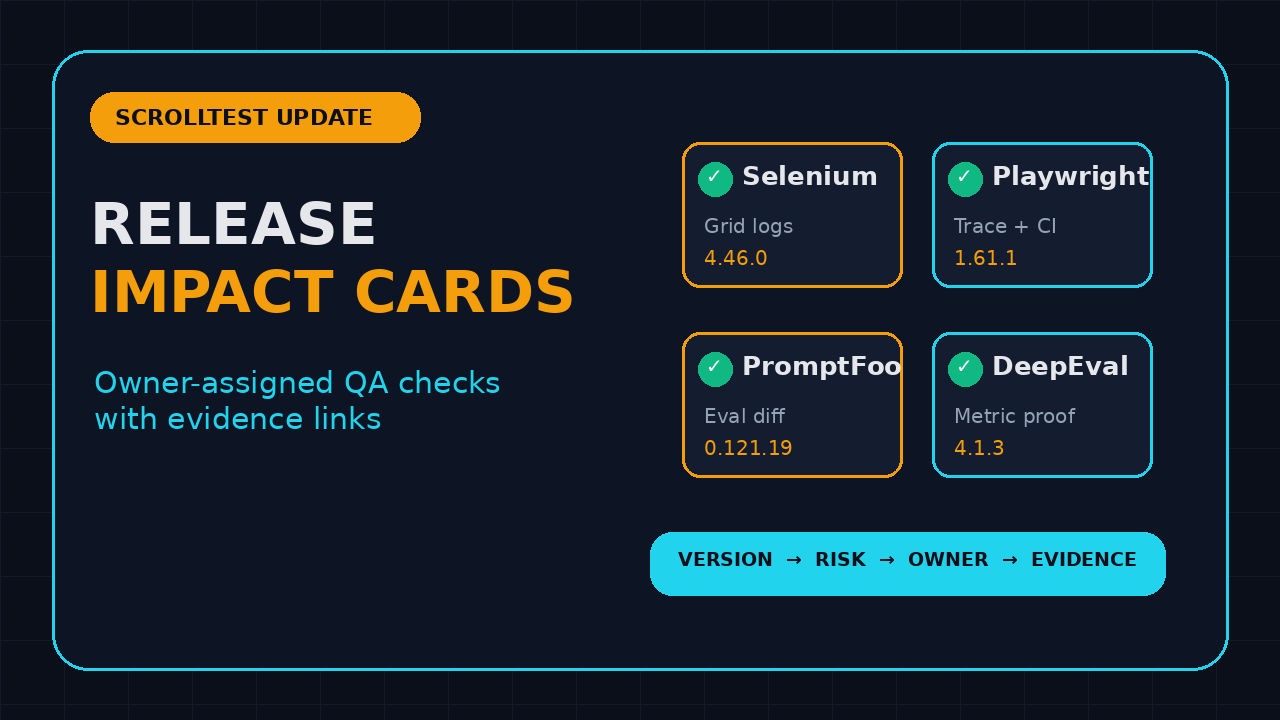
Release-impact cards are my answer to a simple failure pattern: Selenium, Playwright, PromptFoo, or DeepEval ships a new version, but the QA plan stays frozen. ScrollTest now turns those upgrade signals into owner-assigned checks with evidence links, so teams can decide what to test before a framework change reaches production.
This product update is built for SDETs who already have CI, test suites, and release notes, but still lose time deciding what changed and who owns the risk. I want the card to become the smallest useful unit of upgrade governance: one framework version, one impact summary, one owner, one evidence trail.
Table of Contents
- Why Release-Impact Cards Exist
- What ScrollTest Shipped
- Framework Feeds Covered
- The QA Workflow
- The Evidence Model
- CI/CD Example
- India SDET Context
- Rollout Plan
- Key Takeaways
- FAQ
Contents
Why Release-Impact Cards Exist
The upgrade problem is not the version number
Most teams do not fail framework upgrades because they cannot run npm update or pip install -U. They fail because nobody translates a release note into a testable impact. A Playwright release can touch browser binaries, tracing, locators, API testing, or the test runner. A Selenium release can touch Grid, bindings, BiDi, browser driver behavior, or language-specific packages.
The numbers show why this cannot stay informal. At the time of research, the GitHub API reports microsoft/playwright at 93,286 stars and the npm downloads API reports @playwright/test at 187,941,781 downloads in the last month. Selenium is still huge too: the GitHub API reports SeleniumHQ/selenium at 34,308 stars and npm reports selenium-webdriver at 7,514,596 downloads in the last month.
Release notes are not ownership
A release note is a source. It is not an action. The missing layer is ownership. I see teams paste a GitHub link into Slack and call it done. Three days later, a flaky browser test blocks a release, and everyone asks the same question: who checked the framework upgrade?
Release-impact cards fix that gap by converting one version event into a small QA record. The record says what changed, where the risk sits, who owns the check, and what evidence closes the loop.
AI testing makes the issue sharper
The same pattern now exists in LLM QA. PromptFoo and DeepEval are no longer side experiments for many QA teams. The GitHub API reports promptfoo/promptfoo at 23,510 stars, while npm reports promptfoo at 1,695,757 downloads in the last month. The GitHub API reports confident-ai/deepeval at 17,059 stars, and PyPI lists deepeval version 4.1.3.
If an eval framework changes scoring behavior, dataset handling, model routing, or report output, your AI release gate can change without a product code change. That is a QA risk, not just a tooling chore.
What ScrollTest Shipped
A card for every meaningful framework upgrade
ScrollTest now creates release-impact cards for automation framework upgrades across Selenium, Playwright, PromptFoo, and DeepEval feeds. It is a structured testing task that a QA lead can assign during sprint planning or attach to a release gate.
Each card contains:
- Framework name and version, such as Selenium 4.46.0 or Playwright 1.61.1.
- Source release link from GitHub, npm, PyPI, or official docs.
- Impact buckets for runner, browser, grid, selectors, API, eval, or reporting.
- Suggested owner role, usually SDET, QA lead, platform QA, or AI QA owner.
- Evidence checklist with exact artifacts required before closure.
- Risk rating that separates routine patches from upgrade blockers.
The output is built for daily QA work
The goal is not to create another dashboard that nobody opens. The card has to answer the question a manager asks at 6:15 PM before a deployment: did somebody check this tool update? That answer must include evidence, not confidence theater.
For Selenium, a card may ask for Grid smoke evidence, browser-driver compatibility notes, and one failing-test replay if behavior changed. For Playwright, it may ask for a trace from Chromium, Firefox, and WebKit on the top journey. For PromptFoo, it may ask for a baseline eval run, a diff report, and the prompt set used for the comparison. For DeepEval, it may ask for metric version, dataset checksum, and failure examples.
Why this belongs in ScrollTest
ScrollTest already talks to QA teams in the language of checks, risk, and evidence. A release-impact card fits that mental model better than a generic project management ticket. It is close to test automation, close to CI/CD, and specific enough for SDETs to act without a meeting.
If your team already uses the ideas from Selenium 4.46 Grid Regression Plan or Playwright Upgrade Checklist: 3 Files Before Merge, this product update gives you a repeatable place to track that work.
Framework Feeds Covered by Release-Impact Cards
Selenium release feed
Selenium remains the enterprise default in many banks, retail platforms, and service companies. The official Selenium WebDriver documentation defines the browser automation model most teams still recognize. The latest release checked during research was Selenium 4.46.0, published on 2026-07-11 on GitHub.
A Selenium release-impact card focuses on the areas where breakage usually hurts:
- Grid startup, node registration, and session routing.
- Language binding updates for Java, Python, JavaScript, or C#.
- Browser-driver behavior and capability negotiation.
- BiDi-related changes that can affect logs, network, or console capture.
- Docker image changes when Grid runs in CI.
Playwright release feed
Playwright changes land in a different style. The official Playwright installation docs emphasize browser installation, test runner setup, and first-test flow. The latest GitHub release checked during research was Playwright v1.61.1, published on 2026-06-23. Npm showed @playwright/test latest as 1.61.1.
A Playwright release-impact card looks for runner and browser impact first. Did browser binaries change? Did trace output change? Did locator behavior change? Did API testing behavior change? If yes, the card should not be marked complete until a trace, HTML report, and CI run prove the top flows still work.
PromptFoo release feed
PromptFoo sits in the AI testing lane. The official PromptFoo docs position it around evaluating prompts and LLM apps. The latest GitHub release checked during research was 0.121.19, published on 2026-07-14, and npm listed promptfoo latest as 0.121.19.
For PromptFoo, the risk is not browser flakiness. The risk is eval drift. A minor upgrade can affect providers, assertions, red-team output, caching, or report formatting. A release-impact card asks for a baseline run and a post-upgrade run against the same prompt set, same model settings, and same dataset. Without that, the team is guessing.
DeepEval release feed
DeepEval is also in the LLM evaluation workflow. The official DeepEval quickstart introduces the framework as an LLM evaluation framework, and PyPI lists deepeval 4.1.3 during research. The latest GitHub release checked was v4.1.3, published on 2026-07-12.
A DeepEval card cares about metrics, datasets, and reporting output. If a metric implementation changes, a passing AI feature can become a failing one, or worse, a weak output can pass because the gate changed. The card forces the AI QA owner to attach the metric list, dataset hash, and sample failures.
The QA Workflow: From Release Feed to Assigned Check
Step 1: Ingest the release event
The workflow starts by reading version signals from official places. GitHub releases are useful for Selenium, Playwright, PromptFoo, and DeepEval. Npm adds package-level truth for @playwright/test, selenium-webdriver, and promptfoo. PyPI adds package-level truth for selenium and deepeval.
The ingestion rule is strict: every card needs a source URL. If the source is a GitHub release, the card links to that release. If the source is a package registry entry, the card links to the registry or API endpoint. This keeps the discussion out of memory and inside evidence.
Step 2: Map the release to risk buckets
The second step is classification. I keep the buckets simple because QA teams must understand them in 30 seconds:
- Runner impact: test runner, fixtures, retries, parallelism, timeout behavior.
- Browser impact: browser binaries, drivers, channels, headless behavior.
- Selector impact: locators, waits, DOM timing, component behavior.
- Grid impact: Selenium Grid, Docker nodes, remote sessions.
- API impact: request helpers, auth setup, network interception.
- Eval impact: prompt tests, metrics, scoring, datasets, providers.
- Reporting impact: trace, HTML report, JSON output, CI annotations.
This is where the card becomes useful. A patch release with browser impact should go to the SDET who owns cross-browser smoke. A PromptFoo release with eval impact should go to the AI QA owner. A Selenium Grid release should go to the engineer who owns CI infrastructure, not the manual regression team.
Step 3: Assign owner and due date
Ownership is explicit. The card requires one owner and one due date. A card with no owner is just a prettier release note. In a 2-week sprint, I prefer assigning upgrade checks within 24 hours of a release when the framework is part of the release gate. For lower-risk tools, the card can sit in weekly maintenance.
The due date should follow the product release calendar. If the application deploys every Friday, the card cannot be due next Monday. The check must close before the release candidate is approved.
Step 4: Attach evidence and close
A card closes only when evidence is attached. For UI automation, that can be a CI run link, Playwright trace, Selenium Grid log, and failing-test replay. For LLM QA, that can be PromptFoo JSON output, DeepEval metric report, dataset checksum, and 3 representative failures.
This connects directly with the approach in AI Test Evidence in CI/CD Release Gates. Evidence is not a nice extra. It is the control that stops a tool upgrade from becoming an invisible production risk.
The Evidence Model for Release-Impact Cards
Minimum evidence for browser automation
For Selenium and Playwright, the minimum evidence should be concrete enough that another SDET can replay the decision. I use this checklist:
- Before and after framework version, including package manager output.
- One green CI run on the smoke suite.
- One failed run, if the upgrade exposed a real regression.
- Browser matrix covered, such as Chromium, Firefox, WebKit, Chrome, or Edge.
- Trace, video, screenshot, or Grid logs for the most critical journey.
- Known skipped tests with ticket IDs, not vague comments.
A Playwright card without a trace is weak. A Selenium Grid card without node logs is weak. The evidence must match the risk bucket.
Minimum evidence for LLM evaluation tools
For PromptFoo and DeepEval, the artifact is different. I want the team to prove that the eval gate still measures the same behavior after the upgrade. That means the same prompts, same providers, same model config, and same dataset, unless the card explicitly records a change.
A strong LLM QA evidence bundle contains:
- PromptFoo or DeepEval version before and after upgrade.
- Dataset file hash, for example a SHA-256 checksum.
- Model and provider settings used in the run.
- Pass/fail count before and after upgrade.
- At least 3 failure examples with expected and actual output.
- CI job URL or artifact URL.
If you are new to this style of testing, read DeepEval Quick Start for QA Engineers after this post. The mental shift is important: AI testing needs repeatable evidence, not prompt screenshots pasted into chat.
What not to attach
Do not attach only a Slack message. Do not attach a screenshot of a green check without the run URL. Do not attach a release note and call it evidence. The card should help the next engineer understand what was tested 30 days later.
CI/CD Example: Turning Cards into a Release Gate
A simple TypeScript impact classifier
You can start without a large platform. Here is a small TypeScript example that maps a framework update into an impact card. In a real ScrollTest workflow, the feed parser does this automatically, but the logic should feel familiar.
type Framework = "selenium" | "playwright" | "promptfoo" | "deepeval";

type ImpactBucket =
  | "runner"
  | "browser"
  | "selector"
  | "grid"
  | "api"
  | "eval"
  | "reporting";

type ReleaseImpactCard = {
  framework: Framework;
  version: string;
  sourceUrl: string;
  buckets: ImpactBucket[];
  owner: string;
  evidenceRequired: string[];
  dueInHours: number;
};

function createImpactCard(framework: Framework, version: string, sourceUrl: string): ReleaseImpactCard {
  const defaults = {
    selenium: {
      buckets: ["grid", "browser", "runner"] as ImpactBucket[],
      owner: "platform-sdet",
      evidenceRequired: ["grid-log", "smoke-ci-run", "browser-matrix"],
    },
    playwright: {
      buckets: ["runner", "browser", "selector", "reporting"] as ImpactBucket[],
      owner: "ui-automation-owner",
      evidenceRequired: ["html-report", "trace.zip", "smoke-ci-run"],
    },
    promptfoo: {
      buckets: ["eval", "reporting"] as ImpactBucket[],
      owner: "ai-qa-owner",
      evidenceRequired: ["baseline-json", "post-upgrade-json", "prompt-set-hash"],
    },
    deepeval: {
      buckets: ["eval", "reporting"] as ImpactBucket[],
      owner: "ai-qa-owner",
      evidenceRequired: ["metric-list", "dataset-hash", "failure-samples"],
    },
  } as const;

  const rule = defaults[framework];

  return {
    framework,
    version,
    sourceUrl,
    buckets: rule.buckets,
    owner: rule.owner,
    evidenceRequired: [...rule.evidenceRequired, "decision-note"],
    dueInHours: framework === "selenium" || framework === "playwright" ? 24 : 48,
  };
}

const card = createImpactCard(
  "playwright",
  "1.61.1",
  "https://github.com/microsoft/playwright/releases/tag/v1.61.1"
);

console.log(JSON.stringify(card, null, 2));
A GitHub Actions gate
The card becomes stronger when CI enforces evidence. This example is intentionally small. It fails the job when an upgrade card exists but the required evidence folder is missing.
name: framework-upgrade-evidence

on:
  pull_request:
    paths:
      - "package.json"
      - "package-lock.json"
      - "requirements.txt"
      - "playwright.config.ts"

jobs:
  verify-upgrade-evidence:
    runs-on: ubuntu-latest
    steps:
      - uses: actions/checkout@v4
      - name: Check release-impact card evidence
        run: |
          if git diff --name-only origin/main...HEAD | grep -E "package-lock.json|requirements.txt"; then
            test -d evidence/framework-upgrades
            test -f evidence/framework-upgrades/decision-note.md
            test -f evidence/framework-upgrades/ci-run-url.txt
          fi
This is not meant to replace your test suite. It stops a common bad habit: merging tool upgrades with no attached reasoning. Once the team gets used to the pattern, the evidence folder becomes boring.
How ScrollTest makes it cleaner
ScrollTest removes the manual glue. Instead of every repo inventing its own checklist, the release-impact card provides a consistent template. The CI job can point to a card ID, and the card can point back to CI artifacts. That two-way link is what auditors, QA leads, and release managers need when something breaks after an upgrade.
India SDET Context: Why This Matters in 2026 Hiring
Ownership separates senior SDETs from script writers
In India, many QA engineers still get evaluated on tool names: Selenium, Playwright, Java, TypeScript, Docker, Jenkins. That is fine for entry and mid-level roles. For senior SDET and QA lead roles, the stronger signal is ownership. Can you explain how a framework upgrade changes release risk? Can you create a test plan from a release note? Can you defend the evidence in a release review?
This matters for compensation too. In my experience, product companies and serious SaaS teams pay more for SDETs who own CI risk, flaky test triage, and framework governance. A ₹25-40 LPA SDET cannot say, “the library changed, so tests are flaky.” That engineer is expected to create the upgrade control before the problem hits the release train.
Service company teams need a lightweight pattern
Teams in TCS, Infosys, Wipro, Cognizant, Accenture, and similar environments often support multiple clients and multiple automation stacks. One account may run Selenium Java. Another may run Playwright TypeScript. A third may ask about AI testing with PromptFoo or DeepEval. The release-impact card gives those teams one vocabulary across stacks.
The card also helps managers. Instead of asking for a generic status update, the manager can ask for 4 fields: version, risk bucket, owner, evidence. That is enough to catch most upgrade gaps before they become production noise.
AI tools raise the bar
AI coding agents can update a package in seconds. That speed is useful, but it also creates a new QA gap. If Codex, Claude Code, Cursor, or another agent updates Playwright or PromptFoo, who checks the release impact? Who proves that the generated test still measures the product and not just the tool’s new behavior?
This is why I connect release-impact cards with AI QA practice. A human still owns the evidence. The tool can generate the checklist. The SDET must judge whether the evidence is enough.
A Practical Rollout Plan for Your Team
Start with 4 feeds, not 40
Do not start by monitoring every dependency in your organization. Pick the tools that directly affect release confidence. For most QA teams, I would start with 4 feeds:
- Selenium releases for WebDriver and Grid teams.
- Playwright releases for modern UI and API automation teams.
- PromptFoo releases for prompt and LLM app evaluation.
- DeepEval releases for metric-based LLM quality gates.
Once the team can close 10 cards without confusion, add more tools. Cypress, Appium, Docker images, browser releases, and CI runner images can come next.
Define closure rules before the first card
The closure rule is the most important part. A release-impact card should not close because someone says “looks good.” It closes because the evidence matches the bucket. Browser impact needs browser evidence. Eval impact needs eval evidence. Reporting impact needs report evidence.
I recommend this first-week plan:
- Day 1: Pick 4 framework feeds and assign one owner per feed.
- Day 2: Create one card template per risk bucket.
- Day 3: Connect the card to CI artifact links.
- Day 4: Run one real upgrade through the process.
- Day 5: Review what evidence was missing and tighten the template.
Keep the wording boring
Do not turn the card into a novel. The best card is boring and complete. Version. Source. Impact. Owner. Evidence. Decision. If the team needs a 900-word explanation inside the card, the template is doing too much.
Key Takeaways: Release-Impact Cards Make Upgrades Testable
Release-impact cards give QA teams a practical way to turn framework updates into assigned, evidence-backed checks. The point is not paperwork. The point is release confidence.
- Framework upgrades are release risks when nobody maps them to test impact.
- Selenium, Playwright, PromptFoo, and DeepEval each need different evidence.
- ScrollTest cards connect source releases, risk buckets, owners, and artifacts.
- CI/CD gates become stronger when they require upgrade evidence before merge.
- Senior SDETs in India can use this pattern to show real ownership, not just tool knowledge.
If your team already uses release-note reviews, this update makes them actionable. If your team does not review framework releases yet, start with one Playwright or Selenium card this week and attach the evidence before your next deployment.
FAQ
What are release-impact cards?
Release-impact cards are structured QA tasks that convert framework release events into owner-assigned checks. Each card includes the framework version, source URL, impact buckets, owner, due date, and evidence required to close the check.
Which tools should I track first?
Start with the tools that can change release confidence quickly. For many teams, that means Selenium, Playwright, PromptFoo, and DeepEval. Add Cypress, Appium, browser releases, Docker images, and CI runner images after the first workflow is stable.
How are release-impact cards different from Jira tickets?
A Jira ticket can hold the work, but it rarely defines the QA evidence model by default. A release-impact card is specific to framework upgrades. It says what risk bucket changed and what artifact proves the check was done.
Do small patch releases need cards?
Yes, when the framework is part of your release gate. A patch can still affect browser binaries, reporting, Grid sessions, metrics, or provider behavior. The card can be low risk, but it should still record the decision.
Can AI agents create these cards?
Yes. An agent can read GitHub releases, npm metadata, and PyPI metadata, then draft the card. But a human SDET should still review the risk bucket and evidence before the upgrade is accepted in CI/CD.


